
In Article 5 of this series, I argued that Caribbean firms which pre-position their balance sheets for the next risk-off episode will gain market share from those that do not. This week, the series turns to the structural condition that makes that pre-positioning so consequential — the most important shift in the cost of capital that Caribbean firms have faced in more than two decades.
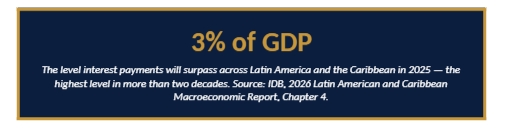
Chapter 4 of the IDB’s 2026 Macroeconomic Report carries the title “Fiscal Policy in Uncertain Times: Old Lessons, New Tools.” Its headline finding is that interest payments across Latin America and the Caribbean will surpass 3% of GDP in 2025 — their highest level since the early 2000s. The chapter then does something unusually useful for entrepreneurs reading it. It decomposes the rise in debt-service burden into its three components, and the decomposition tells us, with precision, what has already happened, what is currently happening, and what is likely to keep happening.
That decomposition is the analytical foundation for this article. Once Caribbean boards understand what the IDB is showing them about sovereign debt service, the implications for firm-level capital structure become clear and unavoidable. The era of cheap debt has ended. Firms that built capital structures assuming pre-2022 borrowing costs need to refinance, term out, or de-lever now. The next three years’ worth of board decisions will determine, more than anything else, which Caribbean firms compound earnings through this cycle and which surrender them.
The three drivers of today’s debt-service burden
The IDB’s most useful single chart in Chapter 4 is its decomposition of the rise in interest payments since 2021. The chapter asks a simple counterfactual question: of the increase in debt-service burden the region is now carrying, how much comes from new borrowing during the pandemic, how much from higher interest rates, and how much from exchange rate movements? Here is the answer, restated in operating terms for Caribbean entrepreneurs:
| Driver of today’s regional debt-service burden | Share | What it tells us |
| Pandemic-era debt accumulation (already-locked-in) | 55% | More than half of today’s burden would exist even at 2021 interest rates. This is sunk; it is paid down only through time and balance-sheet discipline. |
| Higher effective interest rates since 2021 | 38% | Driven by the tightening of global financial conditions since 2021. This portion will persist for as long as long-term rates remain elevated. |
| Exchange rate movements | 7% | Foreign-currency debt converted to local currency at less favourable rates. Smaller in aggregate, but acute for individual jurisdictions. |
Source: IDB 2026 Macroeconomic Report, Figure 4.3, Panel A.
Three observations land hardest in this table for me.
First, the 55% share that comes from pandemic-era debt accumulation is the most important single number for understanding 2026 capital structure decisions. It tells us that more than half of the regional debt-service burden was set before the rate-rise cycle even began. That portion of the burden can only be paid down through time and disciplined balance-sheet management. There is no rate cycle, however generous, that makes that 55% go away quickly.
Second, the 38% from higher effective interest rates is the portion that will keep growing for as long as long-term rates remain where they are. The IDB notes that long-term yields in advanced economies have remained elevated despite policy-rate cuts — reflecting continued concerns over U.S. fiscal sustainability, leveraged asset valuations, and policy uncertainty. The yield curve has steepened. The expensive part of the curve is precisely the part that determines the cost of Caribbean firm debt.
Third, the 7% from exchange rate movements is small in aggregate but acute for individual jurisdictions and individual firms. Caribbean firms with material foreign-currency obligations against local-currency cash flows have felt this directly. The decomposition tells us that the FX component is meaningful even when aggregate regional currencies have been comparatively stable.
More than half of today’s debt-service burden was already locked in by pandemic-era borrowing. The remainder is being driven by rates that show no sign of returning to pre-2022 levels. There is no rate cycle that makes this go away.
The lesson governments are teaching us, by accident
The IDB chapter contains a Box 4.1 finding that, in my view, every Caribbean CFO should read carefully. It is about what regional sovereigns themselves have been doing in response to higher rates — and it is the precise inverse of what well-run firms should be doing.
Between 2021 and 2025, regional sovereigns shortened the average maturity of their newly issued U.S. dollar bonds by more than twelve years. They concentrated issuance at the short and medium end of the curve, where financing conditions looked relatively more favourable. The IDB’s counterfactual analysis shows this saved sovereigns about 50 basis points on new external issuance. In the short run, that is real money.
In the medium run, it is a problem. The IDB notes that this shorter-maturity profile creates rollover pressure that will emerge as these bonds approach maturity — at exactly the points where global financial conditions may not be as accommodating as today. Several sovereigns have, in effect, traded a known small cost today for an unknown larger cost in three to five years. The IDB chapter goes so far as to highlight “pressures to relax fiscal frameworks and shorten debt maturities” as one of the consequences of the higher-for-longer environment.
This is the strategy Caribbean firms should not copy. The temptation to refinance into shorter, cheaper paper today — and accept the rollover risk that comes with it — is real and will intensify as the corporate-debt market in our region adjusts to higher rates. The firms that succumb to it will save money in 2026 and lose it back, painfully, in 2028 or 2029. The firms that resist it — that pay the 50 to 150 basis-point termout premium today to extend their weighted-average maturity — are the firms that will not be forced to refinance in whatever window is open in three years’ time.
How sovereign debt-service pressure reaches the firm
Some readers may wonder, at this point, why a macroeconomic discussion about sovereign interest payments matters to a privately held mid-market Caribbean firm. The answer is direct: it matters because sovereign debt-service pressure transmits to the firm through four operating channels, each of which is now larger and more reliable than it was three years ago.
Tax base broadening. When sovereign debt-service consumes a larger share of revenue, governments must either cut spending or raise revenue. Across the region, the response has been broadly distributed but tilted toward revenue. Tax compliance is being tightened. New levies are appearing on previously untaxed activities. Existing tax regimes are being reinterpreted more aggressively. The firm that has not stress-tested its 2026 plan against a meaningfully higher effective tax rate, particularly in jurisdictions with thin fiscal space, is planning against an assumption that is no longer holding.
Slower public-sector payment cycles. When fiscal pressure is acute, governments delay payments. Caribbean firms that serve the public sector — directly, or through institutional clients with significant public-sector revenue — feel this through accounts-receivable elongation. Days-sales-outstanding lengthens. Working capital tightens. Firms whose top customers are governments or government-adjacent are exposed in ways their valuation typically does not reflect.
Tighter bank credit. When sovereign spreads widen, the regulatory capital cost of private-sector lending rises. Banks reprice loans, tighten covenants, reduce facility sizes, and become more selective about new commitments. Caribbean firms that have been counting on standing relationships with regional banks — “they’ll work with us” — should expect that relationship to be tested under pressure. It is not a question of intent; it is a question of regulatory capital.
Regulatory and compliance cost. Fiscally stressed governments expand the regulatory perimeter to support compliance and revenue. New reporting obligations, expanded audit coverage, more aggressive enforcement, and longer permitting and approval timelines are all consequences of fiscal pressure. The firm that has not budgeted for a step-change in compliance and regulatory cost over the next three years is under-budgeting.
Each of these four channels acts independently. They also reinforce each other, particularly in the smaller Caribbean economies. The firm that has stress-tested its 2026 plan against only one of them — typically the bank-credit channel — has not stress-tested the macro environment. The interaction is, again, the point.
Three balance-sheet moves Caribbean firms should make this year
Given the structural picture, three balance-sheet moves should be on every Caribbean board’s agenda this year. None of them is novel. Each of them is now materially more consequential than it was three years ago because the cost of getting them wrong is materially higher. Here is the framework:
| Move | What it does | When it matters most |
| 1. Maturity termout | Extend the weighted-average maturity of debt. Replace short-dated facilities (≤12 months) with medium-term (3-5 years). Accept a 50-150 bps premium to lock in duration. | When more than 30% of debt matures inside 12 months. When refinancing windows are open but expected to narrow. |
| 2. Hedge the open FX position | Match foreign-currency obligations against foreign-currency cash flows. Use forwards, swaps, or natural hedges through cross-border invoicing where available. | When USD obligations exceed 90 days of USD revenue. When commodity-linked revenues are exposed to FX-driven margin compression. |
| 3. Optimise the WACC | Rebalance debt-to-equity. Where debt service threatens covenants or growth, raise equity (or quasi-equity) rather than refinance into more expensive debt. | When stress-tested debt service consumes more than 35% of operating cash flow. When growth capital is being deferred to service existing facilities. |
Source: Dawgen Global Treasury and Capital Structure framework.
Two notes on this framework are worth making explicitly.
First, the 50 to 150 basis-point premium for maturity termout is not a cost; it is an insurance premium. The Caribbean firm that pays 100 bps to extend its weighted-average debt maturity from 14 months to 42 months is paying for the right not to refinance in a constrained window in 2028. The firms in our portfolio that have paid that premium consistently over the past five years have outperformed peers that have not — not because they had better operational performance, but because they were not forced into distressed refinancing when conditions tightened.
Second, the third move — optimising the WACC by raising equity — is the move Caribbean firms find hardest to take. The cultural reluctance to dilute ownership is real and, in many cases, justified. But there is a specific situation in which it is the correct move: when stress-tested debt service consumes more than 35% of operating cash flow, and where rolling existing facilities at current rates would mathematically prevent the firm from investing in growth. In that situation, the firm that raises equity at a reasonable valuation today is the firm that will be able to acquire weaker competitors at distressed valuations in two years’ time. The firm that refinances into more expensive debt to avoid dilution today is the firm that will, two years from now, be the one being acquired.
The Virtual CFO playbook: monthly cash-flow visibility as a survival discipline
Across our portfolio of Caribbean mid-market clients, the single operational discipline that separates firms which manage through this environment from firms that struggle is monthly cash-flow visibility. Not quarterly. Not annually as part of a budgeting exercise. Monthly, in a standardised format, on a defined cadence.
The Virtual CFO playbook our firm operates with clients has five components. Each one is cheap to install relative to the cost of operating without it.
- 13-week rolling cash forecast. A monthly 13-week rolling cash forecast, prepared by the finance function and reviewed by the CEO and CFO together. The horizon is short enough to be accurate and long enough to be actionable.
- Four-buffer dashboard. A monthly snapshot of the four buffer ratios introduced in Article 5 — FX cover, working capital cover, weighted-average debt maturity, customer concentration — against pre-agreed board thresholds. When a metric breaches a threshold, the management action list executes automatically.
- Debt and covenant tracker. A monthly review of the debt schedule, including upcoming maturities, covenant headroom, and refinancing options being explored. The agenda is to surface refinancing actions twelve to eighteen months before they become urgent, not three months before they become urgent.
- Working capital cadence. A monthly view of accounts receivable, accounts payable, and inventory turns by customer concentration and supplier criticality. This is where the slower public-sector payment cycle, the lengthening DSO, and the working-capital squeeze show up first.
- Scenario refresh. A monthly stress test running the firm’s actual current position through one moderate and one severe scenario, with the management response committed in advance. This is the operational version of the framework introduced in Article 5.
The cumulative effect of these five disciplines, executed monthly for two years, is a finance function that anticipates pressure rather than reacts to it. The firms that operate at this cadence make better, faster decisions; refinance on better terms; negotiate harder with customers and suppliers; and compound through cycles in ways the firms that do not operate at this cadence simply cannot match.
Tax planning in a higher-rate environment
The fourth element of the response — and the element most Caribbean firms most underuse — is active tax planning calibrated to the new environment. Three specific dimensions deserve immediate board-level attention.
Interest deductibility strategy. As interest costs rise, the value of interest deductibility rises with them. Many Caribbean jurisdictions cap interest deductibility through thin-capitalisation rules or earnings-stripping limitations. Firms whose deductible interest has been pushed against the ceiling by higher rates are paying more tax on the same activity than they were three years ago. Restructuring the debt profile — sometimes through intercompany arrangements, sometimes through shifting between local and foreign-currency debt — can preserve real cash value. The work is technical, but the recovered cash is meaningful.
Transfer pricing exposure. Caribbean groups with operations across multiple territories are facing more aggressive transfer pricing enforcement as jurisdictions seek revenue. Pricing of intercompany services, royalties, and interest is being examined more carefully than it was three years ago. Firms operating across multiple CARICOM jurisdictions, or between the Caribbean and North American or European parent groups, should treat transfer pricing review as a 2026 priority rather than a 2027 one.
Incentive-regime mapping across jurisdictions. Caribbean jurisdictions compete aggressively on tax-incentive regimes — for headquartering, for specific sectors, for export activity, for digital and financial services. As the cost of capital rises, the after-tax economics of where to locate which activity becomes meaningfully more sensitive than it was at lower rates. Firms operating regionally should be running a fresh incentive-regime map every twelve months. Most do it every five.
In our work across more than fifteen Caribbean territories, tax planning calibrated to the higher-rate environment is one of the highest-return advisory activities a firm can commission. It is also, regrettably, one of the lowest-take-up ones. The cultural pattern in our region is to treat tax as a compliance function rather than a strategic one. The cost of that pattern, in a higher-for-longer environment, compounds.
How Dawgen Global supports this work
Capital-structure work in a higher-for-longer environment engages four of our practice areas, and the integrated multidisciplinary model is, in our experience, materially more useful than the same work done in silos.
- Tax Advisory: for the interest-deductibility strategy, transfer pricing review, and incentive-regime mapping that preserves real cash value as the cost of capital rises.
- Virtual CFO and Accounting BPO: for the Virtual CFO playbook described in Section 5 — the monthly cash-flow visibility, four-buffer dashboard, debt and covenant tracking, working capital cadence, and scenario refresh. Cross-link to the firm’s CASHFLOW360™ and WC-PULSE™ frameworks.
- Audit & Assurance: for the covenant-compliance verification, financial-reporting accuracy, and audit-readiness that institutional lenders and capital partners require under tightened scrutiny.
- M&A and Corporate Recovery: for firms whose stress-tested debt service indicates that the right move is structural rather than incremental — equity raise, strategic restructuring, or M&A. Cross-link to the firm’s M&A advisory practice and to the TRANSCEND™ corporate restructuring framework.
Together, these capabilities answer the central capital-structure question every Caribbean board should be asking this year — not “what does refinancing look like” but “what is the right capital structure for the next five years given what we now know about the cost of capital.” That question is integrated and multidisciplinary by nature. The work that answers it should be too.
Five questions every Caribbean board should ask the leadership team this quarter
If this article does its job, every Caribbean board with material debt, foreign-currency obligations, or refinancing exposure will spend a meaningful portion of its next strategic session on five questions:
- What is the weighted-average maturity of our debt stack, and what portion matures inside the next 12 months? If we cannot answer this within an hour, we are operating on assumptions rather than analysis.
- How does our 2026 plan look under stressed debt-service assumptions — 200 to 400 basis points above current rates? If our 2026 plan assumes pre-2022 borrowing costs, it is planning against an environment that no longer exists.
- Where are we relative to the temptation that has tripped up regional sovereigns? If we are tempted to refinance short to save 50 basis points today, we should know exactly what rollover risk we are accepting in exchange.
- Have we reviewed our interest-deductibility, transfer pricing, and incentive-regime position against the new environment? Most Caribbean firms have not. The recovered cash is real and meaningful in a tighter cost-of-capital environment.
- If our stress test indicates the right move is structural rather than incremental, are we prepared to raise equity? If stress-tested debt service exceeds 35% of operating cash flow and rolling facilities at current rates would prevent growth investment, the answer is yes. Doing nothing in that case is the most expensive choice available.
Next !
Article 7 turns to the question of how Caribbean entrepreneurs should read the new monetary landscape. IDB Chapter 5 documents that inflation-targeting regimes across the region have largely returned inflation to target — but flags a behavioural risk: economic agents who lived through the 2021-23 inflation surge may keep inflation expectations elevated for years. For Caribbean firms, that has direct implications for pricing discipline, contract design, wage negotiations, and treasury modernisation in a world of more flexible exchange rates.
Closing
The era of cheap debt has ended. The 55% of the regional debt-service burden that is already locked in will be paid down only through time and discipline. The 38% that is being driven by higher effective interest rates will persist for as long as long-term rates remain elevated, which the IDB and every major central bank suggests will be longer than markets are currently pricing in.
For Caribbean firms, the implication is direct. The capital structure that worked in 2021 will not work in 2026. The refinance, the hedge, the maturity extension, and — where the math demands it — the equity raise belong on the next board agenda. The firms that do this work now, while the windows are open and the optionality is high, will be the firms that compound earnings through this cycle. The firms that wait will find that the choices available to them in 2028 are dramatically narrower than the choices available to them today.
Cheap debt is not coming back. The capital structure that worked in 2021 will not work in 2026. The refinance, the hedge, and the equity raise belong on the next board agenda.
— ◆ —
About the author
Dr. Dawkins Brown is the Executive Chairman and Founder of Dawgen Global, an independent, integrated multidisciplinary professional services firm headquartered in Kingston, Jamaica, and operating across more than fifteen Caribbean territories.
Continue the conversation
Subscribe to The Caribbean Advisory Brief on the Dawgen Global LinkedIn page for the next instalment.
Direct enquiries: [email protected] | +1-876-929-3670 | dawgen.global
Source
Ayres, J. and Juvenal, L. (2026). Resilience and Growth Prospects in a Shifting Global Economy: 2026 Latin American and Caribbean Macroeconomic Report. Inter-American Development Bank, Chapter 4: Fiscal Policy in Uncertain Times — Old Lessons, New Tools, pp. 65–87; Box 4.1, pp. 79–82.
About Dawgen Global
“Embrace BIG FIRM capabilities without the big firm price at Dawgen Global, your committed partner in carving a pathway to continual progress in the vibrant Caribbean region. Our integrated, multidisciplinary approach is finely tuned to address the unique intricacies and lucrative prospects that the region has to offer. Offering a rich array of services, including audit, accounting, tax, IT, HR, risk management, and more, we facilitate smarter and more effective decisions that set the stage for unprecedented triumphs. Let’s collaborate and craft a future where every decision is a steppingstone to greater success. Reach out to explore a partnership that promises not just growth but a future beaming with opportunities and achievements.
 Email: [email protected]
  Visit: Dawgen Global Website

 WhatsApp Global Number : +1 555-795-9071
Caribbean Office: +1876-6655926 / 876-9293670/876-9265210  WhatsApp Global: +1 5557959071
USA Office: 855-354-2447
Join hands with Dawgen Global. Together, let’s venture into a future brimming with opportunities and achievements


