In Article 2 of this series, I argued that the Caribbean’s growth model — built for sixty years on more workers rather than better-deployed workers — has expired. With working-age population growth slowing across CARICOM, productivity is now the only remaining growth lever.
This week, the question becomes: which workers, with which skills, will lift productivity? The IDB’s 2026 Macroeconomic Report has unusually rich data on that question. Tucked inside Box 1.1 of Chapter 1 is a small project most CEOs in our region have not yet heard of. It deserves their full attention.
The IDB Labor Market Observatory — and what it has been quietly revealing
The IDB Labor Market Observatory is a real-time data project that scrapes online job postings across fifteen Latin American and Caribbean countries and analyses them for what employers are actually asking for. Between 2022 and 2025, it ingested more than 6.2 million online vacancies. That is the largest contemporaneous dataset on Caribbean and Latin American labour demand that has ever been assembled.
The IDB published the headline findings in Box 1.1 of the 2026 Macroeconomic Report, and they tell a coherent and uncomfortable story. Three findings stand out for any Caribbean entrepreneur reading this.
Finding 1 — Hiring is decelerating, especially in mid-skill roles. Vacancy volumes have fallen from their 2022 peak. The IDB observes that the decline is concentrated in occupations requiring “medium and higher levels of preparation” — that is, in mid-skill technical and administrative roles. Mid-level back-office roles are not being filled at the rate they once were.
Finding 2 — Demand for digital skills is broad and rising. Across the countries studied, between 15 and 25 percent of all vacancies explicitly require digital skills — data analysis, software development, UX/UI, information systems, cloud-based tools. This is not a single-industry phenomenon. It is the baseline expectation in professional services, finance, information services, and education across the region.
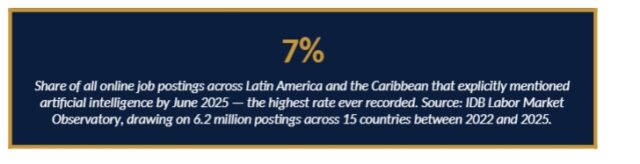
Finding 3 — AI demand is the fastest-growing skill segment in the region. Vacancies referencing AI rose sharply in 2025, reaching 7 percent of all postings by June — the highest rate the Observatory has ever recorded. The IDB observes that AI-linked postings appear “not only in technical fields, such as robotics, engineering, and data science, but in creative occupations, business analytics, and administrative roles.” In other words, AI skill demand has stopped being a niche-tech phenomenon. It has become a general-employability phenomenon.
The IDB summarises this as a “dual transition”: traditional service roles remain central to employment, but the most dynamic growth is concentrated in digital and AI-intensive occupations. The technical literacy that was a competitive advantage in 2022 is now becoming the baseline. The AI fluency that is rare in 2026 will be the baseline by 2028.
AI fluency stopped being a niche-tech phenomenon and became a general-employability phenomenon. The Caribbean firms that have not noticed will discover this the hard way.
What this means for Caribbean employers
Most Caribbean firms are currently structured around a workforce composition that the IDB’s data is now telling us is in slow but steady decline. The mid-level administrative and back-office roles that have been the operational backbone of the Caribbean enterprise for thirty years are precisely the roles for which regional postings have softened the most. Meanwhile, the AI-fluent professionals on whom future productivity gains depend are exactly the workers we have not been hiring or developing.
Three concrete consequences follow.
First, hiring criteria are now out of date. Most Caribbean job descriptions, written before 2024, do not mention AI tools at all. They list the qualifications and software competencies that defined the role five years ago — Microsoft Office, basic accounting packages, ERP familiarity. Each of those is necessary; none is sufficient. The new floor is comfort with AI-assisted workflows: drafting with generative tools, querying data with natural language, automating routine work with AI agents. Hiring against the old criteria means hiring the wrong people for the next five years.
Second, training spend is now under-allocated. Caribbean firms typically spend 0.5–1.5% of payroll on training. Comparable firms in markets where AI fluency has become a strategic priority — Singapore, Estonia, the United Arab Emirates — are now spending closer to 3–4%, and are concentrating that spend on AI-tooling proficiency rather than on traditional management development. A firm that does not increase its training budget and redirect it toward AI fluency this year will be operating with a workforce that is structurally less productive than its competitors within eighteen months.
Third, pay bands are now mispriced. Most Caribbean firms run pay bands that were last reviewed in 2023 or earlier. They reward seniority and tenure rather than skill premium. The IDB data tells us that AI-skilled workers are commanding meaningful premia in regional labour markets. A firm whose 2026 compensation philosophy still pays a senior administrative officer more than a junior data analyst with AI fluency is paying for the wrong attributes — and will lose the latter to a competitor that has updated its pay structure.
The mid-skill squeeze, in Caribbean terms
The phrase “mid-skill squeeze” can sound abstract. It is not. It describes a specific class of role that, until recently, was the backbone of Caribbean professional services, banking, hospitality administration, and corporate functions. These are the roles of the executive assistant, the accounts processor, the payroll administrator, the procurement officer, the customer service team lead, the regulatory filings manager. None of them is being eliminated. All of them are being rebuilt.
Take a single Caribbean accounting firm as an example. Five years ago, a junior accountant might have spent the better part of a workday reconciling bank statements, posting journal entries, and processing accounts payable. Today, those tasks can be substantially automated — the AI-augmented junior who can prompt the workflow correctly does the same volume of work in a quarter of the time. The role has not disappeared. It has been rebuilt, and the firm that has rebuilt it is operating with three junior accountants where its competitor still has twelve. The latter is paying for productivity that no longer exists.
Multiply this across every business function in every mid-market Caribbean enterprise, and you have the full structural significance of the IDB’s finding. Hiring is decelerating in mid-skill roles not because the work has disappeared but because each AI-augmented professional is doing the work of three or four. The Caribbean firms that have made this transition are quietly compounding cost advantages. The Caribbean firms that have not are quietly compounding cost disadvantages.
A reskilling playbook for firms under 250 employees
In our work with Caribbean enterprises across more than fifteen territories, we have found that the most useful framework for thinking about workforce adaptation is to segment the existing workforce into three buckets and then act differently on each. The reskilling effort that works in the AI-fluent professional bucket is wasted on the at-risk-role bucket, and vice versa. Here is the architecture:
| Workforce bucket | What’s happening | 12-month action | What ‘success’ looks like |
| AI-fluent professionals | Demand is rising fastest. Wage premia widening. Loyalty is to challenge, not employer. | Identify, retain, and double the pay-band ceiling. Give them ambitious internal projects. | Zero regretted attrition in this group; 2-3 internal AI projects shipped per year. |
| Adjacent professionals | 70-80% of the workforce. Roles are not disappearing but tasks within them are being rebuilt. | Targeted upskilling: 40-60 hours per person on AI tools relevant to their function. | Measurable productivity gains in finance, marketing, operations within 12-18 months. |
| At-risk roles | Mid-skill administrative and back-office roles softening. Vacancy postings declining. | Honest conversations. Reskill those who can move; do not over-hire into shrinking roles. | Workforce composition shift: fewer admin roles, more analyst and digitally-skilled roles. |
Source: Dawgen Global D-AGENTICA™ workforce framework, 2026.
The middle bucket — adjacent professionals — is the one most Caribbean firms are getting wrong. These are the 70-80% of the existing workforce who are neither AI specialists nor at-risk: the finance team members, the marketing managers, the operations supervisors, the HR partners, the relationship managers. Their jobs are not disappearing, but the way they do those jobs is being substantially rebuilt around AI tools. The right intervention is structured, role-specific upskilling — a finance team member spending forty hours over six months becoming fluent in AI-assisted analysis, modelling, and reporting; a marketing manager spending the same number of hours on AI-assisted content, segmentation, and analytics; an operations supervisor on AI-assisted scheduling, demand forecasting, and supplier coordination.
Forty hours per person, structured and role-specific, is the realistic minimum. Any less is too superficial to change behaviour. Any more, in our experience, runs into diminishing returns and managerial resistance. The firms in our portfolio that have made this commitment are reporting measurable productivity gains within twelve to eighteen months.
Compensation implications: why the firm’s pay bands need a rethink before next year’s appraisal cycle
The single most operationally consequential decision a Caribbean board can make this year is to authorise its HR function to conduct a full pay-band review against the new labour market. Our experience suggests three corrections will need to be made.
- Where AI-fluent roles sit inside the existing pay structure, the upper bound of the band is almost certainly too low. Firms that do not raise the ceiling will lose these people to local competitors, regional employers, and increasingly to remote-first international firms hiring directly out of the Caribbean talent pool.
- Where mid-skill administrative roles sit inside the existing pay structure, the band is probably wider than it should be. Firms that have automated significant portions of these roles’ work are now overpaying at the top of the band. The right correction is not to cut existing salaries — it is to freeze the band ceiling and let attrition and retraining do the structural adjustment over twenty-four months.
- Most Caribbean firms still reward tenure inside the band — meaning two employees doing similar work earn meaningfully different amounts based on years of service. In a labour market where AI fluency is the differentiator, tenure-based progression is exactly the wrong signal to send. Skill-based progression — where moving up the band requires demonstrable acquisition of AI and digital fluency — is the correction. It also doubles as a powerful internal training driver.
None of these is comfortable. All three are necessary. The Caribbean firms that complete this exercise this year will be unrecognisable, in the best sense, by 2028.
The Caribbean dimension: why this is harder for us, and why we have to do it anyway
Three features of the Caribbean operating environment make AI workforce adaptation more difficult here than in larger Latin American markets.
Smaller talent pools. There are far fewer AI-fluent professionals available across CARICOM than in Brazil, Mexico, or Colombia. Caribbean firms competing for this talent are competing not just against each other but increasingly against international remote employers who can pay U.S.- and U.K.-scale salaries to professionals working from Kingston, Bridgetown, or Port of Spain. The premium needed to retain talent is therefore higher than in larger markets.
Thinner training infrastructure. While the University of the West Indies and several other regional institutions are moving to address AI capabilities, the depth and breadth of formal AI education available in the Caribbean is a fraction of what is available in São Paulo or Mexico City. This makes private-sector training spend more important here, not less. The firm cannot wait for the education system to catch up.
Concentrated client bases. Many Caribbean firms serve a small number of large institutional clients. As those clients adopt AI tooling internally, they will quickly stop tolerating slower, manual delivery from their professional service providers. The Caribbean firm that does not adapt will lose its clients to a domestic or regional competitor that has.
These three constraints together mean the Caribbean firm has less time to make this transition than its Latin American or North American counterpart. The compensating advantage is that we have a smaller workforce to retrain, more direct senior-leadership engagement, and decisions that can be made and executed faster than in larger organisations. The firms that capitalise on those advantages will be the ones that compound over the next five years.
How Dawgen Global supports this work
AI workforce transformation sits at the intersection of three of our practices and one of our proprietary frameworks.
- D-AGENTICA™: the firm’s AI Governance & Workforce Framework. D-AGENTICA™ is the structured methodology we use with clients to assess current AI readiness, identify the right workforce buckets, design role-specific upskilling pathways, and measure the productivity gains achieved. The framework was developed and refined across our 12-article D-AGENTICA™ editorial series and is in active use with clients across multiple Caribbean territories.
- HR Advisory: for the pay-band review, the role architecture redesign, the structured upskilling programmes, and the management of attrition and retraining as the workforce composition shifts.
- IT & Digital Transformation: for the technical implementation of the AI-augmented workflows themselves — the ERP integrations, the AI tool selection, the data infrastructure that productivity-augmented work requires.
- Business Advisory: for firms whose strategic positioning, operating model, or M&A optionality is reshaped by the AI transition.
In our experience, firms that approach this transition systematically — with a board-sanctioned mandate, a 12-month plan, and a willingness to revisit pay bands — see materially different outcomes than firms that approach it incrementally. The difference compounds. The cost of moving late is substantially greater than the cost of moving early.
Next :
Article 4 turns to a different kind of transition: the global energy transition and the resulting boom in critical minerals demand. The IDB devotes a full chapter of its 2026 report to this theme, and the Caribbean’s position — through Jamaica’s bauxite, Guyana and Suriname’s adjacent extraction economies, and the regional supply-chain spillovers — is more material than most boards have absorbed. The article will lay out the institutional preconditions that determine whether resource booms produce durable development or boom-and-bust cycles, and what that means for Caribbean boards making capital allocation decisions over the next decade.
Closing
The IDB Labor Market Observatory’s data on Caribbean and Latin American job postings is the cleanest, most contemporaneous evidence we have about where regional labour demand is going. It tells us, with unusual clarity, that AI fluency is becoming the basic floor of professional employability and that the mid-skill roles that have been our operating backbone for a generation are softening. Neither finding is dramatic on its own. Together, they redefine what it means to run a Caribbean firm.
The good news is that the Caribbean firm has every advantage it needs to make this transition successfully — small organisations, direct leadership engagement, fast decision-making cycles. The bad news is that the window in which to act is shorter here than in larger markets, because our talent pools are thinner and our clients’ adaptation is moving faster than ours. The leadership team that puts AI workforce transformation on the next board agenda — with budget, with metrics, and with a 12-month execution plan — is the leadership team whose firm will be unrecognisable, in the best sense, by 2028.
Resilience is built before the storm. Productivity is built before headcount stops growing. AI workforce capability is built before the talent market commodifies it. All three are the work of the leadership team, this quarter, this year.
— ◆ —
About the author
Dr. Dawkins Brown is the Executive Chairman of Dawgen Global, an independent, integrated multidisciplinary professional services firm headquartered in Kingston, Jamaica, and operating across more than fifteen Caribbean territories. He writes the Caribbean Boardroom Perspectives newsletter on LinkedIn.
Continue the conversation
Subscribe to Caribbean Boardroom Perspectives on LinkedIn for the next instalment.
Direct enquiries: [email protected] | +1-876-929-3670 | dawgen.global
Source
Ayres, J. and Juvenal, L. (2026). Resilience and Growth Prospects in a Shifting Global Economy: 2026 Latin American and Caribbean Macroeconomic Report. Inter-American Development Bank. Box 1.1, pp. 12-13; IDB Labor Market Observatory data through September 2025.
About Dawgen Global
“Embrace BIG FIRM capabilities without the big firm price at Dawgen Global, your committed partner in carving a pathway to continual progress in the vibrant Caribbean region. Our integrated, multidisciplinary approach is finely tuned to address the unique intricacies and lucrative prospects that the region has to offer. Offering a rich array of services, including audit, accounting, tax, IT, HR, risk management, and more, we facilitate smarter and more effective decisions that set the stage for unprecedented triumphs. Let’s collaborate and craft a future where every decision is a steppingstone to greater success. Reach out to explore a partnership that promises not just growth but a future beaming with opportunities and achievements.
 Email: [email protected]
  Visit: Dawgen Global Website

 WhatsApp Global Number : +1 555-795-9071
Caribbean Office: +1876-6655926 / 876-9293670/876-9265210  WhatsApp Global: +1 5557959071
USA Office: 855-354-2447
Join hands with Dawgen Global. Together, let’s venture into a future brimming with opportunities and achievements


