
The Unfair Advantage That Hides on the Balance Sheet
Over the course of eleven articles, we have systematically dismantled the conventional approach to working-capital management and replaced it with something fundamentally different. We began by exposing the blind spots in the Cash Conversion Cycle. We built the five-layer PULSE diagnostic architecture. We introduced the Trigger Zone Matrix and the Buffer-versus-Reprice decision protocol. We revealed the P-Layer’s predictive technology, the S-Layer’s ecosystem intelligence, and the E-Layer’s macro-sensitivity monitoring. We designed the governance model, tested it in a 90-day transformation case study, calibrated it for the Caribbean, explored the AI technology stack, and redesigned the board report.
Now, in this final article, we step back from the mechanics and ask the strategic question that underpins the entire series: Why does working-capital excellence matter? Not at the operational level – we have established that the operational benefits are substantial and measurable. But at the strategic level. At the level of competitive advantage. At the level of the question that every CEO and board chair should be asking: Can working capital be a weapon?
The answer is yes. And the organisations that understand this – that treat working capital not as a constraint to be managed but as a strategic asset to be optimised – consistently outperform their competitors on the metrics that matter most: return on invested capital, growth rate, resilience to economic shocks, and long-term shareholder value creation.
Working capital is the last great source of competitive advantage that most companies have not yet exploited. The ones that do will define the next decade of corporate performance.
The Competitive Advantage Engine
Working-capital excellence creates competitive advantage through four distinct mechanisms, each of which compounds over time to create a widening performance gap between the leaders and the laggards.
Mechanism 1: Superior Capital Efficiency
The most direct competitive benefit of working-capital excellence is capital efficiency. An organisation that operates with a 42-day Cash Conversion Cycle while its competitor operates at 62 days is achieving the same revenue throughput with approximately 35 per cent less capital employed in operations. This means more of every invested dollar is generating returns, and the return on invested capital – the single most important metric of long-term value creation – is structurally higher.
The compounding effect is powerful. Over a five-year period, the capital-efficient organisation generates more free cash flow per dollar of revenue, which can be reinvested at the higher ROIC, creating a virtuous cycle of value creation. The capital-inefficient competitor, by contrast, must deploy more capital to achieve the same revenue, generating lower returns, which limits reinvestment capacity, which constrains growth. The gap widens with every passing year – not because the efficient organisation is growing faster, but because every unit of growth it achieves requires less capital and generates more return.
Mechanism 2: Strategic Optionality
Working-capital excellence creates something that no amount of cost-cutting or revenue growth can replicate: strategic optionality. An organisation with a Green Zone PULSE Score, a well-calibrated buffer, and a confirmed surplus has options that its Amber or Red Zone competitors do not.
It can fund acquisitions from internal capital, moving faster than competitors who must arrange external financing and negotiate covenants. It can invest in product development during an economic downturn, building capability while competitors are retrenching. It can offer more competitive customer terms when pursuing a strategic account, because its working-capital efficiency allows it to absorb the financing cost that a less efficient competitor cannot. It can weather a supply-chain disruption by drawing on buffers that its competitors have depleted. Each of these options is individually valuable. Collectively, they represent a strategic arsenal that the working-capital leaders deploy while their competitors are managing crises.
Mechanism 3: Resilience Under Stress
The third mechanism is resilience – the ability to absorb and recover from economic shocks without strategic disruption. The past five years have provided an extraordinary natural experiment in corporate resilience: a global pandemic, supply-chain dislocations, commodity-price whiplash, interest-rate cycles, currency volatility, and geopolitical disruptions. The organisations that emerged strongest from each successive shock share a common characteristic: they entered the shock with working-capital positions that were strong, diversified, and forward-looking.
The PULSE Framework institutionalises resilience. The Red Zone buffer floor ensures minimum reserves. The S-Layer’s ecosystem monitoring detects supply-chain fragility before it becomes a crisis. The E-Layer’s macro-scenario overlays pre-position the organisation for external shocks. And the governance model ensures that resilience is not dependent on individual judgment but embedded in organisational process. This systematic resilience is a competitive advantage because it is rare. Most organisations manage resilience episodically – building buffers after a crisis and depleting them during the subsequent boom. The PULSE-governed organisation maintains calibrated resilience continuously.
Mechanism 4: Negotiating Leverage
The fourth mechanism is leverage – not financial leverage, but negotiating leverage. An organisation with strong working capital negotiates from a position of strength with every counterparty in its ecosystem. With customers, it can enforce disciplined payment terms because it does not need to accommodate late payments to maintain the relationship. With suppliers, it can demand volume discounts and preferential terms because it can offer early payment from its surplus position. With banks, it can negotiate facility terms from a position of confirmed liquidity rather than approaching lenders in a posture of need.
This negotiating leverage creates a self-reinforcing cycle: better working capital enables better terms, which improves working capital further, which enables even better terms. The competitor operating in the Amber or Red Zone faces the reverse: weaker working capital forces acceptance of less favourable terms, which further weakens the position. Over time, these feedback loops create structural advantages that are extraordinarily difficult for competitors to overcome.
The PULSE Maturity Model: Where Leaders Separate from Laggards
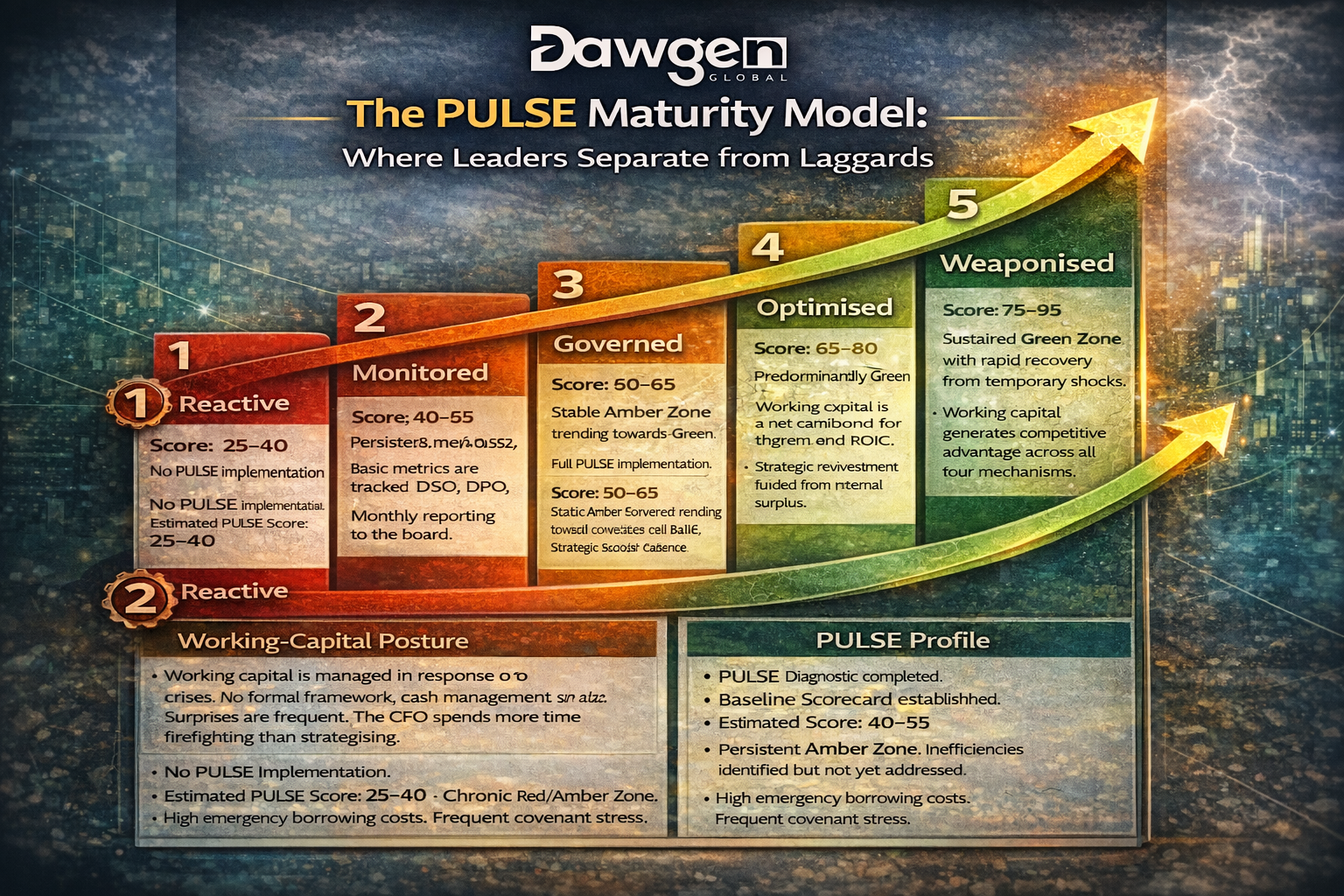
Across our engagements, we have observed that organisations progress through a predictable maturity curve in their working-capital management capability. Understanding where your organisation sits on this curve is the first step towards strategic acceleration.
| Level | Stage | Working-Capital Posture | PULSE Profile |
| 1 | Reactive | Working capital is managed in response to crises. No formal framework. Cash management is ad hoc. Surprises are frequent. The CFO spends more time firefighting than strategising. | No PULSE implementation. Estimated PULSE Score: 25–40. Chronic Red/Amber Zone. High emergency borrowing costs. Frequent covenant stress. |
| 2 | Monitored | Basic metrics are tracked (DSO, DPO, CCC). Monthly reporting to the board. Forecast exists but is static and single-scenario. Working capital is a treasury function, not a strategic capability. | PULSE Diagnostic completed. Baseline Scorecard established. Estimated Score: 40–55. Persistent Amber Zone. Inefficiencies identified but not yet addressed. |
| 3 | Governed | Working Capital Council established. Cross-functional accountability in place. PULSE Dashboard operational. Trigger protocols active. Weekly forecast cadence. Working capital is a governed function with defined ownership. | Full PULSE implementation. Score: 50–65. Stable Amber Zone trending towards Green. Quick wins captured. Governance model embedding. First repricing actions underway. |
| 4 | Optimised | All five PULSE layers fully operational with AI-enhanced P-Layer. Dynamic hedging calibrated to zone status. Repricing playbook actively deployed in Green Zone. Ecosystem diversification programme in progress. Board reporting via PULSE Executive Dashboard. | Score: 65–80. Predominantly Green Zone. Working capital is a net contributor to margin and ROIC. Strategic reinvestment funded from internal surplus. Resilience tested and confirmed. |
| 5 | Weaponised | Working capital is a declared strategic capability. The organisation actively uses its working-capital strength to win customers, negotiate supplier advantage, fund growth, and outcompete peers. Capital efficiency is a board-level KPI and a component of executive compensation. | Score: 75–95. Sustained Green Zone with rapid recovery from temporary shocks. Working capital generates competitive advantage across all four mechanisms. The organisation is a benchmark for its industry. |
In our experience, approximately 50 per cent of mid-market enterprises operate at Level 1, 30 per cent at Level 2, 15 per cent at Level 3, and fewer than 5 per cent at Level 4 or above. Level 5 – the Weaponised stage – is rare, but it is achievable. And the organisations that achieve it create sustainable competitive advantages that their competitors find extraordinarily difficult to replicate, because the advantage is not based on a single decision or a single technology. It is based on an integrated system of diagnostics, governance, culture, and continuous improvement that takes time to build and compound.
The Journey: From First Diagnostic to Competitive Weapon
The transformation from Level 1 to Level 4 follows a predictable timeline that the WC-PULSE implementation methodology has refined across dozens of engagements.
- Days 1–14 – The PULSE Diagnostic Sprint: Baseline Scorecard established. Quick-win opportunities identified and quantified. Data-hygiene issues surfaced and remediation initiated. The organisation sees, for the first time, its true working-capital position across all five dimensions. Typical quick-win value identified: US$2–8 million in releasable working capital.
- Days 15–30 – Trigger Calibration and Governance Design: Layer weights customised. Zone thresholds set. Emergency overrides calibrated. Working Capital Council chartered. RACI matrix defined. Incentive-alignment recommendations delivered. The framework is configured for the organisation’s specific risk profile, industry, and strategic priorities.
- Days 31–60 – Dashboard Build and Automation: PULSE Dashboard deployed on the client’s BI platform. Data pipeline integrated with ERP, banking, and market-data feeds. Behavioural models trained on historical data. Scenario engine operational. First automated trigger alerts configured. The CFO begins receiving weekly PULSE intelligence.
- Days 61–90 – Embed, Execute, and Transfer: Quick-win actions executed. Collections campaigns launched. Inventory right-sizing initiated. FX hedging programme deployed. Working Capital Council holds its first two meetings. Weekly PULSE cadence established. Knowledge transfer to internal FP&A team completed. The organisation is operating the framework independently.
- Months 4–12 – Compound and Optimise: Quarterly recalibrations refine the framework. AI models improve through the feedback loop, increasing forecast accuracy by an additional 10–15 per cent. Green Zone repricing actions capture margin. Supplier diversification reduces concentration risk. Board reporting transitions to the PULSE Executive Dashboard format. The organisation progresses from Level 3 to Level 4, and the competitive advantages described in this article begin to compound.
The total investment required for this journey varies by organisation size and complexity, but the economics are consistently compelling. The working-capital improvements identified in the Diagnostic Sprint alone typically exceed the full engagement cost by a factor of 5 to 10. The ongoing annual value – from reduced borrowing costs, captured repricing margin, avoided emergency financing, and improved capital efficiency – typically ranges from US$1 million to US$5 million for a mid-market enterprise, recurring every year as a permanent improvement in the organisation’s financial structure.
The Dawgen Global Partnership Model
Dawgen Global delivers the WC-PULSE Framework through a partnership model designed for organisations that want a strategic transformation, not a consulting project. The partnership has three tiers, each calibrated to a different starting point and ambition level.
- Tier 1 – The Diagnostic Sprint (2 weeks): For organisations that want to understand their current position before committing to a full implementation. Delivers the Baseline PULSE Scorecard, a Quick-Win Opportunity Map, and a recommended implementation roadmap. No ongoing commitment required. The Sprint is the entry point for most clients and is designed to generate enough quick-win value to fund the subsequent implementation.
- Tier 2 – The 90-Day Implementation (12 weeks): The full PULSE Framework deployment as described throughout this series. Includes all four phases: Diagnostic, Calibration, Dashboard Build, and Embed and Transfer. Delivers the operational PULSE system, the governance model, the trained AI models, and the knowledge transfer to the internal team. Includes one year of quarterly recalibration sessions.
- Tier 3 – The Strategic Partnership (Ongoing): For organisations that want Dawgen Global as a permanent working-capital advisory partner. Includes everything in Tier 2 plus ongoing advisory support, quarterly strategy sessions with the CFO and Working Capital Council, access to the Caribbean CFO Roundtable, annual framework evolution and upgrades, and priority access to new PULSE capabilities as they are developed. The Strategic Partnership is designed for organisations committed to reaching Level 5 on the PULSE Maturity Model.
Regardless of the tier, every Dawgen Global engagement begins with the same first step: a conversation. A 30-minute call with a Senior Advisor to discuss your working-capital challenges, assess the potential fit, and determine whether the PULSE Framework is the right solution for your organisation. There is no cost and no obligation. Just a conversation between professionals about a problem that matters.
A Final Thought
Twelve articles ago, we posed a simple question: Is your Cash Conversion Cycle lying to you? The answer, for most organisations, was yes. The CCC – and the entire traditional approach to working-capital management that it represents – provides a dangerously incomplete picture of an organisation’s financial health, strategic capacity, and competitive positioning.
The WC-PULSE Framework was designed to replace that incomplete picture with a comprehensive one. Five diagnostic layers that capture what single metrics cannot see. A Trigger Zone Matrix that converts data into decisions. A governance model that breaks down silos and aligns incentives. A technology stack that brings predictive intelligence to every forecast. And a board-reporting format that elevates working capital from a compliance line item to a strategic conversation.
But the framework is not the point. The point is what the framework enables: the confidence to build buffers when the data says you need them, the courage to reprice when the data says you can, and the discipline to know the difference. That confidence, that courage, and that discipline are what separate the organisations that merely survive from the ones that use their working capital to compete, to grow, and to win.
Working capital is not a back-office function. It is a strategic weapon. The only question is whether you are wielding it – or whether your competitor is.
THE CONVERSATION STARTS HERE.
Book Your Complimentary PULSE Strategy Session
Dawgen Global is a Caribbean-headquartered, globally connected advisory firm delivering transformation across Strategy, Finance, Operations, Technology, and Governance. Our Working Capital Advisory practice is powered by the proprietary WC-PULSE Framework™, the most comprehensive working-capital diagnostic, governance, and optimisation system available to mid-market and large enterprises. We have implemented the Framework across manufacturing, distribution, financial services, professional services, technology, and energy enterprises in the Caribbean, North America, and international markets. Our clients have collectively released more than US$200 million in trapped working capital through PULSE-guided interventions.
A 30-minute conversation with a Dawgen Global Senior Advisor to discuss your working-capital position, explore the potential fit of the WC-PULSE Framework, and determine the right starting point for your organisation – whether that is the Diagnostic Sprint, the 90-Day Implementation, or the Strategic Partnership. Email us : info@dawgen.global |
No cost. No obligation. Just a conversation about a problem that matters.
The Complete WC-PULSE Thought Leadership Series
Article 1: “Your Cash Conversion Cycle Is Lying to You: Why CFOs Need a PULSE Check”
Article 2: “Buffer or Bleed: The US$2.4 Trillion Question Every CFO Gets Wrong”
Article 3: “The CFO’s 13-Week Crystal Ball: Predictive Cash-Flow Modelling That Actually Works”
Article 4: “Supplier Risk Is Working-Capital Risk: How to Stress-Test Your Ecosystem”
Article 5: “From Treasury Silo to Strategic Nerve Centre: Reinventing Working Capital Governance”
Article 6: “The Reprice Playbook: How Top CFOs Turn Surplus Liquidity Into Margin”
Article 7: “Interest Rates, FX Shocks, and Your Balance Sheet: Mastering the E-Layer”
Article 8: “The 90-Day Working Capital Transformation: A PULSE Implementation Case Study”
Article 9: “Caribbean CFO Survival Guide: Working Capital in a Small, Open Economy”
Article 10: “AI-Powered Cash Forecasting: The P-Layer Technology Stack Revealed”
Article 11: “The Board-Ready Working Capital Report: What Directors Actually Need to See”
Article 12: “Working Capital as a Weapon: How the Best-Run Companies Use PULSE to Outcompete”
About Dawgen Global
“Embrace BIG FIRM capabilities without the big firm price at Dawgen Global, your committed partner in carving a pathway to continual progress in the vibrant Caribbean region. Our integrated, multidisciplinary approach is finely tuned to address the unique intricacies and lucrative prospects that the region has to offer. Offering a rich array of services, including audit, accounting, tax, IT, HR, risk management, and more, we facilitate smarter and more effective decisions that set the stage for unprecedented triumphs. Let’s collaborate and craft a future where every decision is a steppingstone to greater success. Reach out to explore a partnership that promises not just growth but a future beaming with opportunities and achievements.
 Email: [email protected]
  Visit: Dawgen Global Website

 WhatsApp Global Number : +1 555-795-9071
Caribbean Office: +1876-6655926 / 876-9293670/876-9265210  WhatsApp Global: +1 5557959071
USA Office: 855-354-2447
Join hands with Dawgen Global. Together, let’s venture into a future brimming with opportunities and achievements


