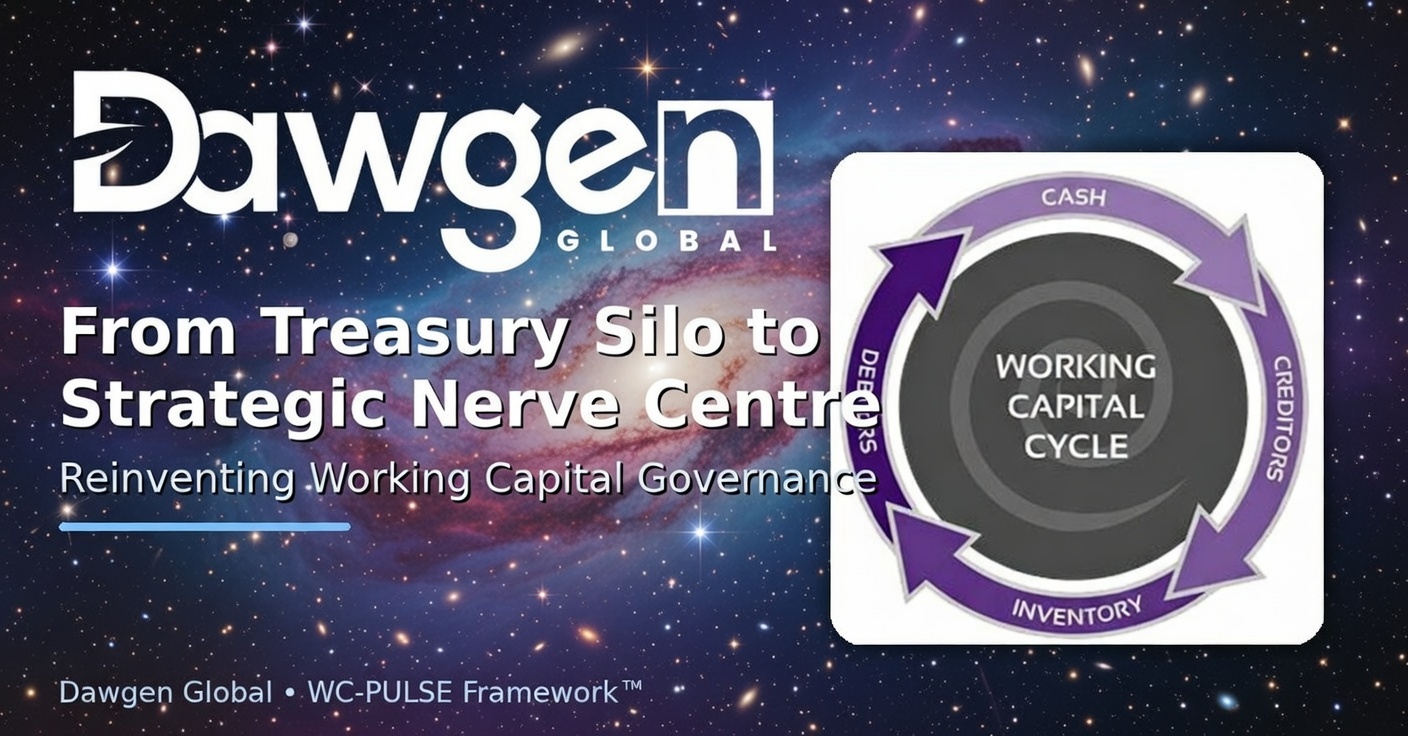
The Meeting That Reveals Everything
Imagine this scene. It plays out every month in boardrooms across the Caribbean, North America, and beyond. The monthly operating review has reached the working-capital agenda item. The Treasurer presents the dashboard: DSO is 47 days, DPO is 38 days, the Cash Conversion Cycle is 52 days, and the current ratio is 1.6. The numbers are within target. The board nods. The CFO moves to the next item.
But no one in that room has asked – or can answer – the following questions: Why has DSO increased by 4 days since last quarter, and which specific customers are responsible? Why did the VP of Sales approve net-90 payment terms for a new client last month without consulting Treasury about the cash-flow impact? Why is the procurement team sitting on US$3.2 million in slow-moving inventory that was ordered six months ago to capture a bulk discount that no one in Finance authorised? And why did the operations team accelerate US$1.8 million in capital expenditure into the current quarter without flagging it to the Treasurer, blowing a hole in the 13-week cash-flow forecast?
The answer to all four questions is the same: working-capital management is siloed. Treasury monitors cash. Sales manages revenue. Procurement manages suppliers. Operations manages production. Each function optimises for its own metrics, and no one governs the interactions between them. The result is a working-capital position that is the accidental by-product of uncoordinated functional decisions rather than the deliberate output of an integrated strategy.
This is the governance problem that Article 5 addresses. The first four articles in this series introduced the WC-PULSE Framework™, the Trigger Zone Matrix, the P-Layer, and the S-Layer. This article explains how to wire those tools into the organisational fabric so that every function that touches working capital is aligned, accountable, and operating from a single source of truth.
Working capital is not a Treasury problem. It is the outcome of every decision that every function makes about cash, inventory, receivables, and payables. Governing it requires a structure that connects all of them.
Anatomy of the Silo Problem
The silo problem in working-capital management is not a failure of competence. It is a failure of architecture. Each function that influences working capital operates within its own incentive structure, its own reporting cadence, and its own definition of success. These structures were designed for functional excellence, not for cross-functional optimization, and the conflicts they create are systematic, predictable, and devastatingly expensive.
The Sales-Treasury Disconnect
The Sales function is incentivized to close deals. Revenue targets, commission structures, and pipeline metrics all drive towards booking more business. In pursuit of these goals, Sales teams routinely offer extended payment terms – net-60, net-90, even net-120 – as a competitive lever to win or retain customers. From the Sales perspective, this is rational: a deal closed on net-90 is still a deal closed.
From the Treasury perspective, it is a US$4.1 million interest-free loan to the customer. For a company with US$50 million in annual revenue and a weighted average cost of capital of 10 per cent, every additional 30 days of DSO represents approximately US$410,000 in annual carrying cost. When Sales extends terms without consulting Finance, the cost is invisible to the function creating it and devastating to the function absorbing it. Over time, the cumulative impact of uncoordinated term decisions can account for 200 to 400 basis points of margin erosion – margin that the board attributes to “market conditions” because no one has traced it to its operational source.
The Procurement-Finance Disconnect
The Procurement function is incentivized to secure the lowest unit cost. Purchase-price variance is the metric that dominates performance reviews, and it drives procurement professionals towards bulk purchasing, volume discounts, and long-term supply commitments. From the Procurement perspective, buying six months of inventory at a 12 per cent discount is a clear win.
From the Finance perspective, it is a US$3.2 million cash outlay that increases DIO by 45 days, consumes warehouse capacity, generates insurance and obsolescence costs, and locks capital into a depreciating asset when it could have been deployed at a 10 per cent return elsewhere. The net financial impact, when the carrying cost of the excess inventory is subtracted from the procurement savings, is often negative. But this calculation is never performed, because Procurement reports on purchase price and Finance reports on inventory turns, and no one reconciles the two.
The Operations-Treasury Disconnect
The Operations function is incentivised to maintain production continuity and meet delivery commitments. Capital-expenditure decisions, maintenance schedules, and capacity investments are made based on operational necessity and approved through a capex governance process that typically operates on a quarterly or annual cycle. The timing of these expenditures within the approved budget, however, is often left to operational discretion – and operational timing rarely considers the cash-flow implications visible in the 13-week forecast.
When Operations accelerates a US$1.8 million equipment purchase from week ten to week three because the supplier offered a short-term delivery slot, it creates a cash-flow spike that the Treasurer did not anticipate. If this spike coincides with a seasonal revenue trough or a delayed receivable, the combined impact can push the organisation from the Amber Zone into the Red Zone – a zone transition triggered not by external events but by internal coordination failure.
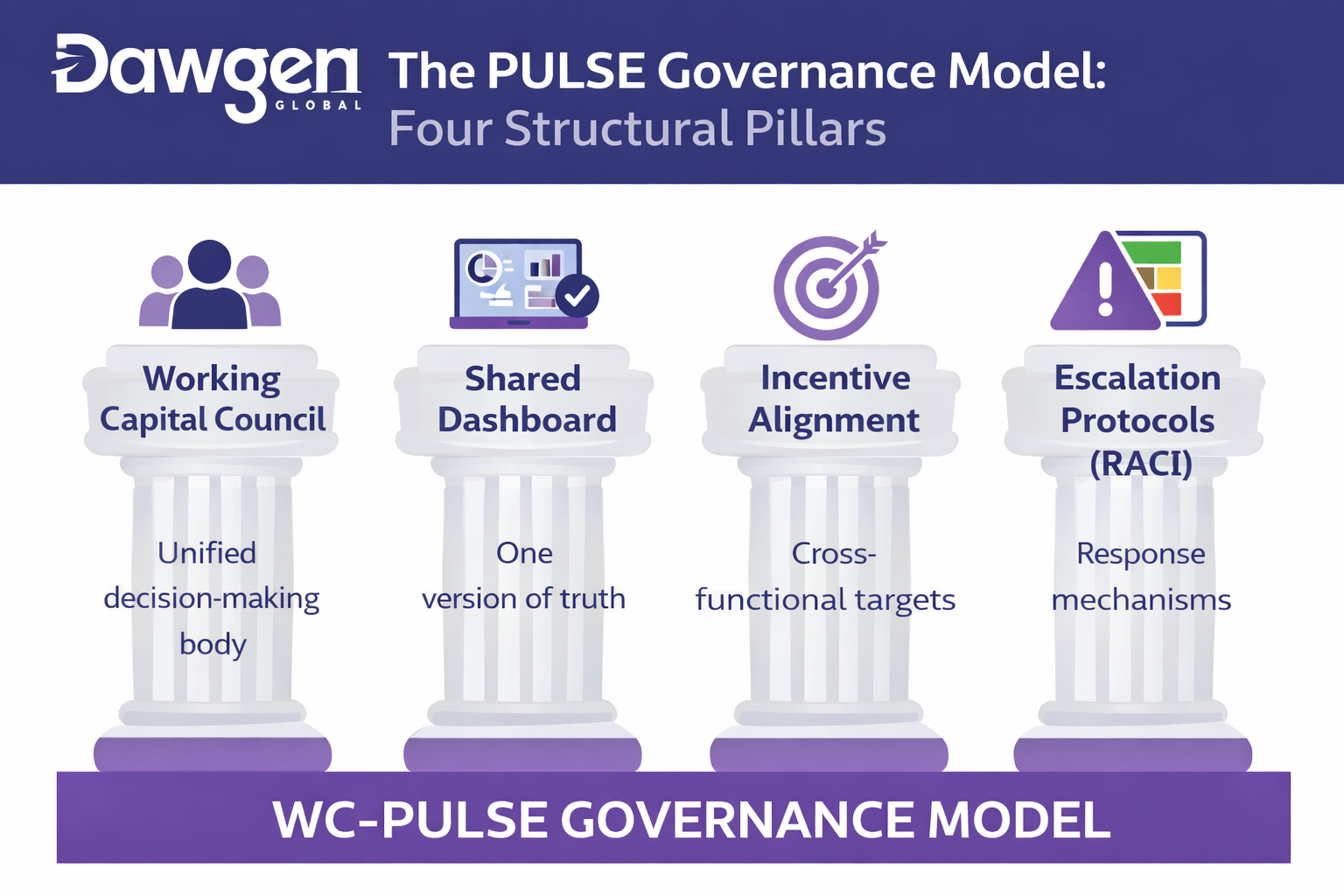
The PULSE Governance Model: Four Structural Pillars
The WC-PULSE Framework addresses the silo problem through a governance model built on four structural pillars. Each pillar is designed to break a specific silo boundary and create the cross-functional alignment that working-capital excellence requires.
Pillar 1: The Working Capital Council
The first and most important structural change is the creation of a Working Capital Council – a cross-functional governance body that meets monthly (weekly in the Red Zone) and has explicit authority over all decisions that materially affect working-capital position.
The Council’s composition is deliberately cross-functional:
- Chair: CFO or Treasurer – accountable for the composite PULSE Score and zone management.
- VP Sales or Chief Revenue Officer – accountable for DSO, customer credit terms, and the revenue-to-cash gap.
- Chief Procurement Officer or VP Supply Chain – accountable for DPO, DIO, supplier terms, and the S-Layer concentration metrics.
- VP Operations or COO – accountable for capex timing, inventory management, and operational cash-flow impact.
- Head of FP&A – responsible for the 13-week forecast, scenario modelling, and PULSE Dashboard reporting.
The Council operates with a defined decision framework: any commercial decision that extends payment terms beyond the standard policy, any procurement commitment exceeding a calibrated threshold, and any capex acceleration outside the approved quarterly schedule requires Council approval. This does not slow decision-making. It coordinates it. The approval process is designed to take less than 48 hours and is supported by real-time PULSE Dashboard data that quantifies the working-capital impact of each proposed decision before it is made.
Pillar 2: Shared Metrics and a Single Dashboard
The second pillar eliminates the information asymmetry that enables silos. Every member of the Working Capital Council – and their direct reports – operates from the same PULSE Dashboard, with the same data, the same scoring, and the same zone classification. There is no longer a separate Treasury view, a separate Sales view, and a separate Procurement view of working-capital reality. There is one view: the PULSE view.
The Dashboard is designed around four layers of visibility:
- Executive Summary: The composite PULSE Score, the current zone classification, the trend direction (improving, stable, or deteriorating), and the top three risk signals requiring attention. This is the board-level view.
- Layer Drill-Down: Each of the five PULSE layers (P, U, L, S, E) with its component metrics, scores, and trigger-signal status. This is the functional-leader view.
- Action Tracker: The current zone protocol actions, their assigned owners, their status (not started, in progress, completed), and their measured impact. This is the operational accountability view.
- Scenario Console: The 13-week forecast with base, downside, and stress scenarios, overlaid with proposed commercial decisions to visualise their cash-flow impact before approval. This is the decision-support view.
The power of a shared dashboard is not merely informational. It is behavioural. When the VP of Sales can see, in real time, that extending net-90 terms to a prospective customer will increase DSO by 2.3 days, consume US$680,000 in additional working capital, and push the P-Layer score down by 4 points, the conversation changes. The decision is no longer Sales versus Finance. It is a shared evaluation of trade-offs, informed by common data, governed by common protocols.
Pillar 3: Incentive Alignment
The third pillar addresses the root cause of silo behaviour: incentives. As long as Sales is measured solely on revenue, Procurement solely on purchase price, and Operations solely on throughput, each function will optimise its own metric at the expense of the aggregate working-capital position. The PULSE Governance Model introduces working-capital performance as a shared metric in every function’s performance framework.
This does not mean that every function is measured on the composite PULSE Score. It means that each function is measured on the working-capital dimension it directly influences:
- Sales: Measured on the DSO of their originated receivables and the percentage of deals closed within standard payment-term policy. A deal closed on net-90 without Council approval counts as a policy exception and is flagged in the performance review.
- Procurement: Measured on total cost of ownership (including carrying cost, not just purchase price) and on the Supplier Concentration Index for their categories. A bulk-purchase decision that improves unit cost but increases DIO beyond the calibrated threshold triggers a working-capital impact assessment.
- Operations: Measured on capex timing variance – the deviation between planned and actual expenditure timing within each quarter – and on inventory turns for finished goods and work-in-progress. Capex acceleration without Council notification is treated as a control exception.
- Treasury/FP&A: Measured on forecast accuracy, PULSE Score stability, and the timeliness of trigger-alert response. Treasury is the steward of the framework’s integrity and the orchestrator of the Council’s agenda.
Incentive alignment does not require dramatic changes to compensation structures. In most cases, it requires adding one or two working-capital-linked metrics to existing performance scorecards, weighted at 10 to 20 per cent. The behavioural impact is disproportionate to the weighting, because the mere presence of the metric signals organisational priority and creates visibility for decisions that were previously invisible.
Pillar 4: Escalation Protocols and RACI Clarity
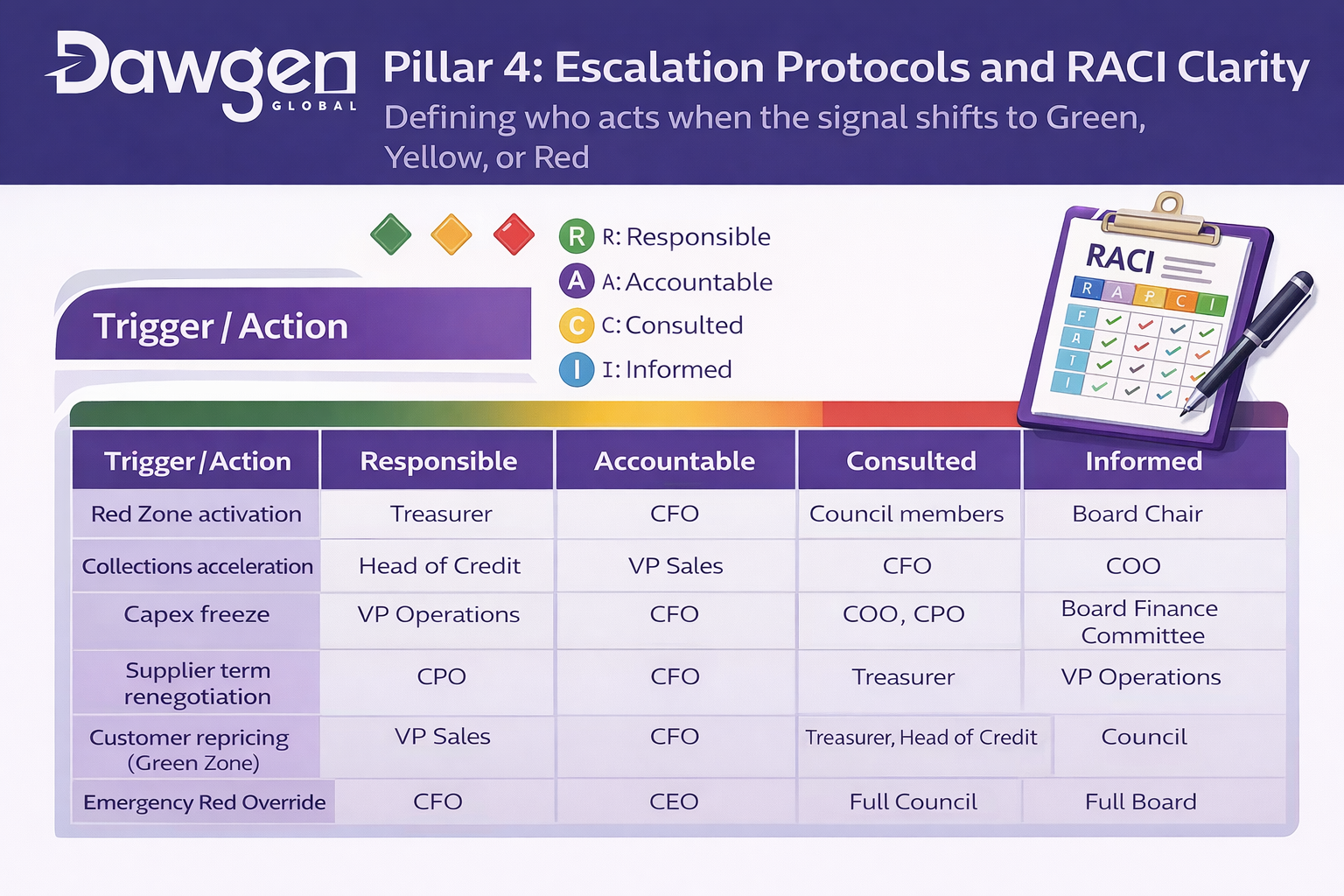
The fourth pillar defines who does what when the PULSE system signals a zone transition. Without clear escalation protocols, alerts become noise. The PULSE Governance Model specifies a RACI matrix – Responsible, Accountable, Consulted, Informed – for every trigger signal and every zone-protocol action.
| Trigger / Action | Responsible | Accountable | Consulted | Informed |
| Red Zone activation | Treasurer | CFO | Council members | Board Chair |
| Collections acceleration | Head of Credit | VP Sales | CFO | COO |
| Capex freeze | VP Operations | CFO | COO, CPO | Board Finance Committee |
| Supplier term renegotiation | CPO | CFO | Treasurer | VP Operations |
| Customer repricing (Green Zone) | VP Sales | CFO | Treasurer, Head of Credit | Council |
| Emergency Red Override | CFO | CEO | Full Council | Full Board |
The RACI matrix ensures that when the PULSE Dashboard fires a trigger alert, the response is not a discussion about who should do what. The roles are pre-assigned, the protocols are pre-approved, and the response can begin within hours rather than days. In a Red Zone scenario, this time advantage can be the difference between a managed response and a crisis.
Embedding PULSE into the Operating Rhythm
A governance model is only as effective as its integration into the organisation’s existing operating cadence. The WC-PULSE Framework does not create a parallel governance universe. It embeds itself into the meetings, reports, and review cycles that already exist, adding working-capital intelligence to forums that previously lacked it.
The Monthly Operating Review
The most important integration point is the Monthly Operating Review – the forum where the executive team assesses operational performance and makes resource-allocation decisions. The PULSE Governance Model adds a structured working-capital segment to this review, replacing the traditional dashboard slide with a four-part agenda:
- PULSE Score Review (5 minutes): Current composite score, zone classification, trend direction, and comparison to prior month. This replaces the static CCC slide and immediately elevates the conversation from “are we within target?” to “are we improving, stable, or deteriorating, and why?”
- Layer Exception Report (10 minutes): Any PULSE layer that has moved more than 5 points in either direction, any trigger signal that has fired, and the actions taken or recommended. This focuses executive attention on the signals that matter, not on the metrics that are stable.
- Decision Impact Review (5 minutes): A summary of the working-capital impact of all significant commercial, procurement, and operational decisions made during the month, with a comparison of the projected impact (estimated at decision time) versus the actual impact observed. This creates a learning loop that improves decision quality over time.
- Forward Look (5 minutes): The 13-week P-Layer forecast summary with scenario analysis, highlighting any projected zone transitions and the pre-positioned response actions. This ensures the executive team is always looking forward, not backward.
Total added time to the Monthly Operating Review: 25 minutes. Total value: the transformation of working capital from a reporting line item into a governed strategic capability.
The Weekly Treasury Cadence
Below the Monthly Operating Review, the Treasury function maintains a weekly cadence that serves as the operational heartbeat of the PULSE system. This weekly cycle includes updating the 13-week rolling forecast, refreshing all five PULSE layer scores, reviewing any trigger alerts and their response status, and preparing the Council agenda for any decisions requiring cross-functional approval.
In the Red Zone, this weekly cadence accelerates to daily. The Cash War Room protocol, described in Article 2, replaces the standard weekly Treasury meeting with a daily 15-minute stand-up focused exclusively on cash position, collections progress, and the evolving PULSE Score trajectory.
The Culture Shift: From Cash as Constraint to Cash as Strategy
The governance structure described in this article – the Working Capital Council, the shared dashboard, the aligned incentives, the RACI protocols, and the embedded operating rhythm – is ultimately a vehicle for a deeper transformation: a cultural shift in how the organisation thinks about cash.
In most enterprises, cash is treated as a constraint. There is a budget. There is a cash forecast. There are limits. Working capital is something to be managed within those limits, and the primary management posture is defensive: make sure we do not run out. This mindset produces adequate but never excellent outcomes. It prevents crises but never creates advantage.
The WC-PULSE Governance Model introduces an alternative mindset: cash as strategy. In this paradigm, working capital is not a constraint to be managed but a resource to be optimised. The question is not “do we have enough?” but “is every dollar of working capital earning the highest risk-adjusted return available to this organisation at this moment?” In the Red Zone, that return is earned through survival – the preservation of the enterprise’s ability to operate. In the Green Zone, it is earned through margin capture, strategic investment, and competitive positioning.
This cultural shift does not happen by decree. It happens through practice – through the repeated experience of using the PULSE system to make better decisions, seeing those decisions produce measurable results, and building organisational confidence in the framework’s integrity. The governance structure provides the container. The discipline of weekly and monthly PULSE reviews provides the repetition. The incentive alignment provides the motivation. And the results – released working capital, avoided crises, captured margin – provide the reinforcement.
The organisations that treat working capital as a strategic weapon outperform their peers on ROIC, growth, and resilience. The governance model is what turns intent into capability.
Getting Started: The PULSE Governance Workshop
The transition from siloed working-capital management to integrated PULSE governance begins with a single event: the Dawgen Global PULSE Governance Workshop. This is a half-day, facilitated session where your leadership team designs the governance model that will govern working capital across your organisation.
The workshop covers four design modules: Working Capital Council charter and composition, PULSE Dashboard configuration and access protocols, incentive-alignment recommendations for each participating function, and RACI matrix design for all trigger signals and zone-protocol actions. The workshop is led by a Dawgen Global Senior Advisor with direct experience implementing PULSE governance models across manufacturing, distribution, financial services, and technology enterprises.
The output is a ready-to-implement governance blueprint, tailored to your organisation’s structure, culture, and operating rhythm. Most clients move from workshop to operational governance within four to six weeks.
READY TO BREAK DOWN THE SILOS?
Schedule a PULSE Governance Workshop
Dawgen Global is a full-spectrum advisory firm delivering transformation across Strategy, Finance, Operations, Technology, and Governance. Our Working Capital Advisory practice is powered by the proprietary WC-PULSE Framework™, designed to convert working-capital management from a reactive function into a strategic capability that drives shareholder value. We serve mid-market and large enterprises across the Caribbean, North America, and international markets.
A half-day facilitated session where your leadership team designs a custom working-capital governance model powered by the WC-PULSE Framework. Walk out with a ready-to-implement blueprint: Council charter, Dashboard configuration, incentive recommendations, and RACI protocols.
 Email: [email protected]

 WhatsApp Global Number : +1 555-795-9071
The WC-PULSE Thought Leadership Series
Article 1: “Your Cash Conversion Cycle Is Lying to You”
Article 2: “Buffer or Bleed: The US$2.4 Trillion Question Every CFO Gets Wrong”
Article 3: “The CFO’s 13-Week Crystal Ball: Predictive Cash-Flow Modelling That Actually Works”
Article 4: “Supplier Risk Is Working-Capital Risk: How to Stress-Test Your Ecosystem”
Article 5: “From Treasury Silo to Strategic Nerve Centre: Reinventing Working Capital Governance” (You are here)
Coming Next – Article 6: “The Reprice Playbook: How Top CFOs Turn Surplus Liquidity Into Margin” – A detailed guide to the Green Zone Protocol, with quantified strategies for payment-term tightening, supplier-discount capture, yield optimisation, and strategic reinvestment.
About Dawgen Global
“Embrace BIG FIRM capabilities without the big firm price at Dawgen Global, your committed partner in carving a pathway to continual progress in the vibrant Caribbean region. Our integrated, multidisciplinary approach is finely tuned to address the unique intricacies and lucrative prospects that the region has to offer. Offering a rich array of services, including audit, accounting, tax, IT, HR, risk management, and more, we facilitate smarter and more effective decisions that set the stage for unprecedented triumphs. Let’s collaborate and craft a future where every decision is a steppingstone to greater success. Reach out to explore a partnership that promises not just growth but a future beaming with opportunities and achievements.
Email: [email protected]  Visit: Dawgen Global Website
WhatsApp Global Number : +1 555-795-9071
Caribbean Office: +1876-6655926 / 876-9293670/876-9265210  WhatsApp Global: +1 5557959071
USA Office: 855-354-2447
Join hands with Dawgen Global. Together, let’s venture into a future brimming with opportunities and achievements


