

Article 6 of THE NEW BOTTOM LINE™, Dawgen Global’s series on IFRS 18 across the Caribbean. IFRS 18 does not change your profit. It may still change your covenant ratios, your bonus pool and your management fee.
IFRS 18 is often described as “just presentation”. Revenue, expenses and profit for the year are the same numbers under the new standard as under IAS 1. That is true, and it is also the reason the standard is dangerous to underestimate.
Many of the agreements that govern a Caribbean business do not refer to profit for the year. They refer to subtotals: operating profit, EBITDA, earnings before interest and tax, finance costs, interest cover. Loan agreements, bond trust deeds, executive incentive plans, management agreements, acquisition earn-outs and some regulatory returns are all built on those numbers. IFRS 18 redefines several of them.
When the subtotal moves, everything built on it moves too, even though the business has not changed at all. This article explains how that happens, which agreements are exposed, and what to do before the first IFRS 18 report reaches your lenders.
Same business, different ratio
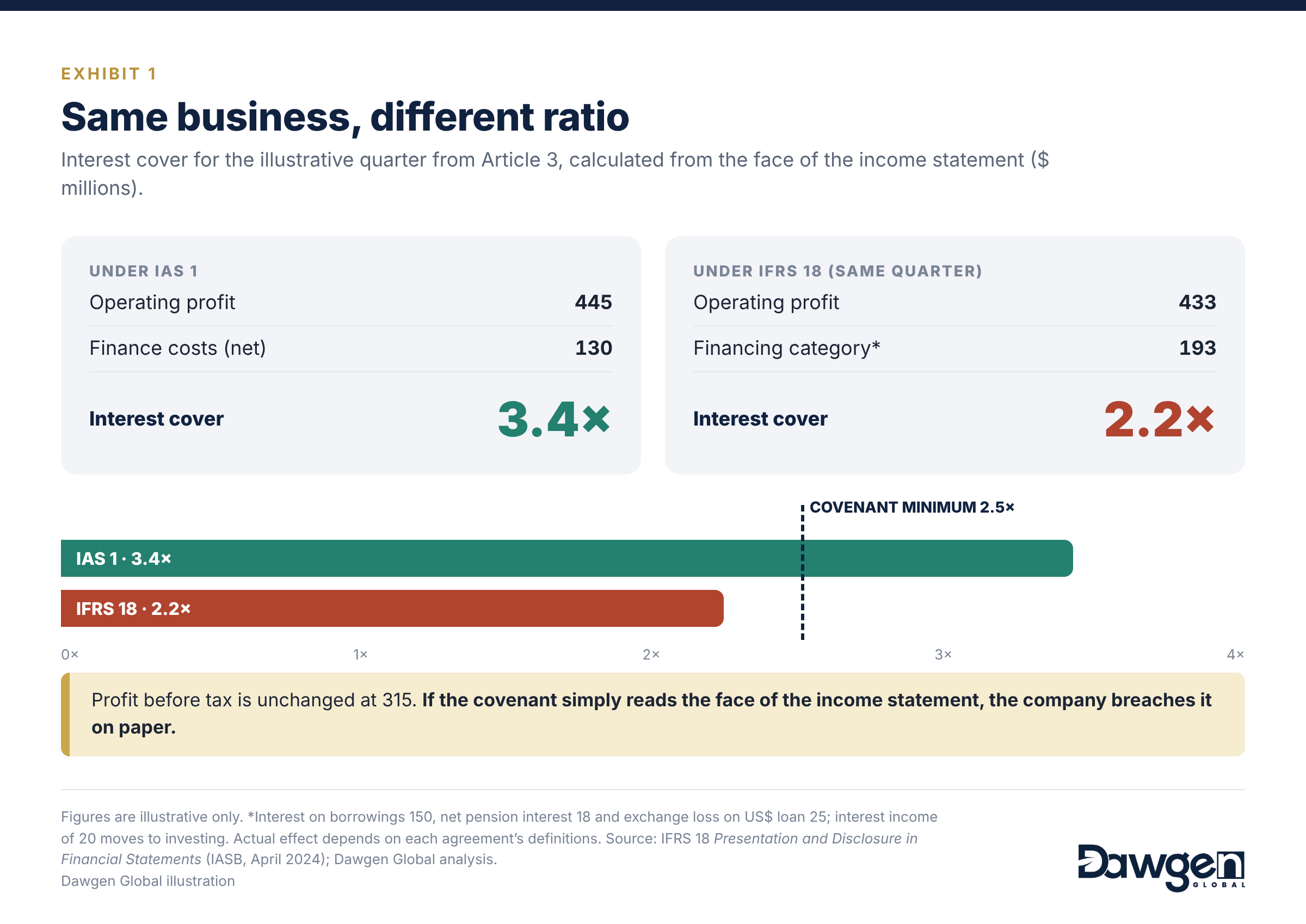
Consider the illustrative company from Article 3 of this series. In the quarter to 31 March 2026, under IAS 1, it reported operating profit of $445 million and net finance costs of $130 million. Its loan agreement requires interest cover, defined as operating profit divided by finance costs, of at least 2.5 times. At 3.4 times, it has comfortable headroom.
Now restate the same quarter under IFRS 18. Nothing about the business changes, and profit before tax stays at $315 million. But three things move:
- Operating profit falls to $433 million. Dividends and rental income move out to investing, while the pension interest and part of the foreign exchange loss move out to financing.
- Interest income is no longer netted against finance costs. It moves to the investing category.
- The financing category grows to $193 million. It now includes the interest on borrowings, the net interest on the pension liability and the exchange loss on the US-dollar loan.
If the covenant simply reads the face of the income statement, interest cover falls from 3.4 times to 2.2 times. On paper, the company has breached its covenant, with no change in trading, cash or risk.
Whether that actually happens depends on two things: exactly how the agreement defines its terms, and whether those definitions are tied to the accounting standards in force when the agreement was signed or to the standards in force today.
Frozen or floating: what your agreements actually say
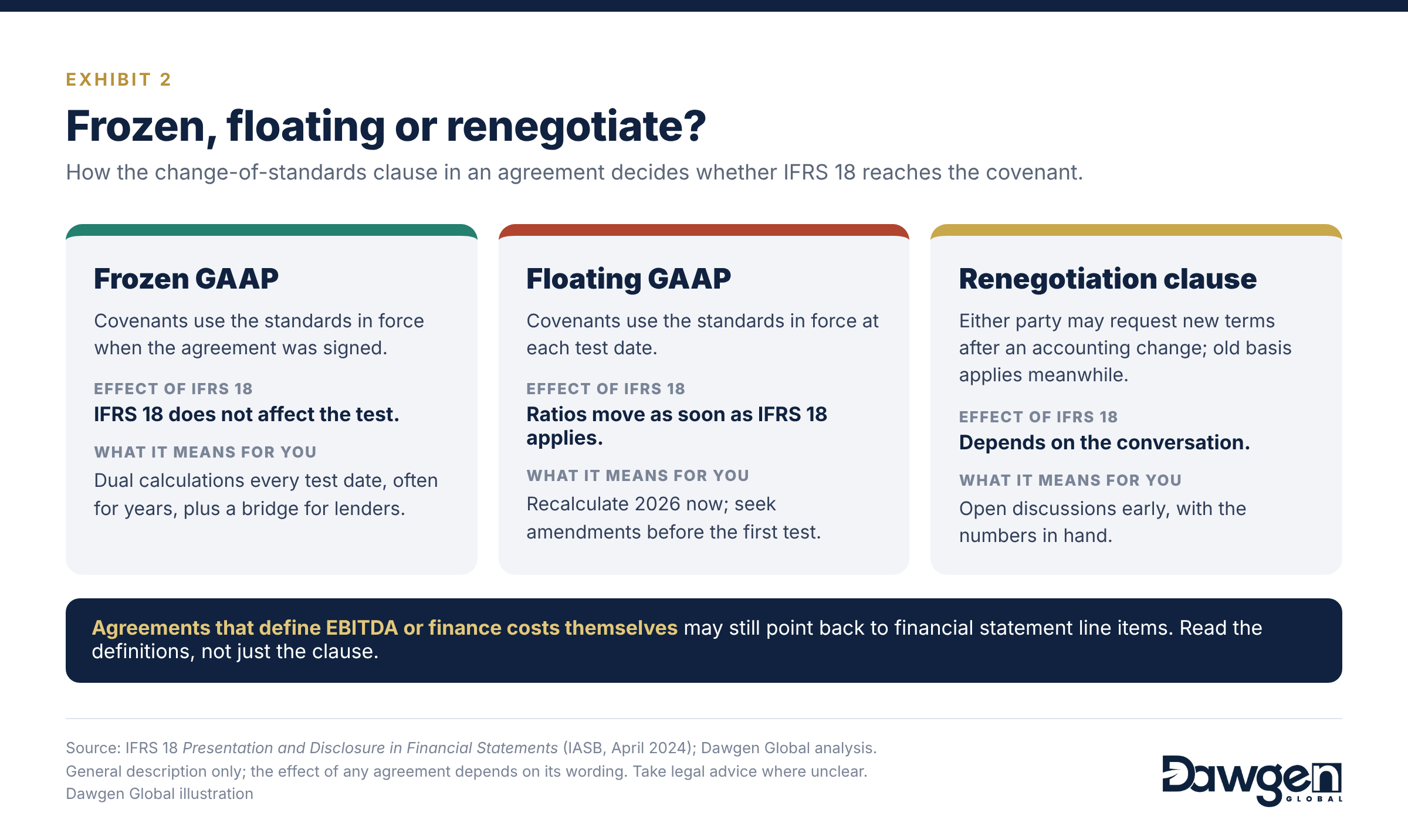
Most financing agreements deal with changes in accounting standards in one of two ways.
- Frozen GAAP. Covenants are calculated using the accounting standards in force when the agreement was signed. A change such as IFRS 18 does not affect the covenant, but the company must keep calculating the old numbers alongside the new ones, often for years, and explain the bridge to its lenders.
- Floating GAAP. Covenants are calculated using the standards in force at each test date. The ratios move as soon as IFRS 18 applies, and the effect described above flows straight into the covenant certificate.
Many agreements sit between the two. A common clause allows either party to request a renegotiation when an accounting change would affect the covenants, with the old basis applying until terms are agreed. Others define “EBITDA” or “finance costs” in the agreement itself, which may protect the company or may not, depending on whether the definition points back to line items in the financial statements.
The only way to know is to read each agreement. In our experience, many Caribbean finance teams have never needed to look at these clauses closely. IFRS 18 is the reason to do it now, before the first IFRS 18 test date rather than after it.

The same applies to bond trust deeds and note programmes. Listed and privately placed corporate bonds in the region often carry financial covenants of their own, and a trustee or bondholder meeting is a slower and more public route to an amendment than a conversation with a single bank.
Beyond the loan agreement
Financing agreements are the most visible exposure, but they are rarely the only one. Any contract or policy that refers to a subtotal of profit should be on the review list.
- Executive and staff incentive schemes. Bonus pools and long-term incentive targets set on “operating profit” or “EBITDA” may pay out differently once those numbers are redefined. Remuneration committees need to decide whether to restate targets, and say so before the year starts, not after the results are known.
- Management and franchise agreements. Management fees, incentive fees and franchise royalties are often calculated on gross operating profit or EBITDA. Both sides of such agreements have an interest in agreeing how IFRS 18 will be treated.
- Acquisition earn-outs and price adjustments. Deferred consideration tied to post-acquisition EBITDA or operating profit can change in value when the definition moves mid-way through the earn-out period.
- Dividend policies. Boards that set payout ratios against operating profit or adjusted earnings should confirm which measure they will use from 2027.
- Regulatory returns and licence conditions. Some regulators draw on line items from the financial statements for prudential returns, fee calculations or licence tests. Regulated entities should confirm whether their returns follow the published financial statements or prescribed definitions.
- Profit-based rents and joint venture agreements. Turnover and profit-sharing clauses in leases and joint arrangements can refer to the same subtotals.
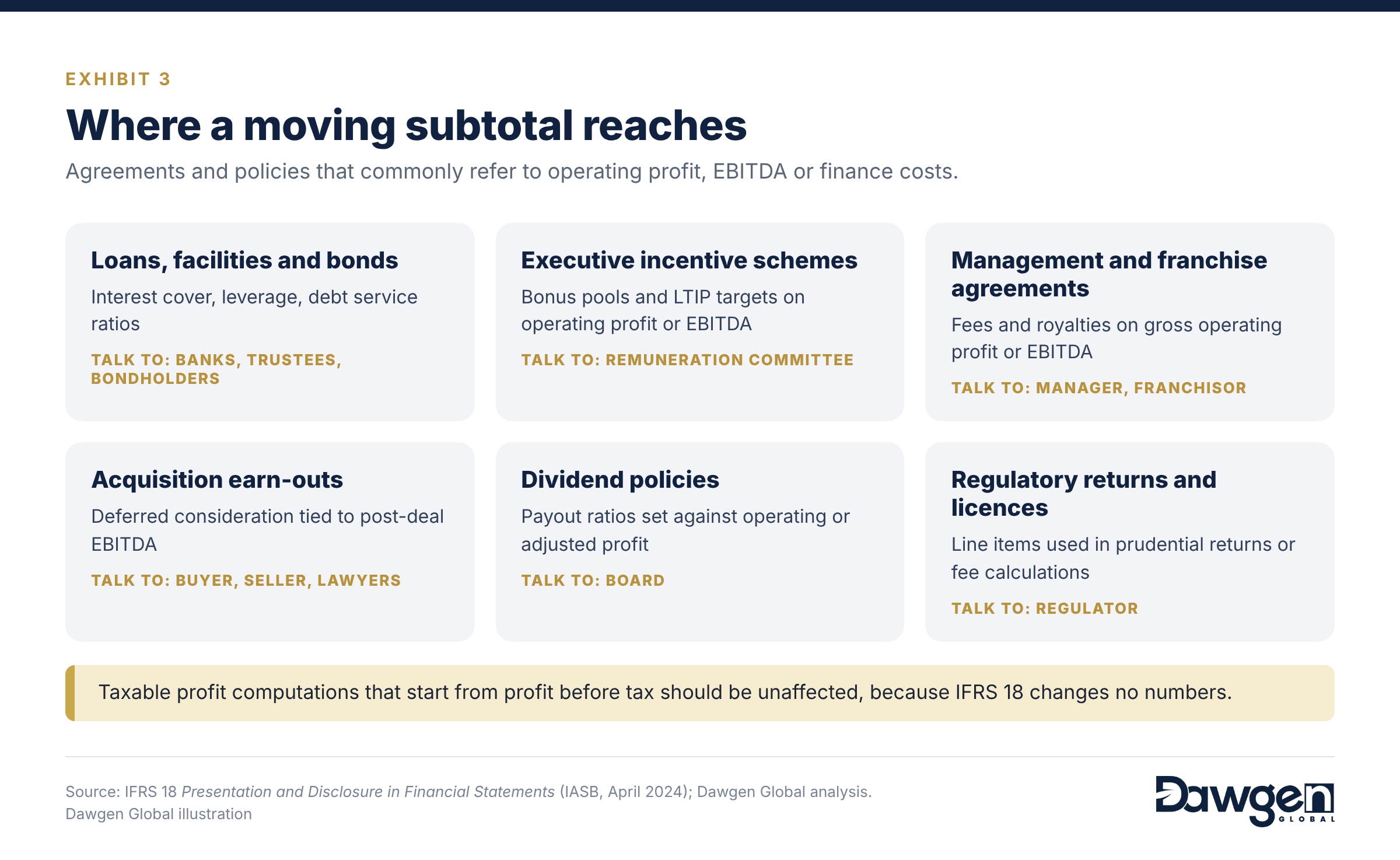
One item is reassuringly unaffected. Because IFRS 18 does not change recognition or measurement, taxable profit computations that start from profit before tax should not change. Tax computations that rely on specific line items, however, are worth a quick check.
A six-step contract review
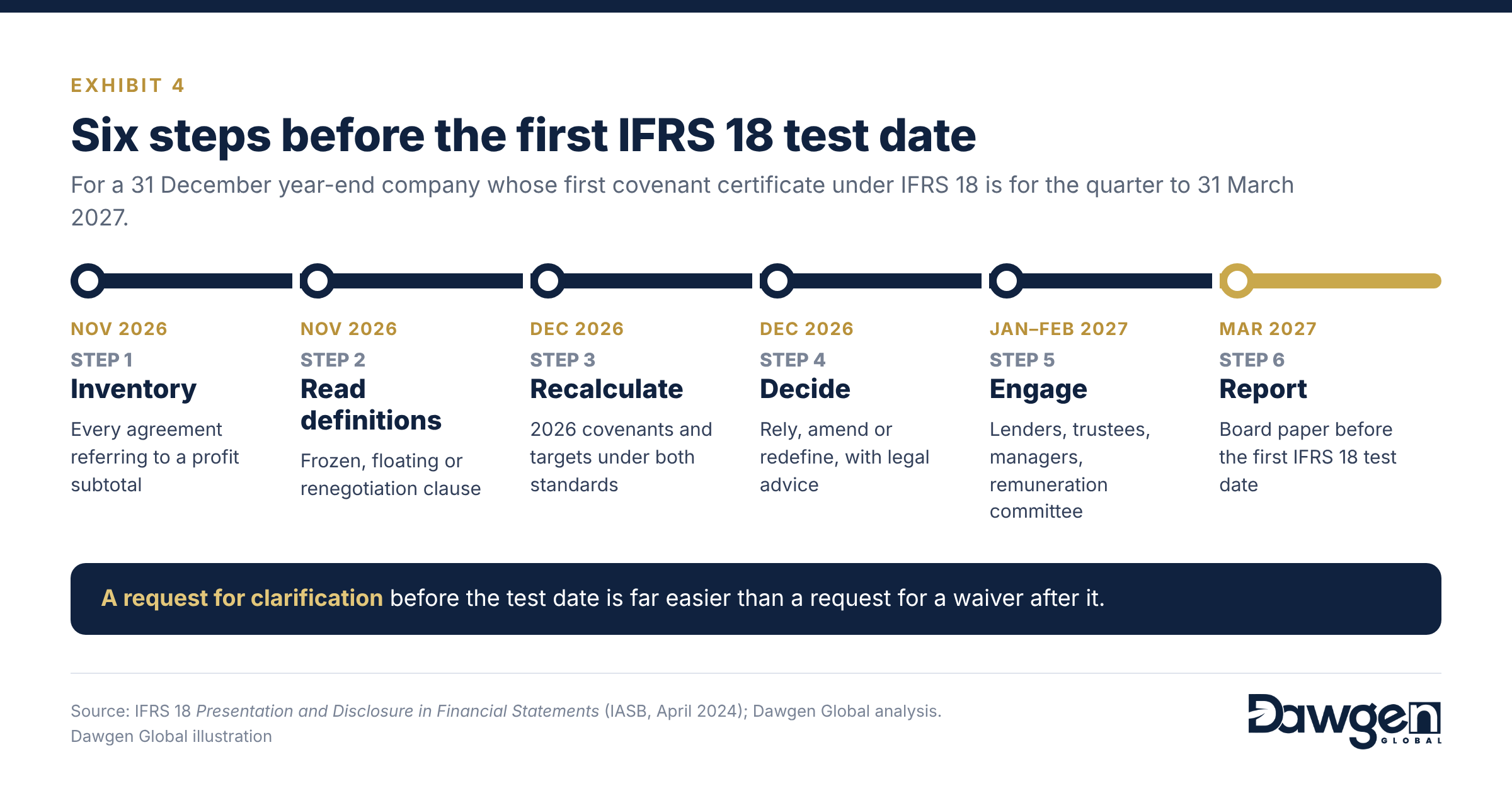
The work is not complicated, but it takes time, and lenders and counterparties need notice. We recommend completing it before the first IFRS 18 test date, which for many December year-end companies is the covenant certificate for the quarter to 31 March 2027.
- Build the inventory. List every loan, facility, bond, guarantee, incentive plan, management or franchise agreement, earn-out and regulatory return that refers to a profit subtotal or a finance cost figure.
- Read the definitions. For each one, record how the measure is defined, whether the agreement uses frozen or floating GAAP, and what the change-of-standards clause requires.
- Recalculate 2026. Using the restated 2026 comparatives, calculate each covenant and target under IFRS 18 as well as under IAS 1. Identify where headroom shrinks, where it grows and where a test could fail.
- Decide the approach. For each agreement, decide whether to rely on frozen GAAP, seek an amendment, or agree an adjusted definition. Take legal advice where the wording is unclear.
- Talk to counterparties early. Approach lenders, trustees, management companies and remuneration committees with the numbers before the first IFRS 18 results, not after. A request for clarification is far easier than a request for a waiver.
- Report to the board. Summarise the exposures, the agreed approach and any amendments in a single paper for the audit committee, and keep the dual calculations on file for as long as frozen GAAP applies.
Companies that do this work early turn a potential covenant problem into a routine housekeeping exercise. Companies that leave it until the first test date risk explaining a technical breach to their bank.
How Dawgen Global can help
Dawgen Global helps companies across more than 15 Caribbean territories identify and manage the contractual effects of IFRS 18, working alongside their legal advisers and lenders.
- Covenant and Contract Impact Scan. An inventory of every agreement that refers to a profit subtotal, with the definition, the frozen or floating basis and the change-of-standards clause recorded for each.
- Dual Covenant Recalculation. 2026 covenants and targets recalculated under IAS 1 and IFRS 18, with headroom analysis and early-warning flags for the first 2027 test dates.
- Lender and Counterparty Briefing Pack. A clear bridge between the old and new numbers that you can share with banks, trustees, management companies and remuneration committees.
- Incentive Plan Review. Support for remuneration committees resetting targets that refer to operating profit or EBITDA.
- Board and Audit Committee Briefing. A single paper on exposures, decisions and amendments.
IFRS 18 will not change what your business earns. Make sure it does not change what your agreements say you earned.

Book your IFRS 18 Readiness Clinic today.
Email [email protected] or call (876) 926-5210 | US 855-354-2447 | dawgen.global
Previously in this series: Ten Weeks to IFRS 18 · 2026 Is Already Your Comparative Year · Your First IFRS 18 Interim Will Be Public · Your “EBITDA” Now Needs a Footnote · Banks, Insurers and the “Main Business Activity” Test. Next: Before and After: A Caribbean P&L Restated.
Dawgen Global is an independent, integrated multidisciplinary professional services firm serving businesses across more than 15 Caribbean territories. Big Firm Capabilities. Caribbean Understanding.
About Dawgen Global
Dawgen Global is an independent, integrated multidisciplinary professional services firm headquartered at 47 Trinidad Terrace, New Kingston, Jamaica, serving more than 15 territories across the Caribbean. Founded and led by Dr. Dawkins Brown, Executive Chairman, the firm is independent and not affiliated with any international network. It delivers a full suite of professional services under one roof: audit and assurance; tax advisory; IT and digital transformation; risk management; cybersecurity; actuarial and insurance regulatory advisory; HR advisory; mergers and acquisitions; corporate recovery; business advisory and strategy; accounting BPO and virtual CFO services; and legal process outsourcing.
The proposition is simple: big-firm capability without the big-firm price. Dawgen Global’s integrated approach is built for the specific complexities and opportunities of the Caribbean market, helping organizations make sharper, better-informed decisions that drive measurable progress.
To explore a partnership, reach out:
- Website: dawgen.global
- Email: [email protected]
- WhatsApp (Global): +1 555-795-9071
- Caribbean offices: +1 876-665-5926 | +1 876-929-3670 | +1 876-926-5210