

Why most Caribbean AI investment has not yet reached EBIT — and the six-span crossing that carries it there
Ask the people in any Caribbean head office whether AI has made them more productive and most will say yes. The finance officer drafts the variance commentary in half the time. The customer service lead clears her inbox before lunch. The analyst who used to spend Friday reconciling statements now spends Friday on something else.
Then ask the chief financial officer to show you, in the management accounts, where that productivity went. The silence that follows is the subject of this series.
AI is working. In most organizations, the profit and loss account has not noticed. The reason is not that the technology is weak, or that the region is behind. It is that productivity and profit are separated by a series of crossings that someone has to build deliberately — and in most organizations, nobody has been given that job.
This first article of Hours Into Earnings™ sets out why the gap exists, where the value goes, and the single test every board should apply before it approves another dollar of AI spend. The rest of the series takes each crossing in turn.
Eighty per cent feel it. Thirty-seven per cent can find it.
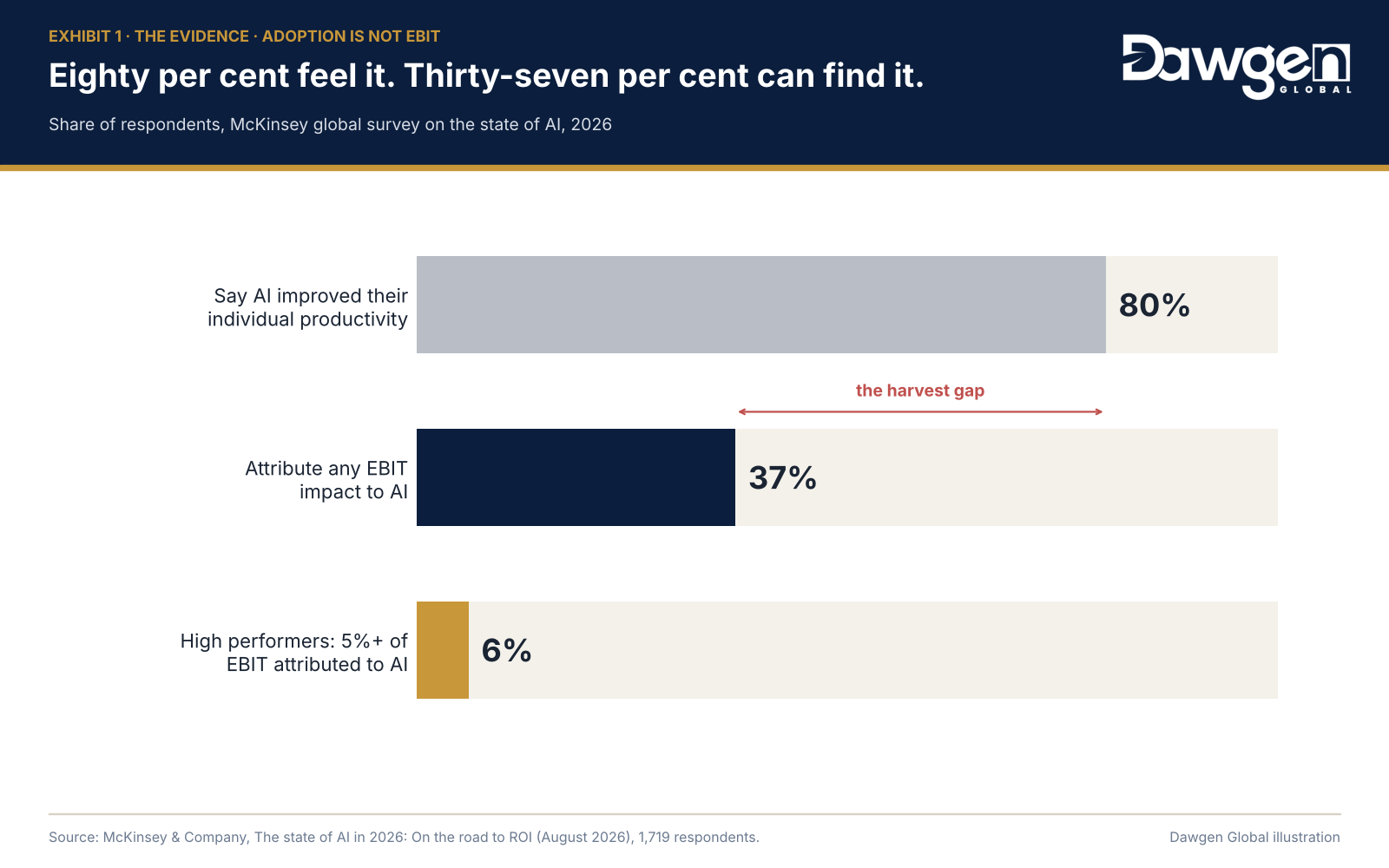
The largest annual survey of corporate AI use tells the story in two numbers. In McKinsey’s State of AI in 2026, published in August, 80% of respondents said AI had improved their individual productivity. Only 37% said AI had made any contribution to their organization’s earnings before interest and taxes — a share essentially unchanged from the year before. Roughly 6% qualified as genuine high performers, attributing at least 5% of EBIT to AI.
The gap between 80 and 37 is not a measurement quirk. It is the distance between a person working faster and a company earning more. A year earlier, MIT’s Project NANDA had put the same problem more starkly, reporting that about 95% of enterprise generative AI pilots it studied produced no measurable profit-and-loss impact.
Yet the picture is not one of failure. Boston Consulting Group’s Applied AI Index 2026, released in September, found that the small group of “future-built” companies — 7.5% of its sample — delivered 2.3 times the shareholder return, 2.4 times the revenue growth and 2.8 times the EBITDA growth of laggards, and that a further 41% were scaling AI and outperforming. AI value is real, and it is now visible where it matters most: in what companies are worth.
What separates the two groups is not the software. McKinsey’s high performers are about three times as likely as others to have fundamentally redesigned workflows around AI. BCG’s leaders run AI as an enterprise programme, measured directly in the P&L. MIT found the strongest returns not in the sales and marketing tools that attract most budgets, but in back-office work where cost is countable. The winners did not buy better AI. They built the crossings.
Where the value goes: six spans between a tool and a valuation
Value has to cross every span to reach the owner. Dawgen Global illustration.
At Dawgen Global we describe the journey from AI adoption to enterprise value as a crossing of six spans, a framework we call The Dawgen Earnings Crossing™. Value reaches the owner only if it crosses all six. A break at any one leaves the investment sitting on the books as cost.
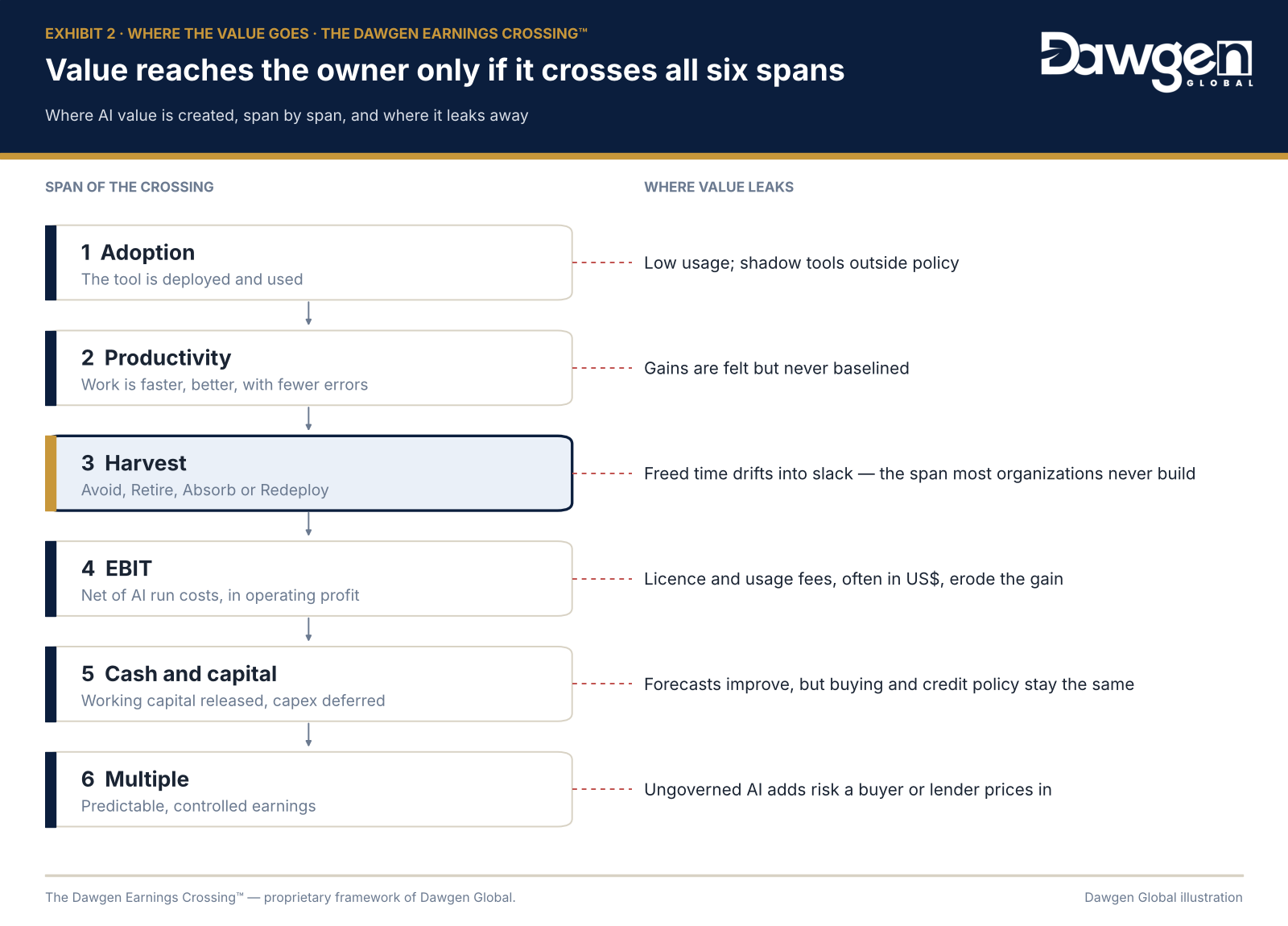
Span 1 — Adoption. The tool is deployed and people use it. This is where most AI reporting stops: licences issued, users active, pilots launched. It is necessary and nearly meaningless to a shareholder.
Span 2 — Productivity. Work is done faster, better or with fewer errors. This is where AI is felt, and it is the 80%.
Span 3 — Harvest. The time or quality gained is deliberately converted into something the ledger records: a hire that is not made, an outsourcing contract that is not renewed, growth absorbed without new cost, or people moved to work that earns revenue. This is the span almost nobody builds. Without it, the hours saved by AI dissolve into a slightly calmer afternoon. Time saved is not money saved.
Span 4 — EBIT. The harvested benefit, net of what the AI itself costs to run, shows up in operating profit and survives the year-end review.
Span 5 — Cash and capital. Better forecasting and faster collections release working capital; predictive maintenance defers capital spend. These gains can be substantial, and they are rarely counted.
Span 6 — Multiple. Earnings that are more predictable, better controlled and less dependent on a handful of individuals earn a higher multiple from buyers, lenders and investors. This is the span that turns an AI programme into a valuation event.
Read that way, the 80-to-37 gap stops being mysterious. Most organizations have built spans one and two. A minority have built three and four. Very few have deliberately built five and six — which is exactly where BCG’s leaders are pulling away.
Why the crossing breaks more easily here

Small enough to redesign whole. Dawgen Global illustration.
The six spans are the same in Kingston, Port of Spain and Bridgetown as they are in New York. But Caribbean conditions change where the crossing is most likely to break.
Our AI costs are in US dollars; our revenue mostly is not. Licences and usage-based AI fees rise with use and with every movement in the exchange rate. McKinsey found that about one in five organizations now say AI operating costs constrain their use. For a regional business, a pilot that looks cheap in its first quarter can quietly become a material foreign-currency operating line.
Our finance and middle-management teams are thin. Productivity gains concentrate in a few people, and a harvest plan that depends on restructuring is hard to execute and socially costly. The right harvest here is usually growth absorbed without new hires, or capacity moved to collections and sales — but only if someone decides that in advance.
Our data lives in spreadsheets, paper files and older systems. Many AI initiatives stall not at the model but at the baseline: if no one measured how long the month-end close took before, no one can prove the improvement after.
Our valuation multiples are lower and our cost of capital is higher. That cuts both ways. Each dollar of EBIT is worth fewer turns than in a deep market — but anything that makes earnings more predictable and less dependent on key individuals has an outsized effect on value. In a market that discounts risk heavily, de-risking is a lever in its own right.
There is also a regional advantage that is rarely stated. A mid-sized Caribbean enterprise can redesign an entire workflow, end to end, in a quarter. A multinational needs a year and a steering committee. Our scale is the reason the crossing can be built quickly — provided it is built on purpose.
The test every board should apply: the Earnings Proof™

Which line will it move, and who signs? Dawgen Global illustration.
The simplest discipline is also the most neglected. Before any AI initiative is funded, management should answer four questions in writing:
- Which line of the income statement or balance sheet will this move?
- What is that line today — measured, not estimated?
- Who signs for the change — a named business owner, not the IT department?
- When will it show — in which month’s management accounts?
An initiative that cannot answer all four is an experiment. Experiments are healthy, but they belong in a capped innovation budget, not in a board paper describing a value programme.
What the arithmetic is worth
The test matters because of what happens when it is applied consistently. Consider an illustrative composite: a Caribbean distribution and services group with J$8.0 billion of revenue, EBIT of J$640 million and an enterprise value of J$3.84 billion at six times EBIT.
Its AI opportunity scan identifies J$260 million of annual benefit. In practice, three-quarters is adopted and roughly four-fifths of that is harvested, so J$154 million reaches the ledger. After J$38 million of AI run costs, net EBIT rises by J$116 million — an 18% increase, but only 45% of the benefit first identified. More than half the value leaked away between the business case and the accounts.
Now follow it to valuation. The extra EBIT, valued at the new multiple, adds about J$754 million. Better forecasting, documented processes and controlled AI support a modest rerating from 6.0 to 6.5 times, worth another J$320 million on the existing earnings base. Collections and forecasting release about J$123 million of working capital. Net of a J$120 million programme, shareholder value rises by about J$1.08 billion, or 28%, roughly nine times the investment.
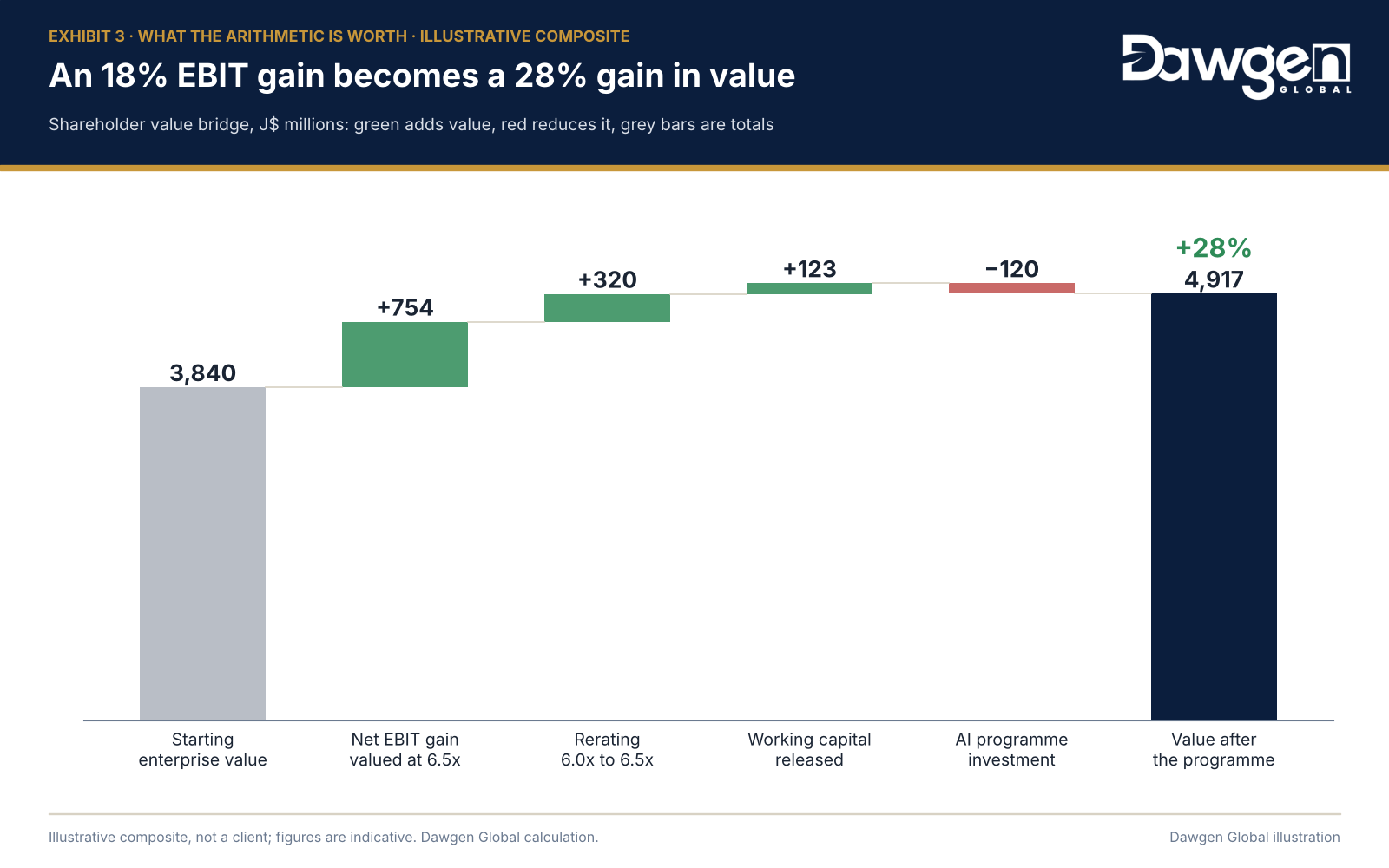
Three lessons sit inside those numbers. Leakage is the biggest line: at a 40% harvest rate instead of 79%, the net EBIT gain would fall from J$116 million to J$40 million. The multiple is not a rounding error: half a turn on the whole earnings base is worth almost a third of the enterprise value gain. And AI run costs are an operating line that must be capped, because here they absorb a quarter of the harvested benefit.
The composite is illustrative and does not describe any client. Figures are indicative.
Three questions to ask this week
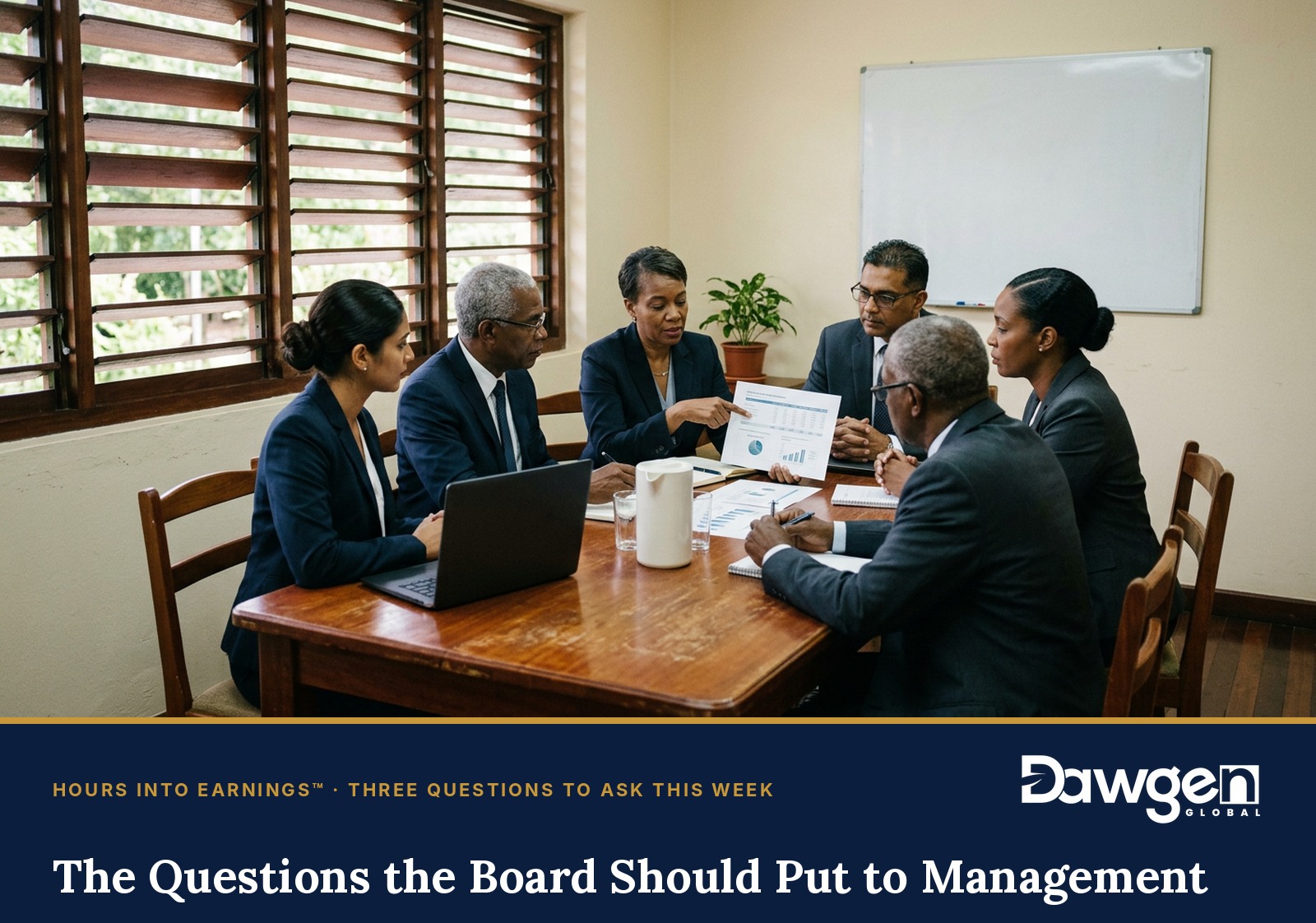
You do not need a consultant to find out which side of the gap your organization is on. Put three questions to your management team:
- Can you list every AI tool in use across the business, and what we spend on it each month — in US dollars?
- For our three largest AI initiatives, which line of the management accounts has moved, and by how much?
- When AI saves time, what happens to that time — and who decided?
If the answers are confident and specific, you are building the crossing. If they are vague, your AI is working, but your P&L hasn’t noticed.
Over the coming months, Hours Into Earnings™ will take each span in turn: how to harvest time, where the back office pays fastest, how to find the margin you are giving away, why cash is the AI dividend nobody counts, and how AI moves the multiple. Each article will leave you with a tool you can use the same day.
Where does your AI show up in EBIT?
Dawgen Global’s Earnings Crossing Scan™ shows a board, in three to four weeks, how much of its AI effort is reaching EBIT today, where the rest is leaking, and which three initiatives would move the numbers first. It is delivered by our Forward-Deployed AI Transformation Group, drawing on the firm’s audit, tax, risk, technology and advisory specialists across the Caribbean. Fees are customized to each client’s circumstances and agreed deliverables.
Request a scoping conversation: info@dawgen.global · (876) 926-5210 · US 855-354-2447 · dawgen.global
Dawgen Global — Big Firm Capabilities. Caribbean Understanding.
About Dawgen Global
Dawgen Global is an independent, integrated multidisciplinary professional services firm headquartered at 47 Trinidad Terrace, New Kingston, Jamaica, serving more than 15 territories across the Caribbean. Founded and led by Dr. Dawkins Brown, Executive Chairman, the firm is independent and not affiliated with any international network. It delivers a full suite of professional services under one roof: audit and assurance; tax advisory; IT and digital transformation; risk management; cybersecurity; actuarial and insurance regulatory advisory; HR advisory; mergers and acquisitions; corporate recovery; business advisory and strategy; accounting BPO and virtual CFO services; and legal process outsourcing.
The proposition is simple: big-firm capability without the big-firm price. Dawgen Global’s integrated approach is built for the specific complexities and opportunities of the Caribbean market, helping organizations make sharper, better-informed decisions that drive measurable progress.
To explore a partnership, reach out:
- Website: dawgen.global
- Email: info@dawgen.global
- WhatsApp (Global): +1 555-795-9071
- Caribbean offices: +1 876-665-5926 | +1 876-929-3670 | +1 876-926-5210