
Why the hours AI frees rarely reach the accounts — and the four routes that carry them there
Every AI business case in the Caribbean now contains the same sentence. This tool will save our team so many hours a week. The number is usually true. The finance officer really does draft the variance commentary in half the time. The claims clerk really does clear the queue by lunch. The hours are real.
Then the year ends, and the accounts look exactly as they would have looked without the tool. Same headcount. Same overtime. Same outsourcing contract renewed. Same cost per transaction. The hours were saved, and nobody can say where they went.
Time saved is not money saved. An hour freed by AI is not a cost avoided until someone decides, in advance, what that hour will become. Left undecided, it becomes a longer coffee break, a slower afternoon, a little more polish on work nobody asked to have polished. Not because people are idle, but because work expands to fill the time available, and an organization that has not redirected its capacity will quietly absorb it.
In the first article of this series we described The Dawgen Earnings Crossing™, the six spans between an AI tool and a valuation. This article is about the third span, Harvest, the one most organizations never build. It sets out why freed time evaporates, the four routes that turn hours into earnings, and a one-page instrument that makes sure every hour has an owner before the tool goes live.
The hours are measured. The earnings are not.
The research now agrees on two things: AI saves real time, and almost none of that time reaches the income statement on its own.
A nationally representative survey by the Federal Reserve Bank of St. Louis found that workers using generative AI saved about 5.4% of their working hours, roughly two hours in a forty-hour week. That is a meaningful amount of capacity. Multiply it across a finance department, a claims unit or a customer service floor and it is the equivalent of several full-time roles.
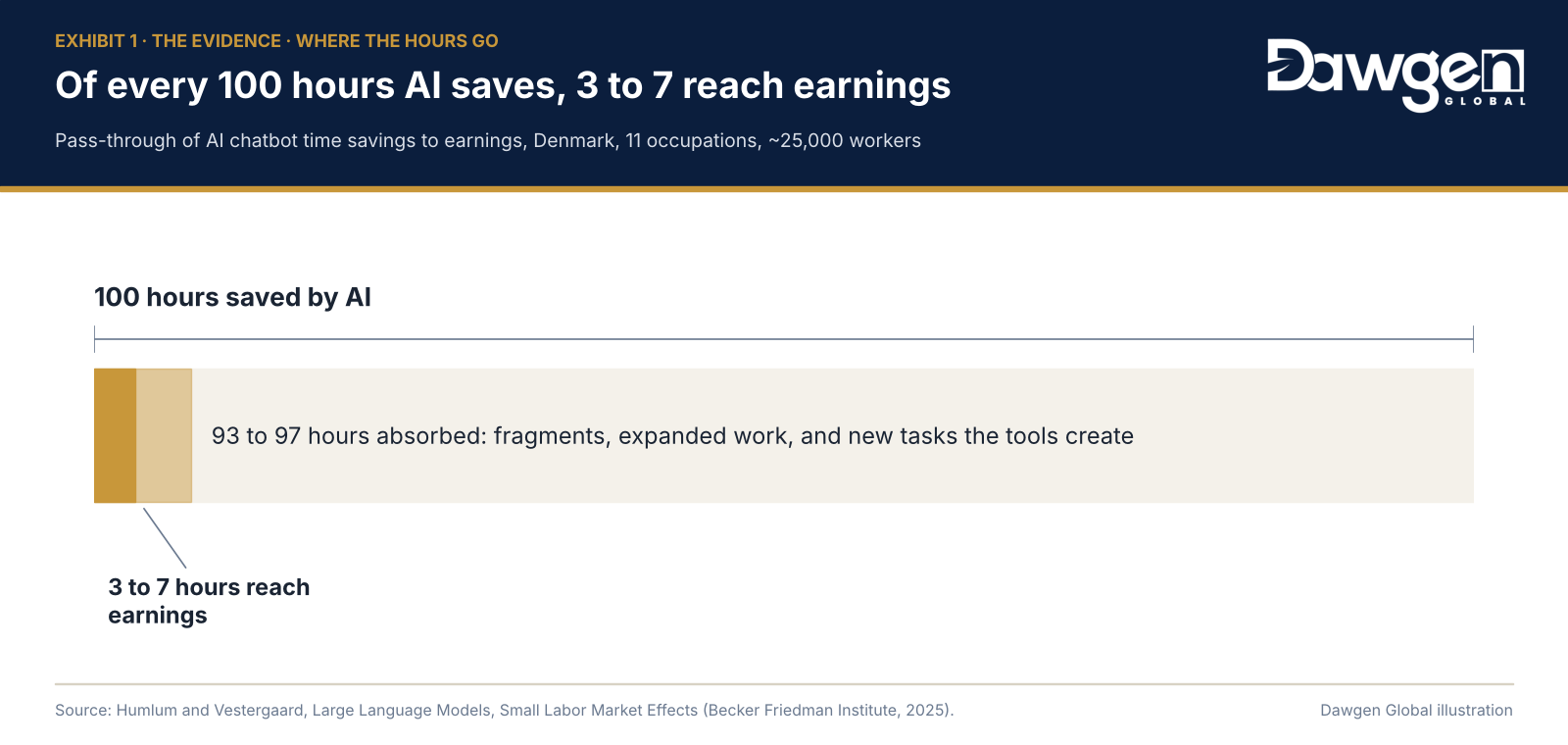
The largest study of where that time actually goes comes from Denmark. Economists at the University of Chicago and the University of Copenhagen matched survey responses from about 25,000 workers in 11 occupations, including accountants, to official payroll and hours records. Users reported saving 2.8% of their work hours. Yet the study found no significant effect on earnings or recorded hours in any occupation, and estimated that only 3–7% of the time saved translated into earnings. The same study found that AI chatbots had created new workloads for 17% of users: some of the time saved was simply spent on new work the tools themselves created.
The pattern repeats at company level. In McKinsey’s 2026 survey, 80% of respondents said AI had improved their personal productivity, while only 37% could attribute any EBIT impact to it.
The lesson is not that AI fails. It is that time saved and money saved are separated by a decision, and most organizations never make it. One more finding from the Danish study points to the remedy: the share of time savings that reached earnings was higher where employers actively encouraged and organized the use of AI. Conversion is a management act, not a technology feature.
Why freed time evaporates
Freed time does not disappear through laziness. It disappears through five ordinary mechanisms, each of which is invisible in a business case and obvious in hindsight.
- It arrives in fragments. AI saves twenty minutes here and forty there, scattered across a week and across a team. Nobody receives a free day; everyone receives a slightly lighter one. Fragments cannot be redeployed unless someone gathers them.
- Work expands to fill it. Reports get longer, emails more polished, analysis more elaborate. The quality may rise, but nobody asked for it and nobody pays more for it.
- The tool creates its own work. Checking outputs, correcting errors, learning prompts and reformatting results all consume part of the time saved, as the Danish study found.
- The budget never hears about it. Headcount plans, overtime allowances and outsourcing contracts are set before the tool arrives and renewed after it, untouched. The saving exists in the office and nowhere in the ledger.
- No one owns the hour. The IT team owns the tool, the business owns the process, finance owns the budget. The freed hour belongs to all three, and therefore to none.
Each of these has the same remedy: decide what the hour becomes before the tool goes live, name who is accountable for that decision, and change the budget line to match.
The Capacity Conversion Rule™: four routes from hours to earnings
Dawgen Global illustration.
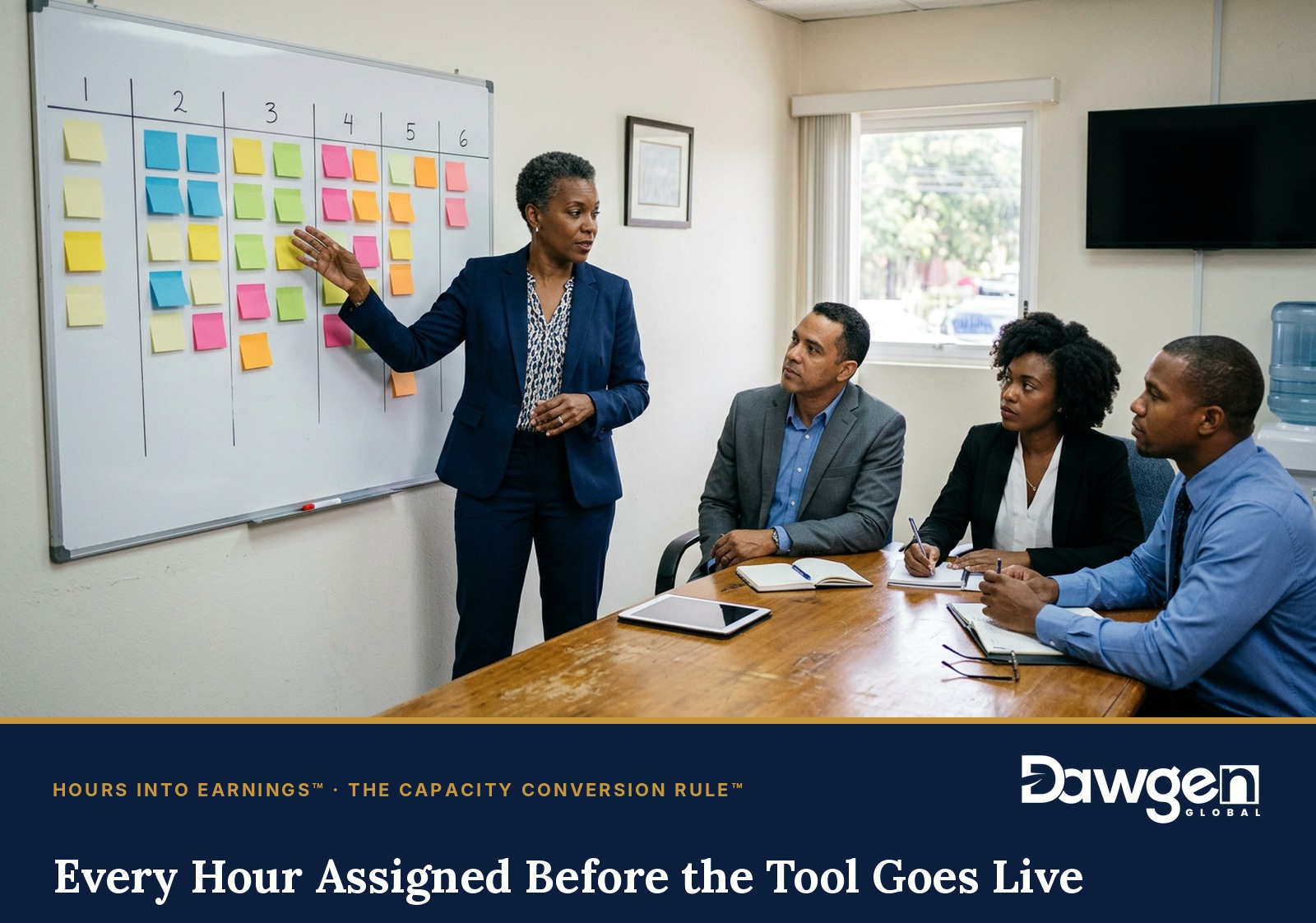
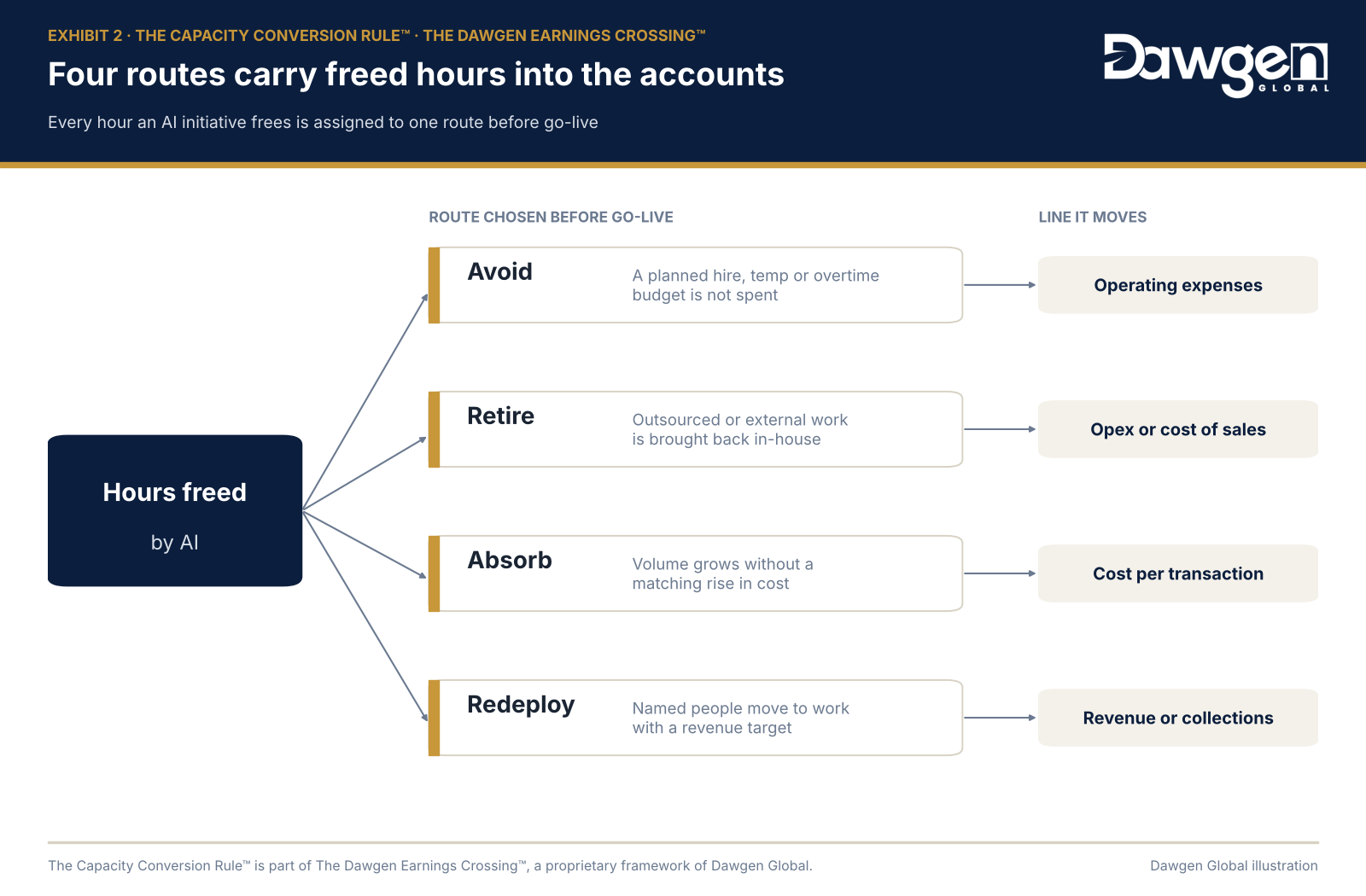
The Capacity Conversion Rule™ is the part of The Dawgen Earnings Crossing™ that governs the third span. It says that every hour an AI initiative is expected to free must be assigned, before deployment, to one of four routes, each of which ends on a named line of the accounts.
| Route | What happens to the freed hours | Line it moves | Evidence it worked |
| Avoid | A planned hire, contractor, temp or overtime budget is not spent | Operating expenses, against budget | Headcount plan and overtime report |
| Retire | External spend is brought in-house or cancelled: outsourcing, agencies, temporary staff, duplicate licences | Operating expenses or cost of sales | Contracts ended; supplier ledger |
| Absorb | Volume grows without a matching rise in cost | Operating margin; cost per transaction | Unit cost trend over four quarters |
| Redeploy | Named people move to work with a revenue or recovery target attached | Revenue, collections or margin | Target set and tracked for the redeployed role |
Three principles keep the rule honest.
One route per initiative, chosen in advance. A business case that says the time will be used “more productively” has chosen no route at all.
A conversion rate, stated and tracked. Not every hour freed can be converted; fragments are hard to gather and some time will go to checking the tool. The rule asks management to state the share it expects to convert, and the register (below) tracks the share it actually did.
The budget changes on the day the tool goes live. If the route is Avoid, the hire comes out of the plan. If it is Retire, the contract end date is set. If it is Absorb, the volume target rises. If it is Redeploy, the new target is issued. A route that does not change a budget line is not a route.
The Caribbean choice: grow into the capacity, do not cut it
Dawgen Global illustration.
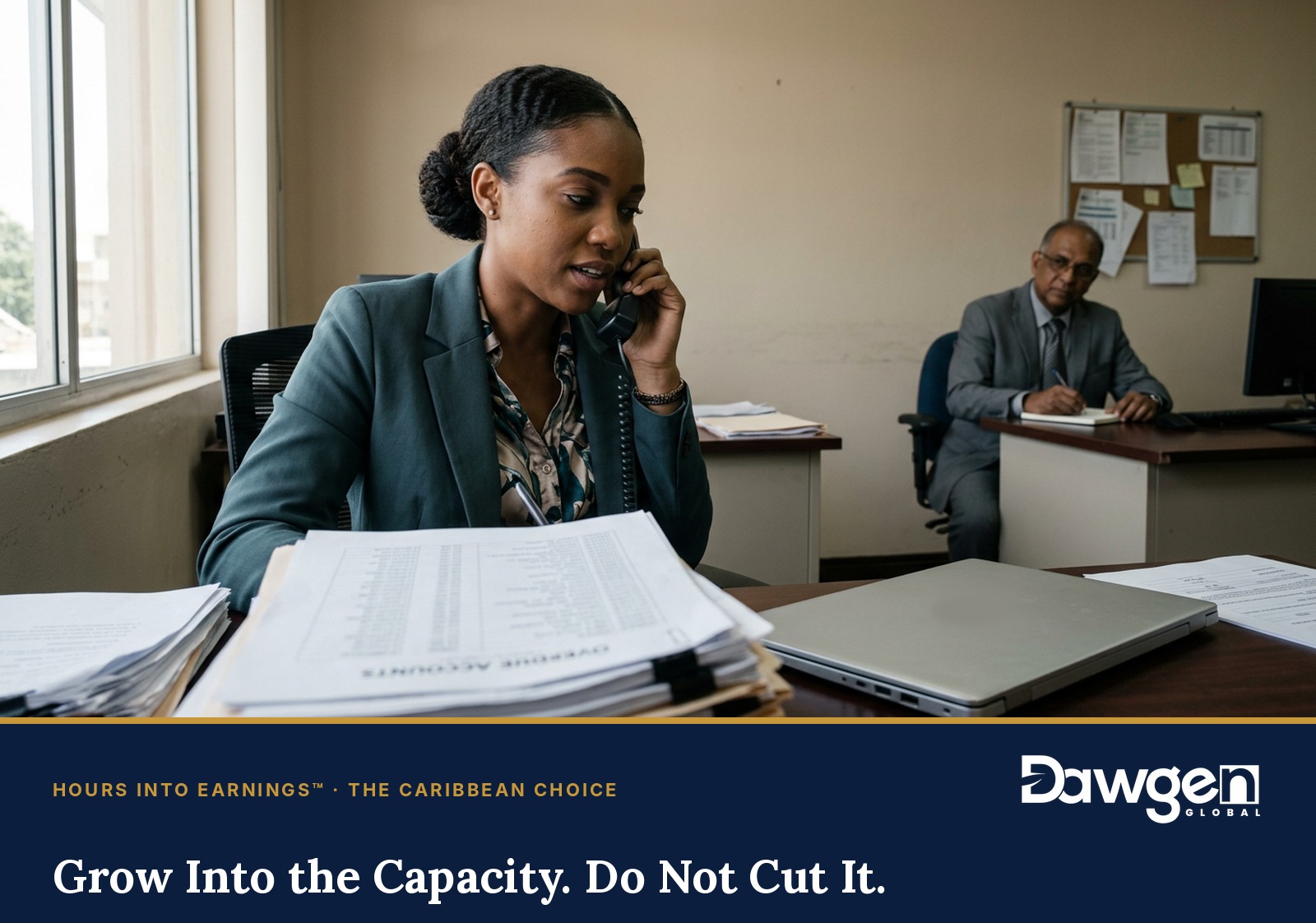
In large economies, the default way to convert freed time is to reduce headcount. In the Caribbean that route is usually the wrong one to lead with, for practical rather than sentimental reasons.
Redundancy is expensive and slow. Statutory severance, notice periods and the cost of rehiring when the business grows again can consume much of the first year’s saving.
Middle teams are already thin. A finance function of six people cannot lose two without losing its institutional memory, its cover for leave, and its ability to close the books when one person is sick.
The social licence matters. In small markets, a company that is seen to replace staff with software pays for it in reputation, in recruitment and sometimes in its relationships with regulators and customers.
The skills are scarce. The people whose time AI frees are often the ones who know the business best. They are worth more redirected than released.
That makes Absorb and Redeploy the natural first routes for most regional businesses. Growth absorbs the capacity: the same team handles 30% more invoices, claims or customers without new hires. Natural attrition does the rest: when someone leaves, the role is not refilled because the capacity already exists. Redeployment turns freed hours into revenue or cash: the accounts payable clerk becomes a collections officer, the analyst who spent Fridays reconciling now spends them on pricing.
Retire is the quiet winner in this region. Many Caribbean businesses pay outside parties for routine work (bookkeeping overflow, data entry, transcription, first-line customer support) that AI can now bring back in-house. Ending those contracts converts freed time into a saving that no one inside the company has to lose a job for.
The arithmetic: the same hours, two very different results
Consider an illustrative composite: a Caribbean financial services company with 60 people in finance, claims and customer service. Each costs the business about J$3.6 million a year, or J$2,000 an hour on a 1,800-hour year. The company deploys AI across these three teams and redesigns the workflows around it. The tools free 8% of working hours: 8,640 hours a year, the equivalent of 4.8 full-time roles, worth J$17.3 million at cost. The tools cost J$4.5 million a year to run.
Without the Capacity Conversion Rule™. No route is chosen. The hours fragment, work expands, the outsourcing contract is renewed. If the company converts a share similar to the 3–7% the Danish study observed, roughly J$0.9 million reaches the accounts. Against J$4.5 million of run costs, the AI programme loses about J$3.6 million a year, while everyone involved sincerely reports that it is saving time.
With the Capacity Conversion Rule™. Before go-live, management assigns the hours:
| Route | Hours assigned | What the company does | Annual EBIT effect (J$m) |
| Retire | 2,400 | Ends the overflow data-entry outsourcing contract | 5.4 |
| Avoid | 1,800 | Removes one planned claims hire from next year’s plan | 3.6 |
| Absorb | 900 | Handles seasonal volume without temporary cover | 1.8 |
| Redeploy | 900 | Moves half a role to collections, cutting bad-debt write-offs | 2.4 |
| Converted | 6,000 (69%) | 13.2 | |
| Less AI run costs | (4.5) | ||
| Net EBIT gain | 8.7 |
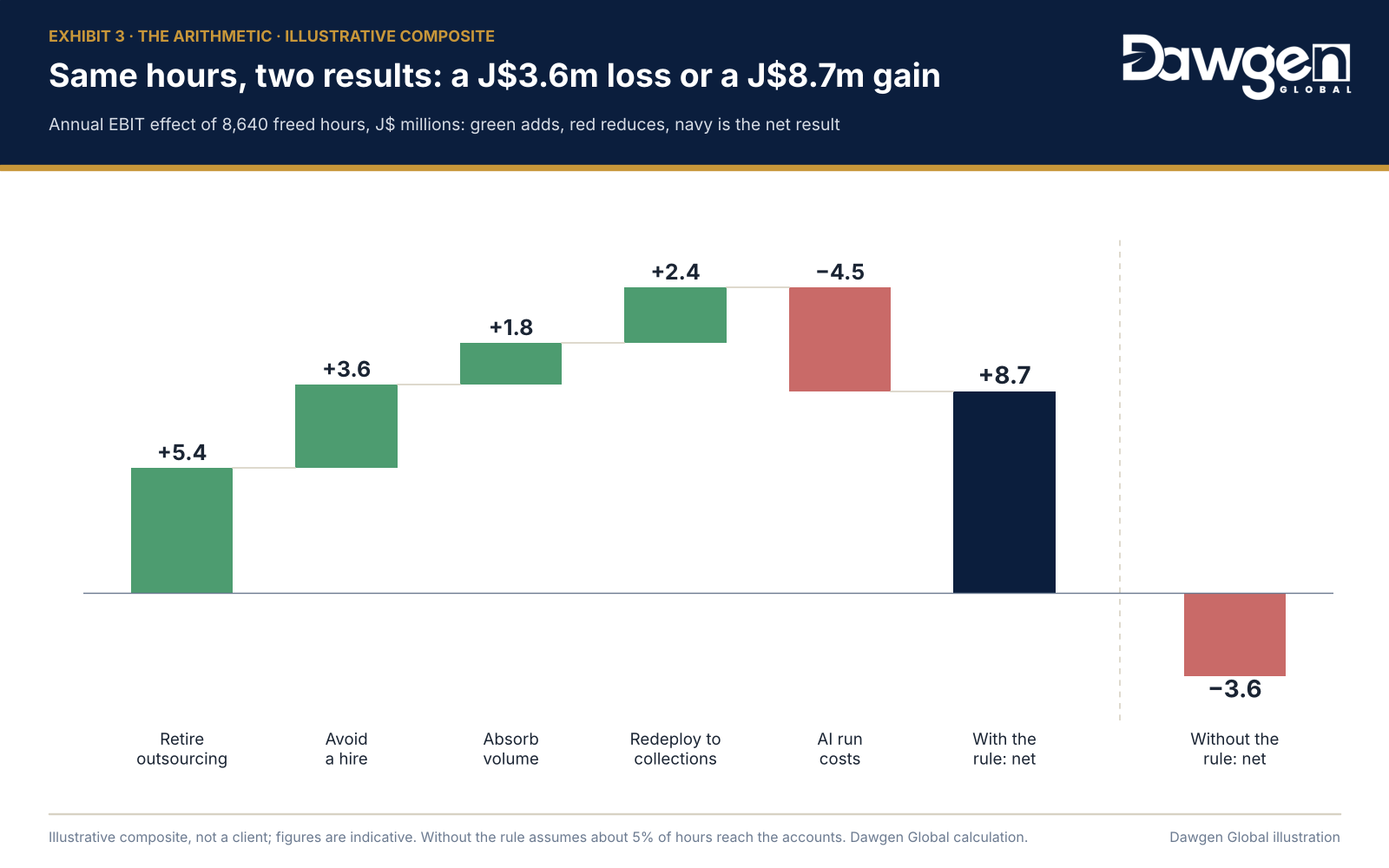 The remaining 2,640 hours, 31% of the total, are deliberately left unconverted: they cover the fragments that cannot be gathered and the time spent checking the tools’ outputs. Stating that number openly is what makes the 69% believable.
Same tools, same people, same hours. The difference between a J$3.6 million loss and a J$8.7 million gain is a one-page decision made before go-live. No one was made redundant: one contract ended, one vacancy was not created, and one person moved to work that brings cash in.
The composite is illustrative and does not describe any client. Figures are indicative.
The Capacity Conversion Register: one page, one owner per hour

Dawgen Global illustration.
The rule becomes practical through a single page that management completes before any AI tool goes live and reviews every month after. It is a working extract of the AI Earnings Register™ introduced with the framework.
| Column | What goes in it |
| Initiative | The AI tool or workflow change |
| Hours expected to be freed | Per year, from a measured baseline, not an estimate |
| Route | Avoid, Retire, Absorb or Redeploy, one only |
| Budget line changed | The specific line, and the date it changes |
| Owner | A named business manager, not the IT team |
| Target conversion rate | The share of freed hours expected to reach the ledger |
| Actual conversion rate | Reported monthly from the management accounts |
| Evidence | The document that proves it: ended contract, revised headcount plan, unit-cost report, collections target |
Two habits make the register work. First, the board sees the actual conversion rate, not the hours saved; hours are an input, conversion is the result. Second, an initiative that misses its conversion target for two consecutive quarters is re-scoped or stopped, and its run costs are cut. That single discipline is what separates organizations that report AI productivity from those that report AI earnings.
Three questions to ask this week
Put three questions to the managers responsible for your AI initiatives:
- For each AI tool we run, how many hours a year does it free, and how was that measured?
- Which of the four routes (Avoid, Retire, Absorb or Redeploy) did we choose for those hours, and which budget line changed as a result?
- What share of the hours freed last quarter can you show me in the management accounts?
If the answer to the third question is “we don’t track that”, your organization is saving time and spending the saving without noticing. That is the most common position in the region, and the easiest to fix.
The next article, Start Where the Cost Is Countable, turns to the back office: why finance, compliance and administration are the fastest place to make the first conversion, and how to choose the first three workflows to redesign.
Where are your AI hours going?
Dawgen Global’s Earnings Crossing Scan™ measures, in three to four weeks, how many hours your AI tools are freeing, what share of them is reaching the accounts, and which of the four conversion routes fits each initiative. It ends with a first draft of your Capacity Conversion Register and the three changes that would move your numbers first. It is delivered by our Forward-Deployed AI Transformation Group, drawing on the firm’s accounting, HR advisory, risk and technology specialists across the Caribbean. Fees are customized to each client’s circumstances and agreed deliverables.
Request a scoping conversation: info@dawgen.global · (876) 926-5210 · US 855-354-2447 · dawgen.global
Dawgen Global — Big Firm Capabilities. Caribbean Understanding.
About Dawgen Global
Dawgen Global is an independent, integrated multidisciplinary professional services firm headquartered at 47 Trinidad Terrace, New Kingston, Jamaica, serving more than 15 territories across the Caribbean. Founded and led by Dr. Dawkins Brown, Executive Chairman, the firm is independent and not affiliated with any international network. It delivers a full suite of professional services under one roof: audit and assurance; tax advisory; IT and digital transformation; risk management; cybersecurity; actuarial and insurance regulatory advisory; HR advisory; mergers and acquisitions; corporate recovery; business advisory and strategy; accounting BPO and virtual CFO services; and legal process outsourcing.
The proposition is simple: big-firm capability without the big-firm price. Dawgen Global’s integrated approach is built for the specific complexities and opportunities of the Caribbean market, helping organizations make sharper, better-informed decisions that drive measurable progress.
To explore a partnership, reach out:
- Website: dawgen.global
- Email: info@dawgen.global
- WhatsApp (Global): +1 555-795-9071
- Caribbean offices: +1 876-665-5926 | +1 876-929-3670 | +1 876-926-5210