

The new presentation standard takes effect on 1 January 2027. For most Caribbean reporters, the work should already be under way.
On 1 January 2027, the way Caribbean companies present their profit changes. IFRS 18, Presentation and Disclosure in Financial Statements, replaces IAS 1 for annual periods beginning on or after that date. It applies to every entity that reports under full IFRS: listed companies on every regional exchange, banks, insurers, pension plans, credit unions, state-owned enterprises, subsidiaries reporting to overseas parents, and private companies whose lenders and investors require IFRS statements.
That is ten weeks from today. And regulators have started asking whether companies are ready.
Regulators are asking
On 16 October 2026, the Regulatory and Market Oversight Division of the Jamaica Stock Exchange wrote to all listed companies. It reminded them of the effective date and asked each one for a brief update by 30 October. The update is to cover three things:
- whether preparations have started, and how far they have got;
- what implementation or transition challenges have emerged; and
- whether the company expects any difficulty meeting its filing deadlines during the transition.
The letter is addressed to Jamaican listed companies. But the three questions should be put to every finance team in the region, because the obligations behind them are the same wherever IFRS applies. Stock exchanges, securities commissions, central banks and insurance supervisors across the Caribbean all receive IFRS financial statements. A company that cannot answer those three questions with confidence today has a problem, whether or not its own regulator has written yet.
What actually changes
IFRS 18 does not change how anything is recognised or measured. Revenue, assets, liabilities and profit are the same numbers under IFRS 18 as under IAS 1. What changes is how they are presented and explained. That is precisely why the work is easy to underestimate. There are four main changes.
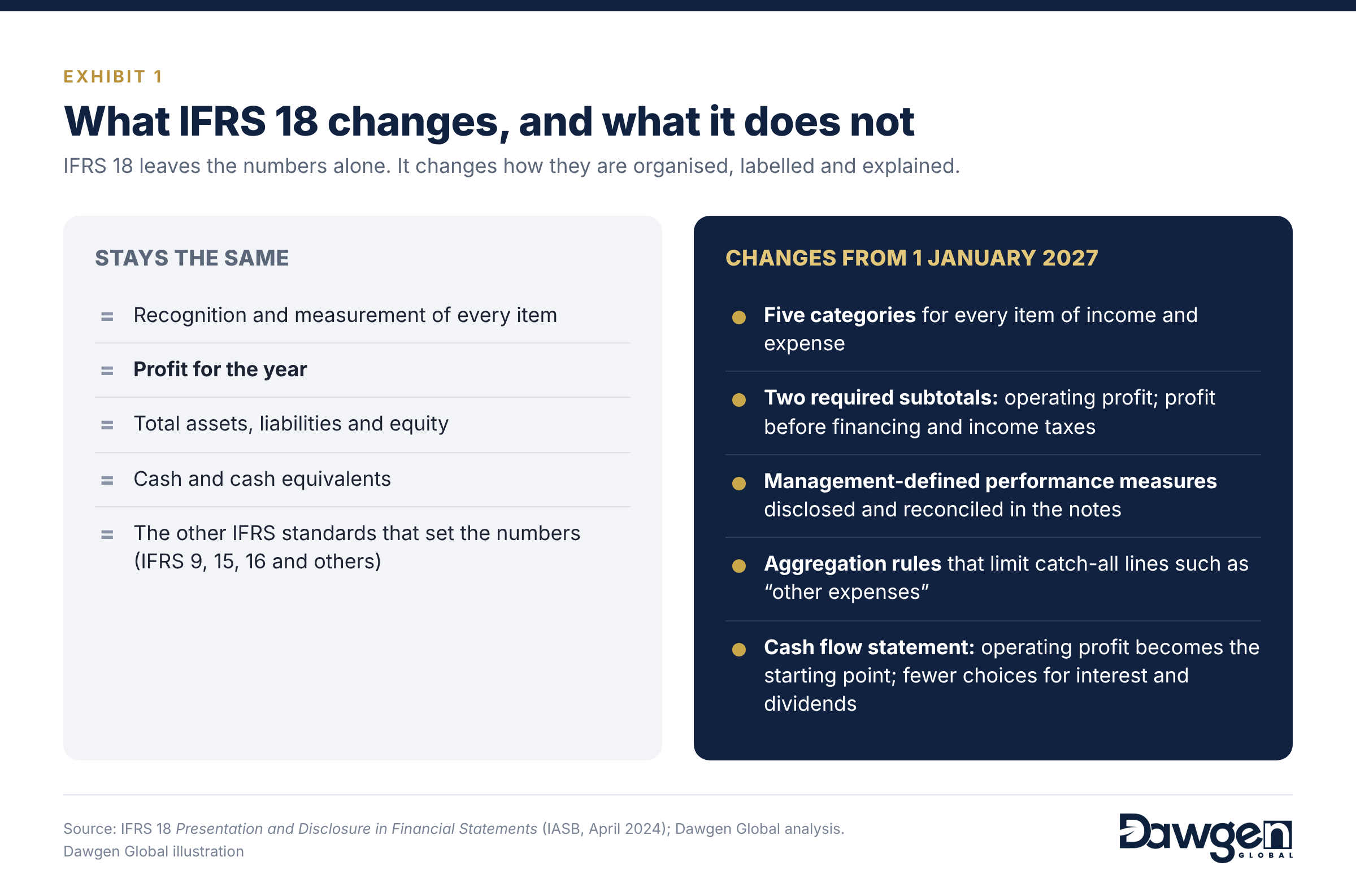
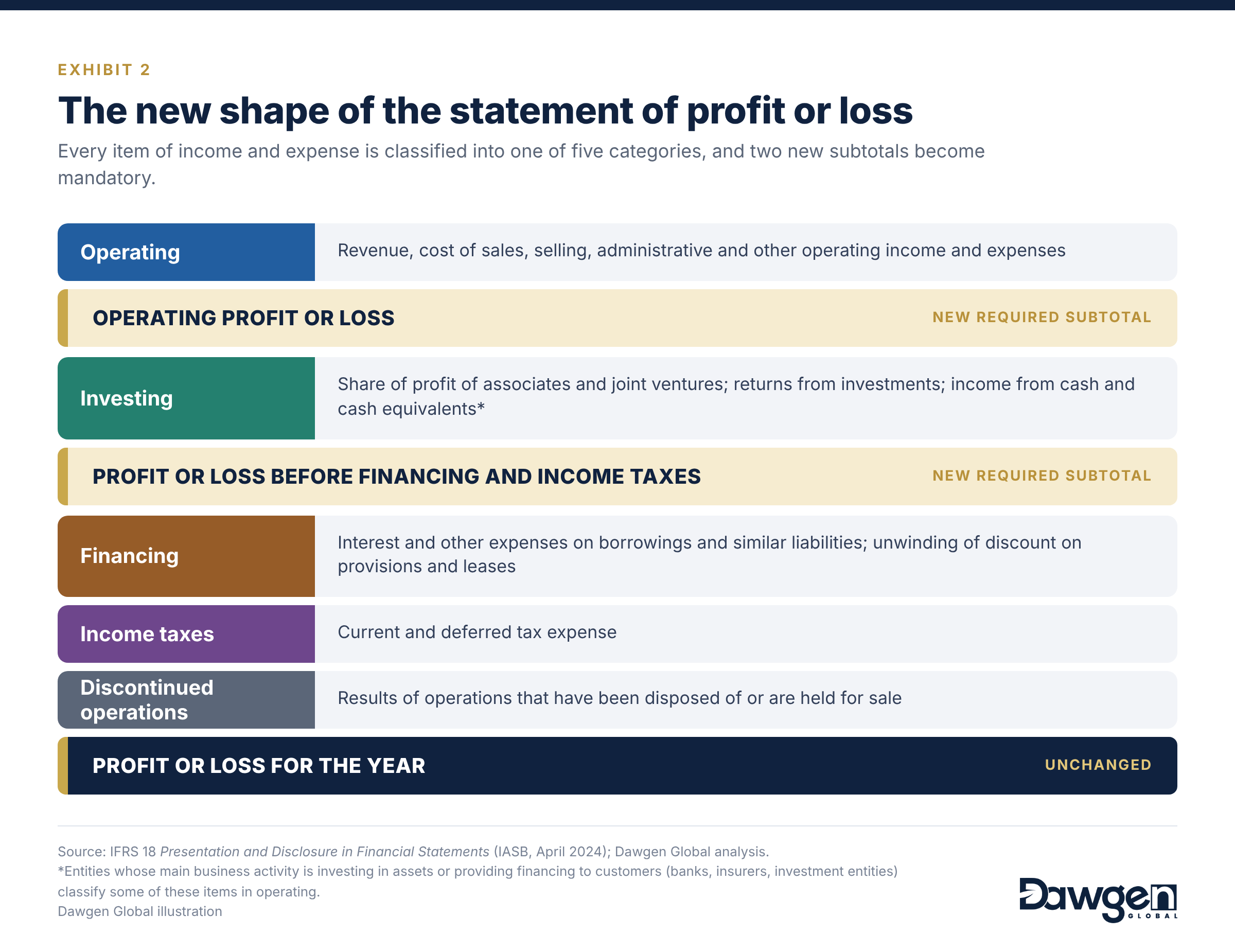
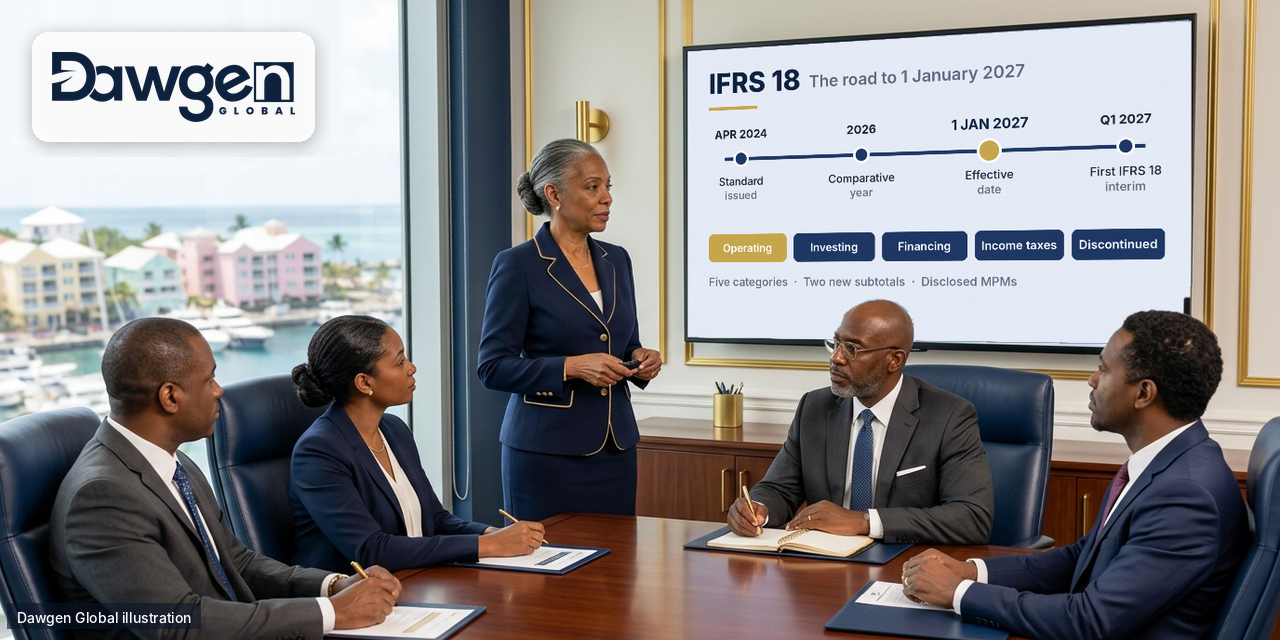
- A structured statement of profit or loss. Every item of income and expense must be classified into one of five categories:
- operating;
- investing;
- financing;
- income taxes; and
- discontinued operations.
Two new subtotals become mandatory: operating profit or loss, and profit or loss before financing and income taxes. For the first time, “operating profit” has a defined meaning. A Caribbean company’s operating profit will be comparable with its competitor’s, and with a company in Toronto or London.
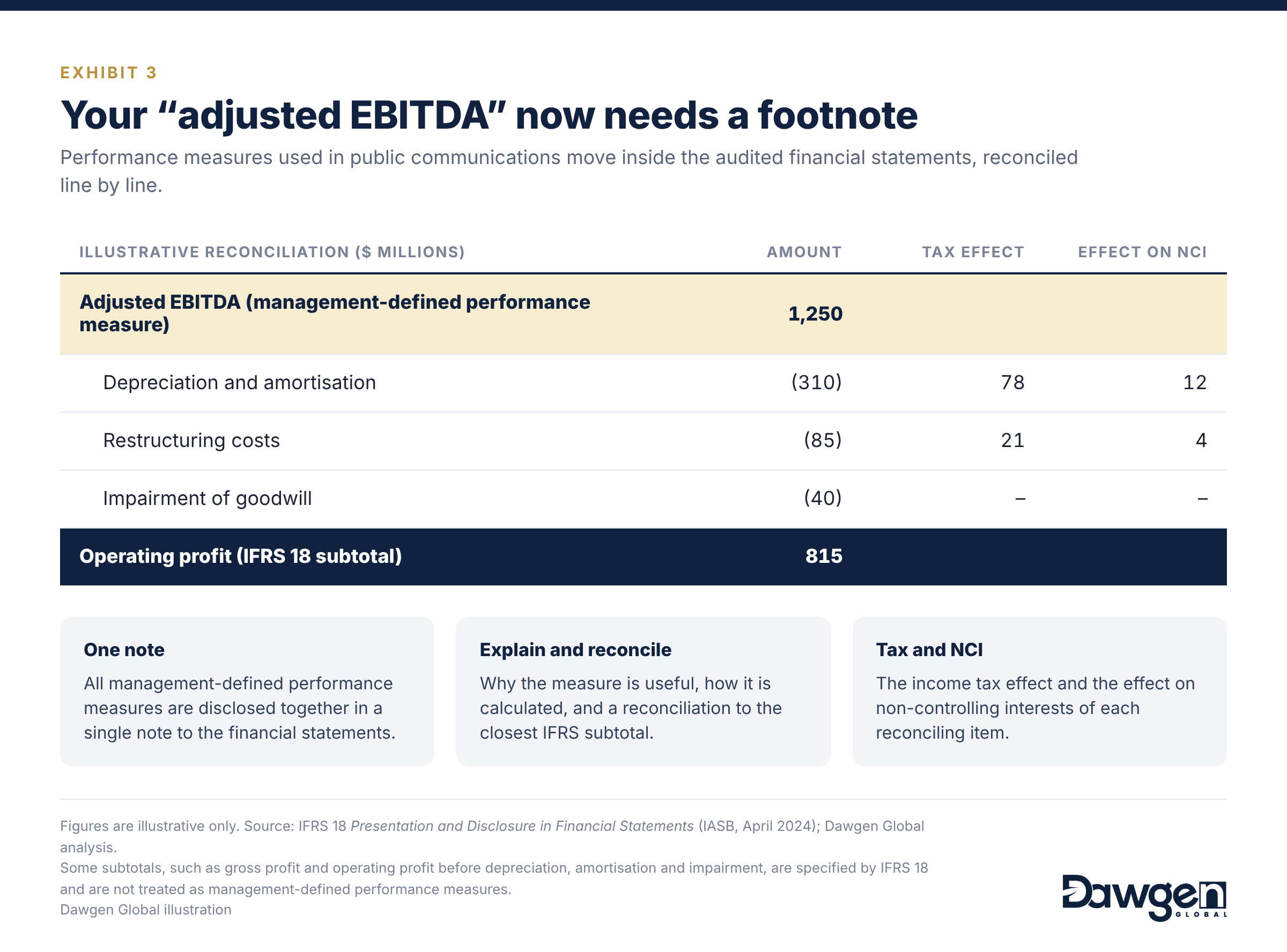
- Management-defined performance measures. Many companies talk about performance in their own terms in investor presentations, chairman’s statements, annual report narratives and press releases. Typical examples are adjusted EBITDA, underlying profit and core earnings. Where those measures are subtotals of income and expenses, IFRS 18 brings them inside the audited financial statements. Each one must be:
- disclosed in a single note;
- explained; and
- reconciled to the nearest IFRS subtotal, with the tax and non-controlling interest effect of each reconciling item.
Measures that boards have used informally for years will now face audit.
- Aggregation and disaggregation. The standard sets principles for when items must be grouped and when they must be separated. The large “other expenses” line, familiar from many Caribbean income statements, will come under pressure. Companies that present expenses by function must also disclose certain expenses by nature in the notes, including:
- depreciation;
- amortisation;
- employee benefits;
- impairment; and
- inventory write-downs.
- Consequential changes to the cash flow statement. Under the indirect method, operating profit becomes the required starting point. For most companies, the existing choices on where to classify interest and dividends are removed.
The trap: 2026 is already the comparative year
IFRS 18 must be applied retrospectively. A company with a 31 December year-end will publish its first IFRS 18 annual financial statements for 2027. Those statements must show 2026 comparatives restated into the new structure.
The 2026 financial year is now nearly over. If the general ledger, the chart of accounts and the management information do not capture data in the way IFRS 18 categories require, the restatement will be done after the fact, by hand, under deadline pressure. Companies with other year-ends have a little more time, but face the same requirement for their own comparative year.
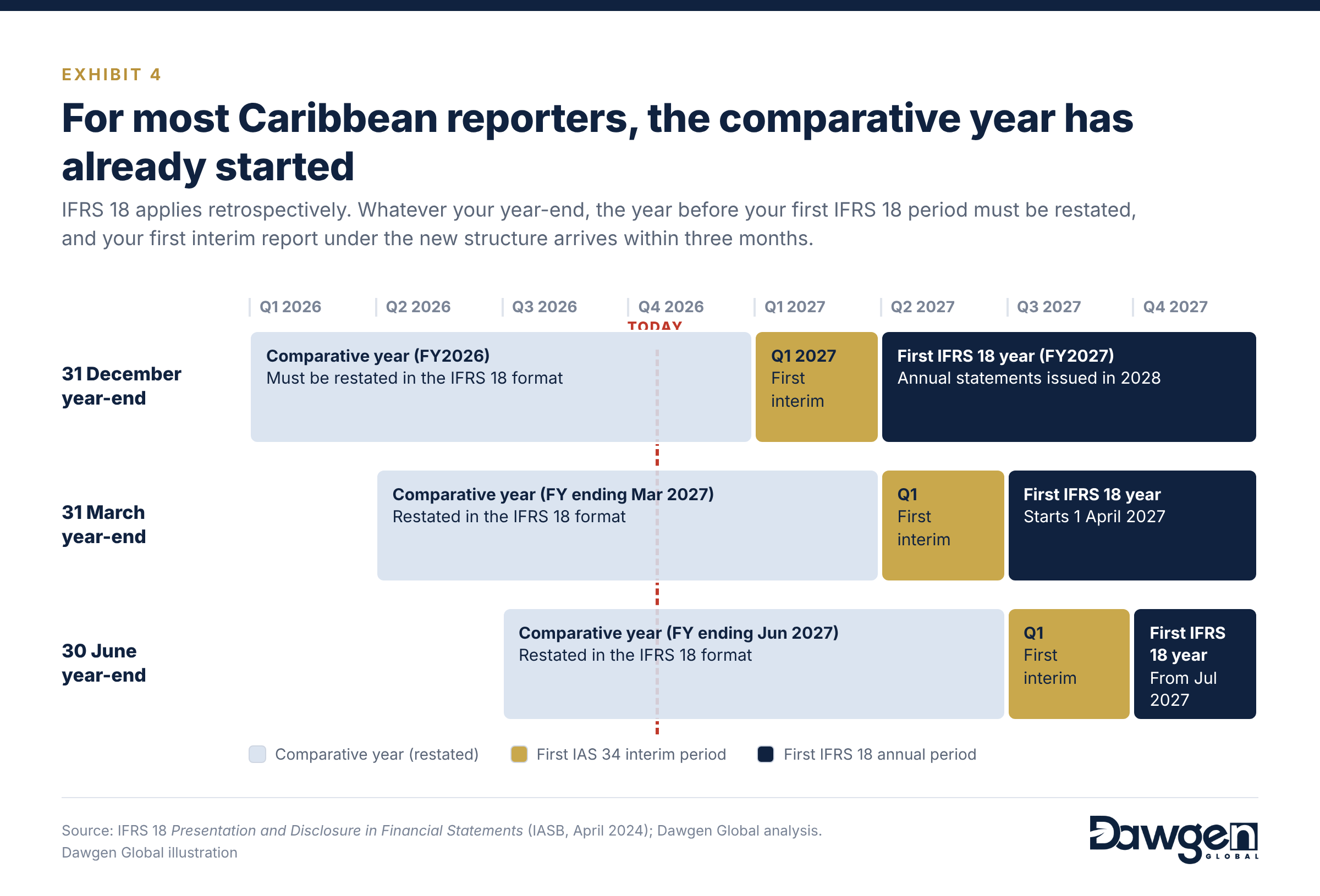
The pressure arrives earlier than the annual report. A December year-end company’s first quarterly report for 2027 already falls within the first IFRS 18 reporting period. It must follow the new structure, with restated comparatives. For listed companies, that is a public document filed under a regulatory deadline in the second quarter of 2027. Errors will be visible to the market long before the first IFRS 18 annual audit is complete.
Who is not affected
Precision matters here, and not every entity needs to act. Entities that report under the IFRS for SMEs Accounting Standard are not directly affected by IFRS 18. Many smaller private companies in the region fall into this group. If your company uses IFRS for SMEs, this transition is not your immediate concern. Confirm with your adviser which framework your financial statements actually follow before deciding either way.
Why this is not just an accounting exercise
The new subtotals and disclosures reach well beyond the finance department:
- Loan covenants are often written around EBITDA, operating profit or interest cover. When the definition of operating profit changes, covenant calculations may move even though the business has not.
- Bonus schemes and incentive plans tied to “operating profit” may need to be re-examined.
- Regulatory returns, particularly for banks and insurers, may draw on line items that are being reclassified.
- Financial institutions face particular questions. Banks, insurers and investment entities must assess whether investing or providing financing to customers is a main business activity, because the answer changes how income and expenses are classified.
- Board communication. The performance story told in the chairman’s statement must now reconcile, line by line, to audited numbers.
For these reasons, we describe IFRS 18 as a governance matter as much as a reporting one. The audit committee should be asking about it now, not in the third quarter of 2027.
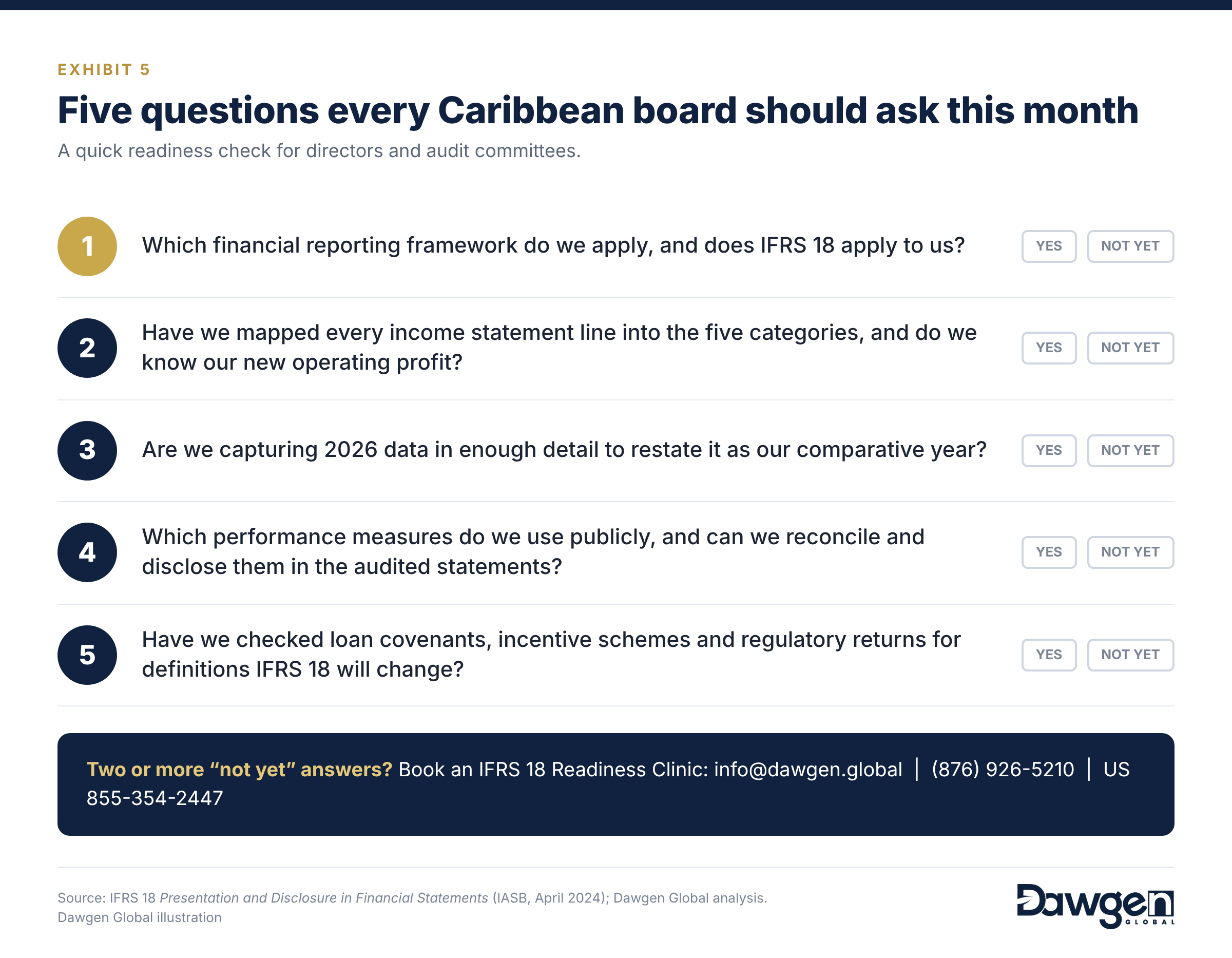
Five questions every Caribbean board should ask this month
- Which financial reporting framework do we apply, and does IFRS 18 apply to us?
- Have we mapped our current income statement lines into the five IFRS 18 categories, and do we know what our new operating profit figure will be?
- Are we capturing 2026 data at the level of detail needed to restate it as our comparative year?
- Which performance measures do we use publicly, and are we prepared to reconcile and disclose them in the audited statements?
- Have we checked our loan agreements, incentive schemes and regulatory returns for definitions that IFRS 18 will change?
If the honest answer to two or more of these is “not yet”, your organisation is not alone. But it is behind.
How Dawgen Global can help
Dawgen Global has followed IFRS 18 since the IASB completed it in April 2024. Our earlier insights cover the standard’s architecture, its mandatory subtotals, its industry impact and the technology needed to support it. We are now working with organisations across more than 15 Caribbean territories to move from awareness to execution. We offer four services:
- IFRS 18 Readiness Clinic. A focused working session with your finance leadership to establish where you actually stand. On request, we help you prepare a readiness update for your board, auditors or regulator.
- IFRS 18 Readiness Diagnostic. A structured gap assessment covering:
- classification of every income statement line into the new categories;
- an inventory of your management-defined performance measures;
- the effects on your covenants and contracts; and
- a practical transition roadmap.
- Transition Programme. End-to-end support covering:
- restated comparatives;
- redesigned financial statement templates and notes;
- chart of accounts and system mapping; and
- the cash flow statement changes.
- Board and Audit Committee Briefings. Concise sessions that equip directors to oversee the transition and to challenge management’s readiness.
Ten weeks is enough time to get organised. It is not enough time to start from nothing in the first quarter of 2027.
Book your IFRS 18 Readiness Clinic today.
Email [email protected] or call (876) 926-5210 | US 855-354-2447 | dawgen.global
Further reading from Dawgen Global: IFRS 18: A New Era in Financial Statement Presentation and Disclosure · From IAS 1 to IFRS 18: The Evolution of Presentation and Disclosure · The New Profit or Loss Structure: Understanding IFRS 18’s Mandatory Subtotals · The Impact of IFRS 18 on Key Industries · IFRS 18 Compliance Roadmap: Practical Steps for a Smooth Transition
Dawgen Global is an independent, integrated multidisciplinary professional services firm serving businesses across more than 15 Caribbean territories. Big Firm Capabilities. Caribbean Understanding.
About Dawgen Global
Dawgen Global is an independent, integrated multidisciplinary professional services firm headquartered at 47 Trinidad Terrace, New Kingston, Jamaica, serving more than 15 territories across the Caribbean. Founded and led by Dr. Dawkins Brown, Executive Chairman, the firm is independent and not affiliated with any international network. It delivers a full suite of professional services under one roof: audit and assurance; tax advisory; IT and digital transformation; risk management; cybersecurity; actuarial and insurance regulatory advisory; HR advisory; mergers and acquisitions; corporate recovery; business advisory and strategy; accounting BPO and virtual CFO services; and legal process outsourcing.
The proposition is simple: big-firm capability without the big-firm price. Dawgen Global’s integrated approach is built for the specific complexities and opportunities of the Caribbean market, helping organizations make sharper, better-informed decisions that drive measurable progress.
To explore a partnership, reach out:
- Website: dawgen.global
- Email: [email protected]
- WhatsApp (Global): +1 555-795-9071
- Caribbean offices: +1 876-665-5926 | +1 876-929-3670 | +1 876-926-5210