

Article 2 of THE NEW BOTTOM LINE™, Dawgen Global’s series on IFRS 18 across the Caribbean. The cheapest time to prepare your IFRS 18 comparatives is before the 2026 books close.
Most finance teams think of IFRS 18 as a 2027 project. For a company with a 31 December year-end, that is a year too late. IFRS 18 applies retrospectively. The first annual financial statements prepared under it must present the prior year restated in the new format. For December year-ends, that prior year is 2026: the year you are closing right now.
Restatement is not a recalculation. IFRS 18 changes no numbers. But it does change how every item of income and expense is classified, and some of those classifications depend on detail your ledger may not hold. If the detail is captured as the 2026 books close, restatement is a mapping exercise. If it is not, someone will be reconstructing it from invoices and spreadsheets in March 2027, with a quarterly filing deadline approaching.
This article sets out what that detail is, and what to do about it in the ten weeks left before the year ends.
Four restatements, not one
The annual comparative is only the start. A listed company that reports quarterly will file its first IFRS 18 interim report for the quarter to 31 March 2027. That report must use the new headings and subtotals, and its comparative is the first quarter of 2026, restated. The same applies to the half-year and nine-month reports that follow.
So a December year-end reporter faces four restatements of 2026, not one:
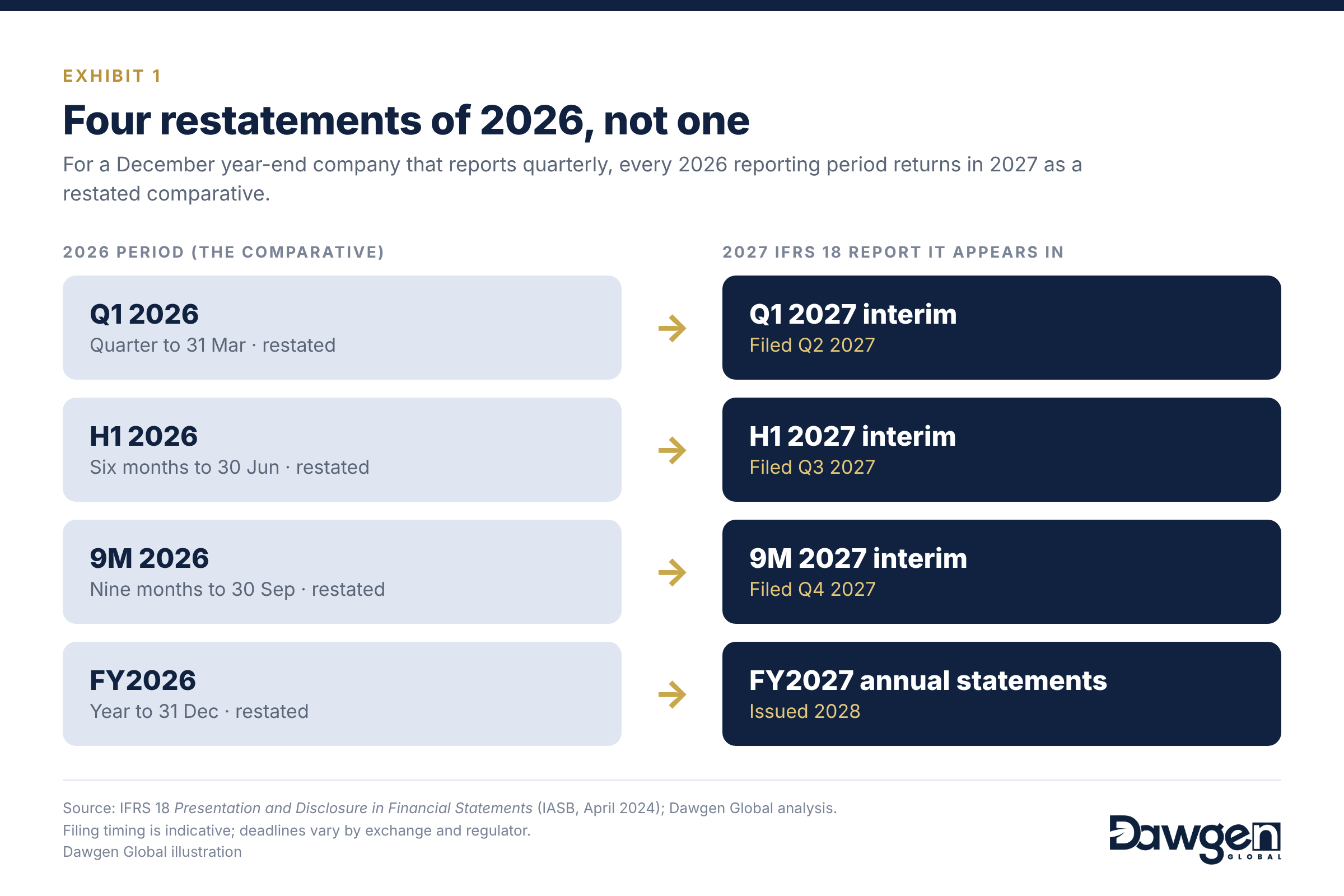
The first of these lands within weeks of the 2026 audit. It is a public document, prepared under a regulatory deadline, while the finance team is still closing the year. In the first annual statements, IFRS 18 also expects you to show how each line in the restated comparative statement of profit or loss reconciles to what you previously reported under IAS 1. Readers, auditors and regulators will see exactly what moved.

Companies with March, June or September year-ends face the same sequence one, two or three quarters later. The principle does not change: the year now under way, or the next one to start, is your comparative year.
Where the lines move
Most Caribbean income statements were built around IAS 1, which left the middle of the statement largely to management. Lines such as “other income”, “finance costs” and “finance income” often hold items that IFRS 18 now sends to different categories. Exhibit 2 shows where common items land for a company whose main business is not investing or lending.
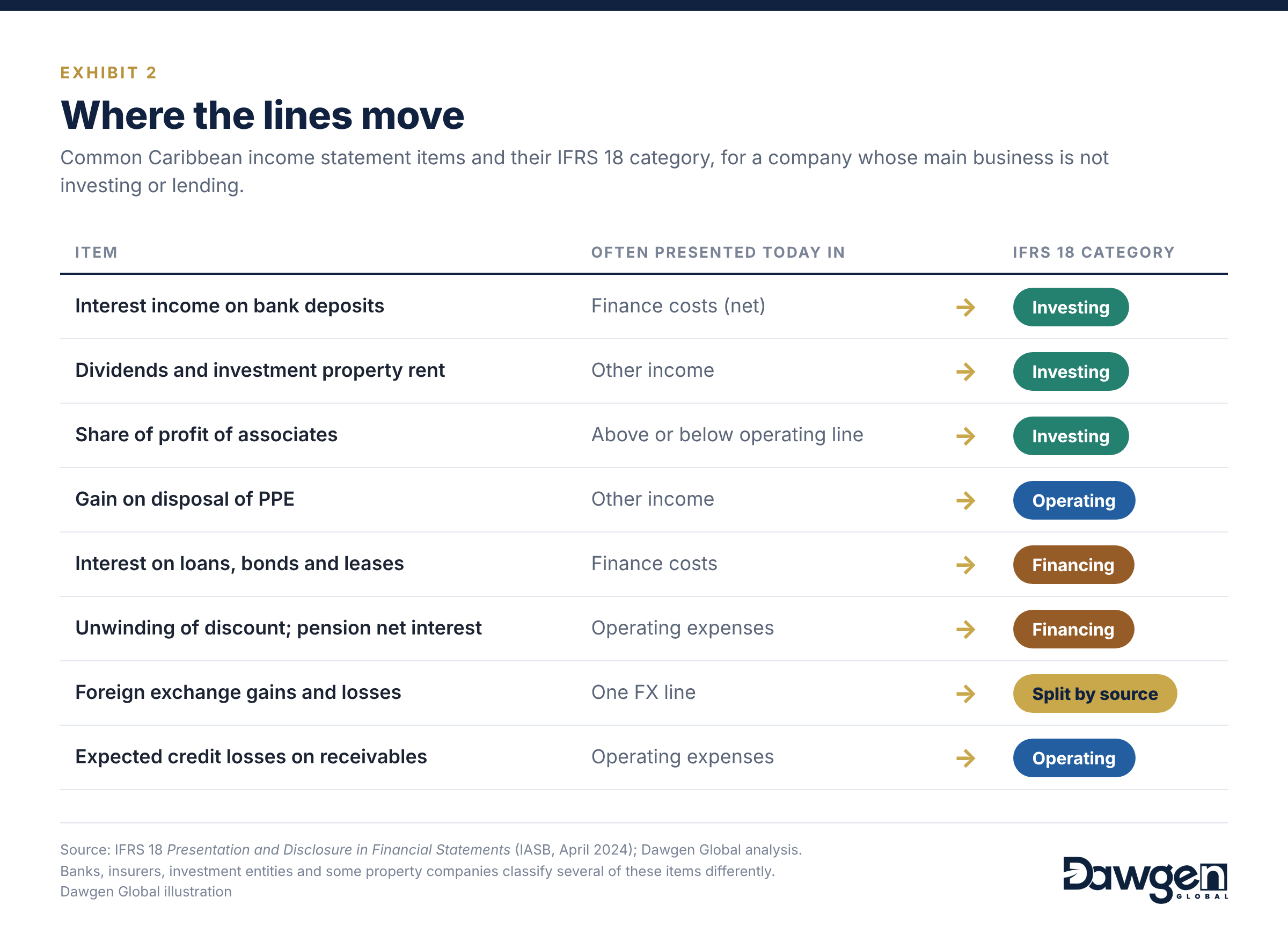
Banks, insurers, investment entities and some property companies whose main business is investing or providing finance follow different rules for several of these items. For them, the assessment of their main business activity comes first, and it should be documented now.
The data you must capture before 31 December
Four kinds of detail decide whether your 2026 restatement is a mapping exercise or a reconstruction.
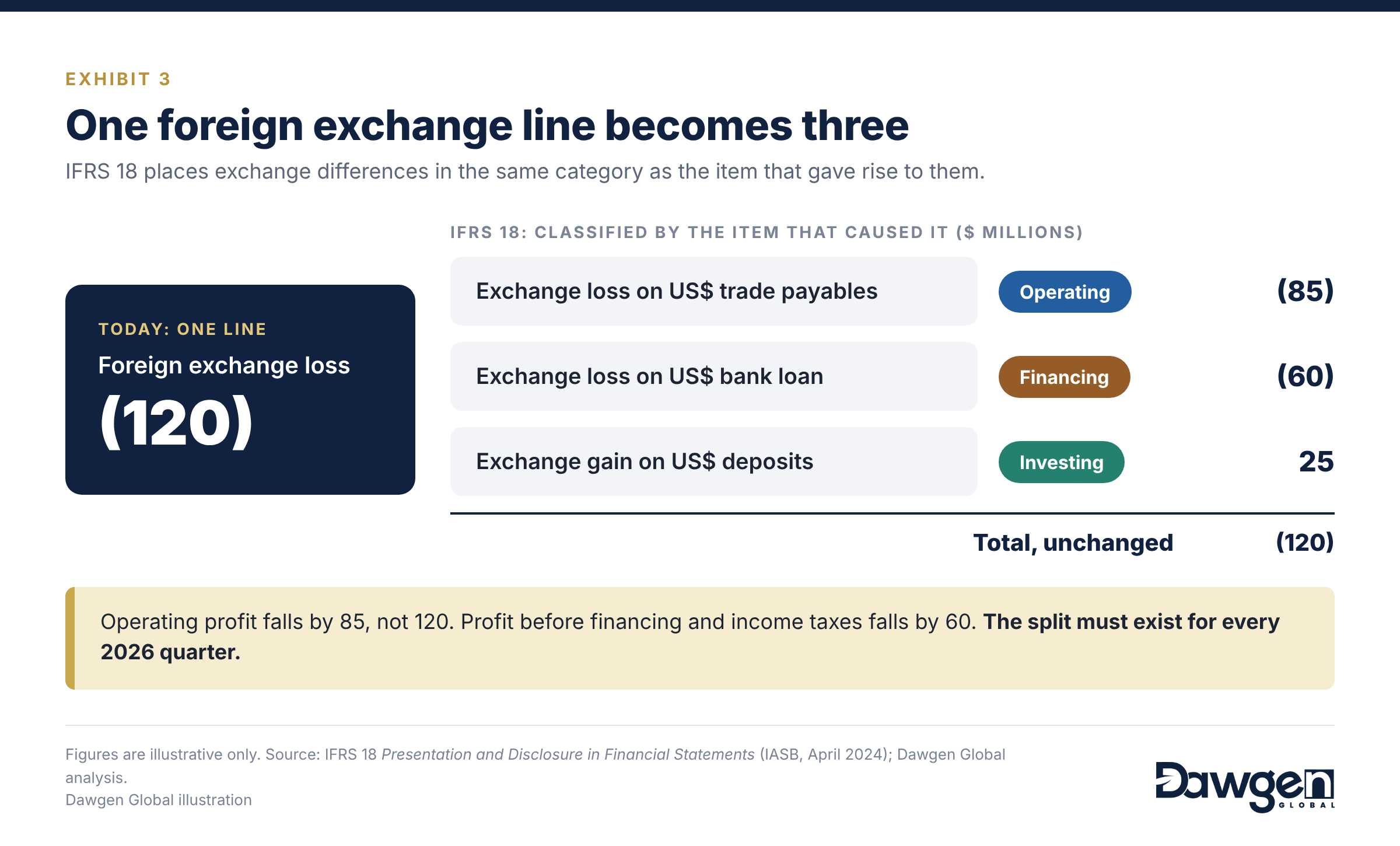
- Foreign exchange, by source. IFRS 18 classifies foreign exchange differences in the same category as the item that gave rise to them. Exchange differences on US-dollar trade payables are operating. Those on a US-dollar loan are financing. Those on a foreign-currency deposit are investing. In economies where many balances are held in US dollars, one “foreign exchange gain/loss” account can be a material number. If it is not split by source as transactions are recorded, it must be rebuilt from revaluation workings, quarter by quarter.
- Expenses by nature, where you present by function. A company that presents cost of sales, distribution and administrative expenses must disclose in the notes the amounts of depreciation, amortisation, employee benefits, impairment and inventory write-downs included in each of those lines. Many ledgers record total payroll and total depreciation but not their allocation across functions. That allocation needs to exist for 2026.
- Your 2026 performance measures. Collect every subtotal you used in 2026 investor presentations, chairman’s statements, annual reports and press releases: adjusted EBITDA, underlying profit, core earnings, recurring profit. Each one that qualifies as a management-defined performance measure will need a 2026 comparative reconciliation, including the tax and non-controlling interest effect of each adjusting item. The definitions and calculations should be documented now, while the people who prepared them are still at hand.
- Cash flow mapping. Under the indirect method, the cash flow statement will start from operating profit rather than profit before tax. Interest and dividends paid and received move to set categories for most companies. The 2026 cash flow statement will be restated too, so the underlying cash movements need to be traceable to the new categories.
None of this requires a new system before year-end. In most cases it requires a handful of new general ledger accounts or analysis codes, set up before the December close, and a clear instruction to the people posting the entries.

A ten-week plan to year-end
Ten weeks remain before 31 December. That is enough for a December year-end company to put its 2026 data in order, if the work starts now.
- Weeks 1–2 (to 7 November): confirm and organise. Confirm the reporting framework and that IFRS 18 applies. Assess and document your main business activity. Name an owner, and brief the audit committee.
- Weeks 3–4 (to 21 November): map the accounts. Assign every profit or loss account in the chart of accounts to one of the five categories. Flag the accounts that mix categories, such as foreign exchange, other income and finance costs.
- Weeks 5–6 (to 5 December): fix the ledger. Open the new accounts or analysis codes. Set allocation keys for expenses by nature. Reclassify January to September 2026 in a working file, quarter by quarter.
- Weeks 7–8 (to 19 December): measures and auditors. Complete the inventory of performance measures used in 2026. Agree the restatement approach and evidence with your auditors. Draft the restated first quarter of 2026.
- Weeks 9–10 (to 31 December): close under the new map. Post December under the new structure. Produce a dry-run restated 2026 statement of profit or loss. Report readiness to the board.
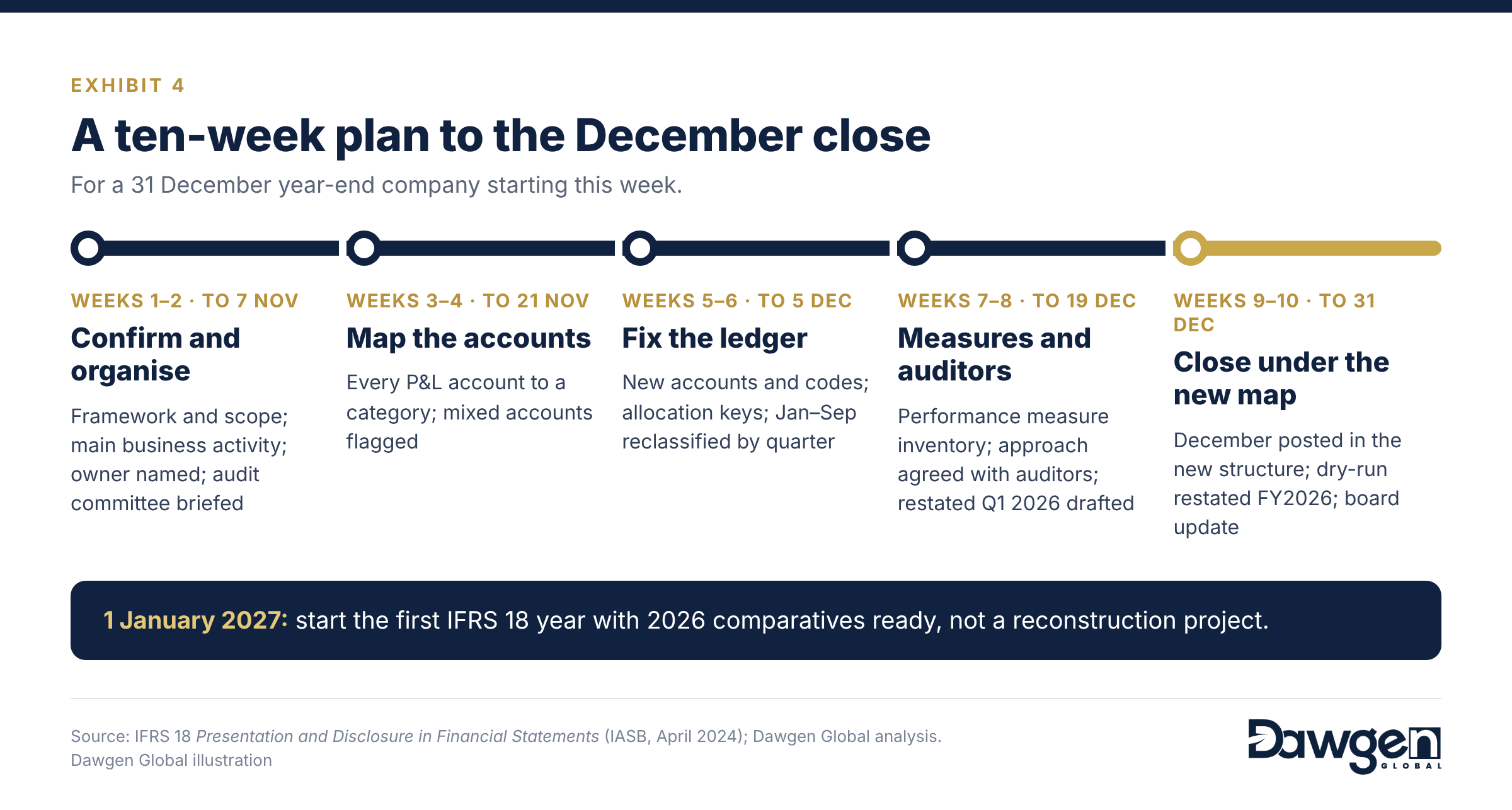
A company that completes these steps starts 2027 with its comparatives ready. One that does not starts 2027 with a reconstruction project and a quarterly deadline.
How Dawgen Global can help
Dawgen Global works with finance teams across more than 15 Caribbean territories on the practical side of IFRS 18: the ledger, the data and the restated numbers.
- 2026 Comparative Year Sprint. A focused engagement before the December close: account-by-account category mapping, new ledger accounts and analysis codes, foreign exchange and expense-by-nature splits, and reclassification worksheets for each 2026 quarter.
- IFRS 18 Readiness Diagnostic. A structured gap assessment and transition roadmap, including the main business activity assessment and an inventory of your performance measures.
- Restated Comparatives and Interim Support. Preparation of the restated 2026 statement of profit or loss, the IAS 1 reconciliation, and your first IFRS 18 interim report.
- Board and Audit Committee Briefings. Concise sessions so directors can oversee the transition with confidence.
The 2026 books close once. The time to shape the data is before they do.
Book your IFRS 18 Readiness Clinic today.
Email [email protected] or call (876) 926-5210 | US 855-354-2447 | dawgen.global
Previously in this series: Ten Weeks to IFRS 18: Where Caribbean Companies Stand. Next: Your First IFRS 18 Interim Will Be Public.
Dawgen Global is an independent, integrated multidisciplinary professional services firm serving businesses across more than 15 Caribbean territories. Big Firm Capabilities. Caribbean Understanding.
About Dawgen Global
Dawgen Global is an independent, integrated multidisciplinary professional services firm headquartered at 47 Trinidad Terrace, New Kingston, Jamaica, serving more than 15 territories across the Caribbean. Founded and led by Dr. Dawkins Brown, Executive Chairman, the firm is independent and not affiliated with any international network. It delivers a full suite of professional services under one roof: audit and assurance; tax advisory; IT and digital transformation; risk management; cybersecurity; actuarial and insurance regulatory advisory; HR advisory; mergers and acquisitions; corporate recovery; business advisory and strategy; accounting BPO and virtual CFO services; and legal process outsourcing.
The proposition is simple: big-firm capability without the big-firm price. Dawgen Global’s integrated approach is built for the specific complexities and opportunities of the Caribbean market, helping organizations make sharper, better-informed decisions that drive measurable progress.
To explore a partnership, reach out:
- Website: dawgen.global
- Email: [email protected]
- WhatsApp (Global): +1 555-795-9071
- Caribbean offices: +1 876-665-5926 | +1 876-929-3670 | +1 876-926-5210