

Article 3 of THE NEW BOTTOM LINE™, Dawgen Global’s series on IFRS 18 across the Caribbean. For listed companies, the market’s first look at IFRS 18 will not be an annual report. It will be a quarterly filing.
Most discussion of IFRS 18 focuses on the first annual financial statements. For a December year-end company, those will not be issued until 2028. Long before then, investors, analysts, lenders and regulators will have seen the new standard at work in a smaller, faster and less forgiving document: the interim report for the quarter to 31 March 2027.
That report will be the first time the market sees your new operating profit figure, your restated 2026 comparatives and your management performance measures set out under the new rules. It will be prepared in weeks, not months, often while the 2026 audit is still being finalised. And because it is unaudited in most cases, there is less of a safety net.

This article explains what the first IFRS 18 interim must contain, where first interims typically go wrong, and how to rehearse it before it counts.
Why year one is different
IAS 34, the interim reporting standard, normally works on a simple assumption. Condensed interim statements use the same headings and subtotals as the company’s most recent annual financial statements. Readers can then compare the quarter with the annual report they already know.
In the first year of IFRS 18, that assumption breaks. The most recent annual statements, for 2026, were prepared under IAS 1. So IFRS 18 changes the rule for that year: the condensed interim statements must instead present each heading the company expects to use in its first IFRS 18 annual statements, together with the subtotals IFRS 18 requires.
In practice, that means the presentation decisions for the 2027 annual report must be made, and settled, before the first quarter’s interim report is published. A company cannot present one structure in March, a different one in June and a third in the annual statements without explaining why. The first interim fixes the shape of the year.
What the first interim must show
Three things set the first IFRS 18 interim apart from every quarterly report that came before it.
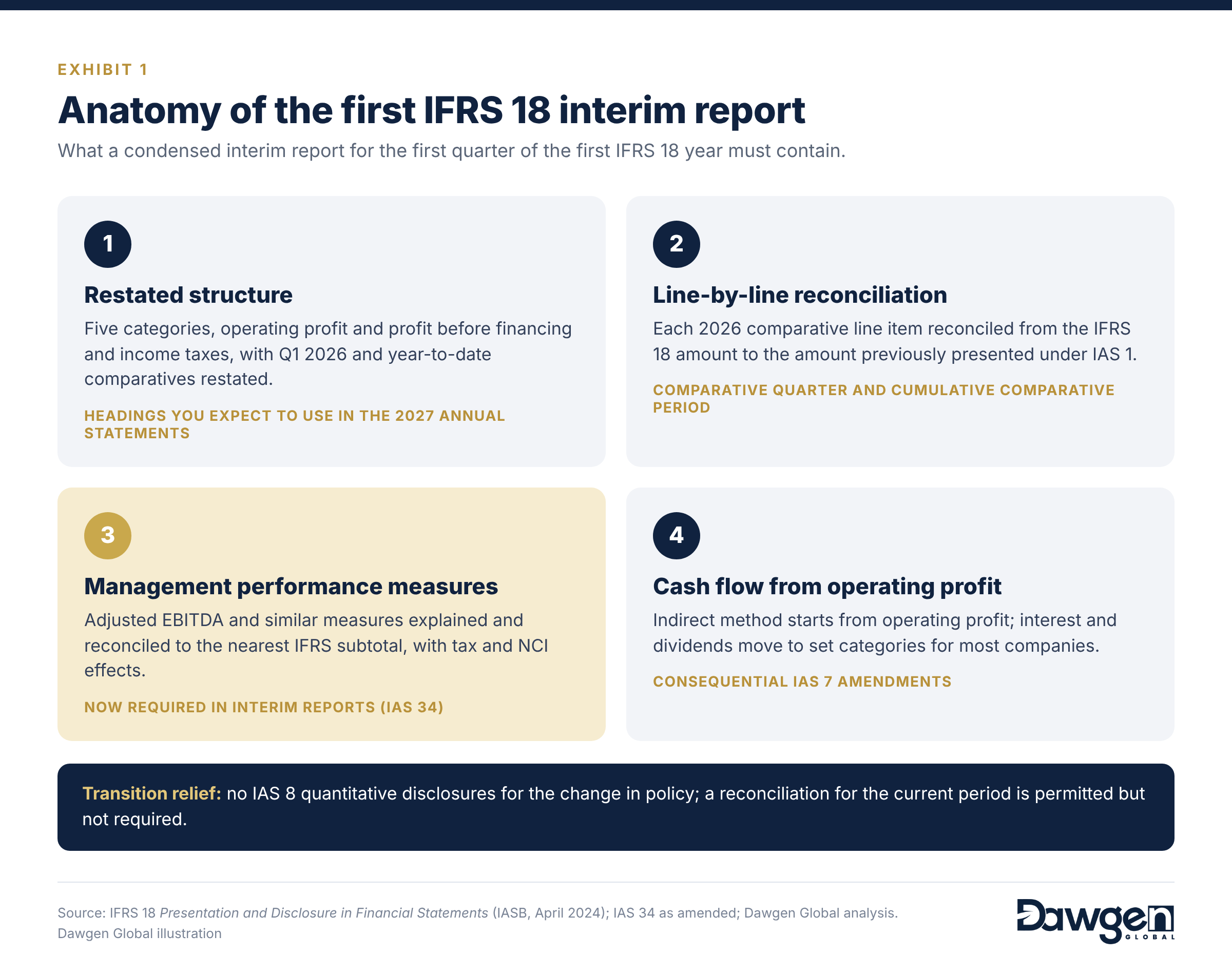
- The new structure, with restated comparatives. The condensed statement of profit or loss must follow the five categories and show the two new subtotals: operating profit, and profit before financing and income taxes. The comparative columns, for the same quarter of 2026 and the 2026 year to date, must be restated on the same basis.
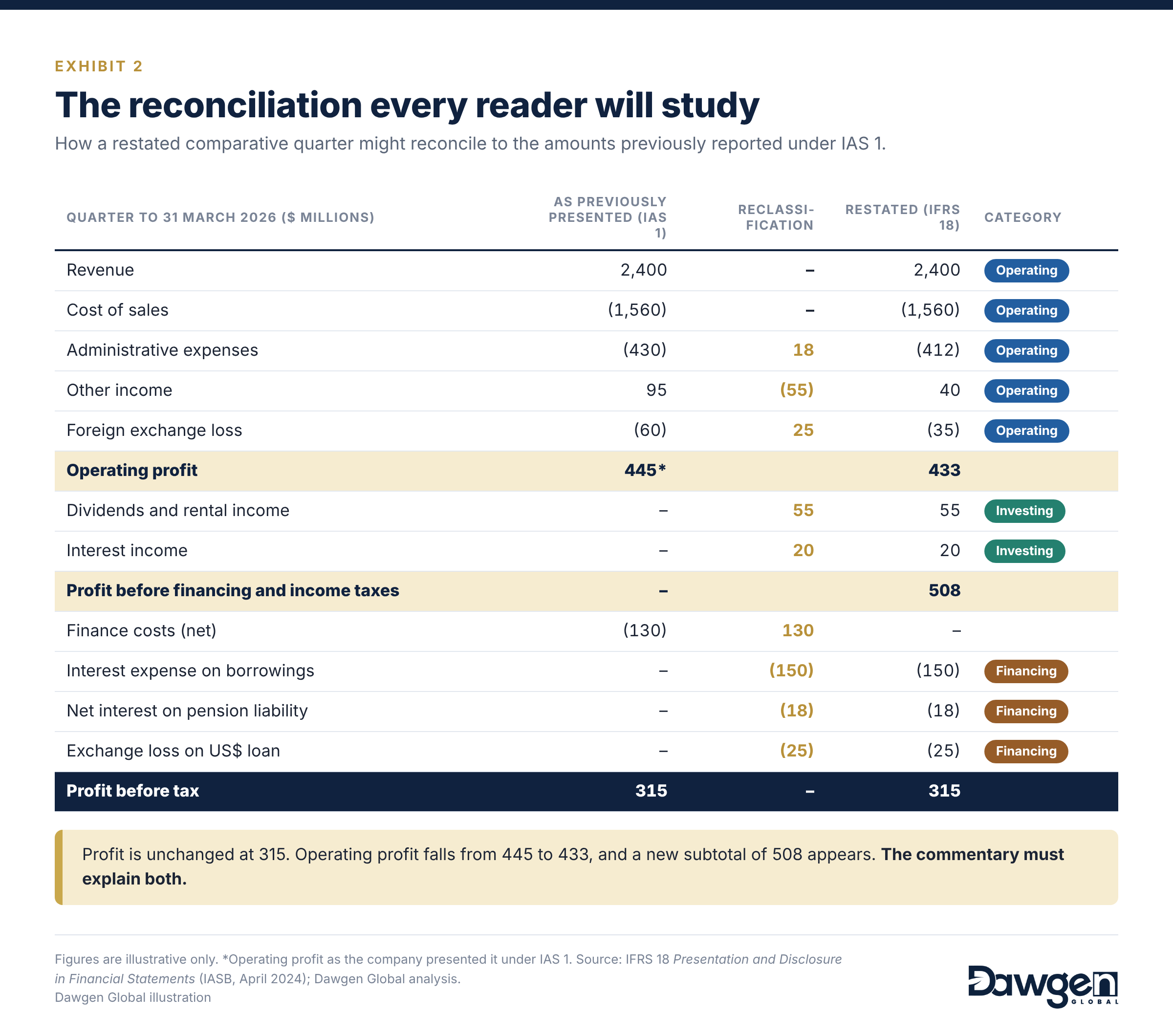
- A line-by-line reconciliation of the comparatives. For the comparative periods, the company must reconcile each line item in the statement of profit or loss from the amount restated under IFRS 18 to the amount previously presented under IAS 1. This applies to both the comparative quarter and the cumulative comparative period. In other words, every reader can see exactly which 2026 amounts moved, and where to.
- The management performance measures note. IFRS 18 amends IAS 34 so that condensed interim statements must include the disclosures for management-defined performance measures. If the company talks about adjusted EBITDA, underlying profit or core earnings in its quarterly communications, those measures must be explained and reconciled to the nearest IFRS subtotal in the interim statements, with the tax and non-controlling interest effect of each adjustment.
Two transition points help. Companies do not need to give the quantitative information that IAS 8 would normally require for a change in accounting policy. And a reconciliation for the current period, as opposed to the comparatives, is permitted but not required.
A fourth change is easy to miss. The condensed cash flow statement must reflect IFRS 18’s consequential amendments to IAS 7. For companies using the indirect method, that means starting from operating profit and applying the new classification of interest and dividends.
Where first interims go wrong
First-time adoptions of new presentation rules tend to fail in predictable ways. For IFRS 18 interims, we expect five.
- The structure changes later in the year. A company presents its first quarter one way, then refines its classifications for the half-year or the annual statements. Each change needs explaining, and frequent changes erode confidence in the numbers.
- Operating profit moves without explanation. Under IFRS 18, operating profit for many companies will differ from the “operating profit” they reported under IAS 1. If the reconciliation is presented without a plain-language explanation, analysts and the press will draw their own conclusions.
- Performance measures do not tie. The adjusted EBITDA in the quarterly press release, the chairman’s commentary and the MPM note must all match. A measure quoted in a results announcement but missing from the interim note is the kind of inconsistency regulators notice.
- The main business activity question is left open. Banks, insurers, investment entities and some property and holding companies must decide how IFRS 18 classifies their investing and financing income. Deciding this in the first quarter, under deadline, is too late.
- The cash flow statement is overlooked. Finance teams focus on the income statement and forget that the cash flow starting point and the classification of interest and dividends also change.
None of these is a measurement error. Each is a presentation or communication failure, and each is avoidable with preparation.
Run the dress rehearsal now
The best way to protect the first IFRS 18 interim is to produce one before it counts. A December year-end company can build a full dry run from the quarter to 30 September 2026, which is already closed: the restated statement of profit or loss, the line-by-line reconciliation, the MPM note and the condensed cash flow statement. That rehearsal tests the mapping, the data and the people, and it gives the audit committee something concrete to review.

From there, the path to the first filing runs as follows:
- November–December 2026: dry run. Prepare a shadow IFRS 18 interim for the third quarter of 2026. Fix the gaps it reveals in the ledger and the mapping.
- December 2026: lock the structure. Agree the headings, subtotals and performance measures you expect to use in the 2027 annual statements. Take the decision to the audit committee.
- January–February 2027: restate 2026. Finalise the restated first quarter of 2026 and the 2026 year as the audit closes. Agree the approach and evidence with your auditors.
- March 2027: build the template. Prepare the Q1 2027 interim template, the reconciliation and the MPM note, with plain-language commentary on what moved.
- April–May 2027: publish. Close the quarter, complete the interim, align the press release and file within the regulator’s deadline. On the Jamaica Stock Exchange, for example, quarterly reports are due within 45 days of the quarter-end.
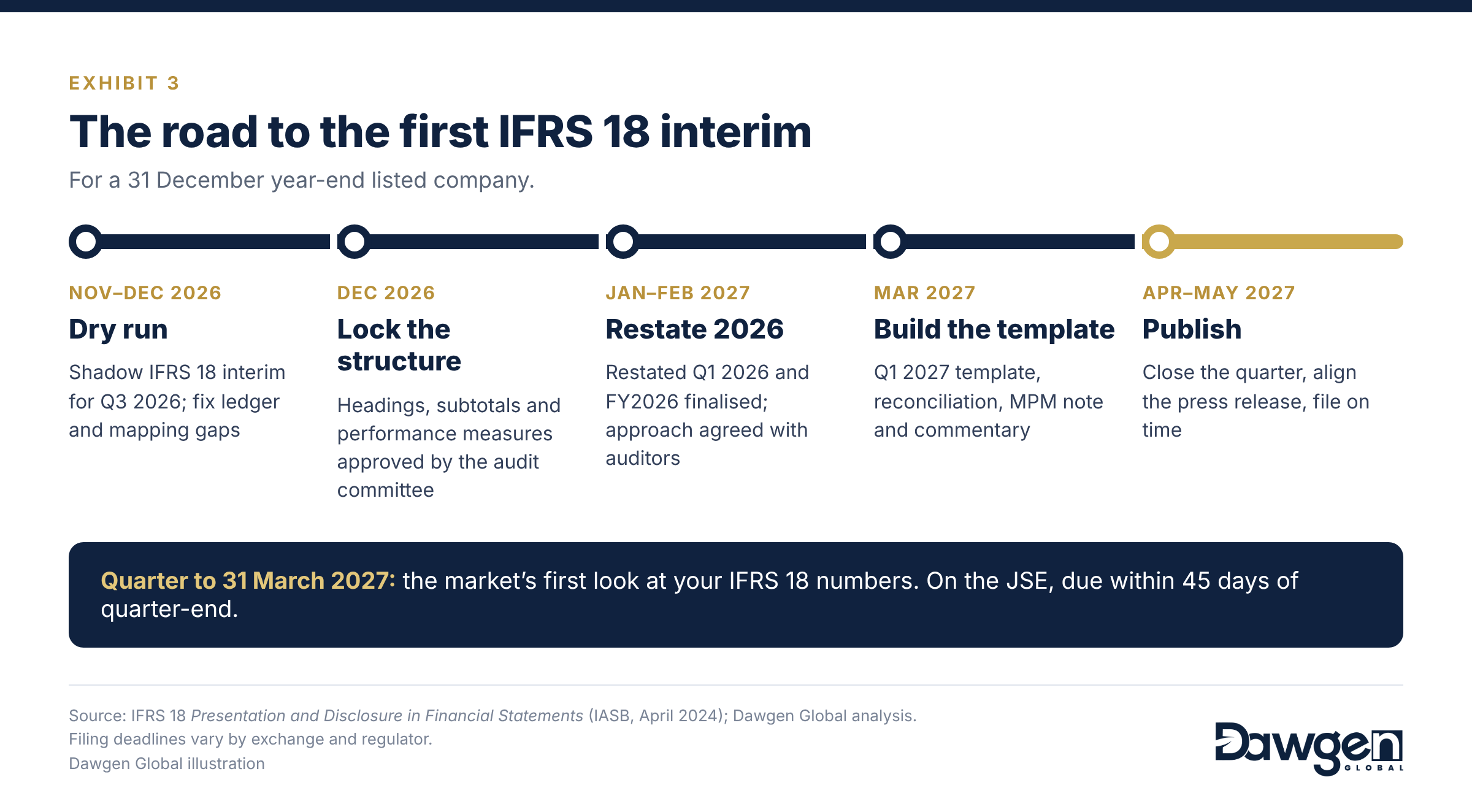
Companies with March, June or September year-ends follow the same sequence, shifted by one, two or three quarters.
How Dawgen Global can help
Dawgen Global supports listed companies and other IFRS reporters across more than 15 Caribbean territories through their first IFRS 18 reporting cycle.
- IFRS 18 Interim Dry Run. A shadow IFRS 18 interim built from your third-quarter 2026 numbers: the restated statement of profit or loss, the line-by-line reconciliation to IAS 1, the MPM note and the condensed cash flow statement.
- First Interim Support. Hands-on preparation of the Q1 2027 interim, the reconciliation disclosures and the commentary that explains what moved.
- Performance Measures Review. An inventory of every measure you use publicly, with definitions, reconciliations and alignment between press releases, commentary and the financial statements.
- Audit Committee Briefing. A focused session so directors can approve the new structure with confidence before the first filing.
The market will read your first IFRS 18 interim closely. Make sure it reads the way you intend.

Book your IFRS 18 Readiness Clinic today.
Email [email protected] or call (876) 926-5210 | US 855-354-2447 | dawgen.global
Previously in this series: Ten Weeks to IFRS 18: Where Caribbean Companies Stand · 2026 Is Already Your Comparative Year. Next: Your “EBITDA” Now Needs a Footnote.
Dawgen Global is an independent, integrated multidisciplinary professional services firm serving businesses across more than 15 Caribbean territories. Big Firm Capabilities. Caribbean Understanding.
About Dawgen Global
Dawgen Global is an independent, integrated multidisciplinary professional services firm headquartered at 47 Trinidad Terrace, New Kingston, Jamaica, serving more than 15 territories across the Caribbean. Founded and led by Dr. Dawkins Brown, Executive Chairman, the firm is independent and not affiliated with any international network. It delivers a full suite of professional services under one roof: audit and assurance; tax advisory; IT and digital transformation; risk management; cybersecurity; actuarial and insurance regulatory advisory; HR advisory; mergers and acquisitions; corporate recovery; business advisory and strategy; accounting BPO and virtual CFO services; and legal process outsourcing.
The proposition is simple: big-firm capability without the big-firm price. Dawgen Global’s integrated approach is built for the specific complexities and opportunities of the Caribbean market, helping organizations make sharper, better-informed decisions that drive measurable progress.
To explore a partnership, reach out:
- Website: dawgen.global
- Email: [email protected]
- WhatsApp (Global): +1 555-795-9071
- Caribbean offices: +1 876-665-5926 | +1 876-929-3670 | +1 876-926-5210