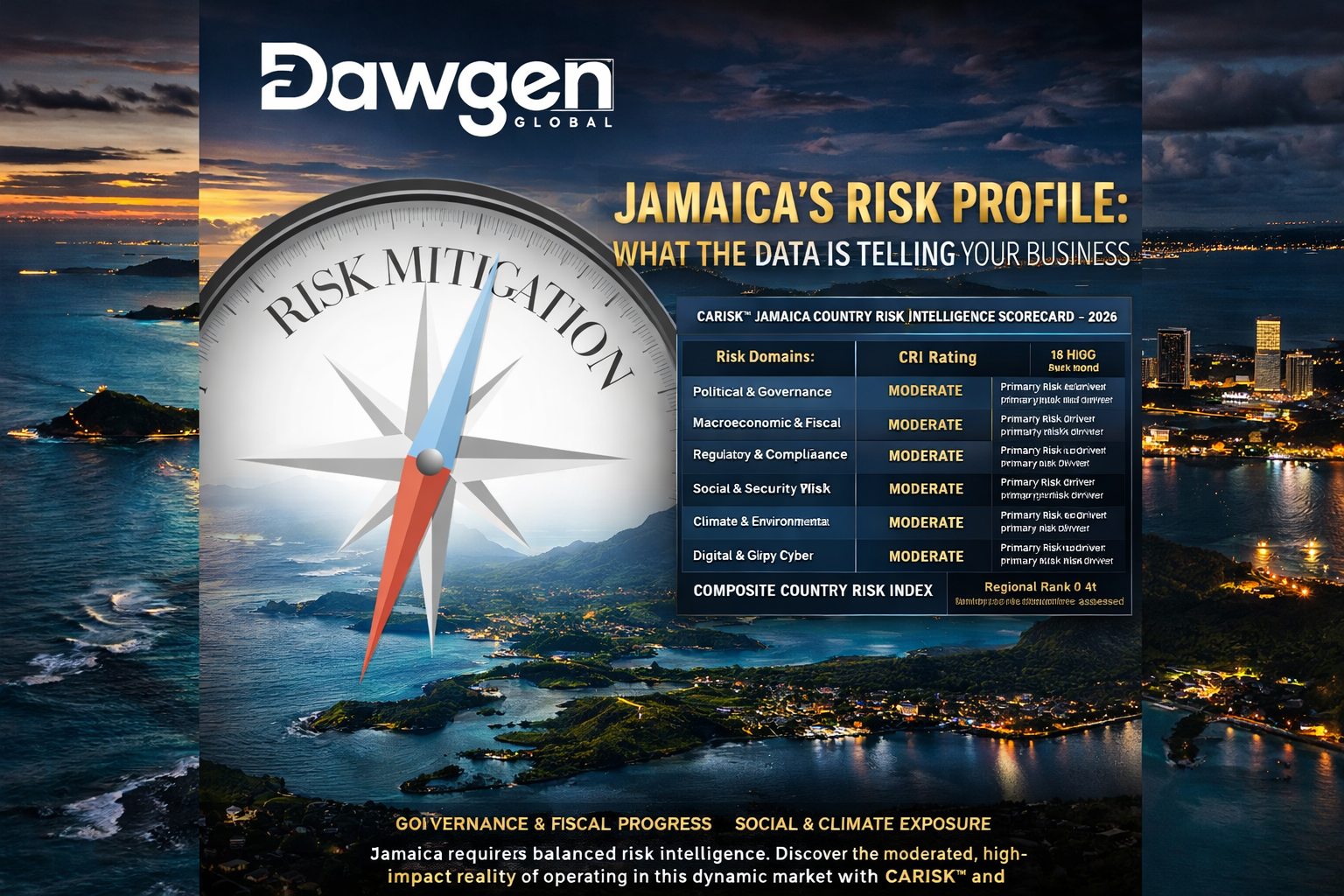
Jamaica is one of the Caribbean’s most dynamic economies — and one of its most complex risk environments. Understanding that complexity is not optional for organisations operating in or entering the Jamaican market. It is the foundation of every sound strategic decision.
CARISK™ JAMAICA COUNTRY RISK INTELLIGENCE SCORECARD — 2026
| Risk Domain | CRI Rating | Primary Risk Driver |
| Political & Governance Risk | MODERATE | Democratic stability offset by governance quality concerns and corruption pressure |
| Macroeconomic & Fiscal Risk | MODERATE | Improving debt trajectory undermined by external shock vulnerability and energy import dependence |
| Regulatory & Compliance Risk | MODERATE | Accelerating regulatory reform with uneven enforcement capacity across sectors |
| Social & Security Risk | HIGH | Among the highest homicide rates globally; gang territorial control affecting commercial districts |
| Climate & Environmental Risk | HIGH | Acute hurricane exposure; coastal flooding; drought risk to agriculture and tourism |
| Digital & Cyber Risk | MODERATE | Rapid digital adoption outpacing cybersecurity infrastructure and regulatory framework |
| COMPOSITE COUNTRY RISK INDEX | MODERATE | Score: 48/100 | Regional Rank: 4th of 15 territories assessed |
Jamaica sits at a strategic crossroads. Over the past decade, the island has delivered one of the Caribbean’s most credible macroeconomic turnaround stories — reducing its public debt burden from over 145 percent of GDP to below 80 percent, maintaining a primary fiscal surplus through successive administrations, anchoring monetary policy credibility, and earning investment-grade ratings from the major credit rating agencies. That story is real, and it matters for how the Jamaican risk landscape is assessed.
And yet, a business leader planning to invest in, operate within, or expand across the Jamaican market cannot assess Jamaica solely through the lens of its macroeconomic progress. Jamaica is simultaneously a high-crime environment, a high-hurricane-exposure island, a rapidly evolving regulatory jurisdiction, and a digital economy whose cybersecurity infrastructure has not yet caught up with its digital ambitions. The organisations that succeed in Jamaica over the long term are those that hold both realities clearly in view — the genuine progress and the genuine risk — and build strategies calibrated to both.
This is what the CARISK™ Country Risk Intelligence assessment for Jamaica is designed to provide. Not a judgment on Jamaica’s prospects, but an honest, data-grounded analysis of the risk environment that businesses, boards, and investors must navigate. In this article, the second in the CARISK™ ten-part series, we work through each of the six CARISK™ risk domains as they apply to Jamaica, translate the domain assessments into enterprise implications, and close with the risk management disciplines that distinguish successful Jamaican market participants from those that encounter preventable difficulty.
Domain 1: Political & Governance Risk — Rating: MODERATE
Jamaica’s political environment is among the most stable in the Caribbean. Since independence in 1962, Jamaica has maintained uninterrupted democratic governance, with regular, credible elections and peaceful transfers of power between the two major political parties — the Jamaica Labour Party (JLP) and the People’s National Party (PNP). The Westminster-model constitutional framework is well-established, the judiciary maintains meaningful independence, and the Electoral Commission of Jamaica is regarded as a credible institution by regional and international observers.
For enterprise risk purposes, this baseline political stability is significant. Investors and operators in Jamaica do not face the sovereign transition risk, arbitrary regulatory reversal, or expropriation risk that characterises more volatile political environments in the region and beyond. Contract enforceability, while imperfect, is grounded in a functioning legal system. Property rights, while subject to delays in the titling and registration system, are legally protected.
Governance Quality Concerns
Within this stable political framework, however, governance quality risks remain material. Corruption perception indices consistently place Jamaica in a mid-tier position — above Haiti and some other regional peers, but well below the governance standards of Barbados, Cayman Islands, and the better-performing OECS states. The Corruption Perceptions Index 2025 placed Jamaica at a score that reflects persistent concerns about procurement integrity, political patronage in public sector appointments, and the penetration of organised crime into legitimate business and political networks.
The justice system’s capacity constraints create a specific enterprise risk: contract disputes and regulatory enforcement actions move slowly through the Jamaican court system, creating a de facto asymmetry between the formal legal protections available and the practical cost and timeline of accessing them. Businesses operating in Jamaica should build contract dispute timelines and resolution costs into their operational risk models — the legal remedy exists, but the journey to it is measured in years, not months.
The garrison community dynamic — concentrated urban areas with strong political affiliations and gang control — creates a governance risk that intersects directly with the social and security risk domain. Political actors and organised crime have historically operated in a mutually reinforcing relationship in certain Jamaican communities, creating an environment where the rule of law is functionally compromised in specific geographic zones and where political calculations can influence regulatory and law enforcement decisions in ways that are difficult to predict or model.
“Jamaica’s political stability is a genuine asset. Its governance quality gaps are a genuine liability. Sophisticated operators hold both assessments simultaneously.”
Domain 2: Macroeconomic & Fiscal Risk — Rating: MODERATE
The macroeconomic story of Jamaica over the past decade is genuinely impressive by regional and global standards. Under successive IMF Extended Fund Facility and Stand-By Arrangements, Jamaica reduced its public debt-to-GDP ratio from a peak of approximately 148 percent in 2012-13 to below 80 percent by 2025 — one of the most sustained fiscal consolidation programmes in the developing world. This achievement was delivered while maintaining positive economic growth in most years, which is a rare combination in the literature on fiscal adjustment.
The Bank of Jamaica has established meaningful monetary policy credibility through its inflation targeting framework, and Jamaica has maintained a flexible exchange rate that, while subject to periodic depreciation pressure, has not produced the disorderly currency crises seen in some peer economies. The Jamaica Stock Exchange has been one of the world’s better-performing equity markets in several recent years, reflecting domestic investor confidence in the macroeconomic trajectory.
Persistent Structural Vulnerabilities
Despite this progress, Jamaica’s macroeconomic risk profile contains several structural vulnerabilities that enterprise risk frameworks must account for. Jamaica is a net importer of energy, with fuel imports representing a significant share of the import bill. This creates a direct transmission mechanism between global oil price shocks and domestic inflation, operating costs, and trade balance pressures. When global energy prices spike — as they did following the Russia-Ukraine conflict — Jamaican businesses experience the impact through energy costs, logistics costs, and inflationary pressure on labour and input prices simultaneously.
Jamaica’s high dependence on tourism as a foreign exchange earner — the sector typically accounts for approximately 30-35 percent of GDP when indirect effects are included — creates a structural vulnerability to external demand shocks. The COVID-19 pandemic demonstrated this vulnerability with full force, eliminating tourism revenues virtually overnight and requiring substantial fiscal support to prevent a cascading collapse of the tourism-linked supply chain. Climate events, global economic downturns, and geopolitical disruptions to air travel all represent transmission channels through which external conditions can rapidly deteriorate Jamaica’s macroeconomic position.
Remittance inflows — another major source of foreign exchange, typically representing 15-20 percent of GDP — provide meaningful economic stabilisation but also expose Jamaica to income conditions in the United States and United Kingdom, where the majority of the Jamaican diaspora is concentrated. A significant deterioration in US labour market conditions would reduce remittance flows and amplify economic pressure on Jamaican households and the broader economy.
| Macroeconomic Indicator | 2025 Position | Enterprise Risk Implication |
| Public Debt-to-GDP | ~78% (declining trajectory) | Reduced sovereign risk; fiscal space remains limited |
| GDP Growth Rate | ~1.5–2.5% (estimated) | Modest domestic market growth; limited consumer expansion |
| Inflation Rate | ~5–7% (above target range) | Input cost pressure; wage demands; working capital strain |
| Current Account Deficit | ~3–5% of GDP | External financing need; FX vulnerability during shocks |
| Unemployment Rate | ~4–6% (structural floor) | Tight skilled labour market in some sectors; wage pressure |
| Tourism Share of GDP | ~30–35% (direct + indirect) | High concentration risk; acute shock sensitivity |
| Remittances/GDP | ~18–22% | Household stabiliser; diaspora income dependency |
Domain 3: Regulatory & Compliance Risk — Rating: MODERATE
Jamaica’s regulatory environment is in active transition — becoming progressively more sophisticated, more enforcement-oriented, and more integrated with international compliance standards. This transition creates both opportunity and risk for operating businesses: opportunity, because well-governed organisations that meet emerging standards gain competitive advantage; risk, because the pace and direction of regulatory change is difficult to anticipate and the compliance cost of regulatory reform can be significant.
The Financial Services Commission (FSC), Bank of Jamaica (BoJ), and Financial Investigations Division (FID) have all materially increased their supervisory intensity in recent years. The AML/CFT framework has been substantially strengthened following FATF engagement, with enhanced customer due diligence requirements, beneficial ownership disclosure obligations, and suspicious transaction reporting standards now more rigorously enforced across the financial sector. Businesses in financial services, professional services, real estate, and other designated non-financial businesses and professions (DNFBPs) face growing compliance obligations that require investment in systems, training, and documented procedures.
The Jamaica Customs Agency’s modernisation programme and the Revenue Protection Division’s enhanced enforcement capacity have increased tax compliance risk for businesses that have historically operated with informal practices. Transfer pricing regulations have been strengthened, and the Tax Administration Jamaica (TAJ) is applying greater analytical sophistication to the identification of non-compliance. Jamaica’s participation in the OECD’s Common Reporting Standard (CRS) and FATCA frameworks has aligned the local tax information environment with international standards.
Sector-specific regulatory developments deserve attention from enterprises in affected industries. The telecommunications sector is navigating regulatory evolution around spectrum allocation and broadband infrastructure investment. The energy sector is undergoing structural change with the growth of renewable energy investment and the evolution of the electricity generation framework. The pharmaceutical and food safety regulatory environment is being progressively aligned with international standards. Each of these sector-specific developments creates compliance obligations and transition costs that sector participants must systematically assess and plan for.
Domain 4: Social & Security Risk — Rating: HIGH
Jamaica’s social and security risk domain carries the highest rating in the CARISK™ country assessment — and this rating demands frank, honest analysis rather than diplomatic circumspection. Jamaica’s homicide rate is among the highest in the world on a per-capita basis, consistently placing the island in the top tier of global violence indices. In 2024, Jamaica recorded over 1,300 homicides — a rate that represents not merely a public safety challenge but a direct enterprise risk factor that every organisation operating in Jamaica must formally assess and manage.
The geography of crime in Jamaica is importantly uneven. The areas of highest violence are concentrated in specific urban communities — particularly in Kingston, Spanish Town, Montego Bay, and parts of St. Catherine — that are characterised by garrison dynamics, gang territorial control, and limited effective state presence. Other parts of Jamaica — including the north coast tourism corridors, most rural parishes, and the commercial districts of New Kingston — experience materially lower levels of violence, though not immunity from it.
Enterprise Security Risk Implications
For businesses operating in Jamaica, the security risk environment translates into several specific enterprise risk categories. Supply chain and logistics security risk is significant for businesses moving goods through high-crime corridors. Extortion risk — the demand for payments from businesses by criminal organisations — is a documented reality for enterprises operating in certain areas, particularly in construction, transportation, and retail in affected communities.
Employee safety and retention risk is a material human capital issue. Talented professionals — particularly in finance, technology, and management — increasingly factor personal security in their career decisions. Jamaica’s brain drain of skilled workers to North America and the United Kingdom has multiple drivers, but personal safety concerns are among them. Businesses that cannot offer credible personal security to their staff face a structural talent disadvantage in attracting and retaining the skills required to grow.
Operational continuity risk arises when gang conflict or States of Public Emergency (SOPEs) — which have been declared in multiple parishes in recent years — disrupt normal commercial activity. SOPEs typically involve curfews, movement restrictions, and heightened security presence that affect logistics, customer access, and employee mobility. While SOPEs are temporary, their frequency and geographic scope have increased, making them a planning scenario that businesses in affected parishes should formally incorporate into their business continuity frameworks.
“The question for Caribbean boards is not whether Jamaica’s security environment presents risk — it clearly does. The question is whether that risk is understood, quantified, and managed with the same rigour applied to financial and operational risk.”
Domain 5: Climate & Environmental Risk — Rating: HIGH
Jamaica sits in the heart of the Atlantic hurricane belt, and its climate risk exposure is both acute and intensifying. The island’s geographic position, mountainous terrain, extensive coastline, and economic concentration in climate-sensitive sectors — tourism, agriculture, and coastal real estate — combine to create a climate risk profile that demands serious strategic attention from every category of organisation operating in the Jamaican market.
Hurricane and Tropical Weather Risk
Jamaica has been affected by major hurricane events at regular intervals throughout its history, but no event in living memory matches the catastrophic scale of Hurricane Melissa, which made direct landfall in southwestern Jamaica on 28 October 2025 as a Category 5 storm with sustained winds of 185 miles per hour — the strongest tropical cyclone ever to strike Jamaica and tied for the most powerful landfalling Atlantic hurricane on record. Melissa made landfall near New Hope, Westmoreland, and carved a path of destruction across the western and central parishes before crossing into Cuba.
The scale of Melissa’s destruction was without precedent in Jamaica’s recorded history. World Bank estimates placed total damage at approximately US$8.8 billion — equivalent to roughly one-third of Jamaica’s annual GDP, as confirmed by Prime Minister Andrew Holness in his address to Parliament. Approximately 150,000 structures were damaged, with roofs torn from some 120,000 buildings. Around 40–50 percent of the island’s hotel stock sustained damage, and Sangster International Airport recorded a decline in air traffic of over 48 percent in December 2025 compared to the prior year. The parishes of St. Elizabeth, Westmoreland, St. James, Trelawny, and Hanover — which received the full force of the eyewall — lost all telecommunications for extended periods, and western communities were without electricity for weeks. Of Jamaica’s 1,010 public schools, 721 were damaged and 160 remained closed six weeks after the storm. Climate scientists concluded that human-driven climate change, which raised ocean temperatures by approximately 2.5°F above historical averages in the storm’s path, materially intensified Melissa’s winds and rainfall. The name Melissa was subsequently retired by the World Meteorological Organization in March 2026 and will never again be assigned to an Atlantic hurricane.
Prior to Melissa, Hurricane Beryl in July 2024 had already demonstrated Jamaica’s vulnerability to near-miss major storms, delivering significant agricultural losses and infrastructure damage even without a direct eyewall landfall. The sequence of Beryl in 2024 and Melissa in 2025 — within thirteen months of each other — illustrates a pattern that climate science had long projected: while the total number of Atlantic tropical storms may not increase dramatically, the proportion reaching major hurricane intensity (Category 3 and above) is rising, and associated rainfall totals are intensifying. For Jamaica, which sits near the centre of the Atlantic hurricane belt, this is no longer a theoretical future risk. It is the demonstrated present reality.
For Jamaican enterprises, Melissa’s aftermath has fundamentally reset the hurricane risk baseline against which every organisation in the country must now plan. Hurricane risk translates directly into asset damage risk, business interruption risk, supply chain disruption risk, and insurance cost risk — and all four categories are now significantly elevated relative to pre-2025 assumptions. The Caribbean Catastrophe Risk Insurance Facility (CCRIF) data has consistently placed Jamaica among the territories with the highest expected annual loss from tropical weather events as a percentage of GDP; Melissa’s US$8.8 billion impact has dramatically reanchored what the tail risk of a single hurricane event looks like for the Jamaican economy. Businesses with physical assets in Jamaica that do not carry current, adequate property and business interruption insurance — or that have not conducted a formal post-Melissa reassessment of their asset vulnerability and coverage adequacy — are carrying unquantified exposure that should concern their boards, their lenders, and their insurers.
Drought, Water Stress, and Agricultural Risk
Jamaica’s climate risk is not limited to hurricane events. The island experiences significant seasonal and inter-annual rainfall variability, with periods of drought that affect both agricultural production and potable water supply. The agriculture sector — which employs a significant share of Jamaica’s rural workforce and produces inputs for the food processing and hospitality industries — is particularly exposed to rainfall variability. The 2024 dry season produced material agricultural losses in several parishes, affecting domestic food prices and the profitability of farming operations.
Water stress is an underappreciated operational risk for Jamaican businesses. Industries with high water intensity — food processing, hospitality, manufacturing, and laundry services — face production continuity risk during periods of water rationing, which have become more frequent in drought years. Businesses that have not assessed their water supply vulnerability and built contingency arrangements into their operational planning are exposed to a risk that is predictable in category even when it is uncertain in timing.
Domain 6: Digital & Cyber Risk — Rating: MODERATE
Jamaica’s digital economy has expanded rapidly over the past decade. Mobile money adoption, online banking penetration, e-government services, digital business registration, and the growth of the Business Process Outsourcing (BPO) sector have all contributed to a significant increase in the digital footprint of Jamaican institutions, businesses, and individuals. This digital expansion is largely positive — it improves economic efficiency, expands financial inclusion, and creates new business models and employment categories.
However, Jamaica’s digital risk profile is characterised by a growing gap between the scale of digital adoption and the maturity of the cybersecurity infrastructure and regulatory framework governing it. The National Cyber Security Strategy has provided a policy framework, but implementation has been uneven across sectors. Incident reporting culture remains immature — many organisations that experience cyber incidents do not report them, creating a significant undercount of the actual frequency and severity of Jamaican cyber events. The talent pool for cybersecurity professionals in Jamaica is limited, creating a structural constraint on the capacity of Jamaican organisations to defend themselves against increasingly sophisticated threats.
The BPO sector — which handles customer data and business process functions for major international corporations — is a particularly significant cyber risk concentration. A major data breach affecting a Jamaican BPO operator would have consequences that extend well beyond Jamaica, damaging the sector’s international reputation and potentially triggering regulatory action from the data protection authorities of client-domiciled jurisdictions. For BPO operators and their Jamaican-based technology infrastructure providers, cyber risk is not a secondary concern; it is a core business risk.
The Jamaican government’s own digital infrastructure has been subject to cyber incidents in recent years, affecting public services and highlighting the vulnerability of interconnected digital systems to disruption. As government-to-business digital interfaces expand — for tax filing, customs processing, and regulatory compliance — the reliability and security of government digital systems becomes a direct enterprise risk factor for businesses dependent on those interfaces.
Enterprise Implications: What Jamaican Market Operators Must Do
The CARISK™ Jamaica assessment translates into a specific set of risk management imperatives for organisations operating in or entering the Jamaican market. These are not generic risk management recommendations; they are Jamaica-specific actions calibrated to the risk profile outlined above.
- Formalise your security risk framework: Every Jamaica-operating entity should have a documented security risk assessment that maps its facilities, staff locations, logistics routes, and supplier networks against the crime geography of the island. This assessment should be reviewed annually and updated following significant security events in areas relevant to the business.
- Stress-test your climate exposure: Conduct a formal climate risk assessment of all Jamaican physical assets, covering hurricane damage exposure, flood risk from storm surge and rainfall, and water supply dependency. Ensure that property insurance coverage is current, adequate, and reflects replacement value rather than historical cost. Review business interruption coverage to ensure it covers the categories and duration of disruption that a major hurricane event would cause.
- Build a regulatory change monitoring function: The pace of regulatory change in Jamaica across tax, AML/CFT, data protection, and sector-specific frameworks requires a systematic monitoring capability. Organisations that discover regulatory requirements after they have been breached are the organisations that face enforcement action. Engage qualified Jamaican legal and tax advisors to maintain a regulatory watch list relevant to your sector.
- Invest in cybersecurity baseline capability: Conduct a cybersecurity gap assessment against a recognised framework (ISO 27001 or NIST CSF) and implement the priority remediations identified. At minimum, ensure that multi-factor authentication is deployed across all critical systems, that data backup and recovery procedures are tested, and that staff receive regular phishing and social engineering awareness training.
- Maintain macroeconomic scenario plans: Given Jamaica’s external shock vulnerability, organisations should maintain formal financial scenarios for at least two adverse macroeconomic conditions: a significant exchange rate depreciation (model a 20-30 percent JMD devaluation) and a major tourism disruption (model a 40 percent revenue decline for a 12-month period). These scenarios should be stress-tested against the organisation’s liquidity position, debt covenants, and operating cost structure.
The Jamaica Risk Summary: What CARISK™ Tells Us
The CARISK™ Jamaica Country Risk Intelligence assessment produces a Composite Country Risk Index score of 48 out of 100, placing Jamaica in the Moderate Risk category and ranking it fourth among the fifteen primary Caribbean territories assessed — above Haiti, OECS cluster states on average, and Belize, but below the regional leaders of Cayman Islands, Barbados, and Trinidad & Tobago.
This ranking reflects the genuine progress Jamaica has made on macroeconomic and fiscal management, and the genuine stability of its political framework. It also reflects the material risk that the social and security environment and the climate exposure represent — risks that are not reducible by macroeconomic progress alone and that require active, structured management by every enterprise operating in the Jamaican market.
The most important insight from the Jamaica CARISK™ assessment is not the composite score but the domain profile. Jamaica is a jurisdiction where the distribution of risk across domains matters enormously for strategy. A logistics business routing goods through inner-city Kingston faces a materially different risk profile from a tourism operator on the north coast, even though both are operating in Jamaica. CARISK™’s domain-level analysis enables organisations to assess their specific exposure with the granularity that a composite score alone cannot provide.
“Jamaica’s risk is real. Jamaica’s opportunity is also real. The organisations that succeed are those that engage both with equal rigour.”
In Article 3 of this series, we turn to Trinidad & Tobago — a risk profile defined by energy sector dependency, fiscal stress, and the question of what comes after hydrocarbons. The T&T risk landscape is distinct from Jamaica’s in important ways, but equally demanding of structured intelligence and strategic discipline.
| REQUEST YOUR CARISK™ JAMAICA RISK BRIEFING
Plan effectively with Dawgen Global’s expert analysis and data on the risk factors affecting your Jamaica strategy. From our detailed CARISK™ Jamaica Country Risk Intelligence scorecard to customisable enterprise risk matrices and real-time event analysis, our Operational Risk service gives you the tools to confidently anticipate and mitigate risk in the Jamaican market. Request a complimentary 60-minute CARISK™ Jamaica Intelligence Briefing today.
|
About the Author
Dr. Dawkins Brown is the Executive Chairman and Founder of Dawgen Global, the Caribbean’s leading multidisciplinary professional services firm. He is the creator of the CARISK™ framework and publishes the Caribbean Boardroom Perspectives newsletter on LinkedIn and the Caribbean Advisory Brief on the Dawgen Global company page. Dawgen Global operates across 15+ Caribbean territories under the tagline: “Big Firm Capabilities. Caribbean Understanding.”
Next in the Series
Article 3 — Trinidad & Tobago: Energy Dependency, Fiscal Stress, and What Comes Next. The T&T risk profile is shaped by its hydrocarbon wealth and the structural question of what follows it. We assess all six CARISK™ domains for T&T and translate them into enterprise risk implications for businesses operating in the twin-island republic.
About Dawgen Global
“Embrace BIG FIRM capabilities without the big firm price at Dawgen Global, your committed partner in carving a pathway to continual progress in the vibrant Caribbean region. Our integrated, multidisciplinary approach is finely tuned to address the unique intricacies and lucrative prospects that the region has to offer. Offering a rich array of services, including audit, accounting, tax, IT, HR, risk management, and more, we facilitate smarter and more effective decisions that set the stage for unprecedented triumphs. Let’s collaborate and craft a future where every decision is a steppingstone to greater success. Reach out to explore a partnership that promises not just growth but a future beaming with opportunities and achievements.
 Email: [email protected]
  Visit: Dawgen Global Website

 WhatsApp Global Number : +1 555-795-9071
Caribbean Office: +1876-6655926 / 876-9293670/876-9265210  WhatsApp Global: +1 5557959071
USA Office: 855-354-2447
Join hands with Dawgen Global. Together, let’s venture into a future brimming with opportunities and achievements


