
Culture is not the poster on the wall. It is what predictably happens when you are not watching — and in a small team, it is broadcast by the leader, whether or not anything is ever built.
The Problem, Lived
“Sherry-Ann” runs an eleven-person property-management company in St. George’s, Grenada, and on paper she has assembled a good team. In practice, she has assembled two camps and a mystery. The old guard moves at the pace of habit; the newer hires arrived energetic and, one by one, slowed to match the room. Deadlines are met with explanations rather than results. Her best coordinator quietly carries the workload of three colleagues and has stopped mentioning it. Team meetings produce silence, followed within the hour by three separate WhatsApp threads saying everything that was not said.
What torments Sherry-Ann most is the pattern she cannot unsee: she hires good people and watches the team make them average. The energy of every new hire has a half-life of roughly four months. She has responded the way many owners do — more pep talks, a staff lunch, a motivational quote in the group chat — while avoiding the one thing that feels impossible: the direct conversation. In an eleven-person company, on a small island, accountability feels like confrontation, and confrontation feels like it will cost her the relationship. So the missed commitment passes with a sigh, again, and the whole team quietly updates its understanding of what the standard here really is.
Here is the reframe Sherry-Ann needs: she thinks she has failed to build a culture. She has not. She has built one — meticulously, daily, by demonstration. Every tolerated miss, every unspoken standard, every hero’s medal pinned on the loudest firefighter taught the team exactly how this company works. In a small team there is no gap between the leader’s behavior and the culture. The culture is the leader’s behavior, amplified by proximity. The question is never whether you are broadcasting. It is what.
Why It Happens Here
Small-market intimacy raises the stakes of every hard conversation. Your employee is your neighbor’s daughter; the man whose performance is sliding will sit two pews over on Sunday. In that world, direct feedback feels like a social rupture, so a regional dialect of conflict-avoidance takes over — everything is “no problem” until, without warning, it is a resignation letter. Meanwhile the performance infrastructure that would make feedback routine simply does not exist in most small firms: no written goals, no review rhythm, no scoreboard. The only performance conversations are the annual raise negotiation and the occasional explosion — which teaches everyone that feedback is either about money or about anger, and to fear both.
Two further patterns finish the job. The word “family” gets deployed as culture — a warm idea that quietly comes to mean no standards, since one does not performance-manage one’s cousins. And hero culture rewards exactly the wrong behavior: the firefighter who rescues the crisis at 9 p.m. gets the praise, while the coordinator whose properties never catch fire gets invisibility. People are not confused by any of this. They read it perfectly, and they perform to what is actually rewarded — which is rarely what the poster says.
| What You Tolerate, You Teach
Run the one-question culture audit: what happens here when someone misses a commitment? Whatever the honest answer is — a sigh, a workaround, a quiet redistribution to the reliable — that is your culture, in one sentence. And know who is watching most closely when the answer is “nothing”: your best people. A-players calibrate their future to what happens to the C-players around them. Tolerated mediocrity is how a small firm quietly unlocks the door that Article 13 warned about — for exactly the people it can least afford to lose. |
Why Generic Advice Fails
The culture industry is built for organizations with HR departments: engagement surveys, values workshops, culture committees, perks catalogs. Little of it survives contact with an eleven-person firm — not because small teams matter less, but because at that scale culture has no bureaucracy to live in. It lives in one place only: the leader’s observable behavior, repeated. You cannot delegate it, outsource it, or laminate it. The good news hiding inside that hard truth is leverage — in a small team, one person changing five behaviors changes the entire company’s weather. That person is you, and the five behaviors are the framework.
The Framework: LEADRIGHT™ — The Five Signals™, Step by Step
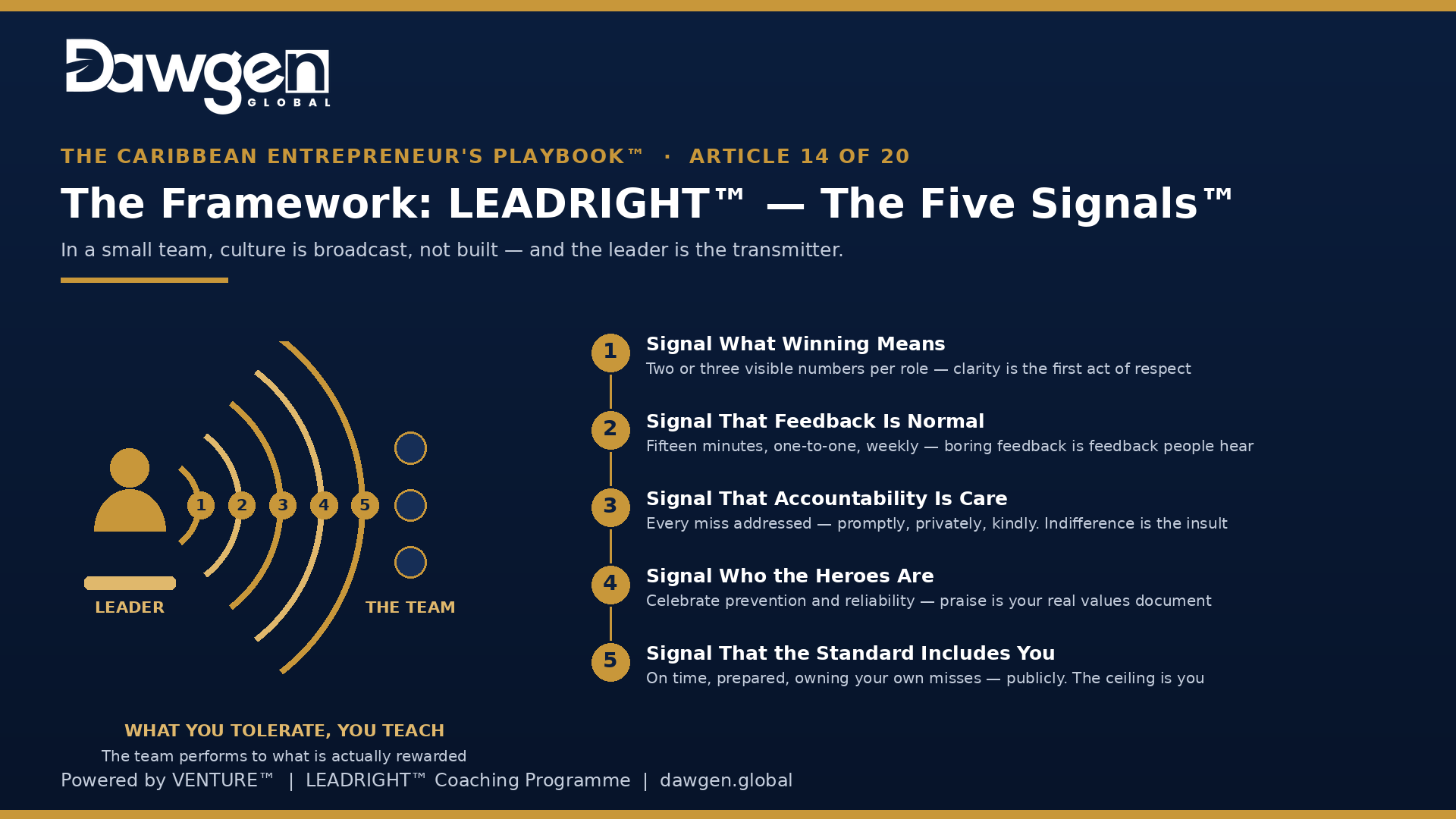
In a small team, culture is broadcast, not built. These are the five signals, and the leader transmits all of them — deliberately or by default:
- Signal 1 · Signal What Winning Means — People cannot perform to a standard they cannot see. Give every role two or three numbers that define a good week — response times, completion rates, whatever expresses the job — and put them on a scoreboard the whole team sees, reviewed together weekly. Vagueness is the ally of the underperformer and the enemy of the star: the moment winning is visible, your best people finally get to be seen winning, and your strugglers lose the fog they were hiding in. Clarity is the first act of respect.
- Signal 2 · Signal That Feedback Is Normal — Feedback delivered rarely is an event; delivered weekly, it is weather. Install a fifteen-minute one-to-one with each person, every week, no agenda beyond: what went well, what needs attention, what do you need from me. Praise specifically and publicly; correct specifically and privately; do both within days of the moment, never saved up for a crisis or a review. The goal is to make feedback so frequent it becomes boring — because boring feedback is feedback people can actually hear.
- Signal 3 · Signal That Accountability Is Care — Address every missed commitment — every one — promptly, privately and kindly: ‘We agreed Friday; it didn’t happen; what got in the way, and what happens now?’ No anger required; anger is what accountability becomes when it has been avoided too long. This is the signal your best people are watching for above all others, and the reframe that unlocks it for conflict-avoidant leaders is this: holding someone to a standard is not an attack on the relationship. It is the belief, expressed out loud, that they are capable of the standard. Indifference is the insult. Accountability is the respect.
- Signal 4 · Signal Who the Heroes Are — Audit what you celebrate, because it is your real values document. If the 9 p.m. firefighter gets the glory while the coordinator whose properties never burn gets silence, you are training your team to let things smolder. Rebalance deliberately: celebrate prevention, reliability, and the person who made a colleague better — by name, in front of the team. Promotion and praise are the two loudest broadcasts a leader owns. Point them at the behavior you actually want multiplied.
- Signal 5 · Signal That the Standard Includes You — The culture ceiling of a small firm is the leader’s own behavior. Be on time to your own meetings, prepared for your own reviews, accountable to your own commitments — visibly. And deploy the most powerful culture tool a small company owns: the leader’s public, unprompted ownership of a mistake. ‘I was slow on those tenant responses last month; that’s below our standard, and here’s my fix.’ One sentence like that, from the top, buys more psychological safety than a year of posters — because it proves the standard is real, universal, and safe to fall short of honestly.
The Framework in Action: A Worked Scenario
The following scenario is a fictional composite created for this series to illustrate the framework. It does not depict any actual business or client of the firm.
Sherry-Ann starts with the scoreboard: three numbers per role, on the wall, reviewed each Monday. The first week is quiet and uncomfortable. The second week, her silent star coordinator speaks in a meeting for the first time in a year — because for the first time, the numbers say out loud what she had been carrying in silence. The fifteen-minute one-to-ones begin, and Sherry-Ann discovers what every leader discovers in them: half her ‘performance problems’ were information problems, fixable in a sentence.
Then comes the conversation she had avoided for two years — the chronic explainer, addressed privately, kindly, and with a documented plan. In this illustration, he chooses the standard and, to her genuine surprise, improves; the version of this story where he chooses the door is also a success, just a sadder one. Hero-of-the-month goes, pointedly, to the coordinator whose properties never make the emergency list — and the team notices what has just been said. In month four Sherry-Ann opens a meeting by owning her own late tenant responses, with her fix, and feels the room change temperature. By month six, the pattern that tormented her has inverted: a new hire arrives energetic and, four months later, is still energetic — because the mean she used to regress toward has moved. The two camps are quietly becoming one, organized not around old and new, but around the only thing that ever really organizes a small team: what the leader demonstrably rewards, tolerates and does.
Self-Diagnostic: What Are You Broadcasting?
One point for every “no”:
- Does every person on your team have two or three visible numbers that define a good week?
- Does each person get fifteen minutes of one-to-one feedback from you, weekly?
- Was the last missed commitment addressed within days — privately, kindly, every time?
- In the last quarter, was prevention or reliability celebrated as loudly as any rescue?
- Have you publicly owned one of your own mistakes to the team in the last six months?
Two or more points means the culture is currently being broadcast by default. The team already knows the real standards. The only person who hasn’t heard the broadcast is the one transmitting it.
When to Call In Help
Culture work has a structural blind spot: the leader is both the instrument and the problem, and no one can hear their own broadcast. Bring in support when the pattern survives your best intentions — when new hires keep regressing to the mean, when your strongest people are quietly overloaded or quietly leaving, when there is a conversation you have needed to have for more than six months, or when ‘family’ has become the reason standards cannot be discussed. A leadership coach does the two things a mirror cannot: shows you your actual signals, and sits with you through the conversations that avoidance has been pricing up for years.
| BOOK A LEADRIGHT™ LEADERSHIP DIAGNOSTIC
The LEADRIGHT™ programme within Dawgen Global’s VENTURE™ Business Coaching System begins with a Leadership Diagnostic: a confidential read of your team’s actual culture — the signals being received, not the ones intended — followed by the full Five Signals™ installation: role scoreboards, the weekly feedback rhythm, accountability scripts for the conversations you’ve been avoiding, and recognition rebalanced toward the behavior you want multiplied. Facilitated by a certified VENTURE™ coach who stays through the hard conversations. Contact us today to book your diagnostic. 📩 [email protected] | 📞 876-929-3670 / 876-665-5926 | 🇺🇸 855-354-2447 | 🌐 dawgen.global GET THE FULL PLAYBOOK This is Article 14 of The Caribbean Entrepreneur’s Playbook™ — 20 problems, 20 how-to frameworks, one system. Pre-register at dawgen.global to receive the complete Playbook e-book on release, free. |
About Dawgen Global
Dawgen Global is an independent, integrated multidisciplinary professional services firm headquartered at 47 Trinidad Terrace, New Kingston, Jamaica, serving more than 15 territories across the Caribbean. Founded and led by Dr. Dawkins Brown, Executive Chairman, the firm is independent and not affiliated with any international network. It delivers a full suite of professional services under one roof: audit and assurance; tax advisory; IT and digital transformation; risk management; cybersecurity; actuarial and insurance regulatory advisory; HR advisory; mergers and acquisitions; corporate recovery; business advisory and strategy; accounting BPO and virtual CFO services; and legal process outsourcing.
The proposition is simple: big-firm capability without the big-firm price. Dawgen Global’s integrated approach is built for the specific complexities and opportunities of the Caribbean market, helping organizations make sharper, better-informed decisions that drive measurable progress.
To explore a partnership, reach out:
- Website: dawgen.global
- Email: [email protected]
- WhatsApp (Global): +1 555-795-9071
- Caribbean offices: +1 876-665-5926 | +1 876-929-3670 | +1 876-926-5210


