
You will never win a bidding war against the banks, the multinationals and the visa. Stop fighting on the salary line — and start winning on the deal.
The Problem, Lived
“Omar” runs a fourteen-person IT services firm in Kingston, and by any fair measure he is one of the best developers of young talent on the island. Juniors arrive raw and leave skilled — that is precisely the problem. Every eighteen to twenty-four months, the cycle completes: a bank or telecoms company offers forty percent more, or a foreign employer offers a remote contract in hard currency, and another of Omar’s best walks out carrying two years of his training. Last month it was his senior developer — the one he was grooming to lead the team — gone to a US company that has never seen her face and pays her in dollars.
Omar has started describing his firm, with a bitterness he dislikes in himself, as “the industry’s free academy.” He cannot match the bank’s salary scale. He certainly cannot match Miami’s. The exit interviews all say the same courteous thing — “a better offer came” — and each one deepens his conviction that this is purely and only about money, which means it is unwinnable, which means the next resignation is already in the post.
Here is what Omar cannot see from inside the cycle: the salary line is only one line of the employment deal, and it is the only line on which he is guaranteed to lose. On most of the other lines — growth, trust, flexibility, being genuinely seen — a fourteen-person firm can beat a fourteen-thousand-person one without spending what it does not have. The talent war is not unwinnable. It is being fought on the wrong field.
Why It Happens Here
The structural forces are real and deserve naming. Large corporates and government bodies anchor wage scales a small firm cannot approach. The migration pull is generational — and remote work has sharpened it into something new: foreign employers now recruit Caribbean talent without asking anyone to leave their grandmother’s Sunday dinner. A small business is bidding against employers who do not even have to buy a plane ticket.
But an honest audit finds self-inflicted wounds beside the structural ones. In most small firms, pay is set ad hoc — negotiated at hiring and frozen by neglect — producing the quiet poison of internal compression, where a loyal three-year employee earns less than the junior hired last month at market rates. Career paths exist nowhere but the owner’s intentions. Development is accidental. And because every exit interview politely cites “the offer,” owners conclude money is the whole story — when the offer was merely the occasion, and the door had been unlocked for months by things that cost nothing to fix: no visible next step, no review in two years, good work absorbed without acknowledgment. People rarely leave for money alone. They leave when money is the only thing holding them, and something better tugs.
| The Polite Exit
“I got a better offer” is the easiest goodbye in the working world — gracious, unarguable, and almost never the whole truth. Treat exit interviews as the beginning of the diagnosis, not the end. The recruiter’s call succeeds or fails months before it is made, based on questions your employee has already answered privately: Do I have a future here? Does anyone notice my work? Would leaving even be hard? A competitor’s salary opens the door. Your own unattended deal is what unlocked it. |
Why Generic Advice Fails
Global retention content is written from inside labor markets that do not resemble ours: stock options for companies with stock, perk catalogs for companies with campuses, and the breezy instruction to “pay top of market” — advice that dissolves on contact with a Caribbean small firm bidding against multinationals and migration simultaneously. What the imported playbooks never address is the actual strategic position of the small regional employer: outgunned on one line of the deal, and structurally advantaged on several others — if those lines are engineered deliberately rather than left to goodwill.
The Framework: PEOPLE360°™ — The Five Levers of the Unmatchable Deal, Step by Step
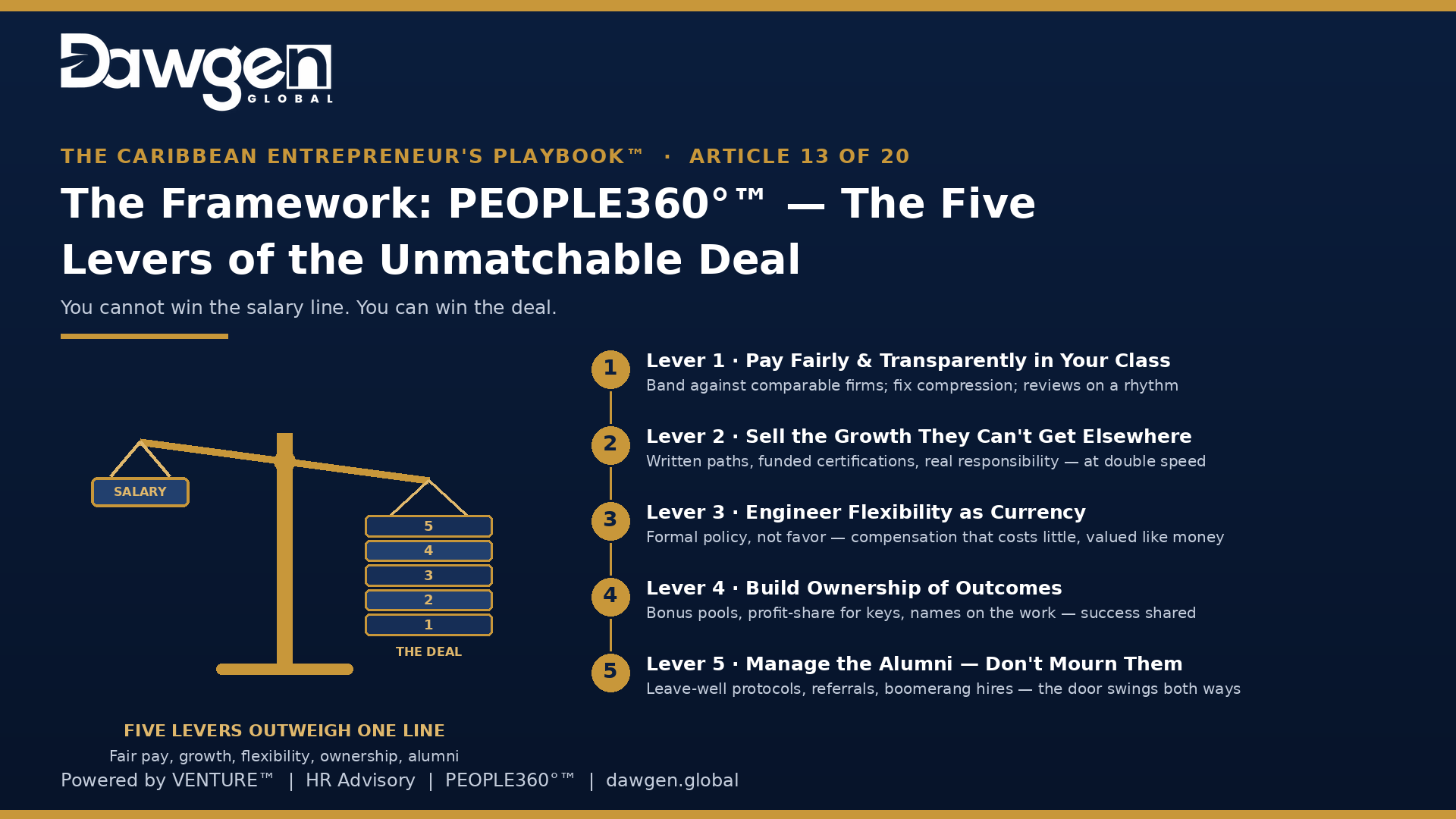
You cannot win the salary line. You can win the deal. Five levers, pulled deliberately:
- Lever 1 · Pay Fairly and Transparently Inside Your Class — Stop benchmarking against the bank — band your roles against comparable-size firms, honestly, and fix internal equity first: compression between loyal staff and new hires is the resentment every recruiter harvests. Put pay reviews on a calendar rhythm, not a squeaky-wheel basis, and make the bands visible. You do not need to pay the most. You need your people to believe — accurately — that they are paid fairly by a system, not by mood. Fair and transparent beats high and arbitrary more often than owners dare to test.
- Lever 2 · Sell the Growth They Cannot Get Elsewhere — Your unmatchable asset is speed of growth: in a small firm, an ambitious person touches real clients, real decisions and real breadth years before a corporate ladder would allow it. Make that advantage explicit and structural — written development paths with named levels, funded certifications paired with reasonable service agreements, and stretch responsibility granted early and publicly. The bank offers more money to stand still politely. You offer a career moving at double speed. Say so, in writing, at hiring — and then keep the promise visibly.
- Lever 3 · Engineer Flexibility as Currency — Flexibility is compensation that costs you little and is valued like money — often above money. Remote days as standard rather than favor, honest accommodation of family realities, output measured over hours. Large employers here remain rigid; every inch of deliberate flexibility you formalize is an inch they cannot easily match. The key word is formalize: flexibility as policy is a benefit people count on and count in the deal. Flexibility as favor is anxiety with extra steps.
- Lever 4 · Build Ownership of Outcomes — Convert employment into stake. Bonus pools tied to project or company results; for genuinely key people, profit-share arrangements that let them win when the firm wins; names on the work, credit given in front of clients, trust extended visibly. People stay where success is shared and attributed. The corporate offers a bigger salary to be anonymous. You offer a smaller stage where their name is on the playbill — for a certain kind of excellent person, that is not a consolation. It is the point.
- Lever 5 · Manage the Alumni — Don’t Mourn Them — Accept the truth the first four levers cannot change: in this region, some of your best will still leave — for scale, for currency, for family abroad. Stop treating each departure as betrayal and start running an alumni strategy: leave-well protocols, a maintained network, an explicit open door. Alumni become referrers of clients and candidates, ambassadors of your name, and — the quiet prize — boomerang hires who return senior, loyal and pre-trained. The ‘free academy’ Omar resents is, reframed and managed, a recruiting pitch no bank can make: train here, grow fast, and the door swings both ways.
The Framework in Action: A Worked Scenario
The following scenario is a fictional composite created for this series to illustrate the framework. It does not depict any actual business or client of the firm.
Omar’s audit begins with Lever 1 and delivers the finding that stings most: two of his most loyal seniors earn less than the junior he hired six months ago — compression he never intended and never checked. He fixes the equity, publishes three-level bands, and calendars reviews. Lever 2 turns his accidental academy into a curriculum: a written path from developer to senior to lead, certifications funded against eighteen-month service agreements, signed without complaint by everyone offered one.
Two remote days become standard policy rather than negotiated favor. A project bonus pool pays out its first modest round within two quarters — and, in this illustration, the effect on how work is finished exceeds the money paid several times over. The alumni lever produces the twist Omar least expected: the senior developer who left for the US remote role refers two clients within a year — “I know exactly how they build,” she tells them — and at the two-year mark, a developer who left for a bank returns as team lead, bringing corporate discipline home to a firm now worth returning to. Attrition roughly halves. But the deeper change is in the hiring interviews, where Omar now opens with the sentence his framework earned him: “I probably can’t pay you the most. Here is everything else — in writing.” The candidates who lean forward at that sentence are exactly the ones he wants.
Self-Diagnostic: How Unlocked Is Your Door?
One point for every “no”:
- Are your roles banded against comparable firms, with internal compression checked in the last year?
- Does every ambitious employee hold a written development path with a visible next level?
- Is flexibility formal policy — counted on, not asked for?
- Does anyone besides you share financially when the firm succeeds?
- Do you have an alumni network that has produced a referral or a returning hire?
Two or more points means the door is already unlocked — and the recruiter’s call, whenever it comes, will merely push it open.
When to Call In Help
Bring in professional support when the pattern turns structural: attrition running well above your industry’s norm; key-person risk concentrated in one or two heads (Article 9’s transfers apply to staff too); pay set with no banding and equity never audited; or a growth plan that assumes a team you have not managed to keep. An outside review does what the owner cannot: it hears what employees will not say to the person who signs their cheque, and it prices the deal — all five levers — against what your people can actually get elsewhere. Retention is cheaper than recruitment by multiples; it is simply invoiced less visibly.
| REQUEST A PEOPLE360°™ COMPENSATION & RETENTION REVIEW
Dawgen Global’s HR Advisory team, through the PEOPLE360°™ framework, delivers a structured Compensation & Retention Review: role banding against your true market class, an internal equity and compression audit, confidential staff listening, and the full five-lever design — development paths, flexibility policy, ownership structures and an alumni strategy — engineered for what your firm can actually afford. Stop bidding. Start dealing. Contact us today to request your review. 📩 [email protected] | 📞 876-929-3670 / 876-665-5926 | 🇺🇸 855-354-2447 | 🌐 dawgen.global GET THE FULL PLAYBOOK This is Article 13 of The Caribbean Entrepreneur’s Playbook™ — 20 problems, 20 how-to frameworks, one system. Pre-register at dawgen.global to receive the complete Playbook e-book on release, free. |
About Dawgen Global
Dawgen Global is an independent, integrated multidisciplinary professional services firm headquartered at 47 Trinidad Terrace, New Kingston, Jamaica, serving more than 15 territories across the Caribbean. Founded and led by Dr. Dawkins Brown, Executive Chairman, the firm is independent and not affiliated with any international network. It delivers a full suite of professional services under one roof: audit and assurance; tax advisory; IT and digital transformation; risk management; cybersecurity; actuarial and insurance regulatory advisory; HR advisory; mergers and acquisitions; corporate recovery; business advisory and strategy; accounting BPO and virtual CFO services; and legal process outsourcing.
The proposition is simple: big-firm capability without the big-firm price. Dawgen Global’s integrated approach is built for the specific complexities and opportunities of the Caribbean market, helping organizations make sharper, better-informed decisions that drive measurable progress.
To explore a partnership, reach out:
- Website: dawgen.global
- Email: [email protected]
- WhatsApp (Global): +1 555-795-9071
- Caribbean offices: +1 876-665-5926 | +1 876-929-3670 | +1 876-926-5210


