If the business cannot run for two weeks without you, you do not own a business. You own a job with employees — and it owns you back.
The Problem, Lived
“Andre” runs an electrical contracting firm in Castries — eighteen staff, a respected name, a solid book of commercial clients across St. Lucia. He is also, by any honest accounting, the company’s single point of failure. Every quote is priced by Andre. Every hire is interviewed by Andre. Every supplier order above pocket change, every client complaint, every scheduling clash — routed through Andre. His technicians are capable people who have learned, rationally, to wait: deciding without him carries risk, and waiting carries none.
The numbers tell the story his pride resists. Revenue has been flat for three years — not because the market stopped, but because Andre’s week has only so many hours, and Andre’s hours are the company’s ceiling. He has not taken a holiday of more than four days in nine years, and even those four days were conducted largely by phone. He tried delegating once, years ago; a job went sideways, a client was lost, and he quietly took everything back. The lesson he drew — “if you want it done right, do it yourself” — has been costing him a company’s worth of growth ever since.
Here is the sentence Andre has never said aloud, and the one this article exists to say for him: the business’s biggest constraint is not the market, the bank or the staff. It is the founder. And the founder is the only person who cannot see it — because from inside the bottleneck, the view looks like dedication.
Why It Happens Here
Founder dependence is universal, but Caribbean conditions concentrate it. Most of our businesses are built on personal reputation in small markets — customers genuinely do “buy Andre,” because for years Andre was all there was to buy. The founder frequently is the most skilled person in a small team, so early delegation genuinely was riskier. Add a trust environment where owners have real stories of theft and carelessness, and holding everything close stops looking like a flaw and starts looking like prudence.
Then the trap closes from two directions at once. Practically: the founder is too busy doing the work to build the systems that would free them from the work — the vicious cycle in its purest form. And psychologically, this is the part rarely said in business articles: being needed feels good. The ringing phone, the queue at the office door, the “only you can sort this” — indispensability is a form of validation, and dismantling it can feel like dismantling one’s own importance. Many founders are not trapped by their businesses. They are holding the door shut from the inside.
| Expect the Delegation Dip
Here is what every founder must know before starting: when you first transfer work, performance will drop before it climbs. A quote will be mispriced. A job will need redoing. This dip is not evidence that delegation fails — it is the tuition the business pays to break its ceiling, and it is temporary. The founders who stay trapped are the ones who treat the first stumble as proof and take everything back. The ones who scale are the ones who hold through the dip. Budget for it, emotionally and financially, in advance. |
Why Generic Advice Fails
The internet’s answer to founder dependence is written for another world: “hire a COO” presumes a deep executive talent market and the payroll to shop in it; “automate everything” confuses tasks with judgment — software can send the invoice, but it cannot decide whether to take the job; and the four-hour-workweek genre is a hammock fantasy with no relevance to a person running eighteen technicians across an island. In a small Caribbean firm you generally cannot hire your way out of founder dependence. You must systemize your way out — converting what lives in the founder’s head into assets the business owns. That conversion is precisely what the SCALEPATH™ framework within Dawgen Global’s VENTURE™ system was built to manage.
The Framework: SCALEPATH™ — The Five Transfers, Step by Step
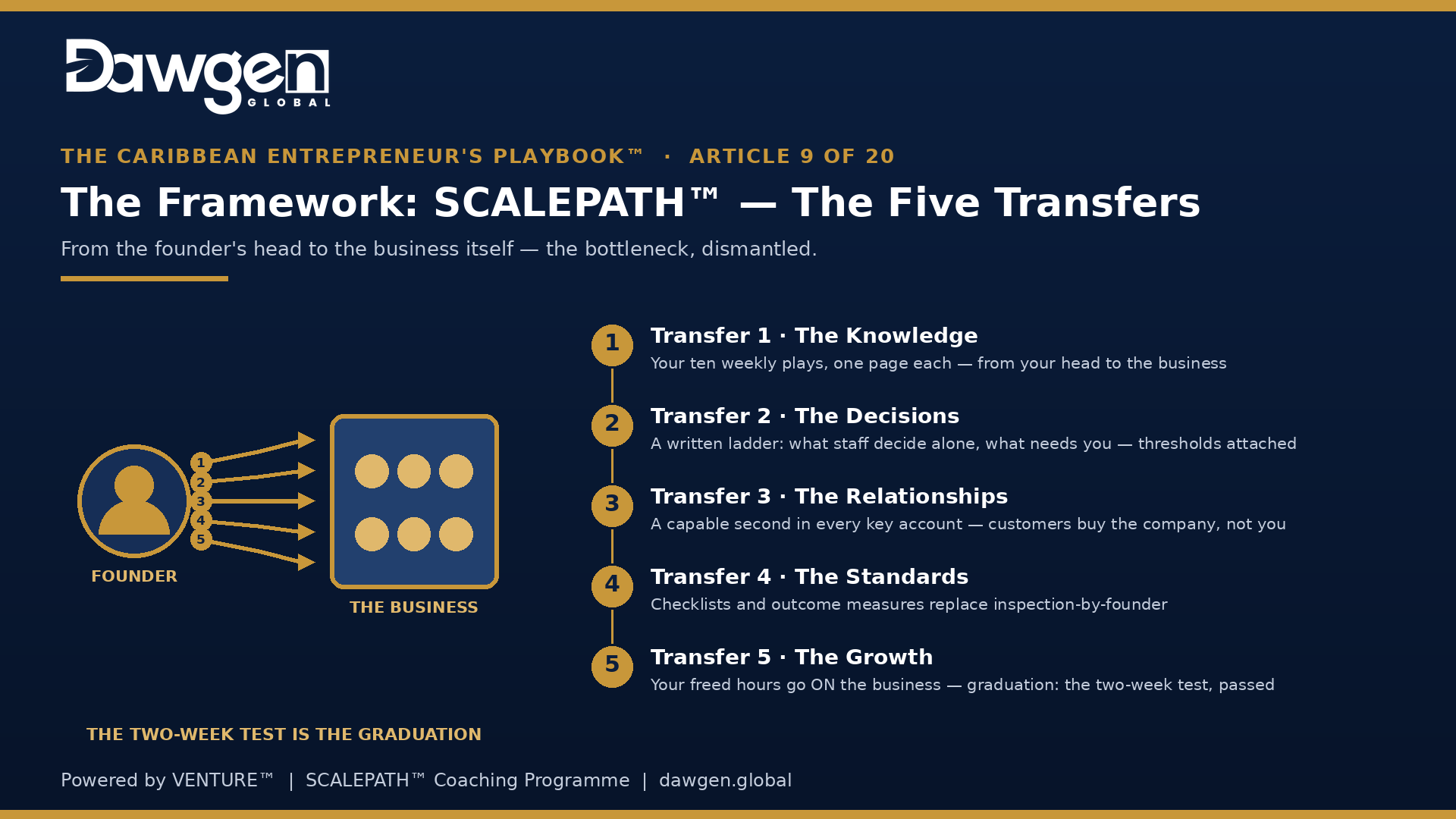
Founder dependence ends when five things move, deliberately, from the founder’s head into the business itself:
- Transfer 1 · The Knowledge — Document the business’s recurring plays — start with the ten processes you repeat every week: how a job is quoted, how a site is assessed, how a complaint is handled, how an invoice is chased. One page each, written or dictated, imperfect but existing. The test is brutal and clarifying: if you were unreachable for a month, could the business find its own answers? Every ‘no’ is a page that needs writing. Knowledge in your head is a liability; knowledge on a page is an asset.
- Transfer 2 · The Decisions — Build a decision ladder: decisions staff make alone (most of them, once named), decisions needing consultation, and the short list genuinely reserved for you. Attach money thresholds and write it down. The revelation for most founders is arithmetic: when the routed-through-me decisions are actually listed, eighty percent turn out to be delegable — they were being hoarded, not required. Every decision queued behind you costs the whole team’s waiting time; the ladder converts a queue into a flow.
- Transfer 3 · The Relationships — Customers and suppliers must graduate from buying you to buying the company. Introduce a capable second into every key relationship — deliberately, in good times, framed as an upgrade (“you now have two people who know your account”) rather than a handoff. The relationship transfer is the slowest of the five and the one most neglected until a crisis forces it; started early, it is painless. Started late, it is succession under fire.
- Transfer 4 · The Standards — Replace inspection-by-founder with quality the business enforces on itself: completion checklists, a defined review rhythm, and outcome measures — jobs right first time, complaints, rework — visible to the team weekly. Your eye was the quality system; now the system is the quality system, and your eye audits it occasionally instead of supervising it constantly. Measure outcomes, not presence: the goal is a business that performs when unobserved, which is the only kind that can grow.
- Transfer 5 · The Growth — The founder’s freed hours are not for leisure — they are for the job no one else can do: working on the business instead of in it. Pipeline and key-account development, strategy and pricing (Articles 1 and 7), people development, the expansion the flat years postponed. This is also the graduation exam: the two-week test. When you can leave for two weeks — genuinely unreachable — and return to a business that ran, decided and sold without you, the bottleneck is broken. That trip is not a reward for the work. It is the proof of it.
The Framework in Action: A Worked Scenario
The following scenario is a fictional composite created for this series to illustrate the framework. It does not depict any actual business or client of the firm.
Andre’s audit begins with an uncomfortable inventory: one week of logging shows thirty-one decisions routed through him, of which — by his own eventual admission — twenty-five needed only a rule, not a founder. The transfers begin. Ten one-page playbooks are dictated in the truck between site visits. His senior technician of eleven years becomes operations lead, with a written decision ladder and a spending threshold. Two clients meet their “second” over lunches Andre hosts personally.
The dip arrives on schedule: a mispriced quote in month two, a rework job in month three. Andre’s hand hovers over the wheel — and, coached through the moment, he holds. The playbook gets a paragraph instead of the ops lead losing the pen. In this illustration, month seven delivers the moment the whole framework points to: Andre takes his family to Grenada for two full weeks, phone off by agreement. While he is away, the company prices, wins and mobilizes the largest commercial contract in its history — closed entirely by the team, using the quoting playbook he dictated in a truck. He frames the signed contract beside a photo from the trip. One is the proof of the other.
Self-Diagnostic: Are You the Bottleneck?
One point for every “no”:
- Could the business run — decide, deliver, sell — for two weeks with you unreachable?
- Are your ten most repeated processes documented anywhere outside your head?
- Is there a written line showing which decisions staff make without you?
- Does every key customer and supplier relationship have a capable second?
- Have you taken a genuine, unplugged holiday of a week or more in the past two years?
Two or more points means the ceiling on your business has a name, and it is on the door of your office. The good news: unlike markets and banks, this constraint answers entirely to you.
When to Call In Help
This is the one problem in this series where outside help is nearly structural, because the founder is simultaneously the subject, the obstacle and the judge. The signals that say now: revenue flat for two or more years while you work at capacity; good staff leaving for employers who let them decide; health or family paying the business’s bills in hours and stress; or a succession horizon approaching (Article 15) with everything still in your head. A coach does what no employee can — tells the founder the truth about the founder — and what no founder can do alone: hold your hand off the wheel through the dip.
| BOOK A SCALEPATH™ FOUNDER-DEPENDENCE AUDIT
The SCALEPATH™ programme within Dawgen Global’s VENTURE™ Business Coaching System begins with a Founder-Dependence Audit: one week of decision logging, a dependence score across the Five Transfers, and a sequenced transfer plan — playbooks, decision ladder, relationship seconds, standards system — facilitated by a certified VENTURE™ coach who stays with you through the dip. The exit criterion is written into the engagement: the two-week test, passed. Contact us today to book your audit. 📩 [email protected] | 📞 876-929-3670 / 876-665-5926 | 🇺🇸 855-354-2447 | 🌐 dawgen.global GET THE FULL PLAYBOOK This is Article 9 of The Caribbean Entrepreneur’s Playbook™ — 20 problems, 20 how-to frameworks, one system. Pre-register at dawgen.global to receive the complete Playbook e-book on release, free. |
About Dawgen Global
Dawgen Global is an independent, integrated multidisciplinary professional services firm headquartered at 47 Trinidad Terrace, New Kingston, Jamaica, serving more than 15 territories across the Caribbean. Founded and led by Dr. Dawkins Brown, Executive Chairman, the firm is independent and not affiliated with any international network. It delivers a full suite of professional services under one roof: audit and assurance; tax advisory; IT and digital transformation; risk management; cybersecurity; actuarial and insurance regulatory advisory; HR advisory; mergers and acquisitions; corporate recovery; business advisory and strategy; accounting BPO and virtual CFO services; and legal process outsourcing.
The proposition is simple: big-firm capability without the big-firm price. Dawgen Global’s integrated approach is built for the specific complexities and opportunities of the Caribbean market, helping organizations make sharper, better-informed decisions that drive measurable progress.
To explore a partnership, reach out:
- Website: dawgen.global
- Email: [email protected]
- WhatsApp (Global): +1 555-795-9071
- Caribbean offices: +1 876-665-5926 | +1 876-929-3670 | +1 876-926-5210


