
Pricing is the most powerful profit lever a business owns — and the only one most owners pull once, by fear, and never touch again.
The Problem, Lived
“Marcus” builds custom furniture in a workshop outside Port of Spain — good work, a strong reputation, a full order book. Last year was the busiest in his company’s history: more jobs, more staff hours, more lumber through the shop than ever before. It was also, when his accountant finished the year-end numbers, one of his least profitable. Busiest year, thinnest margin. Busy and broke.
The autopsy is not complicated. Marcus set his prices years ago by looking at what two competitors charged and going slightly under. Since then, the imported hardwood, hardware and finishes that make up most of his cost have risen more than thirty percent — pushed by freight and the exchange rate — while his prices have moved once, timidly, by ten. Every quote he sends still “feels” right, because it is the number he is used to. And on several of his most popular pieces, he is now — without knowing it — paying customers for the privilege of building their furniture.
Marcus is not an exception; he is the pattern. Across the region, capable businesses are working harder every year for less, because the one number that determines profitability more than any other — the price — is set by habit, fear and folklore rather than by method.
Why It Happens Here
Small societies make pricing emotional. In a market where your customers are also your neighbors, raising prices feels like a public statement — “he get too dear” travels fast — so owners hold prices flat for years as a form of social self-defense. Competitor-copying compounds the problem: businesses benchmark against rivals’ prices without knowing rivals’ costs, so three underpricers can happily reference each other all the way to insolvency. And the region’s haggling culture trains both sides — customers open every purchase with “what’s your best price?”, and owners, dreading the dance, pre-discount by building the concession into the sticker.
Beneath the psychology sit two quiet structural killers. The first is FX drift: in import-dependent economies, input costs rise continuously with the exchange rate, so a price held flat is not stable — it is falling in real terms, every month, silently. The second is the invisible employee: most owners never cost their own labor into their products. The business “makes money” only because its most skilled worker — the owner — works for free. Any price built on free labor is not a price; it is a subsidy, and the owner is the sponsor.
| The Arithmetic Nobody Runs
For a business earning a thirty percent gross margin, a ten percent price increase — even if it costs some volume — flows almost entirely to profit. The same business granting a ten percent discount must sell roughly fifty percent more units just to earn the same gross profit as before. Read that again: the discount you give away in five seconds of negotiation requires half again your entire workload to recover. No other number in your business punishes casual handling this severely. |
Why Generic Advice Fails
Online pricing content lives in another economy: Silicon Valley articles about SaaS tiers and “charging what you’re worth,” written for products with zero marginal cost and continental markets. None of it survives contact with a Caribbean trading or manufacturing business facing FX-driven input costs, a finite local customer base and buyers who negotiate as a courtesy ritual. The imported advice fails in both directions — it either emboldens reckless increases with no costing behind them, or it drowns the owner in strategy theory while the real problem sits unexamined: nobody in the business actually knows what anything truly costs to sell.
The Framework: The PRICE Discipline™, Step by Step
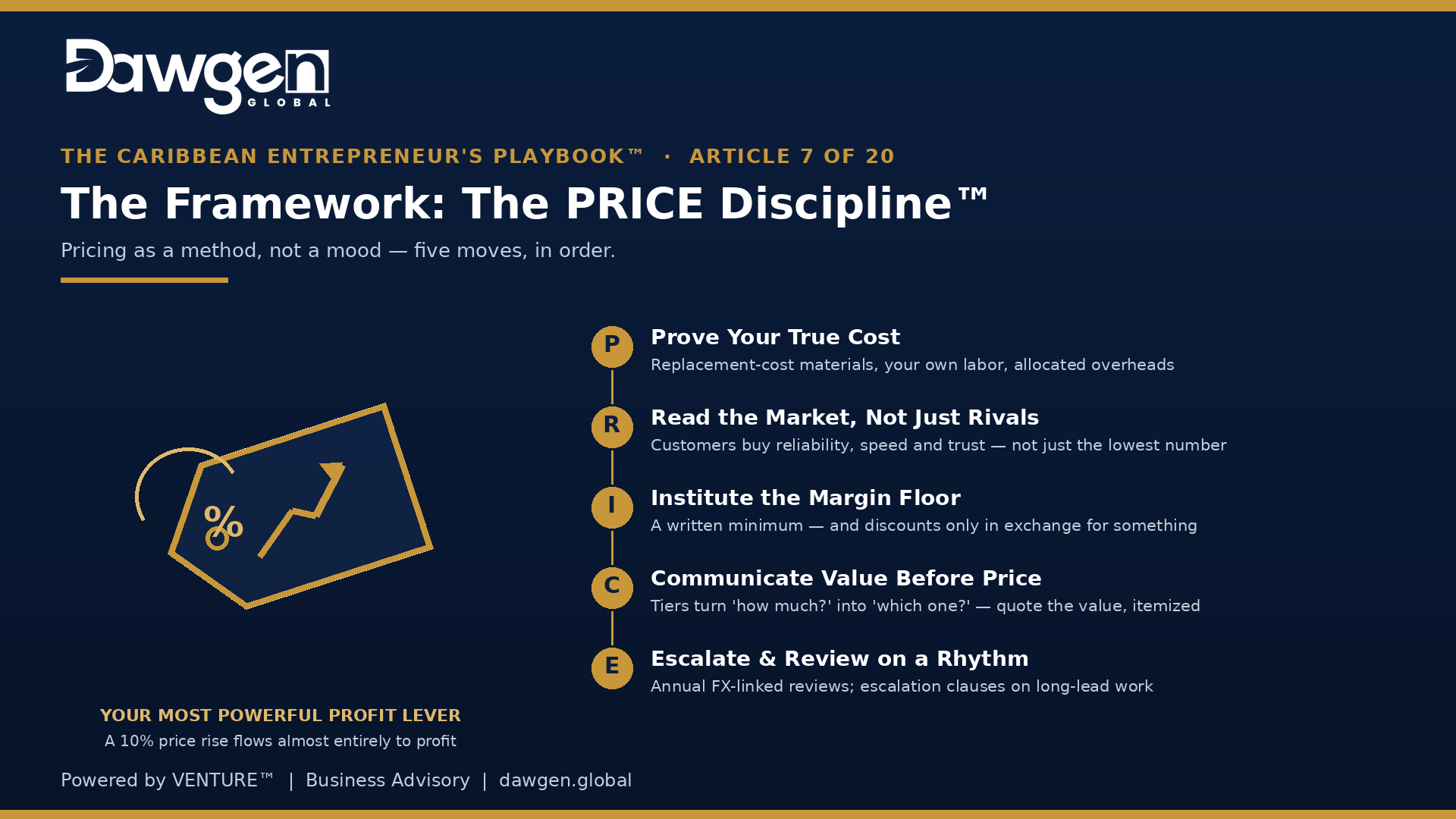
Pricing for profit is a discipline with five moves — P·R·I·C·E — done in order, because each one makes the next possible:
- P · Prove Your True Cost — Build the honest cost of every product or service: materials at today’s replacement cost (not what you paid last year — what it will cost to buy again at today’s exchange rate), a fair market wage for your own hours, and a real share of the overheads — rent, utilities, insurance, vehicle — that every job must carry. Most owners who do this exercise properly discover at least one offering they have been selling at a loss for years. You cannot price with confidence until you know, per item, the number below which every sale makes you poorer.
- R · Read the Market, Not Just Rivals — Competitor prices tell you what others charge, not what customers will pay — and those are very different numbers. Study what your best customers actually buy from you: reliability, speed, trust, the phone that gets answered, the job done right the first time. In small markets these count double, because word of mouth is the market. Buyers who choose purely on price are one segment, not the market — and usually the segment you can most afford to lose.
- I · Institute the Margin Floor — Set a written minimum margin below which the business does not sell — not “tries not to,” does not — and convert your discount chaos into discount rules: who may discount, by how much, and always in exchange for something (larger volume, faster payment, a deposit). A discount that buys nothing is not a negotiation; it is a donation. The margin floor turns pricing from a mood into a policy, which is precisely what makes it survivable in the haggling dance — “the price is the price” is easy to say when it is written down.
- C · Communicate Value Before Price — Restructure how prices are presented. Offer tiers — a good, better and best version of what you sell — so the customer’s question changes from “how much?” to “which one?”, and the negotiation moves from your margin to their options. Quote in writing, itemizing what the price contains: the materials grade, the timeline, the warranty, the aftercare. A number arriving naked invites attack; a number arriving dressed in its value invites comparison — and you win comparisons you lose haggles.
- E · Escalate and Review on a Rhythm — Put pricing on the calendar: a full review at least annually, tied explicitly to input costs and the exchange rate, with modest regular adjustments instead of rare traumatic ones — customers forgive a small annual increase and resent a sudden thirty percent correction, even when the correction is years overdue. And for any work quoted today but delivered months away, build an escalation clause: long lead times in an FX economy without price protection are speculation, with your margin as the stake.
The Framework in Action: A Worked Scenario
The following scenario is a fictional composite created for this series to illustrate the framework. It does not depict any actual business or client of the firm.
Marcus starts with P, and the costing exercise delivers its customary shock: once his own bench hours carry a wage and his lumber is priced at replacement cost, two of his five standard pieces have been selling below true cost — including the dining set that drives most of his volume. The busiest-year-thinnest-margin mystery dissolves: he had been scaling a loss.
The rebuild follows the letters. His quotes become documents — materials grade, build time, finish warranty — presented in three tiers, and he discovers what tiered sellers everywhere discover: a meaningful share of customers choose the middle or upper option when given the choice they were never offered. Prices on custom work rise twelve percent behind the new presentation. A handful of haggle-first customers leave loudly; in this illustration, revenue barely moves, but gross margin climbs from single digits to the high teens within three quarters — the difference between a business that consumes its owner and one that pays him. His long-lead contracts now carry an FX escalation clause, and every January the price list gets its annual review, on the calendar, like the fire extinguisher inspection: routine, boring and life-saving.
Self-Diagnostic: Is Your Pricing a Method or a Mood?
One point for every “no”:
- Do you know the true cost — materials at replacement cost, your own labor, allocated overheads — of each thing you sell?
- Have your prices been reviewed against input costs and the exchange rate within the last twelve months?
- Is there a written margin floor below which the business will not sell?
- Do your quotes present tiers and itemized value rather than a single naked number?
- Do your discount decisions follow rules — who, how much, in exchange for what?
Two or more points means your prices are being set by history and hope — and in an FX economy, history and hope have a direction, and it is down.
When to Call In Help
Certain patterns say the pricing problem has outgrown self-help: you are busier than ever and less profitable than before; you cannot state your margin by product or service; prices have not moved in two or more years while the exchange rate has; every sale ends in negotiation; or you are bidding on contracts without a costing model behind the bids. Each is a version of the same disease — flying a business on instruments that were never calibrated — and the fix is not courage, it is method. An outside review also does something psychologically valuable: it takes the price increase out of your mouth and puts it in the analysis, where customers and even your own staff receive it differently.
| BOOK A PRICING & MARGIN REVIEW
Dawgen Global’s Business Advisory team delivers a structured Pricing & Margin Review: we build your true per-product costing — replacement-cost materials, owner labor, allocated overheads — benchmark your market position, quantify exactly where margin is leaking, and install the PRICE Discipline™: margin floors, discount rules, tiered offers, value-framed quoting and an FX-linked review rhythm. Most businesses find their next year of profit growth hiding inside their current price list. Contact us today to book your review. 📩 [email protected] | 📞 876-929-3670 / 876-665-5926 | 🇺🇸 855-354-2447 | 🌐 dawgen.global GET THE FULL PLAYBOOK This is Article 7 of The Caribbean Entrepreneur’s Playbook™ — 20 problems, 20 how-to frameworks, one system. Pre-register at dawgen.global to receive the complete Playbook e-book on release, free. |
About Dawgen Global
Dawgen Global is an independent, integrated multidisciplinary professional services firm headquartered at 47 Trinidad Terrace, New Kingston, Jamaica, serving more than 15 territories across the Caribbean. Founded and led by Dr. Dawkins Brown, Executive Chairman, the firm is independent and not affiliated with any international network. It delivers a full suite of professional services under one roof: audit and assurance; tax advisory; IT and digital transformation; risk management; cybersecurity; actuarial and insurance regulatory advisory; HR advisory; mergers and acquisitions; corporate recovery; business advisory and strategy; accounting BPO and virtual CFO services; and legal process outsourcing.
The proposition is simple: big-firm capability without the big-firm price. Dawgen Global’s integrated approach is built for the specific complexities and opportunities of the Caribbean market, helping organizations make sharper, better-informed decisions that drive measurable progress.
To explore a partnership, reach out:
- Website: dawgen.global
- Email: [email protected]
- WhatsApp (Global): +1 555-795-9071
- Caribbean offices: +1 876-665-5926 | +1 876-929-3670 | +1 876-926-5210


