
Your business may already own all the cash it needs. It is simply being stored in other people’s bank accounts — and on your own shelves.
The Problem, Lived
“Simone” runs a food-and-beverage distribution business out of Bridgetown, supplying hotels, restaurants and supermarkets across the island. Last month she sat across from a bank officer and heard the word “declined” on a working capital facility she needed to take on a new hotel group. On the drive back to the warehouse, the arithmetic tormented her: the amount she had asked the bank for was less than half of what her own customers currently owed her.
Walk through her operation and the picture sharpens. The receivables ledger shows invoices at forty, sixty, ninety days — hotels that pay “when the cheque run happens,” a supermarket chain that unilaterally decided its terms are seventy-five days, and a handful of smaller accounts that have quietly become interest-free loans. Meanwhile the storeroom tells the other half of the story: pallets of slow-moving stock bought in bulk to save on freight, sitting there month after month, each carton a small brick of frozen cash.
Simone’s business is not short of capital. Her capital is simply out on unauthorized loan — to her customers, and to her own shelves. This is the asset-rich, cash-poor trap, and it is the standard operating condition of the Caribbean trading business. Article 5 of this series taught you to see your cash. This article is about going and getting it back.
Why It Happens Here
Start with the power asymmetry. The region’s dominant buyers — hotel groups, supermarket chains, government agencies — set payment terms by fiat, and a small supplier’s leverage to object feels close to zero. But asymmetry only explains part of the ledger. Much of what sits in Caribbean receivables is not imposed; it is conceded — by businesses that never set terms at the start, never established credit limits, and never built a systematic follow-up because chasing money feels like an accusation. In small societies, this is real: the customer who owes you sixty days is also someone you will see at church, at the school gate, at the funeral. So the call does not get made, and courtesy quietly becomes financing.
The inventory side has its own regional logic. Import economics push owners to over-order — three months of stock to fill a container, to hedge shipping delays, to beat a price increase. Each decision is individually rational; collectively they turn the storeroom into a warehouse of trapped capital, carrying costs, expiry risk and dust. Then there is the governance gap that ties it together: in most small firms, nobody owns the number. Receivables are “the office’s” job, no aging report is reviewed weekly, and the owner discovers the problem the way Simone did — in a bank meeting, at the worst possible moment.
| Stock Is Cash in Costume
Every dollar on your shelves and every dollar in your debtors’ hands is a dollar of your capital working for someone else, interest-free. Before asking a bank to lend you working capital at commercial rates, ask a harder question first: how much of your own working capital have you lent out — and what would it take to call the loan? |
Why Generic Advice Fails
The internet’s receivables playbook leans on tools that assume another market’s infrastructure: invoice factoring platforms that barely operate here, automated dunning software wired to banking rails the region does not have, and the confident advice to “charge late fees” — try invoicing a penalty to a hotel group that represents thirty percent of your revenue and see which of you blinks. None of it engages the actual Caribbean levers: policy set before the sale, disciplined human follow-up that preserves relationships precisely because it is systematic rather than personal, and the neglected other half of working capital — the shelf and the supplier.
That whole-cycle view is what Dawgen Global’s WC-PULSE™ framework was built for: working capital as one connected system — customers, stock and suppliers — with cash released from all three at once.
The Framework: WC-PULSE™ — The Five Releases, Step by Step
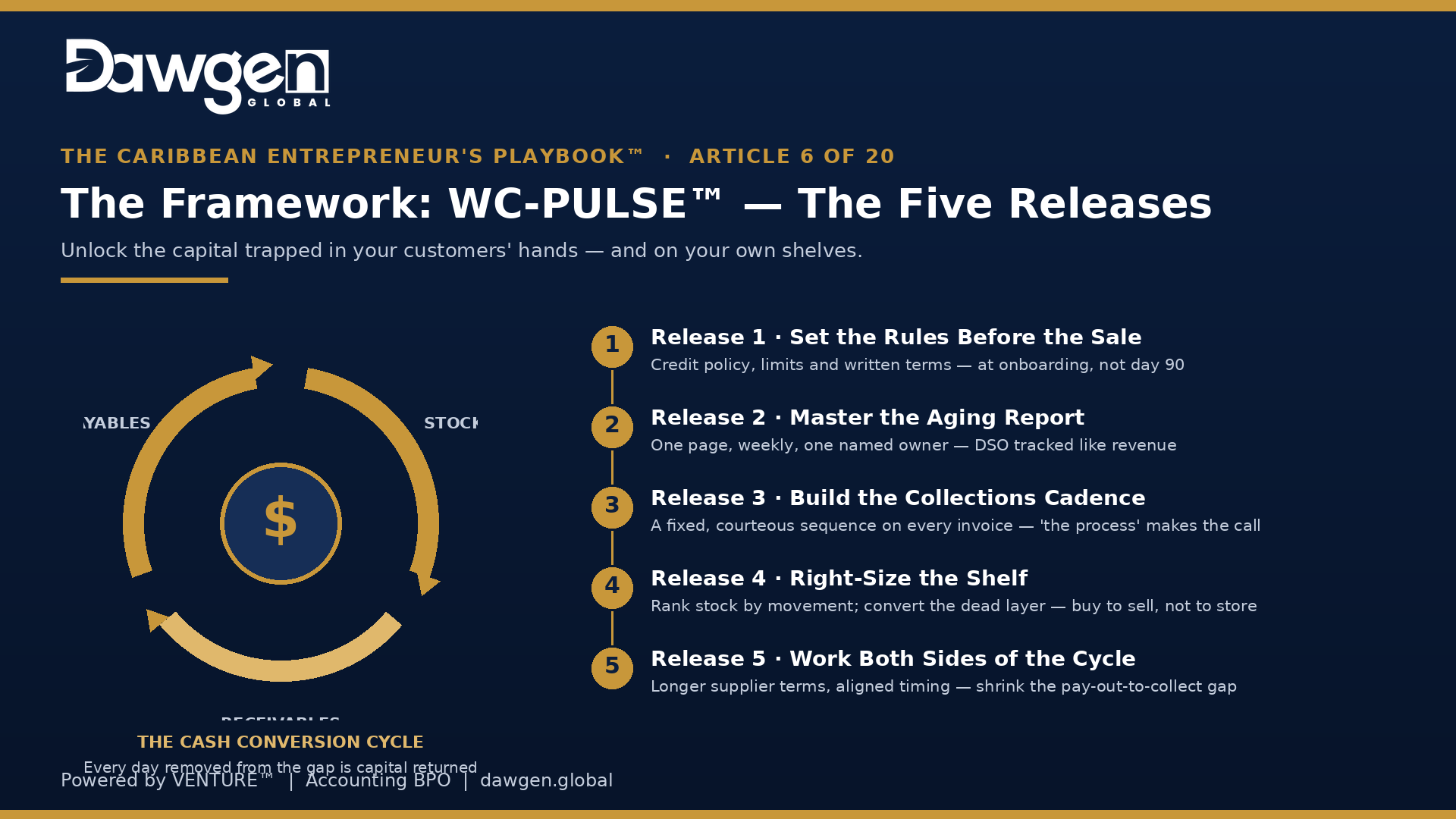
Think of trapped working capital as held in five locks. Each release opens one:
- Release 1 · Set the Rules Before the Sale — Collections begin at onboarding, not at the due date. Every new credit customer gets a simple credit application, a defined limit, agreed written terms, and — for larger exposures — a basic credit check. The customer who resists reasonable terms at the start is showing you the future; believe them. It is a hundred times easier to set rules before the first invoice than to impose them after the ninetieth day.
- Release 2 · Master the Aging Report — One page, reviewed every week without exception: every amount owed, bucketed by age — current, 30, 60, 90-plus — with one named person who owns the number. Track your Days Sales Outstanding (DSO) monthly the way you track revenue; it is the vital sign of your working capital. What is startling about this discipline is not its difficulty but its rarity: most owners who install it are seeing their true exposure, by name and by age, for the first time.
- Release 3 · Build the Collections Cadence — Replace sporadic, awkward chasing with a fixed, polite sequence that runs on every invoice automatically: a statement before the due date, a courteous call at the due date, a firmer escalation at fifteen days, a stop-supply conversation at an agreed threshold. The cadence protects the relationship because it depersonalizes the ask — “our process” made the call, not wounded feelings. Customers pay the suppliers who follow up systematically first. Quiet suppliers are paid last, everywhere on earth.
- Release 4 · Right-Size the Shelf — Audit the storeroom with cold eyes: rank stock by how fast it moves, flag everything that has not turned in ninety days, and convert the dead layer to cash — promotion, bundle, discount, even at cost. Then fix the intake side with simple reorder points that balance freight economics against carrying cost honestly: the container savings are visible on the invoice, but the capital, storage, spoilage and obsolescence they cost you never appear on any bill. Buy to sell, not to store.
- Release 5 · Work Both Sides of the Cycle — Working capital is a cycle with three dials: how long stock sits (inventory days), how long customers take to pay (DSO), and how long you take to pay suppliers (payable days). You have now shortened the first two — complete the cycle by negotiating the third: longer supplier terms in exchange for volume commitments or reliability, and payment timing aligned to your collection rhythm. Shrinking the gap between paying out and collecting in is the entire game. Every day removed from that gap is capital returned to you, permanently, without borrowing a cent.
A Note on Financing the Gap
Sometimes, even with all five releases done, growth genuinely outruns internal capital — a contract too large to self-fund is a good problem that deserves proper financing, and options from working capital facilities to receivables financing have their place. The sequencing rule is what matters: fix the process first, finance second. Borrowing against a broken receivables process does not solve the problem; it rents a postponement of it, at interest. Lenders can see the difference too — the business that arrives with a weekly aging report, a falling DSO and a documented credit policy is a different applicant from the one Simone was in that first meeting.
The Framework in Action: A Worked Scenario
The following scenario is a fictional composite created for this series to illustrate the framework. It does not depict any actual business or client of the firm.
Simone’s first aging report is the shock the framework predicts: over forty percent of her receivables are beyond sixty days, and two customers account for half of everything owed. The releases go in one at a time. New accounts — including the hotel group she was chasing — now onboard with credit applications, limits and agreed terms; one prospective customer balks and walks, which she now reads correctly as a bad debt declining to happen. The cadence starts running: statements, calls, escalations, all courteous, all relentless, all “the process.”
The storeroom audit is humbling — a meaningful slice of her stock has not moved in a hundred days — and a six-week promotion converts most of the dead layer back into cash. Her two largest suppliers, offered a committed monthly volume, extend her terms substantially. In this illustration, two quarters later her DSO has fallen from the low seventies to the mid-forties, inventory turns have nearly doubled, and the combined release has freed more cash than the facility the bank declined. She takes on the hotel group anyway — self-funded — and when she returns to the bank a year later for a genuine growth facility, she brings the aging report with her. This time the conversation is different, because the business asking is different.
Self-Diagnostic: How Much of Your Capital Is Out on Loan?
One point for every “no”:
- Do you review a receivables aging report every week, with one named person owning it?
- Does every credit customer have written terms and a credit limit agreed before their first order?
- Does a fixed follow-up sequence run automatically on every invoice — starting before the due date?
- Do you know which of your stock items have not moved in ninety days?
- Do you know your cash conversion cycle — the days between paying suppliers and collecting from customers?
Two or more points means a meaningful share of your working capital is currently financing other businesses. They have not asked for the loan, and they are not paying interest — but they will keep it for as long as you let them.
When to Call In Help
Bring in professional support when the signals turn structural: you cannot produce an aging report because the bookkeeping behind it is behind; your DSO is above sixty days or simply unknown; a bank has declined you for working capital; you are contemplating receivables financing; or growth is accelerating and every new customer stretches the gap wider. Each of these says the system, not the effort, is the constraint — and systems are precisely what an outside team installs faster and more objectively than anyone inside the daily relationships can.
| REQUEST A WC-PULSE™ WORKING CAPITAL ASSESSMENT
Dawgen Global’s Accounting BPO team delivers the WC-PULSE™ Working Capital Assessment: we build your true aging picture, measure your cash conversion cycle, quantify exactly how much of your capital is trapped in receivables and stock, and install the Five Releases — credit policy, weekly aging discipline, collections cadence, inventory right-sizing and supplier-terms strategy. Most businesses discover they are their own largest untapped lender. Contact us today to request your assessment. 📩 [email protected] | 📞 876-929-3670 / 876-665-5926 | 🇺🇸 855-354-2447 | 🌐 dawgen.global GET THE FULL PLAYBOOK This is Article 6 of The Caribbean Entrepreneur’s Playbook™ — 20 problems, 20 how-to frameworks, one system. Pre-register at dawgen.global to receive the complete Playbook e-book on release, free. |
About Dawgen Global
Dawgen Global is an independent, integrated multidisciplinary professional services firm headquartered at 47 Trinidad Terrace, New Kingston, Jamaica, serving more than 15 territories across the Caribbean. Founded and led by Dr. Dawkins Brown, Executive Chairman, the firm is independent and not affiliated with any international network. It delivers a full suite of professional services under one roof: audit and assurance; tax advisory; IT and digital transformation; risk management; cybersecurity; actuarial and insurance regulatory advisory; HR advisory; mergers and acquisitions; corporate recovery; business advisory and strategy; accounting BPO and virtual CFO services; and legal process outsourcing.
The proposition is simple: big-firm capability without the big-firm price. Dawgen Global’s integrated approach is built for the specific complexities and opportunities of the Caribbean market, helping organizations make sharper, better-informed decisions that drive measurable progress.
To explore a partnership, reach out:
- Website: dawgen.global
- Email: [email protected]
- WhatsApp (Global): +1 555-795-9071
- Caribbean offices: +1 876-665-5926 | +1 876-929-3670 | +1 876-926-5210


