
The invisible ceiling on your growth may not be your product, your prices or your effort. It may be your paperwork.
The Problem, Lived
Picture “Damion,” who has spent six years building an auto-parts supply operation out of Half-Way Tree. His customer base is loyal, his sourcing network is excellent, and his monthly sales would surprise many registered companies. Then a logistics company with a forty-vehicle fleet asks him to quote on a supply contract — the kind of customer that changes a business permanently.
The procurement officer asks for three things: a certificate of incorporation or business registration, a Tax Compliance Certificate, and financial statements. Damion has none of them. The contract goes to a smaller, less capable — but registered — competitor. No banker, no grant programme and no corporate customer will ever tell him how much opportunity his informality is costing him. They will simply, quietly, choose someone else.
This is the formalization trap: the hustle that got the business off the ground becomes the ceiling that stops it from rising. And it is one of the most widespread — and most solvable — problems in Caribbean enterprise.
Why It Happens Here
Informality is not laziness or evasion; across the Caribbean it is the default starting condition of entrepreneurship. Businesses are born from necessity, in cash, at speed. Registration feels like something you do “once the business is big enough” — and there is genuine fear underneath the delay: fear that registering means taxes on day one, fear of bureaucracy, fear that the paperwork demands an accountant the business cannot yet afford.
The result is a large informal economy in which capable operators systematically exclude themselves from everything that scales a business: bank credit, supplier credit terms, government and corporate contracts, grant and development funding, insurance, and ultimately a business that can be valued and sold. Informal businesses do not just grow slower — they are structurally locked out of the mechanisms of growth.
It is worth confronting the biggest fear directly, because it is largely a myth: registering does not mean the tax authorities take a slice of everything from day one. Tax is assessed on profit, not on existence — a newly formalized business investing in growth may owe little in its early years, and formalization actually unlocks deductions, incentives and thresholds that informal operators can never claim. Meanwhile, GCT registration is only compulsory once turnover crosses the statutory threshold. The fear of formalization is almost always larger than the reality of it; the cost of informality is almost always larger than the owner believes.
| Reframe the Question
The question is not “can I afford to formalize?” It is “how much is informality already costing me?” Every declined contract, every loan you never applied for, and every supplier who will not extend credit terms is the invisible tax you are paying right now. |
Why Generic Advice Fails
Search online for “how to register a business” and you will find detailed guidance on Delaware LLCs, IRS employer identification numbers and Stripe Atlas — none of which will register a single business in Kingston, Bridgetown or Port of Spain. Caribbean formalization runs through Caribbean institutions: in Jamaica, the Companies Office of Jamaica, Tax Administration Jamaica, and the statutory payroll agencies. The sequence, thresholds and documents are specific — and getting them wrong at the start creates compliance debt that costs far more to fix later than to do correctly now.
The Framework: The Formalization Ladder™, Step by Step
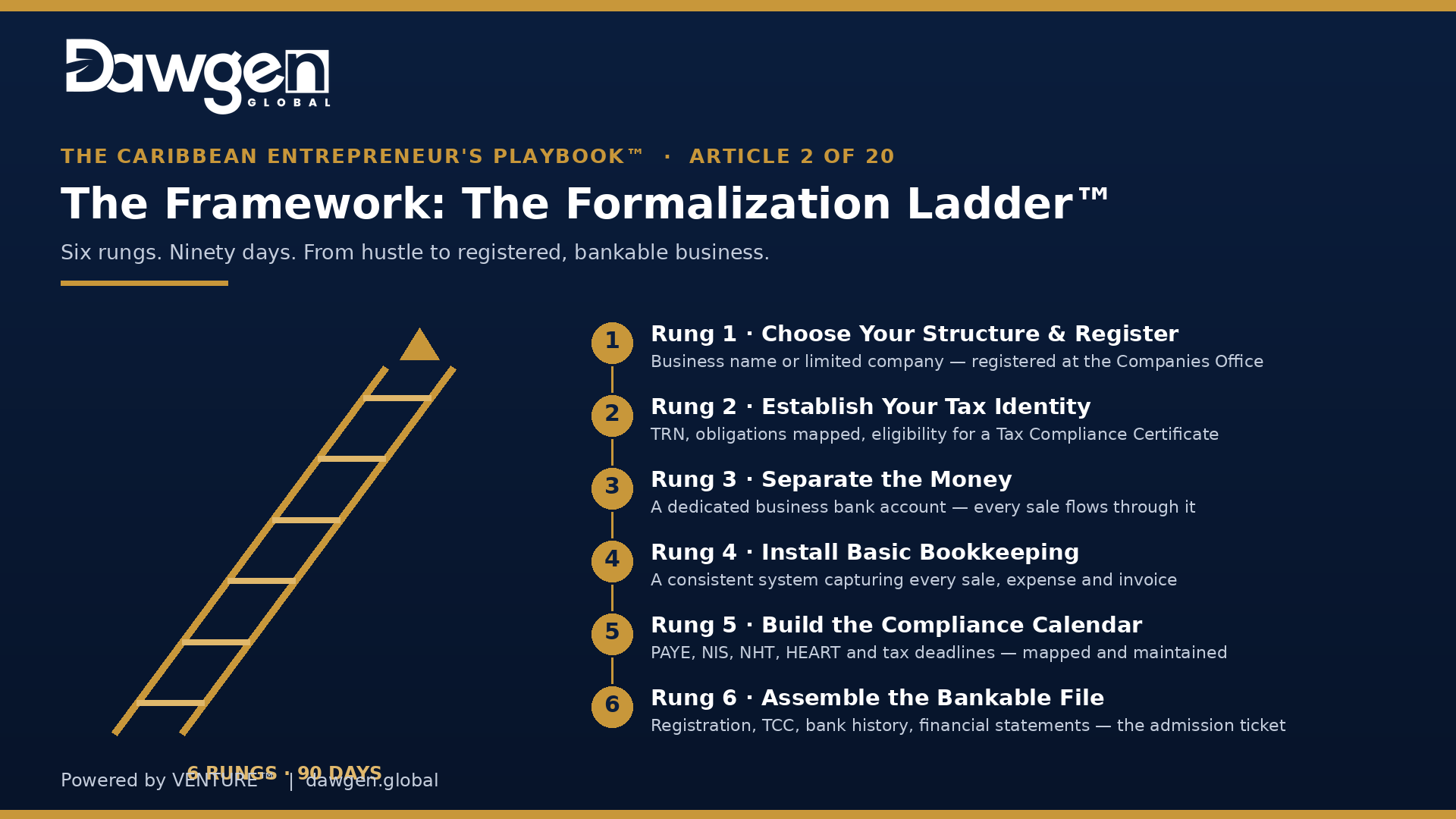
Formalization is not one giant leap; it is a ladder with six rungs, climbable in roughly 90 days. Here is the sequence — using Jamaica as the reference market; certified advisors adapt it across our 15+ territories:
- Rung 1 · Choose Your Structure and Register — Decide between registering a business name (sole trader) and incorporating a limited liability company. The right answer depends on liability exposure, the contracts you intend to pursue, and your growth and succession intentions — corporate customers and lenders generally take incorporated entities more seriously. Registration is completed through the Companies Office of Jamaica.
- Rung 2 · Establish Your Tax Identity — Secure the business’s Taxpayer Registration Number and understand your obligations with Tax Administration Jamaica. Note that GCT registration is only mandatory above the statutory annual turnover threshold — many small businesses formalize without immediately collecting GCT. The prize at this rung is eligibility for a Tax Compliance Certificate (TCC), the document that unlocks corporate and government contracts.
- Rung 3 · Separate the Money — Open a dedicated business bank account and stop running the business through personal accounts. This is the single most transformative operational step: it creates the transaction history that future loan applications, financial statements and valuations are built on.
- Rung 4 · Install Basic Bookkeeping — Adopt a simple, consistent system — cloud accounting software or an outsourced bookkeeping service — that captures every sale, expense and invoice. Records are not a compliance chore; they are how you learn what the business actually earns, and they become the raw material of bankability.
- Rung 5 · Build the Statutory Compliance Calendar — If you employ staff, map the payroll-related statutory obligations — PAYE, NIS, NHT and HEART contributions — and their filing dates, alongside your income tax and any GCT deadlines. A one-page compliance calendar, maintained monthly, keeps the newly formal business clean. Falling behind quietly is how formal businesses drift back into trouble.
- Rung 6 · Assemble the Bankable File — Compile the pack every gatekeeper asks for: registration documents, TCC, bank statements, and — as your records mature — proper financial statements. This file is your admission ticket to fleet contracts, tender lists, credit facilities and grant programmes. From here, opportunity stops filtering you out.
The sequence matters as much as the steps. Structure before tax identity, tax identity before banking, banking before records, records before the bankable file — each rung is built on the one below it, which is why businesses that formalize piecemeal, out of order, so often end up with gaps that surface at the worst possible moment: mid-tender, or mid-loan-application. Climbed in order, the ladder is a 90-day project. Climbed randomly, it can take years and still be incomplete.
The Framework in Action: A Worked Scenario
The following scenario is a fictional composite created for this series to illustrate the framework. It does not depict any actual business or client of the firm.
Return to Damion. Stung by the lost fleet contract, he commits to the ladder. In month one he incorporates a limited company and secures its TRN. In month two he opens the business account, routes all sales through it, and engages an outsourced bookkeeping service for a modest monthly fee — less than he spends on phone credit and fuel for informal workarounds. In month three he brings his one employee onto a proper payroll and builds his compliance calendar.
By month four he holds a Tax Compliance Certificate and a bank file showing real, verifiable revenue. When the logistics company tenders again the following quarter — in this illustration — Damion submits a compliant bid and wins a twelve-month supply contract. Six months later, his transaction history supports a working capital facility to stock ahead of demand. Nothing about his skill changed. What changed is that the formal economy could finally see him.
Self-Diagnostic: How Visible Is Your Business?
One point for every “no”:
- Is your business registered or incorporated in its own right?
- Could you produce a Tax Compliance Certificate within two weeks if a contract required it?
- Does the business have its own bank account through which all revenue flows?
- Are your sales and expenses recorded in a system other than your memory or a notebook?
- If asked for last year’s financial statements, could you provide them?
Two or more points means the formal economy — its contracts, credit and capital — currently cannot see you. The good news: this is the most fixable problem in this entire series.
When to Call In Help
The ladder can be climbed alone, but the two places owners most often stall are structure selection (Rung 1) and the tax registrations (Rung 2) — where an early wrong choice creates years of unnecessary cost or compliance debt. Choosing the wrong structure can mean personal exposure to business liabilities, or a corporate shell whose obligations outweigh its benefits at your current size. Mishandling the transition of an operation that already has revenue history is riskier still, and deserves professional guidance on how to enter the formal system cleanly and correctly.
If your business already has meaningful revenue in the informal economy, that guidance is not a luxury; it is protection. And the arithmetic is straightforward: a structured formalization engagement typically costs a fraction of a single lost corporate contract — the kind you may already have lost without ever knowing it was on the table.
| REQUEST A FORMALIZATION READINESS REVIEW
Dawgen Global’s Accounting BPO and Tax Advisory teams provide a structured Formalization Readiness Review: we assess your current position, recommend the right structure, sequence your registrations, install your bookkeeping and compliance calendar, and assemble your bankable file — a guided 90-day path from hustle to registered, bankable business. Contact us today to request your review. 📩 [email protected] | 📞 876-929-3670 / 876-665-5926 | 🇺🇸 855-354-2447 | 🌐 dawgen.global GET THE FULL PLAYBOOK This is Article 2 of The Caribbean Entrepreneur’s Playbook™ — 20 problems, 20 how-to frameworks, one system. Pre-register at dawgen.global to receive the complete Playbook e-book on release, free. |
About Dawgen Global
Dawgen Global is an independent, integrated multidisciplinary professional services firm headquartered at 47 Trinidad Terrace, New Kingston, Jamaica, serving more than 15 territories across the Caribbean. Founded and led by Dr. Dawkins Brown, Executive Chairman, the firm is independent and not affiliated with any international network. It delivers a full suite of professional services under one roof: audit and assurance; tax advisory; IT and digital transformation; risk management; cybersecurity; actuarial and insurance regulatory advisory; HR advisory; mergers and acquisitions; corporate recovery; business advisory and strategy; accounting BPO and virtual CFO services; and legal process outsourcing.
The proposition is simple: big-firm capability without the big-firm price. Dawgen Global’s integrated approach is built for the specific complexities and opportunities of the Caribbean market, helping organizations make sharper, better-informed decisions that drive measurable progress.
To explore a partnership, reach out:
- Website: dawgen.global
- Email: [email protected]
- WhatsApp (Global): +1 555-795-9071
- Caribbean offices: +1 876-665-5926 | +1 876-929-3670 | +1 876-926-5210


