How organizations can turn responsible AI principles into daily control discipline
EXECUTIVE SUMMARY
Many organizations have responded to AI risk by drafting an AI policy. That is a necessary first step — but a policy is not governance. A policy defines the rules; an AI Operating Model defines how those rules are executed: who approves use cases, who owns risks, who monitors activity, who validates outputs, who responds to incidents, and who reports to the board. This article — the ninth in Dawgen Global’s AI Governance & Assurance Series, and the piece where the series becomes implementable — sets out the eight components of the Dawgen Global AI Operating Model, wiring together the disciplines built across the previous eight articles into a single, proportionate, daily control discipline. It also addresses the question mid-sized Caribbean organizations ask most: how to achieve this discipline without a dedicated AI governance office.
A policy is not governance
Many organizations have responded to artificial intelligence risk by drafting an AI policy. This is a necessary first step. A policy can define acceptable use, prohibited activities, data restrictions, approval requirements, vendor expectations, employee responsibilities, and escalation procedures.
But a policy is not governance.
A policy may say that confidential data must not be entered into public AI tools. But if employees are not trained, approved tools are not available, AI usage is not monitored, and data loss controls are weak, the policy may have limited practical effect.
A policy may say that AI outputs must be reviewed before use. But if review standards are unclear, approval evidence is not retained, and accountability is vague, the control may become symbolic.
A policy may say that AI vendors must be assessed. But if procurement, legal, cybersecurity, data protection, and business teams are not aligned, AI vendor risk may still enter the organization unnoticed.
The next stage of AI governance is therefore not simply better policy. It is the creation of an AI Operating Model.
This article is the ninth in our AI Governance & Assurance Series — and it is where the series becomes implementable. The previous eight articles built the disciplines: converged cyber-AI controls, agent guardrails, independent assurance, continuous validation, evidence trails, vendor risk, sector application, and generative AI security. The operating model is where those disciplines stop being articles and start being someone’s job.
Why AI governance must become operational
AI adoption is no longer confined to technology departments. Employees may use generative AI for drafting, analysis, coding, research, reporting, and communication. Vendors may embed AI into systems already used by finance, HR, customer service, marketing, operations, legal, compliance, and cybersecurity. Business units may pilot AI agents to automate workflows and improve productivity.
This means AI risk now appears across the enterprise. The organization needs a practical operating model that answers:
- Who approves AI use cases, and who owns AI risks?
- Who reviews AI vendors, and who monitors AI activity?
- Who validates AI outputs, and who responds to AI incidents?
- Who reports AI risk to the board, and who provides independent assurance?
Without clear ownership, AI governance becomes fragmented. Departments may act independently, controls may vary, and management may lack a consolidated view of exposure.
For organizations subject to Jamaica’s Data Protection Act, the operational point is statutory as well as practical: accountability under the Act means being able to demonstrate compliant processing — a requirement satisfied by structures, workflows, and evidence, not by a policy document in a shared drive.
The difference between policy and operating model
An AI policy defines the rules. An AI Operating Model defines how those rules are executed.
The operating model assigns roles, workflows, decision rights, controls, monitoring routines, escalation paths, reporting lines, assurance procedures, and accountability mechanisms. It converts responsible AI principles into repeatable business practice.
A strong AI Operating Model ensures that AI governance is not dependent on individual judgment alone. It becomes embedded into procurement, technology deployment, cybersecurity, internal audit, risk management, data governance, HR training, legal review, and board oversight.
The eight components of the Dawgen Global AI Operating Model
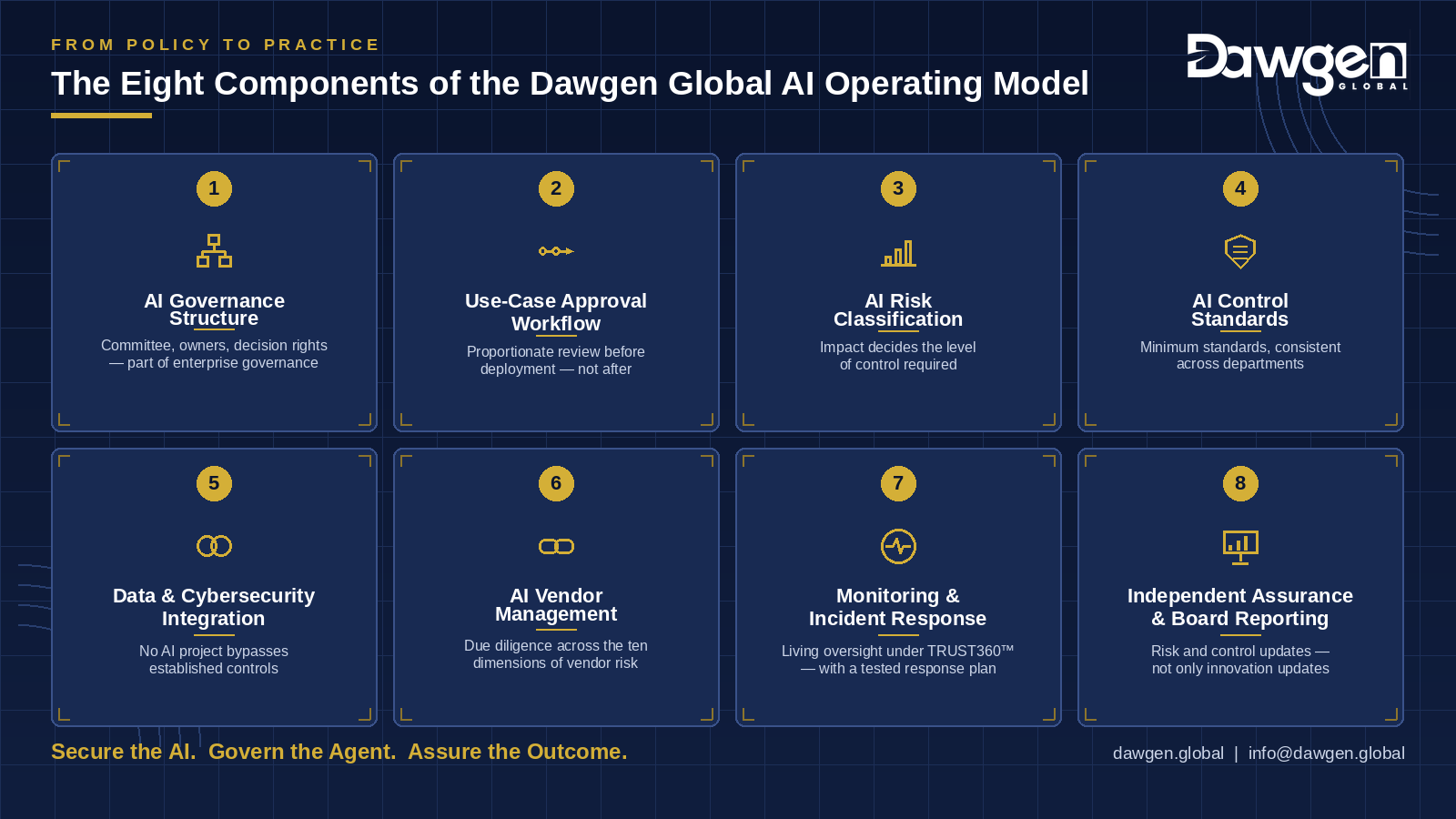
Dawgen Global recommends that organizations build their AI Operating Model around eight practical components — each of which operationalizes a discipline established earlier in this series.
1. AI governance structure
Organizations should establish a clear governance structure for AI. This may include an AI steering committee, executive sponsor, risk owner, technology owner, data protection representative, cybersecurity lead, legal and compliance adviser, internal audit liaison, and business unit representatives.
The governance structure should define who has authority to approve AI use cases, classify risk, accept residual risk, escalate issues, and report to executive management and the board. AI governance should not be informal or optional. It should be part of the enterprise governance framework.
2. AI use-case approval workflow
Every AI use case should follow a defined approval process proportionate to risk. Low-risk use cases may require light review, while high-risk use cases should require formal assessment, control design, validation, legal review, cybersecurity review, and management approval.
A practical approval workflow should consider:
- Business purpose, data used, and system access
- Vendor involvement and autonomy level — where agents are involved, the guardrail disciplines of D-AGENTICA™ apply
- Regulatory exposure and customer or employee impact
- Cybersecurity implications and required human oversight
- Audit logging, monitoring, and assurance needs
This allows innovation to proceed while ensuring that risk is assessed before deployment.
3. AI risk classification
The organization should classify AI use cases based on potential impact. Risk classification determines the level of control required.
A low-risk AI tool used for internal drafting may not require the same review as an AI model supporting lending, hiring, customer complaints, public service decisions, financial reporting, cybersecurity response, or healthcare administration.
Risk classification should be documented and reviewed periodically. As AI use evolves, risk ratings may change.
4. AI control standards
The operating model should define minimum control standards for different categories of AI use. These standards should cover data protection, cybersecurity, access rights, validation, human oversight, vendor review, audit logging, incident response, and user training.
For high-risk AI systems, control standards should be more rigorous. They may include pre-deployment testing, independent validation, continuous monitoring, formal approval gates, audit trails built to the evidence disciplines of article five, and board reporting. Control standards make AI governance consistent across departments.
5. Data and cybersecurity integration
AI governance must be integrated with data governance and cybersecurity — the one-control-narrative principle with which this series began.
Data teams must define what information AI systems may access. Cybersecurity teams must assess AI platforms, integrations, APIs, agents, credentials, and monitoring requirements. Privacy and compliance teams must evaluate legal obligations. Business owners must confirm that AI outputs are used appropriately.
The operating model should prevent AI projects from bypassing established technology and data control processes.
6. AI vendor management
Many AI risks enter through third-party vendors. AI may be embedded in software platforms, cloud tools, customer systems, HR platforms, finance applications, cybersecurity tools, and marketing technology.
AI vendor management should include due diligence over data processing and retention, model training practices, cybersecurity controls, privacy commitments, subcontractors, model updates, service resilience, incident reporting, audit rights, regulatory compliance, and termination and data return — the ten dimensions of the third-party AI risk framework we set out in article six.
Procurement teams should not assess AI vendors without input from cybersecurity, legal, data protection, compliance, and business owners.
7. Monitoring and incident response
An AI Operating Model must include ongoing monitoring. AI systems change, users adapt, vendors update platforms, and new threats emerge. Monitoring should include AI usage, data exposure, prompt activity, access exceptions, output quality, model drift, cyber alerts, vendor changes, and policy violations — the continuous-validation discipline of Dawgen Global’s TRUST360™ approach.
Organizations should also define AI incident response procedures. An AI incident may involve data leakage, harmful output, unauthorized agent action, model failure, cyber compromise, vendor breach, regulatory issue, or reputational harm. The operating model should define who investigates, who escalates, who communicates, and who approves remediation.
8. Independent assurance and board reporting
AI governance requires assurance. Internal audit, IT audit, cybersecurity assurance, compliance review, and external advisers should evaluate whether AI controls are designed effectively and operating as intended.
Board reporting should provide a clear view of AI adoption, high-risk use cases, incidents, control maturity, remediation actions, and assurance findings. Boards should not receive only innovation updates. They should receive AI risk and control updates.
Why ownership matters
One of the most common AI governance weaknesses is unclear ownership.
Technology teams may assume business units own AI outputs. Business units may assume technology teams own AI controls. Legal may assume procurement reviewed the vendor. Procurement may assume cybersecurity assessed the platform. Employees may assume that if a tool is available, it is approved for all uses. This creates control gaps.
A strong AI Operating Model defines ownership at three levels:
- Business ownership for purpose, use, and outcomes
- Technical ownership for systems, integrations, and performance
- Risk ownership for controls, compliance, and monitoring
When ownership is clear, accountability improves.
Right-sizing the model: the Caribbean reality
A common objection — heard often from mid-sized Caribbean organizations — is that an AI Operating Model sounds like something only a multinational can staff. That is a misunderstanding of proportionality.
Most regional organizations do not need a dedicated AI governance office. They need a right-sized model: a lean steering group drawn from existing leadership, clear three-level ownership, approval workflows proportionate to risk, monitoring focused on the handful of genuinely high-impact use cases, and assurance delivered through a co-sourced or fractional arrangement rather than new headcount.
The discipline is non-negotiable; the scale is not. A credit union, a hospital group, a hotel operator, or a government agency can run an effective AI Operating Model with the people it already has — supported, where needed, by an external partner providing the specialist AI, cyber, and assurance capability on a fractional basis. This is precisely the operating partnership Dawgen Global provides.
The role of internal audit
Internal audit should play a key role in evaluating the AI Operating Model. It should assess whether governance structures, approval workflows, control standards, monitoring routines, vendor reviews, and reporting mechanisms are working in practice.
Internal audit should also test whether departments are complying with AI policies and whether high-risk AI use cases are properly controlled.
This does not mean internal audit owns AI governance. Management owns the controls. Internal audit provides independent assurance over those controls.
The role of the board
Boards and audit committees should ask management whether AI governance has moved beyond documentation. Useful questions include:
- Do we have an AI governance structure?
- Who approves high-risk AI use cases?
- Do we have an AI inventory, and how are AI risks classified?
- What controls are mandatory for high-risk AI systems?
- How are AI vendors assessed?
- How do we monitor AI usage and incidents?
- What assurance has been performed?
- What AI risk information is reported to the board?
These questions help shift AI oversight from aspiration to accountability.
From compliance to value creation
An AI Operating Model is not designed to slow innovation. It is designed to make innovation scalable and defensible.
When governance is clear, employees know which tools they can use. Business units know how to propose AI use cases. Technology teams know the security requirements. Procurement teams know how to review AI vendors. Boards know how AI risk is being managed. This creates confidence.
The organizations that build strong AI operating models will be better positioned to scale AI adoption, reduce risk, satisfy regulators, protect stakeholders, and capture measurable business value.
A Dawgen Global perspective
Dawgen Global believes that AI governance must move from policy documents to operational discipline. Responsible AI must be embedded into structures, workflows, controls, evidence, monitoring, and assurance.
“An AI policy may define the rules, but an AI Operating Model makes those rules real. Governance becomes effective only when accountability, controls, monitoring, and assurance are built into daily operations.”
— Dr. Dawkins Brown, Executive Chairman, Dawgen Global
How Dawgen Global can help
Dawgen Global supports organizations across the Caribbean and globally in designing practical AI Operating Models that align governance, cybersecurity, risk, compliance, data protection, technology, internal audit, and board oversight — big firm capabilities, Caribbean understanding.
A practical engagement pathway:
- Assess — AI Governance & Cyber Risk Readiness Assessment; AI Inventory and Risk Classification; AI Vendor Risk Assessment; Generative AI Cyber Risk Assessment
- Design — AI Operating Model Design; AI Policy, Procedure, and Control Framework Development; AI Use-Case Approval Workflow Design; Agentic AI Guardrails Design; Board and Executive AI Risk Briefings
- Assure continuously — Continuous AI Control Monitoring under TRUST360™; AI Auditability and Evidence Trail Review; Independent AI Assurance Review; fractional AI governance and internal audit co-sourcing support
Take the first step
Has your organization drafted an AI policy but not yet built the operating model to enforce it? Dawgen Global can help you move from AI documentation to AI discipline by designing the governance structures, workflows, controls, monitoring routines, and assurance mechanisms needed for responsible AI adoption.
Secure the AI. Govern the Agent. Assure the Outcome.
Contact Dawgen Global today to request an AI Operating Model Design Consultation.
Email: [email protected] | Web: dawgen.global
About Dawgen Global
Dawgen Global is an independent, integrated multidisciplinary professional services firm headquartered at 47 Trinidad Terrace, New Kingston, Jamaica, serving more than 15 territories across the Caribbean. Founded and led by Dr. Dawkins Brown, Executive Chairman, the firm is independent and not affiliated with any international network. It delivers a full suite of professional services under one roof: audit and assurance; tax advisory; IT and digital transformation; risk management; cybersecurity; actuarial and insurance regulatory advisory; HR advisory; mergers and acquisitions; corporate recovery; business advisory and strategy; accounting BPO and virtual CFO services; and legal process outsourcing.
The proposition is simple: big-firm capability without the big-firm price. Dawgen Global’s integrated approach is built for the specific complexities and opportunities of the Caribbean market, helping organizations make sharper, better-informed decisions that drive measurable progress.
To explore a partnership, reach out:
- Website: dawgen.global
- Email: [email protected]
- WhatsApp (Global): +1 555-795-9071
- Caribbean offices: +1 876-665-5926 | +1 876-929-3670 | +1 876-926-5210


