Why boards must govern AI vendors, embedded platforms, and outsourced intelligence before risk enters through the supply chain
EXECUTIVE SUMMARY
Artificial intelligence is increasingly being adopted through third-party platforms, cloud applications, software vendors, APIs, copilots, analytics tools, outsourced service providers, and embedded enterprise systems. This creates a major governance challenge: the organization may rely on AI decisions, outputs, workflows, or recommendations without fully controlling the model, the data environment, the training process, the security architecture, or the change-management cycle.
For boards, audit committees, executives, CIOs, CISOs, internal auditors, procurement leaders, and risk professionals, the question is no longer only “Are we using AI?” The deeper question is: “Are we exposed to AI risk through vendors and platforms we do not fully control?”
This article — the sixth in Dawgen Global’s AI Governance & Assurance Series — explains why third-party AI risk must be treated as an enterprise control issue, not merely a procurement concern. It sets out the key risks created by vendor-based AI, identifies the contractual and assurance questions boards should ask, and introduces a practical third-party AI risk framework for Caribbean and global organizations.
AI risk may already be inside your organization — through your vendors
Many organizations believe they are still in the early stages of artificial intelligence adoption. They may not have built their own AI models. They may not have deployed autonomous AI agents. They may not have a formal enterprise AI strategy.
Yet AI may already be operating inside the business.
It may be embedded in customer relationship management systems, cloud accounting platforms, audit tools, fraud detection applications, cybersecurity platforms, human resources systems, procurement software, document management tools, marketing automation systems, legal technology, analytics dashboards, and outsourced service arrangements.
This means AI risk does not always enter through a board-approved transformation project. Increasingly, it enters through the vendor ecosystem.
A software update may introduce AI functionality. A cloud provider may embed generative AI into workflow tools. A third-party service provider may use AI to process customer data. An outsourced analytics vendor may rely on machine-learning models. A cybersecurity platform may use AI to classify threats and recommend actions. A recruitment platform may use AI to screen candidates. A finance tool may use AI to forecast cash flow or detect anomalies.
The organization may be consuming AI outputs without owning the model, controlling the data, or understanding the underlying assumptions.
That is why third-party AI risk is now one of the most important control issues in AI governance — and why it sits at the center of this series. Everything the previous five articles established must now be achieved through a contract rather than through direct control: converged cyber-AI controls (article one), agent guardrails (article two), independent assurance (article three), continuous validation (article four), and evidence trails (article five) all become harder — and more important — when the model is not yours.
The accountability problem: the model may be external, but the risk remains internal
A common mistake is to assume that because an AI system is provided by a vendor, the vendor owns the risk.
That view is incomplete.
The vendor may own the technology. The vendor may operate the platform. The vendor may control the model architecture, updates, training process, infrastructure, and security design. But the organization remains accountable for how the AI system is selected, approved, configured, used, monitored, and relied upon.
If the AI system processes personal data, the organization may still have data protection obligations. If the AI output affects a customer, employee, supplier, financial statement, regulatory report, or operational decision, the organization must still be able to justify its use. If the vendor’s AI creates an error, bias, data exposure, service disruption, or unauthorized action, the organization may still face customer, regulatory, legal, financial, and reputational consequences.
The model may not be yours. The accountability may still be.
Boards and executives must therefore treat third-party AI as part of the organization’s control environment.
Why traditional vendor due diligence is not enough
Most organizations already perform some form of vendor due diligence. They may review pricing, service quality, reputation, financial standing, data security, service-level agreements, insurance, and basic compliance obligations.
Those procedures remain important. However, AI-enabled vendors require deeper questions.
Traditional vendor due diligence may ask:
- Is the vendor reputable, and is the system secure?
- Does the vendor have appropriate certifications?
- Are service levels defined?
- Are data protection clauses included?
- Is there a termination clause?
AI vendor due diligence must go further:
- Does the vendor use AI in delivering the service, and what data does the AI process?
- Is customer or employee data used to train or improve the model — and can the organization opt out?
- How are AI outputs generated, monitored, and validated?
- Can the vendor explain model changes, and what happens if the AI produces harmful or inaccurate output?
- Are audit rights included, and can the organization obtain evidence of controls?
- How quickly will the vendor disclose an AI-related incident?
- Can the AI function be disabled if required?
Without these questions, organizations may sign contracts for technology they do not fully understand and risk they cannot evidence.
The hidden risks of embedded AI
Embedded AI creates a particular challenge because it may appear as a feature rather than a separate system.
A vendor may introduce AI functionality into a platform that the organization already uses. Users may begin relying on AI-generated summaries, recommendations, scores, classifications, alerts, drafts, or workflow triggers without a formal risk assessment. Management may not realize that the control environment has changed.
Embedded AI can create several risks:
- Confidential data may be processed through AI features without proper approval
- AI outputs may influence decisions without validation, and users may rely on AI summaries without reviewing source documents
- Model updates may change performance without notice
- Logs may not capture the full AI interaction
- The organization may not know whether data is retained or used for training
- Vendor contracts may not provide adequate transparency or audit rights
- AI functionality may be enabled by default without governance review
This is why AI inventory management must include vendor-based and embedded AI, not only internally developed systems.
If management does not know where vendor AI exists, it cannot govern the risk.
Third-party AI risk is a board-level issue
Boards do not need to approve every AI feature in every vendor platform. However, they should expect management to have a disciplined framework for identifying, approving, monitoring, and assuring third-party AI risk.
This is especially important where AI touches customer data, employee data, financial reporting, regulatory reporting, credit decisions, insurance underwriting, fraud detection, cybersecurity response, procurement decisions, legal or compliance reviews, recruitment and performance management, customer communications, and high-impact operational workflows.
In these areas, third-party AI risk can affect internal control, regulatory compliance, cybersecurity, operational resilience, customer trust, and enterprise value.
For Caribbean organizations, the issue is particularly important. Many businesses across the region rely heavily on international software vendors, cloud platforms, outsourced service providers, and managed technology solutions. Financial institutions, BPO operators, healthcare providers, public bodies, hospitality groups, utilities, professional service firms, and SMEs may all consume AI-enabled services before they build internal AI governance capacity. The exposure is compounded by practical realities: vendor contracts are often governed by foreign law, AI features are switched on by default from abroad, and — for BPO and shared-services operators — international clients are already auditing AI controls down the supply chain.
That creates a timing gap: AI risk may arrive through vendors before governance is ready.
The Dawgen Global third-party AI risk framework
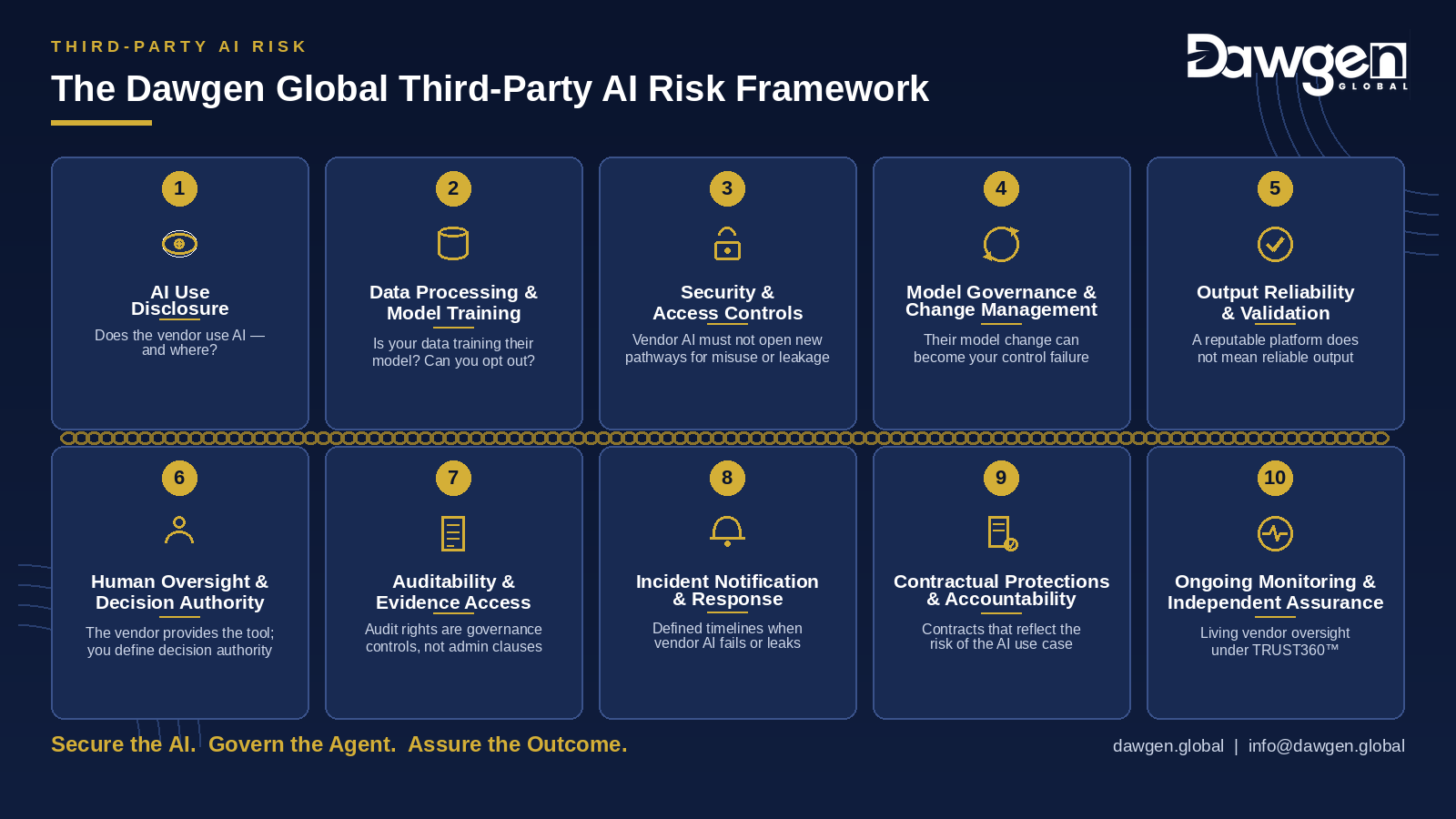
Dawgen Global recommends that organizations assess third-party AI risk across ten practical dimensions.
1. AI use disclosure
Vendors should disclose whether AI is used in the product, platform, service, workflow, support process, analytics engine, or outsourced delivery model.
Organizations should not have to discover AI use after implementation. Vendor onboarding should require clear disclosure of AI-enabled features, embedded models, automated decision tools, generative AI functionality, copilots, agents, and machine-learning components.
The first control question is simple: does the vendor use AI, and where?
2. Data processing and model training
Organizations must understand what data the vendor’s AI system accesses, processes, stores, transmits, retains, or uses for improvement. Key questions include:
- Is personal, confidential, financial, legal, customer, employee, or regulated data processed?
- Is organizational data used to train or fine-tune the vendor’s model — and can the organization opt out?
- Where is the data stored, and which subcontractors or infrastructure providers are involved?
- What retention rules apply, and how is data deleted at contract termination?
This is especially important for organizations subject to Jamaica’s Data Protection Act and other regional data protection regimes. AI vendor risk is also data protection risk.
3. Security and access controls
AI-enabled vendors must be assessed for cybersecurity controls, including identity and access management, encryption, secure APIs, vulnerability management, incident response, privileged access, logging, segregation of customer environments, and secure development practices.
Where the vendor provides AI agents, automation tools, integrations, or workflow triggers, the review must also consider whether those systems can access enterprise applications, retrieve sensitive data, or initiate actions — the guardrail disciplines of Dawgen Global’s D-AGENTICA™ methodology apply with equal force when the agent belongs to a vendor.
The cybersecurity question is not only whether the vendor platform is secure. It is whether the AI functionality creates new pathways for misuse, data leakage, prompt injection, unauthorized access, or compromised decision flows.
4. Model governance and change management
AI systems can change over time. Vendors may update models, alter prompts, modify algorithms, change training data, introduce new features, or adjust system behavior. Organizations should understand how vendors govern those changes:
- How are model changes approved, and how are customers notified of material changes?
- Does the vendor test for accuracy, bias, drift, and harmful outputs?
- Can the organization review change logs, and can AI features be disabled or controlled?
- Does the vendor provide release notes specific to AI functionality?
- Are customers informed when changes affect risk, performance, or data handling?
A vendor’s model change can become the organization’s control failure if it affects business decisions or regulated processes.
5. Output reliability and validation
Organizations should not assume that vendor AI outputs are correct simply because they come from a reputable platform.
Vendor AI outputs may be inaccurate, incomplete, biased, outdated, misleading, or unsuitable for the organization’s context. The organization must determine how outputs will be validated before they are used in decisions.
For high-impact use cases, management should define validation routines, accuracy thresholds, exception procedures, human review requirements, and escalation protocols. The higher the reliance on vendor AI, the stronger the validation must be.
6. Human oversight and decision authority
Third-party AI should not silently replace human accountability.
Organizations must define which AI-generated outputs require human review, which actions require approval, and which decisions cannot be fully delegated to AI. This is particularly important for financial reporting, lending, hiring, legal conclusions, customer communication, regulatory submissions, cybersecurity response, procurement awards, and medical or safety-related decisions.
The vendor may provide the tool. The organization must define the decision authority.
7. Auditability and evidence access
AI vendor risk cannot be properly assured without evidence.
Contracts and operating procedures should address whether the organization can obtain logs, reports, model documentation, control evidence, security certifications, incident records, data processing records, change notices, and audit reports.
As we argued in article five of this series, if an AI-supported decision is challenged, the organization must be able to reconstruct what happened. When the model belongs to a vendor, that reconstruction may depend on evidence only the vendor holds. Audit rights are therefore not administrative clauses. They are critical AI governance controls.
8. Incident notification and response
AI-related incidents may include data exposure, harmful outputs, model failures, unauthorized actions, cybersecurity compromise, service disruption, privacy breach, bias events, regulatory issues, or reputational harm.
Organizations should define how vendors must notify them of AI-related incidents, including timelines, escalation contacts, investigation support, evidence preservation, customer communication support, and remediation obligations.
For high-risk AI vendors, the organization should also understand whether the vendor has tested incident response procedures for AI-specific failure scenarios. An AI incident response plan that excludes vendors is incomplete.
9. Contractual protections and accountability
Contracts with AI-enabled vendors should be reviewed carefully. Important areas include:
- AI use disclosure; data protection and confidentiality; restrictions on model training; subprocessor disclosure
- Security obligations and regulatory compliance
- Audit rights, incident notification, and model-change notification
- Service-level commitments and explainability and documentation obligations
- Liability and indemnity; termination rights; data return and deletion
- Business continuity and exit planning
Standard vendor contracts may not be sufficient for AI-enabled services. The contract must reflect the risk profile of the AI use case.
10. Ongoing monitoring and independent assurance
Third-party AI risk cannot be managed only at onboarding. Vendors, models, features, data flows, and regulatory expectations change over time.
Organizations should periodically reassess AI-enabled vendors, especially those supporting high-risk processes. This reassessment should include security reviews, performance monitoring, vendor attestations, contract compliance, AI feature reviews, data protection checks, incident history, and audit evidence.
Under Dawgen Global’s TRUST360™ continuous-governance approach, third-party AI risk is monitored as a living control environment, not treated as a one-time procurement checklist.
Procurement, legal, IT, risk, and audit must work together
Third-party AI risk is multidisciplinary.
Procurement may manage the vendor selection process. Legal may review the contract. IT may evaluate architecture and integration. Cybersecurity may assess security controls. Data protection teams may review privacy implications. Risk management may classify the exposure. Internal audit may test whether controls are operating effectively. Business owners must understand how the AI tool affects their processes.
No single function can manage this risk alone. A strong third-party AI governance process should require collaboration before adoption, during implementation, and throughout the vendor lifecycle.
This is particularly important where AI systems are procured directly by business units. Shadow AI procurement — where departments adopt AI-enabled tools without central review — can create serious data protection, cybersecurity, contractual, and auditability gaps.
The audit committee’s third-party AI agenda
Audit committees should begin asking management for a clear view of AI-enabled vendors and outsourced AI exposure. A practical agenda may include:
- A register of AI-enabled vendors and platforms, with high-risk third-party AI use cases identified
- Assessment of data processed by AI vendors
- Review of vendor contracts for AI-specific protections
- Cybersecurity assessment of AI-enabled platforms
- Review of model-change notification arrangements
- Assessment of human oversight and validation procedures
- Review of vendor incident response obligations
- Evaluation of audit rights and evidence access
- Independent assurance over third-party AI controls
The audit committee does not need to manage vendor relationships. But it should obtain assurance that vendor-based AI risk is visible, governed, monitored, and defensible.
Five questions boards should ask about third-party AI risk
If the board asks nothing else this quarter, it should ask:
- Which vendors, platforms, and outsourced providers are using AI in services delivered to our organization?
- What organizational, customer, employee, financial, or regulated data is processed by those AI systems?
- Do our contracts restrict data use, provide audit rights, require incident notification, and address AI model changes?
- How does management validate AI outputs from vendor systems before relying on them?
- If a vendor AI system causes harm, who is accountable, what evidence can we obtain, and how quickly can we respond?
If management cannot answer these questions, the organization has a third-party AI governance gap.
Third-party AI risk as a strategic trust issue
AI vendors can create enormous value. They can help organizations improve productivity, strengthen analytics, automate workflows, enhance customer experience, improve cybersecurity, detect fraud, reduce manual effort, and scale specialist capability.
The issue is not whether organizations should use AI-enabled vendors. They will, and in many cases they should. The issue is whether they can use them responsibly, securely, contractually, and with assurance.
Organizations that manage third-party AI risk well will be better positioned to innovate confidently. They will satisfy regulators, customers, auditors, international partners, and boards. They will avoid becoming dependent on systems they cannot explain, monitor, or defend.
In the AI era, vendor management is no longer only about cost, service, and delivery. It is about trust, evidence, accountability, and resilience.
“Organizations may outsource technology, but they cannot outsource accountability. When AI enters through the vendor ecosystem, boards must ensure that governance, evidence, and assurance enter with it.”
— Dr. Dawkins Brown, Executive Chairman, Dawgen Global
How Dawgen Global can help
Dawgen Global supports organizations across the Caribbean and globally in identifying, assessing, and strengthening third-party AI governance, cybersecurity, contract, data protection, and assurance controls. Our integrated multidisciplinary model brings together cybersecurity, IT audit, internal audit, external audit, procurement advisory, risk advisory, data protection, compliance, technology, and board advisory expertise — big firm capabilities, Caribbean understanding.
A practical engagement pathway:
- Assess — Third-Party AI Vendor Risk Assessment; AI Vendor Inventory and Risk Classification; AI Governance & Cyber Risk Readiness Assessment; AI Vendor Audit Rights and Transparency Review
- Design — AI Vendor Due Diligence Framework; AI Contract Control Checklist; AI Vendor Monitoring Dashboard; AI Data Protection and Model Training Control Framework; AI Incident Response and Vendor Escalation Protocols
- Assure continuously — Independent Third-Party AI Assurance Review; Continuous AI Vendor Risk Monitoring under TRUST360™; AI Vendor Cybersecurity Review; Internal Audit Co-Sourcing for AI Vendor Controls
Take the first step
Is your organization using AI-enabled vendors, cloud platforms, copilots, outsourced providers, analytics tools, or embedded AI features without a clear governance and assurance framework?
Dawgen Global can help you identify third-party AI exposure, strengthen contracts, assess vendor controls, protect sensitive data, and provide independent confidence to management, boards, regulators, customers, and stakeholders.
Secure the AI. Govern the Agent. Assure the Outcome.
Contact Dawgen Global today to request a Third-Party AI Vendor Risk Assessment.
Email: [email protected] | Web: dawgen.global
About Dawgen Global
Dawgen Global is an independent, integrated multidisciplinary professional services firm headquartered at 47 Trinidad Terrace, New Kingston, Jamaica, serving more than 15 territories across the Caribbean. Founded and led by Dr. Dawkins Brown, Executive Chairman, the firm is independent and not affiliated with any international network. It delivers a full suite of professional services under one roof: audit and assurance; tax advisory; IT and digital transformation; risk management; cybersecurity; actuarial and insurance regulatory advisory; HR advisory; mergers and acquisitions; corporate recovery; business advisory and strategy; accounting BPO and virtual CFO services; and legal process outsourcing.
The proposition is simple: big-firm capability without the big-firm price. Dawgen Global’s integrated approach is built for the specific complexities and opportunities of the Caribbean market, helping organizations make sharper, better-informed decisions that drive measurable progress.
To explore a partnership, reach out:
- Website: dawgen.global
- Email: [email protected]
- WhatsApp (Global): +1 555-795-9071
- Caribbean offices: +1 876-665-5926 | +1 876-929-3670 | +1 876-926-5210


