A standing guide for owner-managed businesses, their boards and their advisers
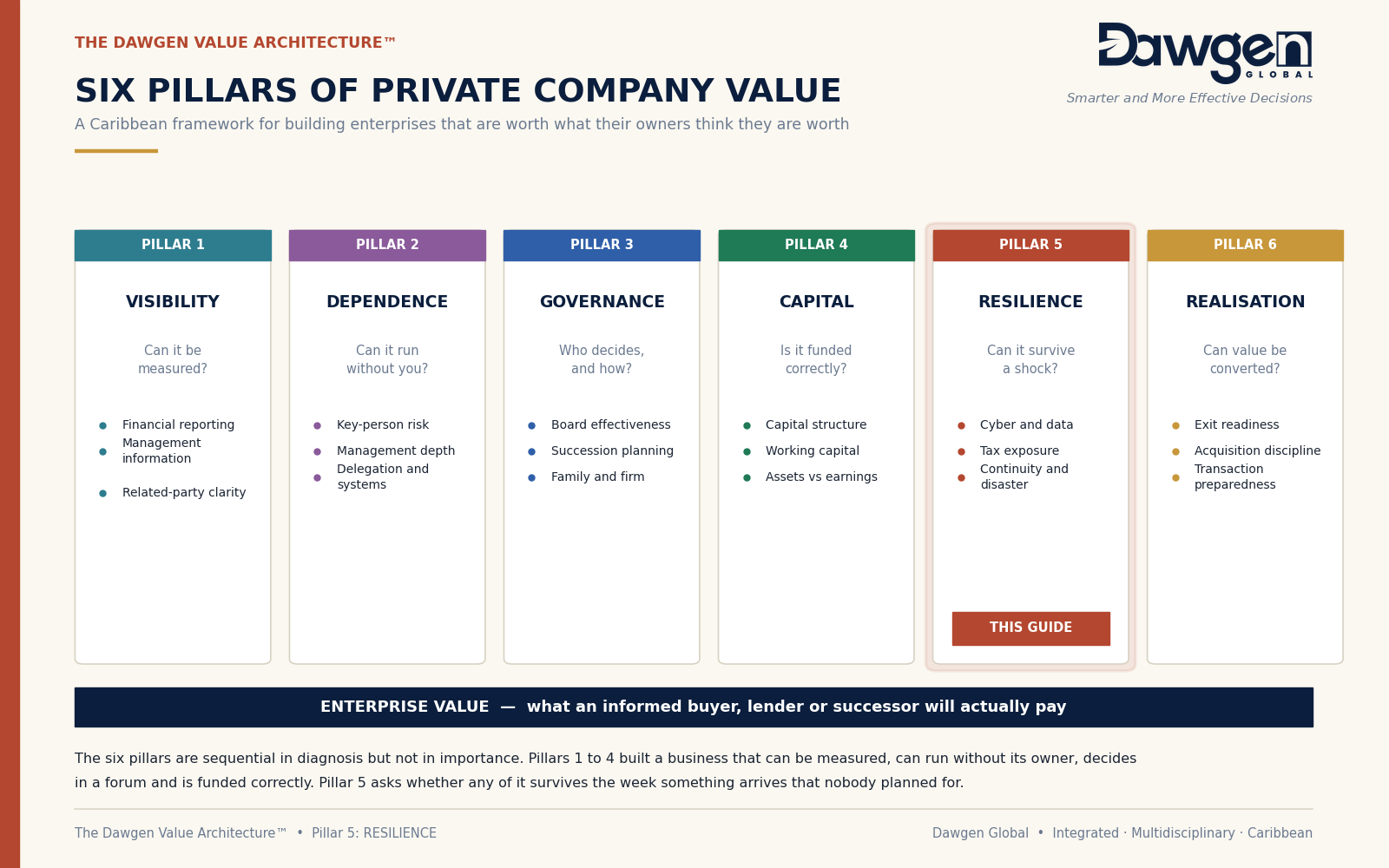
The Dawgen Value Architecture™ — six pillars of private company value. This guide addresses Pillar 5.
The Dawgen Value Architecture™
Most owner-managed businesses in the Caribbean are worth less than the people who built them believe. That is not a comment on the quality of those businesses. It is a comment on the difference between value that exists and value that can be demonstrated to a lender, a buyer, a regulator or a successor. The gap between the two is rarely closed by trading harder. It is closed by building the conditions under which value becomes visible, transferable and durable.
The Dawgen Value Architecture™ is the framework we use to name those conditions. It holds that what a private company is actually worth is determined by six things, each of which can be assessed, scored and improved. The framework was developed from patterns that recur across private company advisory engagements in this region, and it is set out here in full so that owners and boards can apply it to their own businesses without engaging anyone at all.
The six pillars
PILLAR 1 · VISIBILITY Can it be measured?
PILLAR 2 · DEPENDENCE Can it run without you?
PILLAR 3 · GOVERNANCE Who decides, and how?
PILLAR 4 · CAPITAL Is it funded correctly?
PILLAR 5 · RESILIENCE Can it survive a shock?
PILLAR 6 · REALISATION Can value be converted?
The order is deliberate, but it is an order of diagnosis rather than an order of importance. Pillars 1 to 4 build a business that can be measured, can run without its owner, decides in a forum that records its decisions, and is funded in a way that matches what it does. Pillar 5 asks the question that determines whether any of that survives contact with an event nobody scheduled.
How each guide is built
Every guide in the series follows the same structure, so that a reader who has worked through one will know exactly where to look in the next. Each begins with the pattern as it presents itself in practice, then examines the Caribbean conditions that make the pattern harder to resolve here than elsewhere. It then sets out what the problem costs in cash terms, why owners nonetheless leave it unaddressed, and a staged remedy organised into the first ninety days, months three to twelve, and beyond. Each guide closes with a scored diagnostic the reader can complete unaided, and a short section on where to begin.
The guides are written as standing reference documents rather than articles. They are intended to be returned to, worked through with a management team, and used as the basis for a board conversation. Figures presented as ranges are indicative of what we observe in practice and in the published international literature; they are not the output of a survey, and they are labelled as such wherever they appear.
| Where this guide sits
This is Pillar 5 of 6. It addresses cyber and data, tax exposure, and continuity and disaster — the three components of whether a business survives a shock it did not choose. Pillars 1 to 4 precede it, and each of them is also what is at risk: the reporting, the management depth, the board record and the funding structure are all held in systems, buildings and people that a single event can remove. Pillar 6 follows, and the capstone across the whole framework is the Private Company Value Scorecard, which consolidates the six diagnostics into a single view of what a business would be worth to an informed buyer, lender or successor. |
SECTION 1
The Pattern
Ask an owner whether the business is backed up and the answer is almost always yes. Ask when a backup was last restored — actually restored, onto a working machine, with somebody watching the clock — and the answer is almost always silence. The same exchange works for insurance. The policy exists, the premium is paid, and nobody in the building has read what it excludes or when the sums insured were last compared to what rebuilding would now cost.
This is the characteristic shape of the resilience problem in private business. It is not usually neglect. Most of these companies have bought the right things. What they have not done is verify that the things they bought would work, and the gap between purchase and verification is where the entire loss occurs.
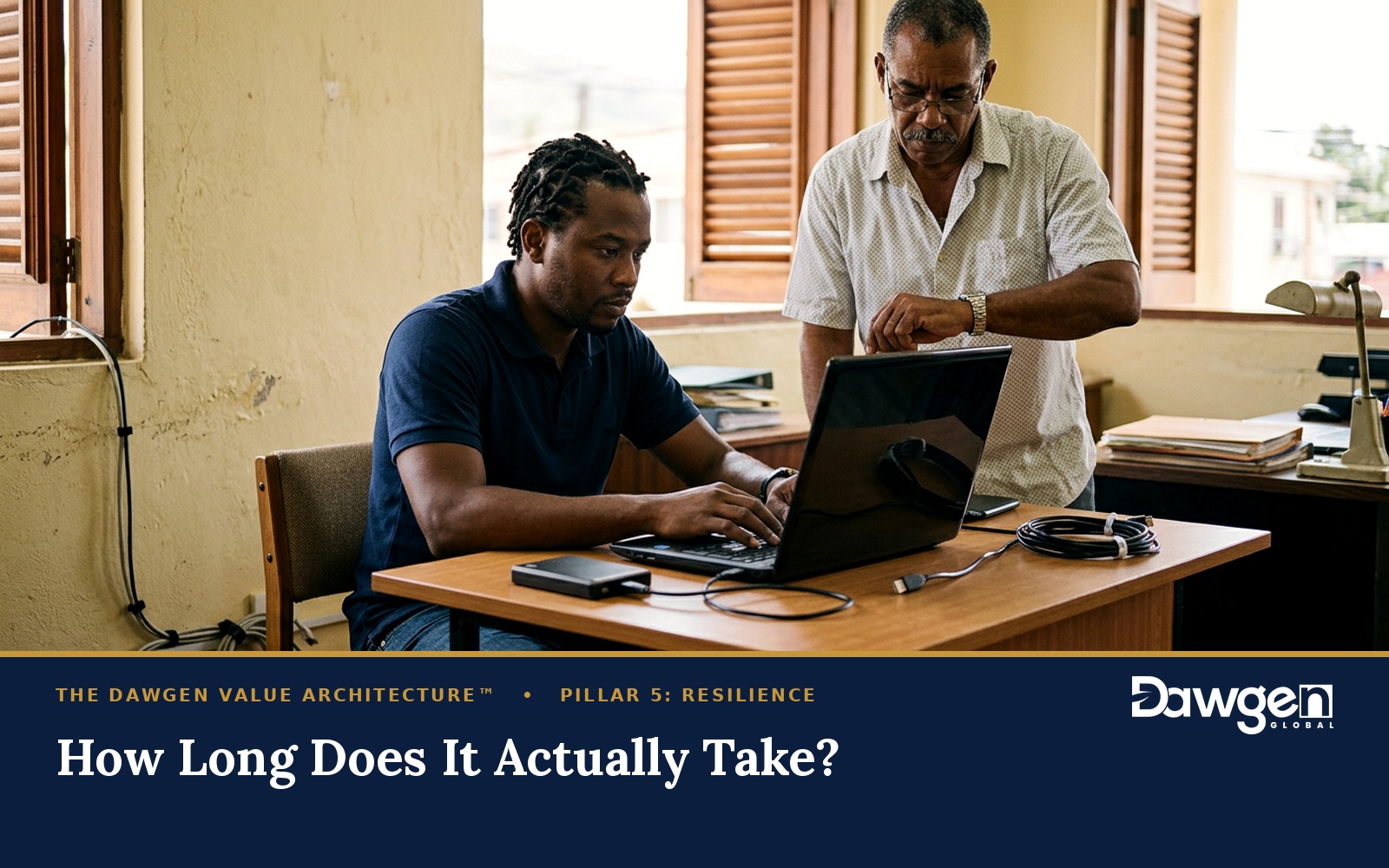
A backup that has never been restored is not a backup. It is a receipt for a service, and a receipt does not bring a business back.
Why this is Pillar 5
The first four pillars produce something worth protecting. Reliable reporting, a management team that can act, a board record that proves how decisions were made, a funding structure that matches the business — all of it is held in systems, in buildings, in files and in people. A single event can remove any of them, and the work of the preceding four pillars goes with it.
There is also a harder point. The three areas this pillar covers — data, tax and continuity — are usually managed by three different people who never meet, if they are managed at all. The IT supplier holds the backups, an insurance broker holds the policy, the accountant holds the tax file, and nobody holds the question of what happens on the morning all three are needed at once.
The test that settles it
Name the four events that could stop this business on a Friday night. Then answer four questions about each of them, in writing, without consulting anybody outside the room.
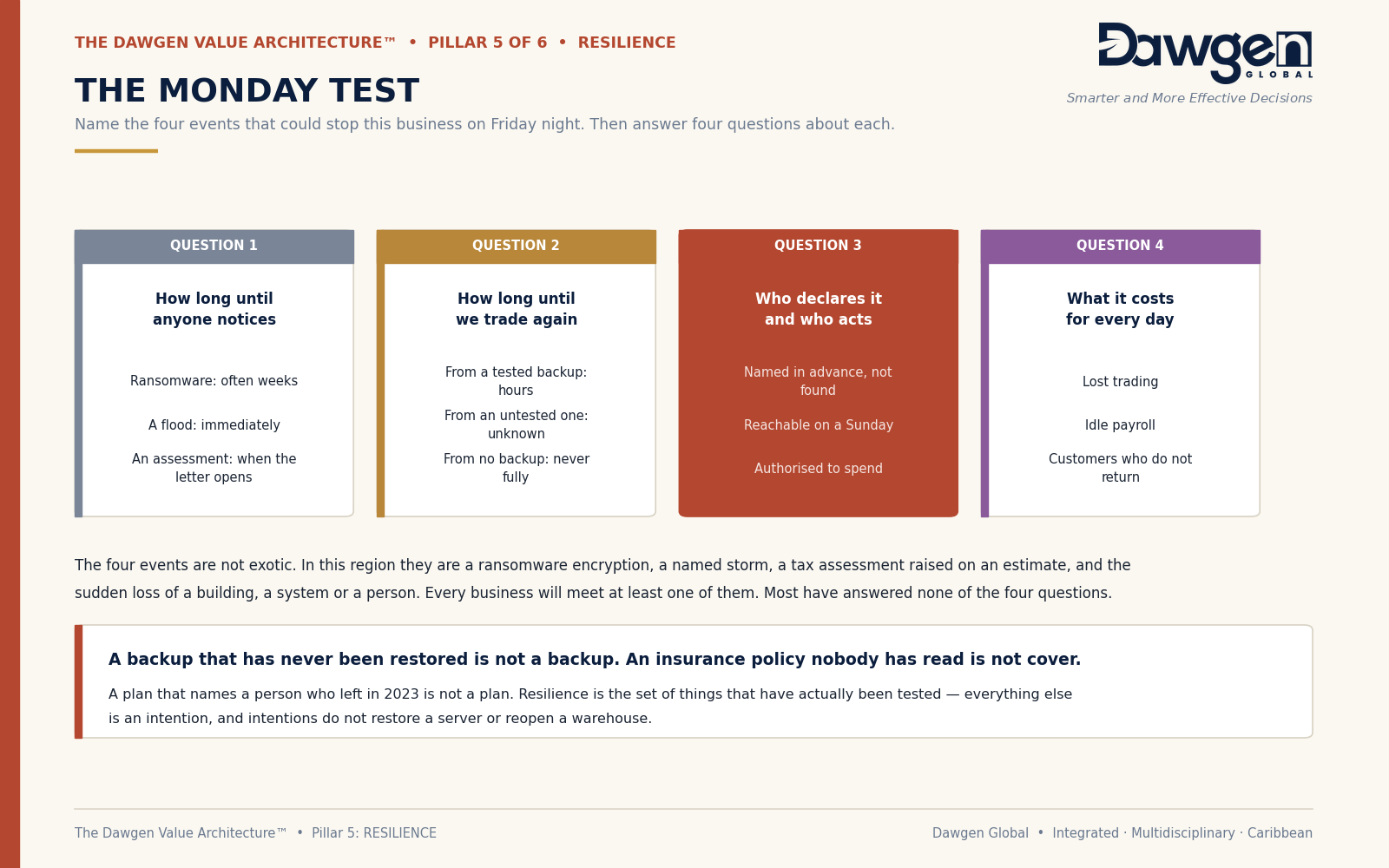
How long until anyone notices. How long until the business trades again. Who declares the incident and who is authorised to act. And what each day of interruption costs in lost trading, idle payroll and customers who go elsewhere and do not come back.
The four events are not exotic. In this region they are a ransomware encryption, a named storm, a tax assessment raised on an estimate, and the sudden loss of a building, a system or a person. Every business will meet at least one of them. Most can answer none of the four questions, and the ones that can usually discover that the answers are held in one person’s head rather than on a page.
SECTION 2
The Caribbean Variant
Every business everywhere faces disruption. What is regional is the combination of higher likelihood and slower recovery — and the fact that the standard advice assumes an infrastructure and a supplier market that do not exist here at the required depth. Six conditions recur with enough regularity to be treated as structural.
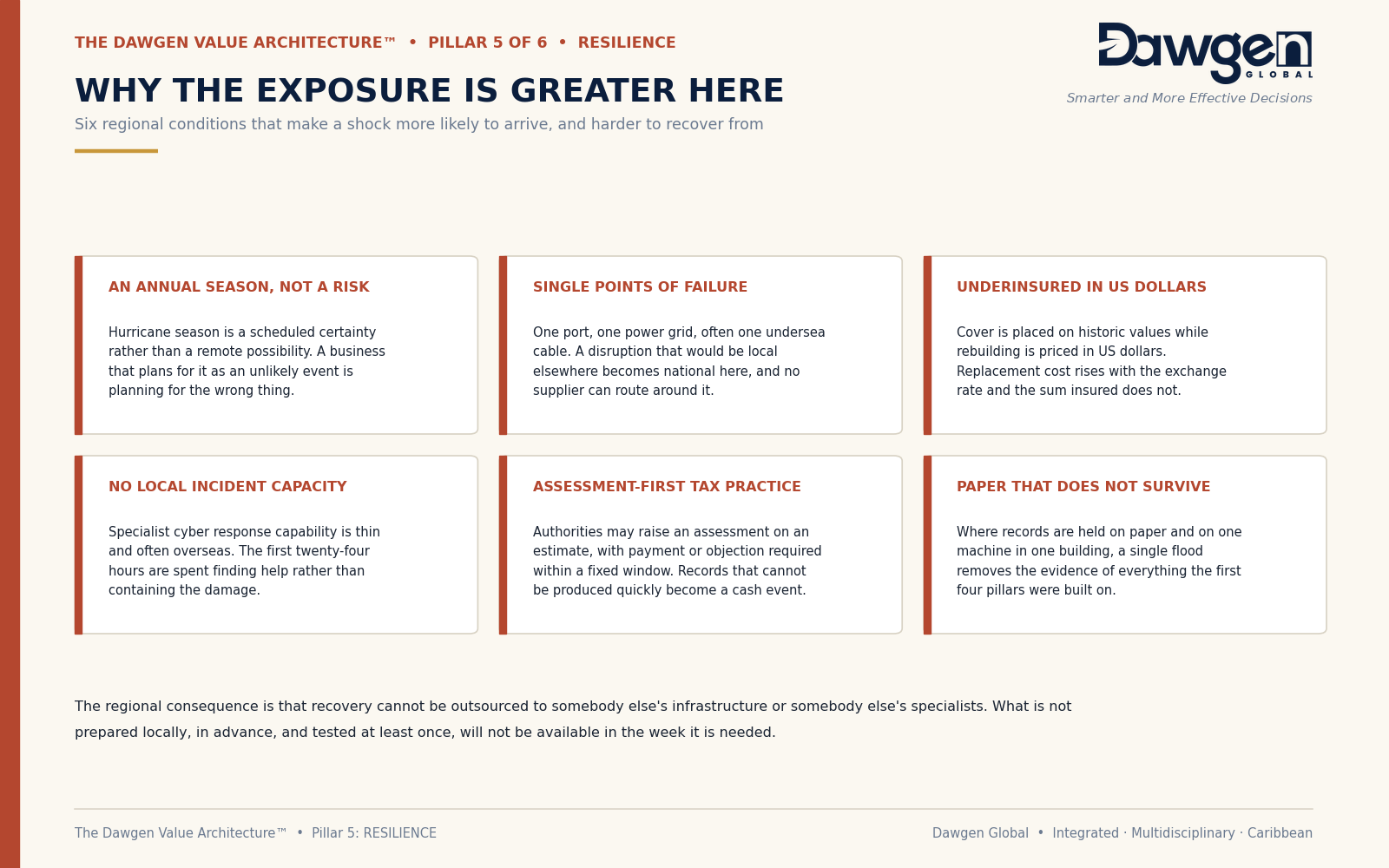
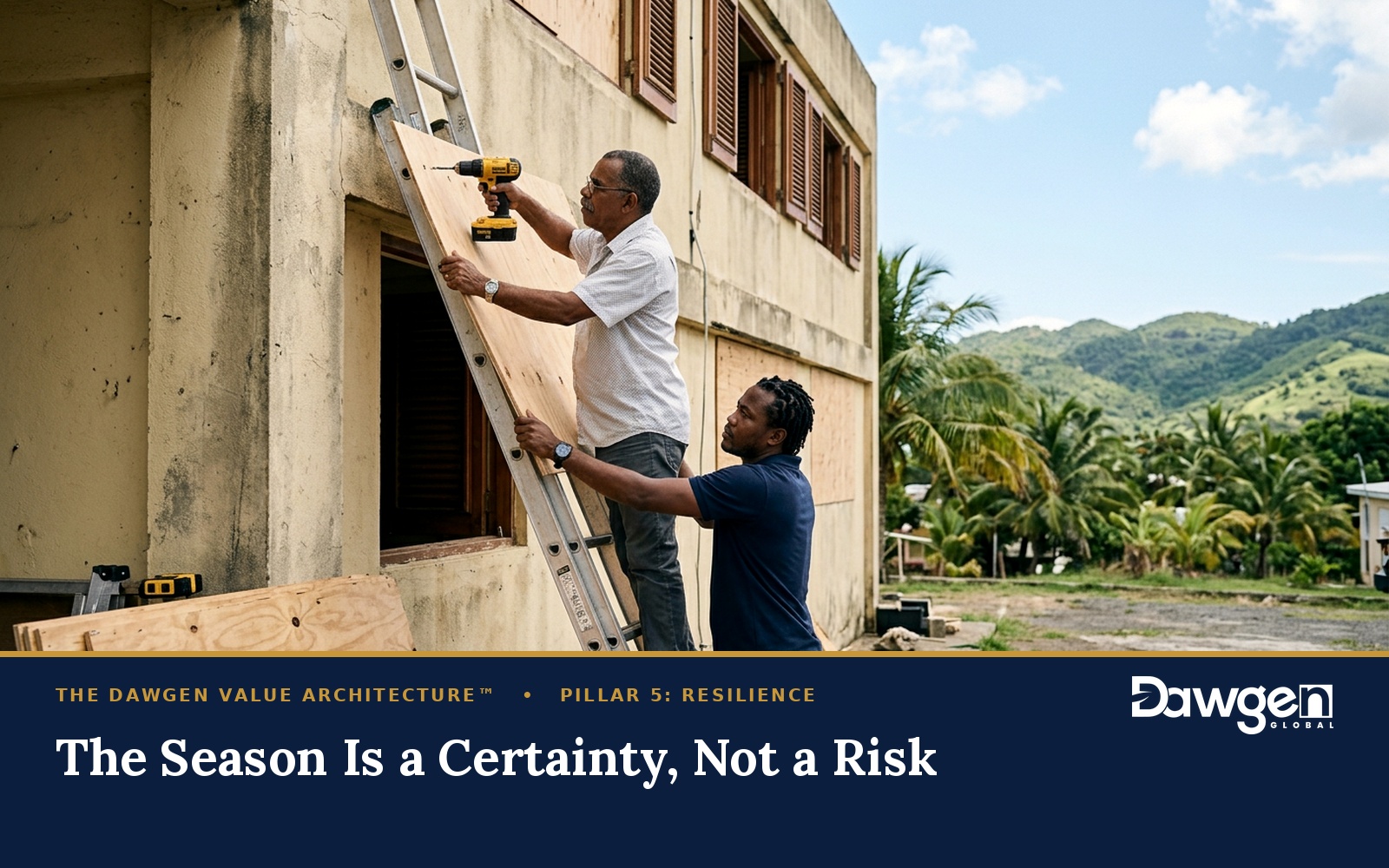
The first is that hurricane season is a season rather than a risk. It arrives annually, it is forecast, and it lasts for months. A business that treats it as a low-probability event is misreading a scheduled certainty, and the preparation that matters — the shutdown checklist, the records held elsewhere, the decision about when to close — is preparation that must be complete before the season opens rather than assembled when a system is named.
The second is concentration of infrastructure. One port, one power grid, and in many territories one undersea cable carrying the connectivity everything else depends on. A disruption that would be a local inconvenience in a large market becomes a national outage here, and no supplier can route around it because there is nothing to route around it to.
The third is underinsurance denominated in a currency the business does not earn. Cover is commonly placed on historic values and renewed at last year’s figure, while the cost of rebuilding — imported materials, imported equipment, imported labour — is priced in United States dollars and rises with the exchange rate. The gap between the sum insured and the replacement cost widens quietly every year that nobody looks at it.
The fourth is the thinness of local incident response capability. Specialist cyber assistance exists in the region but is not deep, and much of it is overseas and engaged only after a contract is signed. The first twenty-four hours of an incident, which are the hours that determine the outcome, are frequently spent finding help rather than containing damage.
The fifth is assessment-first tax practice. Where an authority may raise an assessment on an estimated basis, with objection or payment required inside a fixed window, the ability to produce records quickly is not an administrative nicety. It is the difference between a query and a cash event, and it depends entirely on the record-keeping established under Pillar 1.
The sixth is that too much still exists only on paper, or on one machine, in one building. A single flood removes the ledgers, the contracts, the board minutes and the evidence of everything the first four pillars were built on — and it removes them permanently, because there is no second copy anywhere else.
| Why the standard prescription fails here
International continuity guidance assumes redundant infrastructure, a deep specialist market and same-day replacement of equipment. None of those can be relied on. The sequence therefore inverts: prepare locally and in advance, verify by testing rather than by purchasing, and assume that whatever has not been arranged before the event will not be available during it. |
SECTION 3
What It Costs
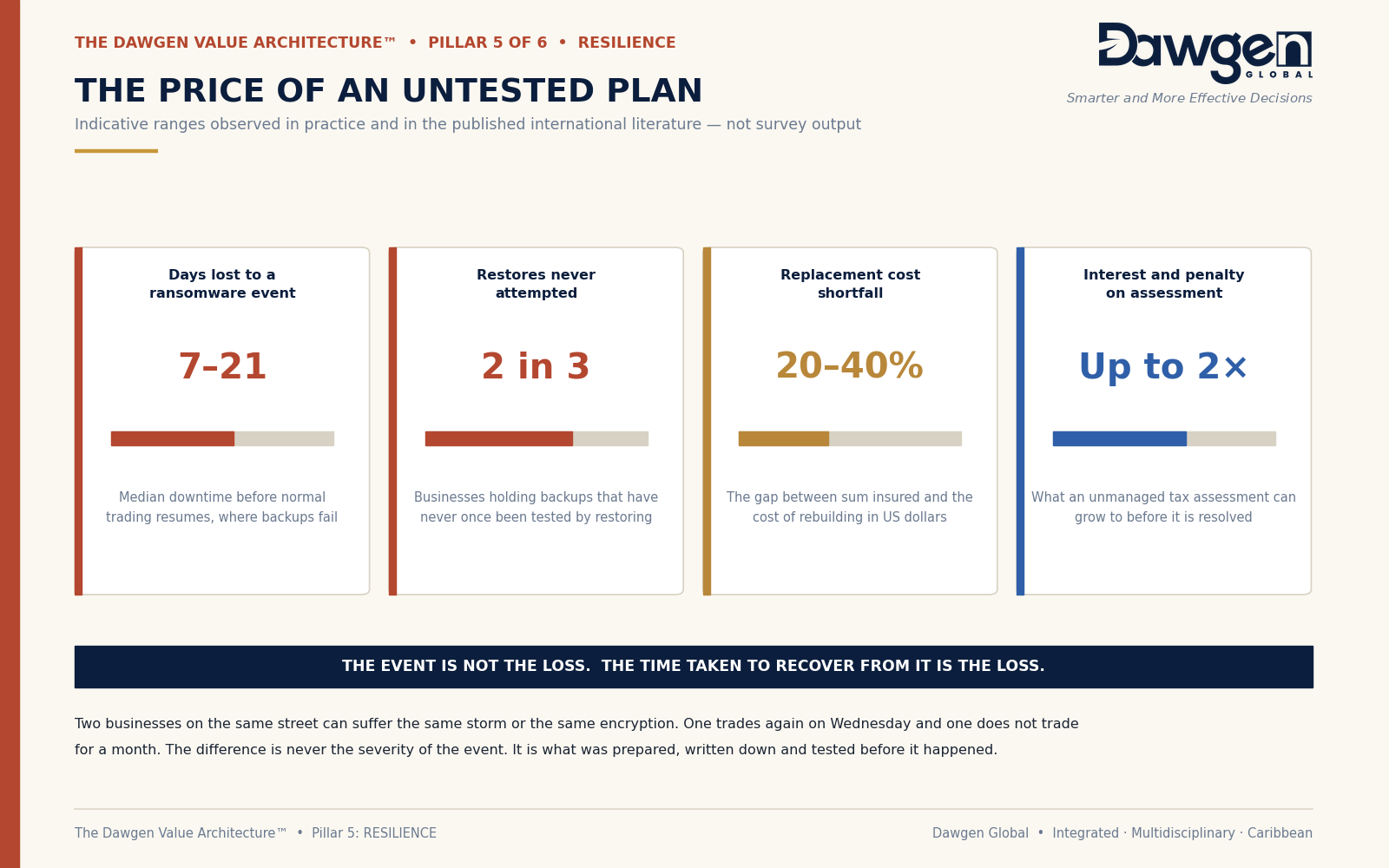
The cost of poor resilience is concentrated and sudden rather than continuous, which is precisely why it is discounted in advance. The ranges below are indicative of what we observe in practice and in the published international literature. They are not the output of a survey, and they should be read as orders of magnitude.
It is paid in days, not in damage
The event itself is rarely the loss. Two businesses on the same street can suffer the same storm or the same encryption; one trades again on Wednesday and the other does not trade for a month. The difference is never the severity of what happened. It is what had been prepared, written down and tested beforehand — and every day of the difference is paid in lost trading, in payroll for staff who cannot work, and in customers who found somebody else and stayed there.
It is paid to the insurer, in reverse
Underinsurance is discovered at the only moment it cannot be corrected. Where the sum insured has not been reviewed against replacement cost, the settlement rebuilds part of the business and the owner funds the rest — usually from the working capital that Pillar 4 was trying to protect. Average clauses and exclusions compound this, and both are in a document that almost nobody has read.
It is paid to the tax authority, with interest
An assessment raised on an estimate becomes a demand if it is not answered within the window. Where records cannot be assembled quickly, the objection is weak or late, and interest and penalties accumulate on a liability that may never have been correct. That is a cash cost imposed by record-keeping rather than by trading.
The event is not the loss. The time taken to recover from it is the loss.
SECTION 4
Why Owners Do Not Fix It

The reasons are consistent, and most of them are ordinary rather than negligent.
The first is that the money has already been spent. A backup service is paid for monthly and a policy is renewed annually, and both feel like the problem has been addressed. Purchase is mistaken for protection, and because the purchase is real the sense of security is genuine — which is why the discovery, when it comes, is so complete.
The second is that testing looks like an admission. Asking to restore a backup can feel like accusing the IT supplier of failure, and asking the broker what the policy excludes can feel like distrust. In a small market where these are long relationships, owners avoid the conversation. The better framing is that a supplier who welcomes a test is a supplier worth keeping.
The third is that the events are individually improbable. No single item on the register will happen this year with any great likelihood. Collectively, over the life of a business, at least one of them is near-certain — and low-probability, high-consequence exposures lose every contest for attention against the operational problem on the desk this morning.
The fourth is that nothing has gone wrong. The company came through the last three seasons, the systems have not been encrypted, and no assessment has arrived. Survival is read as evidence of preparedness when it is usually evidence of nothing more than the event not having occurred yet.
The fifth is that responsibility is distributed to the point of vanishing. The IT supplier assumes the owner has continuity covered; the broker assumes somebody checked the values; the accountant assumes the records are complete. Each party is competent within its own scope and nobody holds the whole, which is exactly the gap a board is for.
| The correct diagnosis
This is a verification problem rather than an investment problem. In most cases the business has already bought what it needs and has never confirmed that it works. The first ninety days of the remedy therefore contain almost no expenditure at all — one restore, one reading of the policy schedule, one page of names, and a copy of the records somewhere the same event cannot reach. |
SECTION 5
The Remedy

The instrument is a single page listing the events that could stop the business, how long the company can bear each one, who declares it and acts, and what must already exist for the response to work. It completes the set of one-page documents the series has built: the delegation register of Pillar 2, the reserved matters schedule of Pillar 3, the funding match of Pillar 4, and now the recovery register.
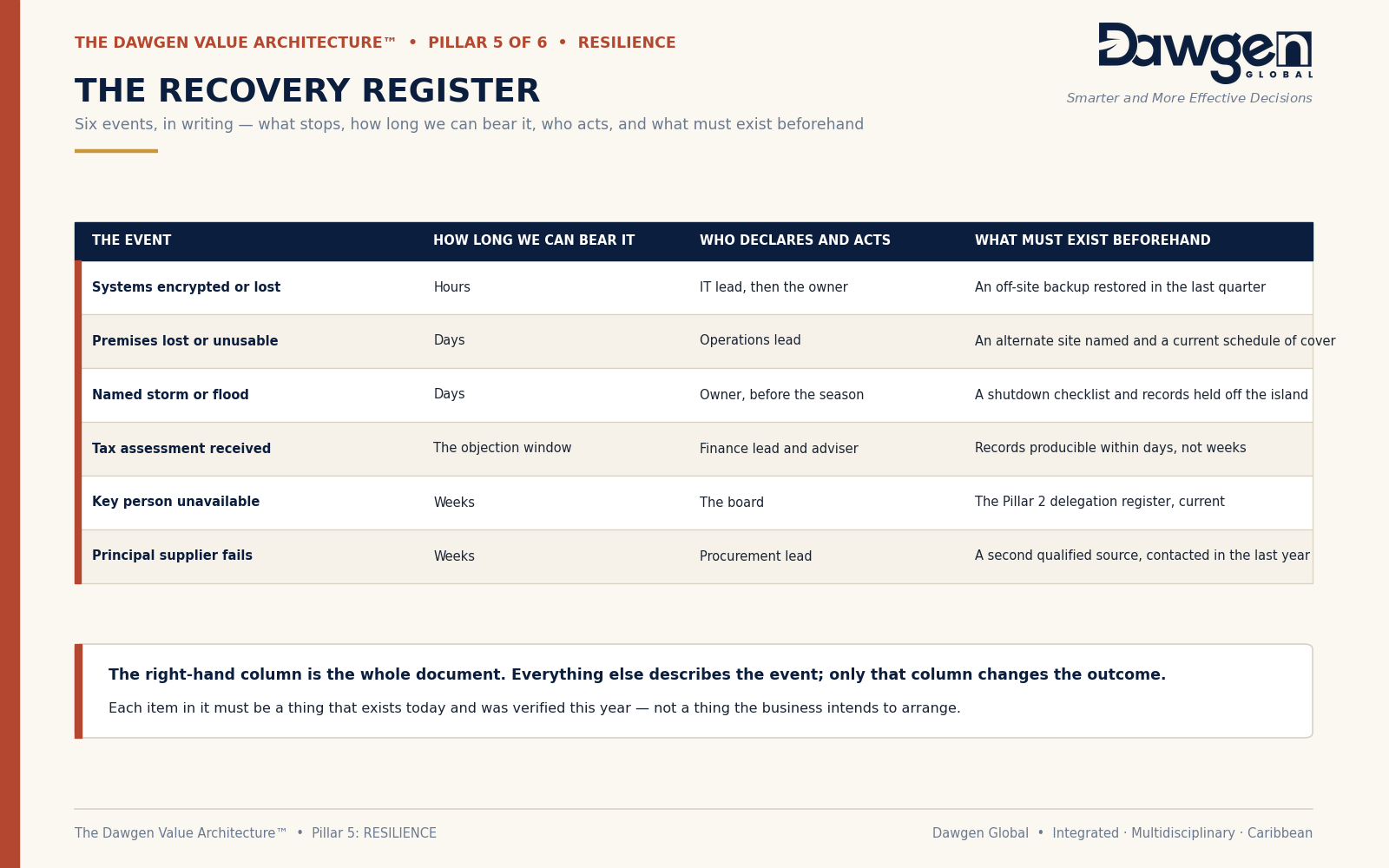
The right-hand column is the whole document. Everything to the left of it describes the event; only that column changes the outcome. Each item in it must be something that exists today and was verified this year, not something the business intends to arrange.
Phase one: the first ninety days
The objective of the first ninety days is verification, not procurement. Almost nothing in this phase costs money.
- Restore one backup to a spare machine and time how long it takes — this single act moves more businesses up the ladder than any purchase.
- Read the insurance schedule, and compare the sums insured to what rebuilding would cost today rather than when the policy was written.
- Write the recovery register — six events is enough to begin.
- Move a copy of the critical records off the premises and off the island.
- Name who declares an incident and give the management team a number that reaches that person at a weekend.
Phase two: months three to twelve
The second phase closes the gaps the first phase exposed, and rehearses.
- Rehearse one event with the management team for one hour, in a room, with the register on the table.
- Close the insurance gap, or record the board’s decision to accept it — an accepted risk is a governance position, an unnoticed one is not.
- Enable multi-factor authentication on email, banking and the accounting system, which is the highest-value hour of cyber work available to a private company.
- Complete a tax health check so that an assessment, if it arrives, meets a file that is already assembled.
- Qualify a second source for the one supplier the business could not replace inside a month.
Phase three: beyond twelve months
The third phase makes preparedness a measured, recurring discipline rather than a project that was completed once.
- Rehearse annually, before the season opens rather than while a system is being named.
- Report recovery times to the board as a measured number, alongside the other pillar diagnostics.
- Extend the register to the events the first rehearsal exposed, which are always the ones nobody listed.
- Review cover annually against replacement cost rather than against last year’s premium.
- Move to Pillar 6, REALISATION — a business that survives what it did not choose can now be converted into value.
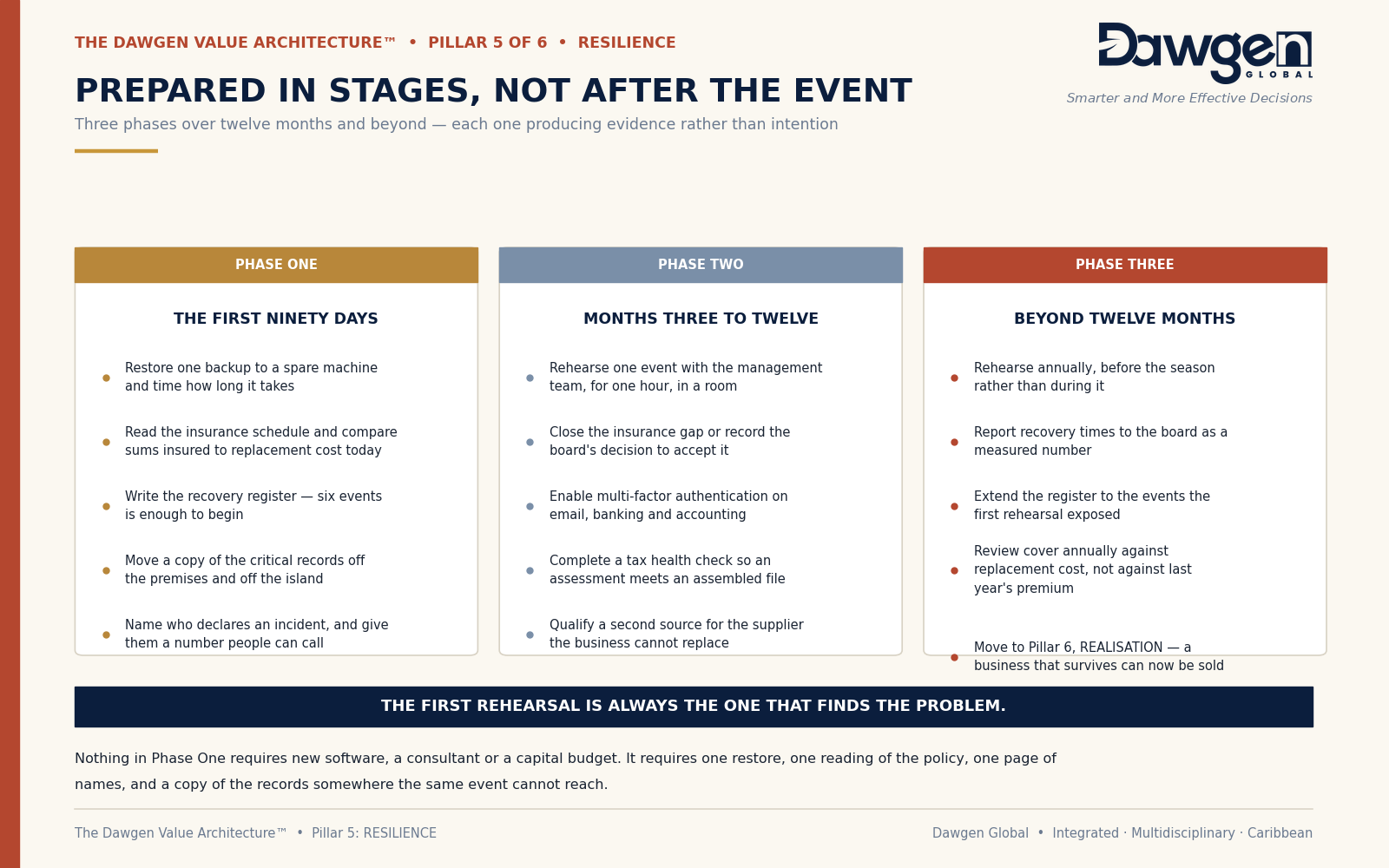
The first rehearsal is always the one that finds the problem. That is the point of holding it while nothing is happening.
SECTION 6
The Diagnostic
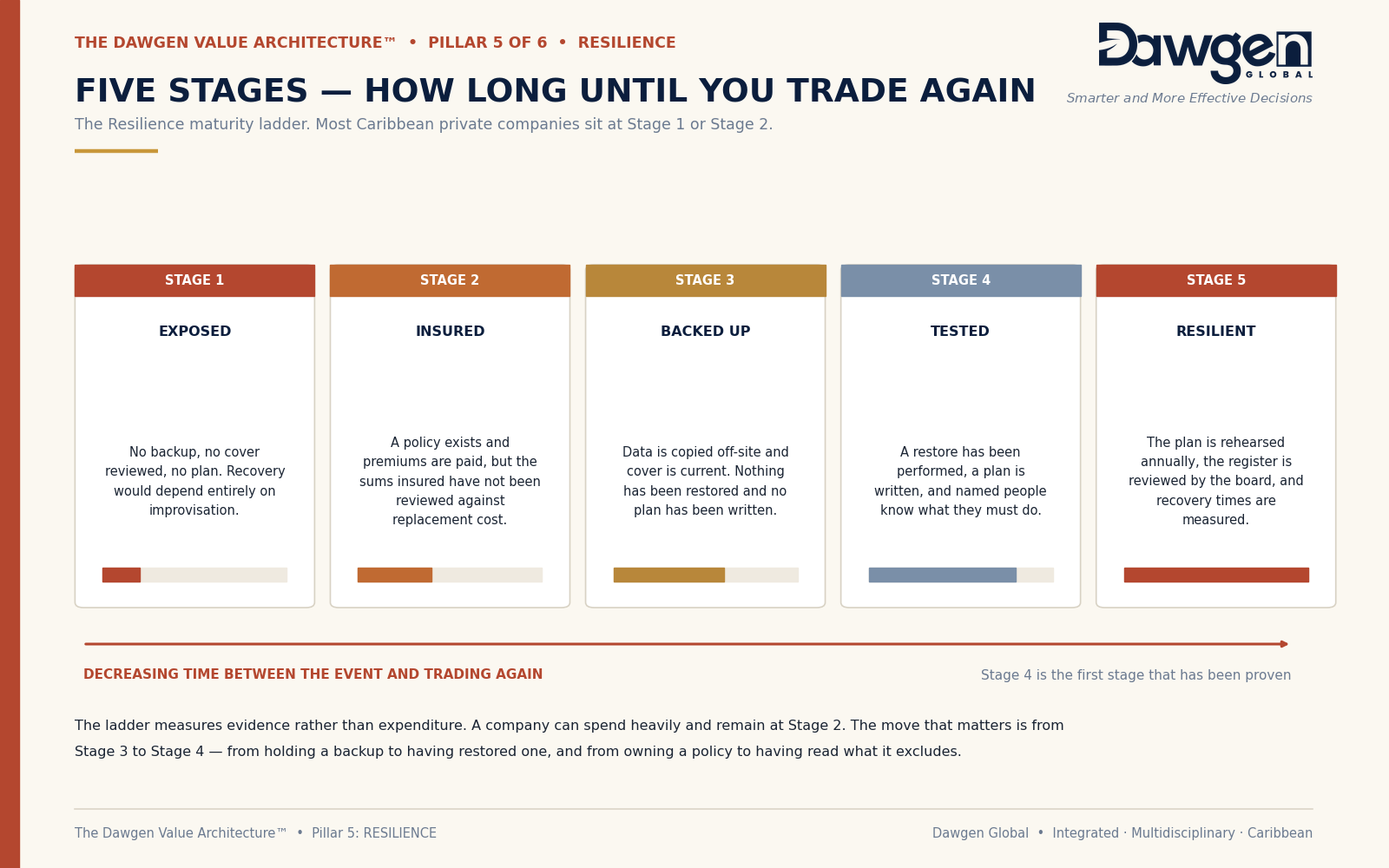
Locate the business honestly on the resilience ladder before deciding where to begin. The ladder measures evidence rather than expenditure, and a company can spend heavily and remain at Stage 2.
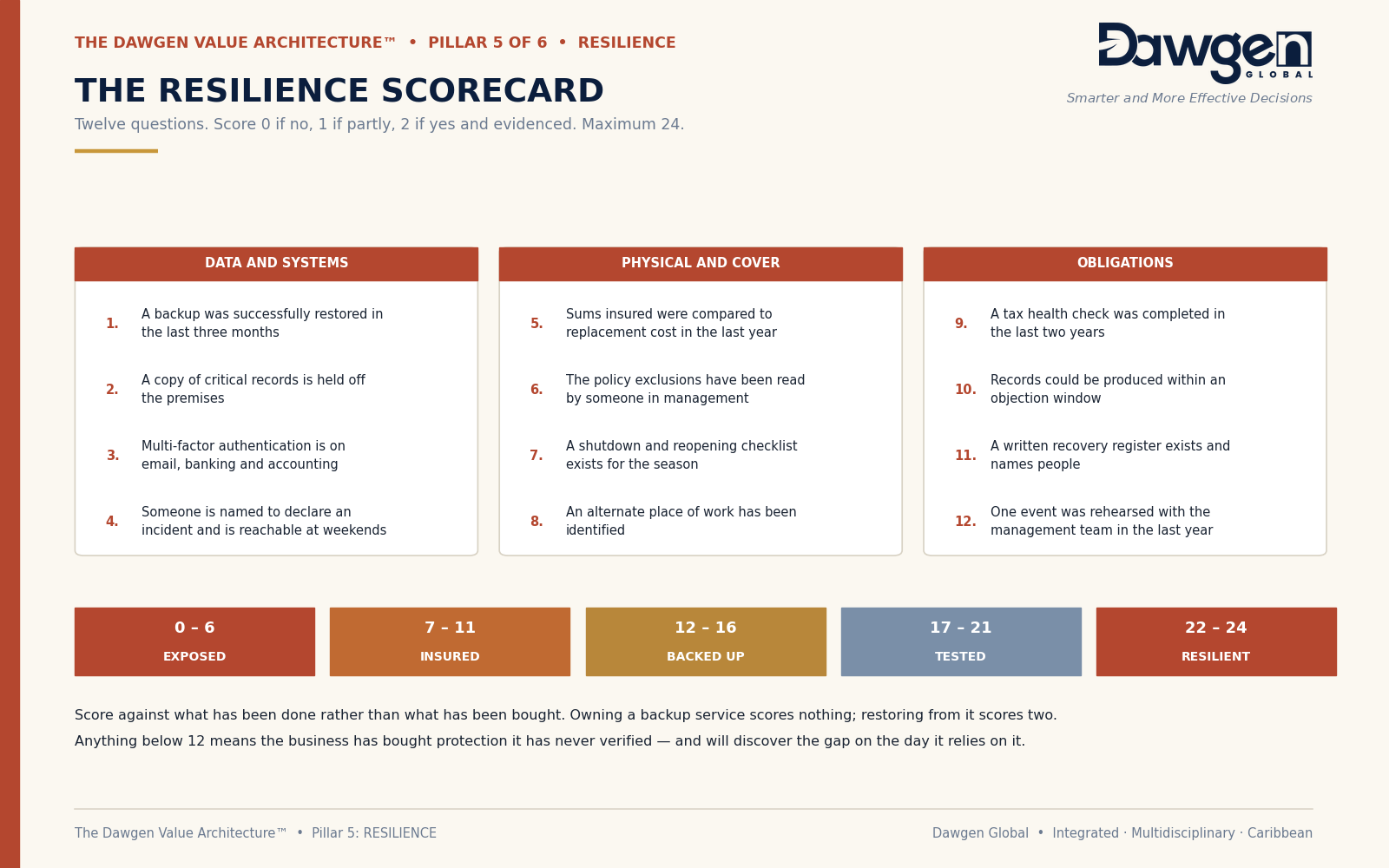
The scorecard converts that judgement into a number. Twelve questions, scored zero for no, one for partly, and two for yes and evidenced. Score against what has been done rather than what has been bought: owning a backup service scores nothing, restoring from it scores two.
| The test that matters
Apply one question to the whole result: if the premises and every system inside them were unavailable from tomorrow morning, what would the business do first, and who would do it without being asked? If that cannot be answered in a sentence by more than one person, the plan does not yet exist in any form that would help. That question is also the bridge to Pillar 6, which asks what a buyer would pay for a business whose continuity depends on nobody having tested it. |
SECTION 7
Where to Start

If you scored between zero and six, do one thing this week and only one: restore a backup. Not a review, not a policy, not a plan. Restore one file set onto a working machine and find out whether what the business believes about itself is true.
If you scored between seven and eleven, the protection is bought and unverified. Read the insurance schedule against today’s replacement cost and move a copy of the records off the island. Both are afternoon tasks with consequences measured in years.
If you scored between twelve and sixteen, the components exist and have never been assembled into a response. Write the recovery register, name the people, and rehearse one event for one hour.
If you scored above seventeen, the remaining work is cadence rather than content. Rehearse annually before the season, report recovery times to the board, and review cover against replacement cost every year without exception.
| The one test to run this week
If nothing else in this guide is acted on, restore a backup. Take one machine, take yesterday’s backup, restore it, and time the exercise from start to finish. It costs nothing, it requires no adviser, and it converts the most dangerous assumption in the business into a measured fact — in either direction. Businesses that have never done this are, on the evidence, roughly evenly split between relief and alarm. |
ABOUT THIS SERIES
The Dawgen Value Architecture™ is a proprietary Dawgen Global framework addressing the six conditions that determine what a private company is actually worth. Each pillar is published as a standing guide: VISIBILITY, DEPENDENCE, GOVERNANCE, CAPITAL, RESILIENCE and REALISATION. The guides are written for Caribbean owner-managed businesses, their boards and their advisers, and are intended to be used without engaging anyone at all.
This series addresses patterns observed across private company advisory engagements and published international evidence. It does not comment on any listed issuer or any specific client, and no company referred to or resembled in these guides is intended to be identifiable.
Next in the series
Pillar 6 — REALISATION: Can Value Be Converted? Exit readiness, acquisition discipline, and the difference between a business that is sold and one that is merely closed.
Take the diagnostic further
The Dawgen Cyber Resilience Diagnostic and Tax Risk Health Check apply this scorecard inside your business, test the backups and the record as an incident would, and deliver a maturity rating, a drafted recovery register and a board-ready summary.
At Dawgen Global, we help you make Smarter and More Effective Decisions.
About Dawgen Global
Dawgen Global is an independent, integrated multidisciplinary professional services firm headquartered at 47 Trinidad Terrace, New Kingston, Jamaica, serving more than 15 territories across the Caribbean. Founded and led by Dr. Dawkins Brown, Executive Chairman, the firm is independent and not affiliated with any international network. It delivers a full suite of professional services under one roof: audit and assurance; tax advisory; IT and digital transformation; risk management; cybersecurity; actuarial and insurance regulatory advisory; HR advisory; mergers and acquisitions; corporate recovery; business advisory and strategy; accounting BPO and virtual CFO services; and legal process outsourcing.
The proposition is simple: big-firm capability without the big-firm price. Dawgen Global’s integrated approach is built for the specific complexities and opportunities of the Caribbean market, helping organizations make sharper, better-informed decisions that drive measurable progress.
To explore a partnership, reach out:
- Website: dawgen.global
- Email: [email protected]
- WhatsApp (Global): +1 555-795-9071
- Caribbean offices: +1 876-665-5926 | +1 876-929-3670 | +1 876-926-5210


