Canada enacted a digital services tax, reached back two years to collect it, then repealed it and refunded the money with interest. The episode is a lesson in legislative risk, and a signpost for Caribbean states choosing between the OECD, the United Nations and their own consumption taxes.
Executive summary
In June 2024 Canada enacted a 3 per cent digital services tax (DST), retroactive to 1 January 2022. A year later, the day before collection was due, it announced the tax would be rescinded to advance trade negotiations with the United States (US). The repeal became law on 26 March 2026, and taxpayers are receiving refunds with interest, reported at about C$647 million. A tax that took years to design was unwound in nine months.
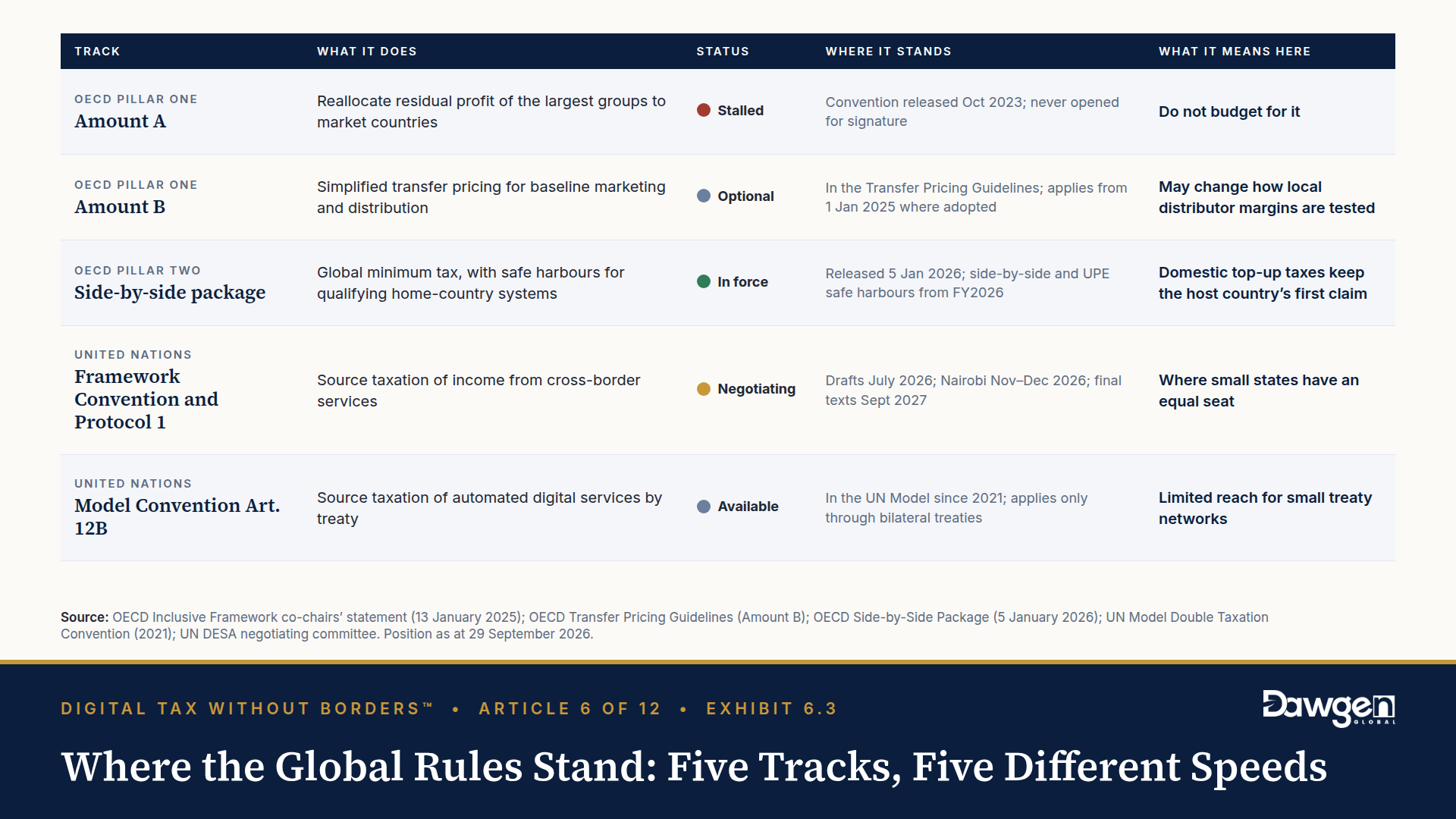
The multilateral solution the DSTs were meant to await has not arrived. The Organisation for Economic Co-operation and Development (OECD) Pillar One Amount A convention has never opened for signature. Amount B exists but is optional. Pillar Two, the global minimum tax, was reshaped in January 2026 by a “side-by-side” package that accommodates the US. Meanwhile the United Nations (UN) is negotiating a Framework Convention on International Tax Cooperation, with a protocol on cross-border services due before the UN General Assembly in September 2027.
Caribbean governments and groups should neither wait for a global deal nor assume unilateral measures will stand. This article draws the lessons from Canada, explains where each international track stands, and sets out three planning scenarios and a monitoring calendar for the next 12 to 18 months.
Canada: from enactment to refund
Canada’s DST was a stop-gap: 3 per cent on revenue from online marketplaces, advertising, social media and user data, reaching back to 1 January 2022 so that the first payment would capture more than two years at once. That made it a large and visible target.
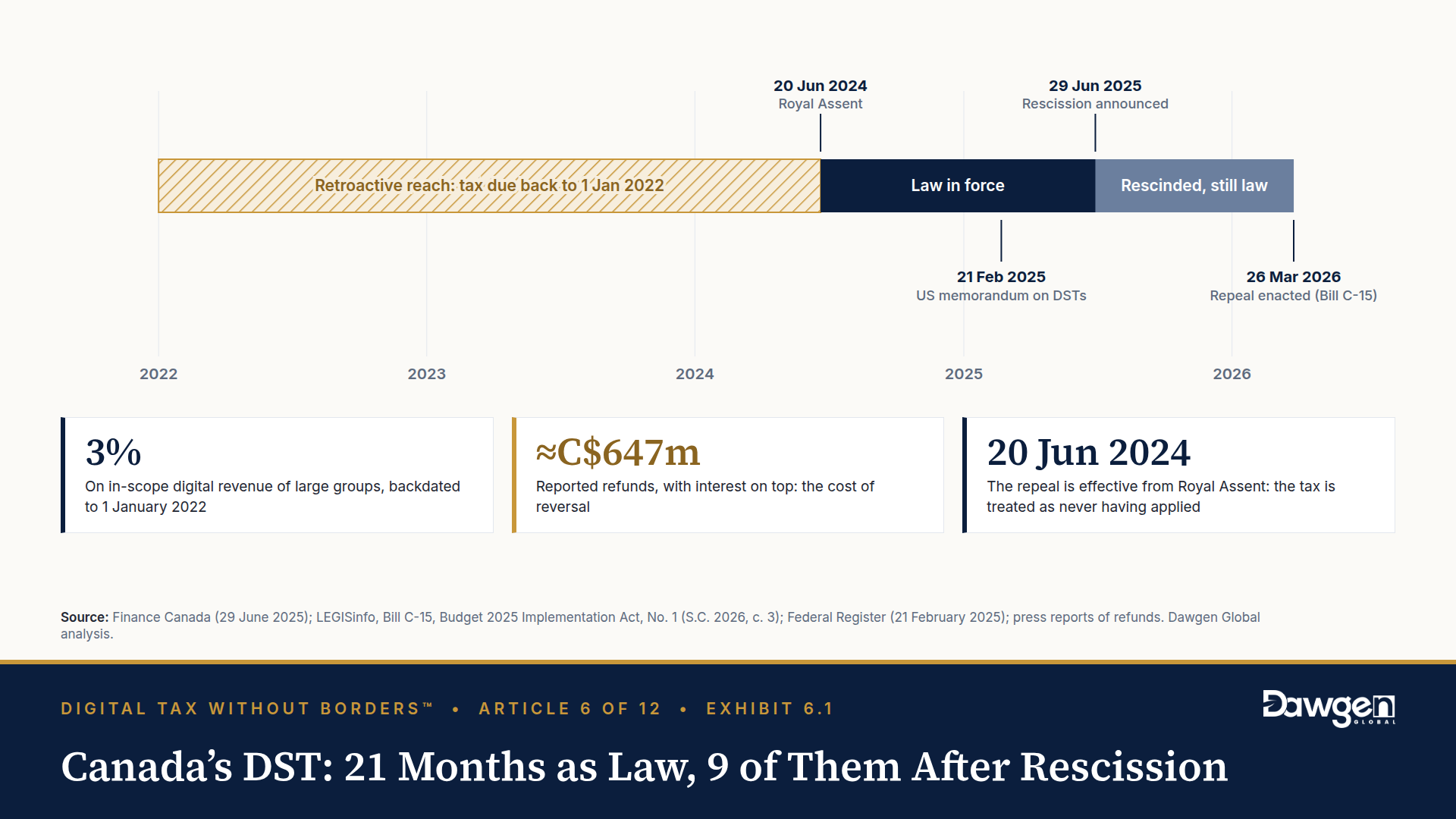
Sources for the exhibit: Finance Canada [1], LEGISinfo [2], Federal Register [3].
For nine months the tax was law but would not be collected. Groups that had paid or recharged it to customers had to manage provisions and receivables while the legislation caught up.
Lessons in legislative risk
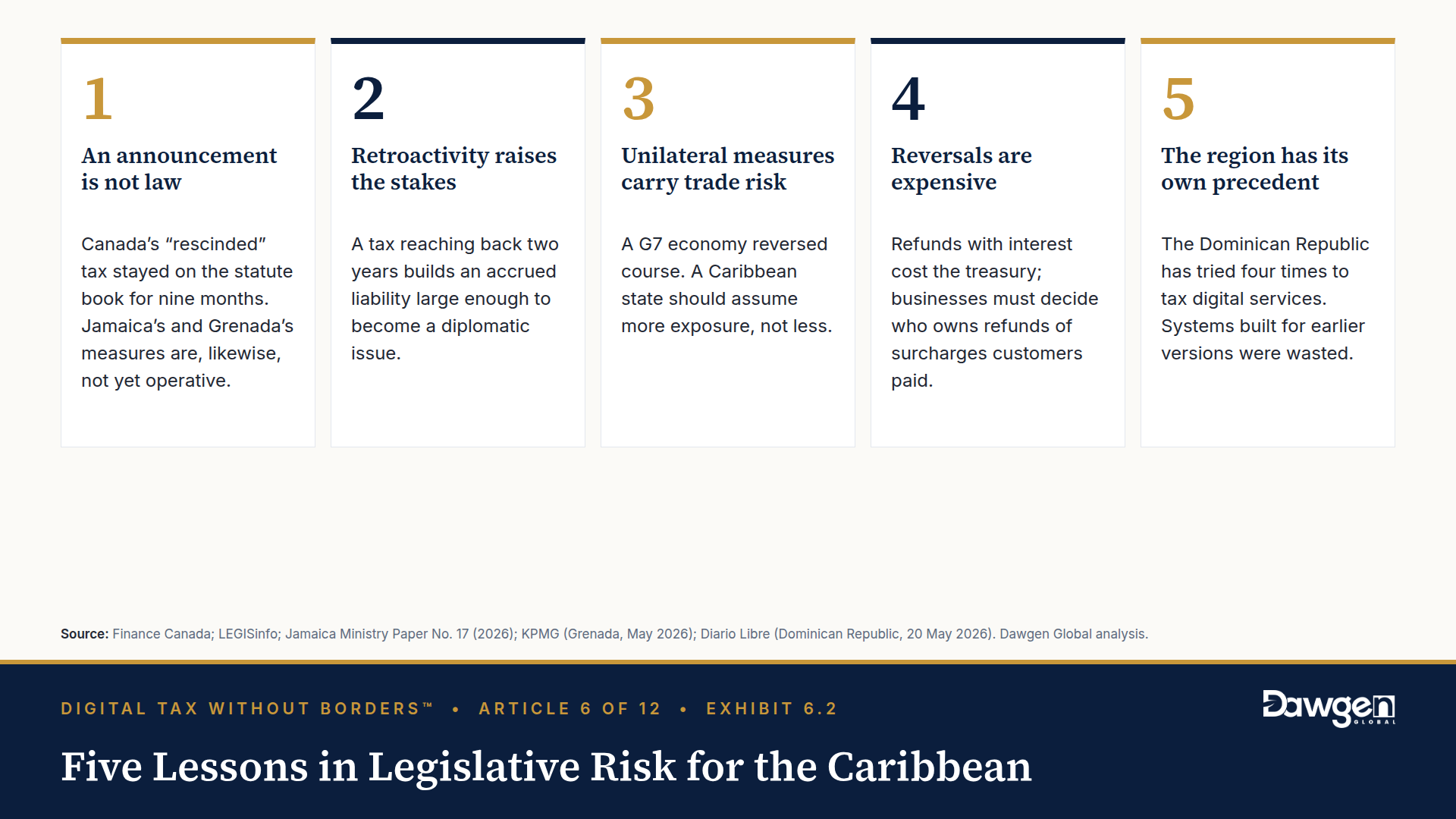
Canada’s reversal is not evidence that every DST will fall. The United Kingdom (UK) still charges 2 per cent above group thresholds of £500 million worldwide and £25 million in the UK [4], and France still charges 3 per cent [5]. But it teaches five lessons that apply directly to the Caribbean.
An announcement is not law, and neither is a repeal announcement. Canada’s tax was “rescinded” in June 2025 but remained on the statute book until March 2026. Caribbean practitioners see the same gap in the other direction. Jamaica’s Ministry Paper No. 17, tabled on 12 February 2026, announced General Consumption Tax (GCT) on digital services and intangibles from abroad, projected at J$300 million in fiscal year (FY) 2026/27 and J$4.2 billion a year from FY2027/28 [6]. As far as public sources show, enabling legislation and Tax Administration Jamaica (TAJ) guidance had not been published by late September 2026. Grenada’s VAT (Amendment) Bill 2026, extending value added tax (VAT) to non-resident digital suppliers, has passed Parliament but awaits assent and a commencement notice [7]. Each is a proposal or a bill, and should be recorded as such until the operative instrument exists.
Retroactivity raises the stakes. A tax reaching back two years creates an accrued liability large enough to become a diplomatic issue.
Unilateral measures carry trade risk. Canada is a Group of Seven economy with deep trade ties to the US and still reversed course. A Caribbean state considering a DST should assume greater, not lesser, exposure.
Reversals are expensive to unwind. Refunds with interest cost the treasury, and businesses must decide whether refunds belong to them or to customers who bore surcharges; few contracts say.
The region has its own precedent. The Dominican Republic has tried several times to apply its 18 per cent ITBIS (Impuesto sobre la Transferencia de Bienes Industrializados y Servicios) to digital services: a 2022 consultation was dropped, a 2024 fiscal modernisation reform was withdrawn, and Decree 30-25 of January 2025 was announced for repeal before it took effect. In May 2026 the tax authority said a new proposal was being prepared [8]. A business that had built systems for any of those versions would have wasted the effort.
Key figure: about C$647 million. That is the refund reported as due to taxpayers after Canada’s repeal, with interest on top. It is the cost of a unilateral tax that did not survive contact with trade policy.
Pillar One: Amount A stalled, Amount B optional
Pillar One was the OECD Inclusive Framework’s answer to the problem DSTs tried to solve: how to give market countries a share of the profits of very large, highly profitable groups that earn revenue there without a physical presence.
Amount A would have reallocated a portion of the residual profit of the largest groups to market jurisdictions, in exchange for the removal of DSTs and similar measures. The Multilateral Convention text was released on 11 October 2023. It has never been opened for signature. On 13 January 2025 the Inclusive Framework co-chairs reported no further developments since June 2024. Without US participation, which the convention’s design requires in practice, Amount A is stalled, and there is no timetable to revive it. Caribbean governments should not budget for Amount A revenue, and businesses should not model it as a near-term obligation.
Amount B is different and is already part of the rulebook. It provides a simplified transfer pricing approach for baseline marketing and distribution activities and was added to the OECD Transfer Pricing Guidelines in February 2024, applicable from 1 January 2025. It is optional: each jurisdiction decides whether to apply it. For Caribbean administrations with limited transfer pricing capacity, it offers a predictable return for local distributors of foreign groups. For a Kingston or Port of Spain distributor of an overseas brand, it may change how the local margin is tested.
Pillar Two after the side-by-side package
Pillar Two, the global minimum tax, is a different mechanism, aimed at large multinational groups above a revenue threshold rather than at digital businesses. On 5 January 2026 the Inclusive Framework released a “Side-by-Side Package” [9]. In brief, it introduced:
- a side-by-side safe harbour and an ultimate parent entity (UPE) safe harbour, from fiscal years beginning on or after 1 January 2026, which recognise qualifying home-country minimum tax systems, chiefly that of the US, in place of the income inclusion and undertaxed profits rules;
- a simplified effective tax rate (ETR) safe harbour to reduce computation burdens; and
- a substance-based tax incentive safe harbour, giving room for incentives linked to real expenditure or production.
For Caribbean jurisdictions, three consequences follow. First, domestic minimum top-up taxes, which some Caribbean jurisdictions have adopted, remain the main way to collect top-up tax locally on low-taxed subsidiaries; the side-by-side package switches off the parent-level rules, not the host country’s first claim. Second, the substance-based incentive safe harbour matters for investment regimes such as special economic zones: incentives tied to real activity are better protected than pure rate reductions. Third, for Caribbean-headquartered groups large enough to be in scope, the simplified ETR safe harbour may reduce compliance cost, but year-end 2026 is the first test.
The UN track: where Caribbean states have a voice
The UN offers the alternative forum. Article 12B, “Income from Automated Digital Services”, was added to the UN Model Double Taxation Convention in its 2021 update [10]. It allows the source state to tax income from automated digital services on a gross basis at a rate negotiated in the treaty, or on a net basis if the taxpayer elects. It works only through bilateral treaties, which limits its reach for small states. The Caribbean Community (CARICOM) Double Taxation Agreement of 1994, already source-based and allowing tax of up to 15 per cent on gross royalties and management fees [11], shows the region’s long preference for source taxation of service income.
The larger development is the UN Framework Convention on International Tax Cooperation. Negotiating sessions began in August 2025. Draft texts of the Convention and two early protocols were released in July 2026 [12]. Protocol 1 concerns the taxation of income from cross-border services in an increasingly digitalised and globalised economy, the same terrain as Amount A and Article 12B. The next session is in Nairobi from 30 November to 11 December 2026, and final texts are due to the UN General Assembly in September 2027 [13].
The UN track gives every member state an equal seat, and it is where small Caribbean states have the most direct voice. Its outcome will bind only countries that sign and ratify, and the US is unlikely to join. But it could give a Caribbean state a multilateral basis for source taxation of digital service income without the trade exposure of a standalone DST.
Three scenarios for Caribbean planning
No one can say which path will prevail by 2028. Boards and ministries should plan against three scenarios and prioritise actions that make sense in all of them.
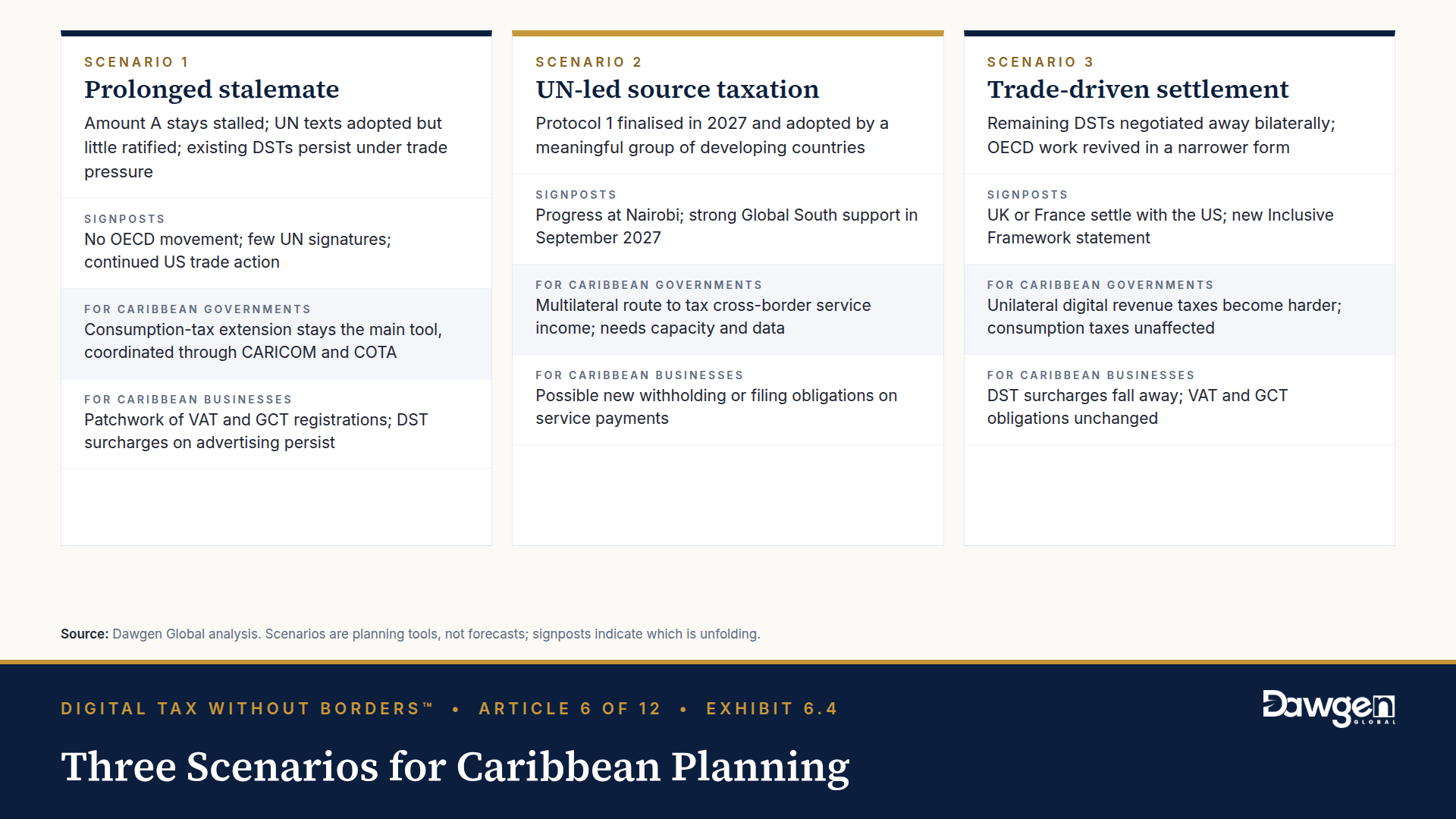
In all three, consumption-tax obligations are unaffected: Barbados, The Bahamas and Suriname already apply VAT to foreign digital services, and Grenada and Jamaica are following. The low-regret actions are therefore the same in every scenario: know where customers are (billing address, card country, Internet Protocol (IP) address), characterise each digital purchase and sale, keep contracts that allocate tax changes, and maintain a register that distinguishes law in force from proposals.
A monitoring calendar for the next 12 to 18 months
Dates are those announced as at 29 September 2026; undated items are developments to watch.
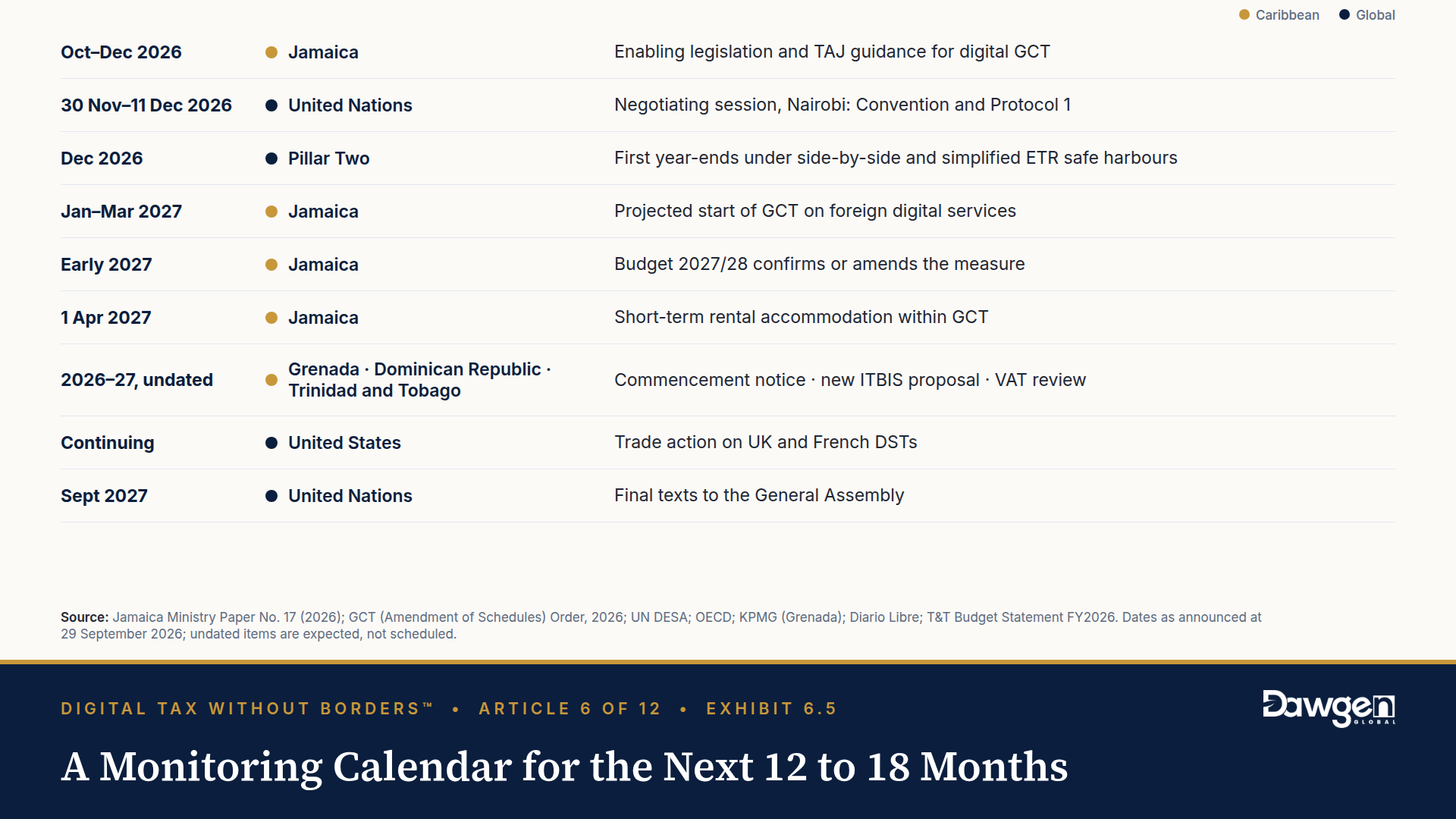
Sources: Jamaica Information Service [6], KPMG [7], Diario Libre [8], Mayer Brown [9], UN Department of Economic and Social Affairs [13], The Gleaner [14], Ministry of Finance, Trinidad and Tobago [15].
The Dawgen Digital Tax COMPASS™
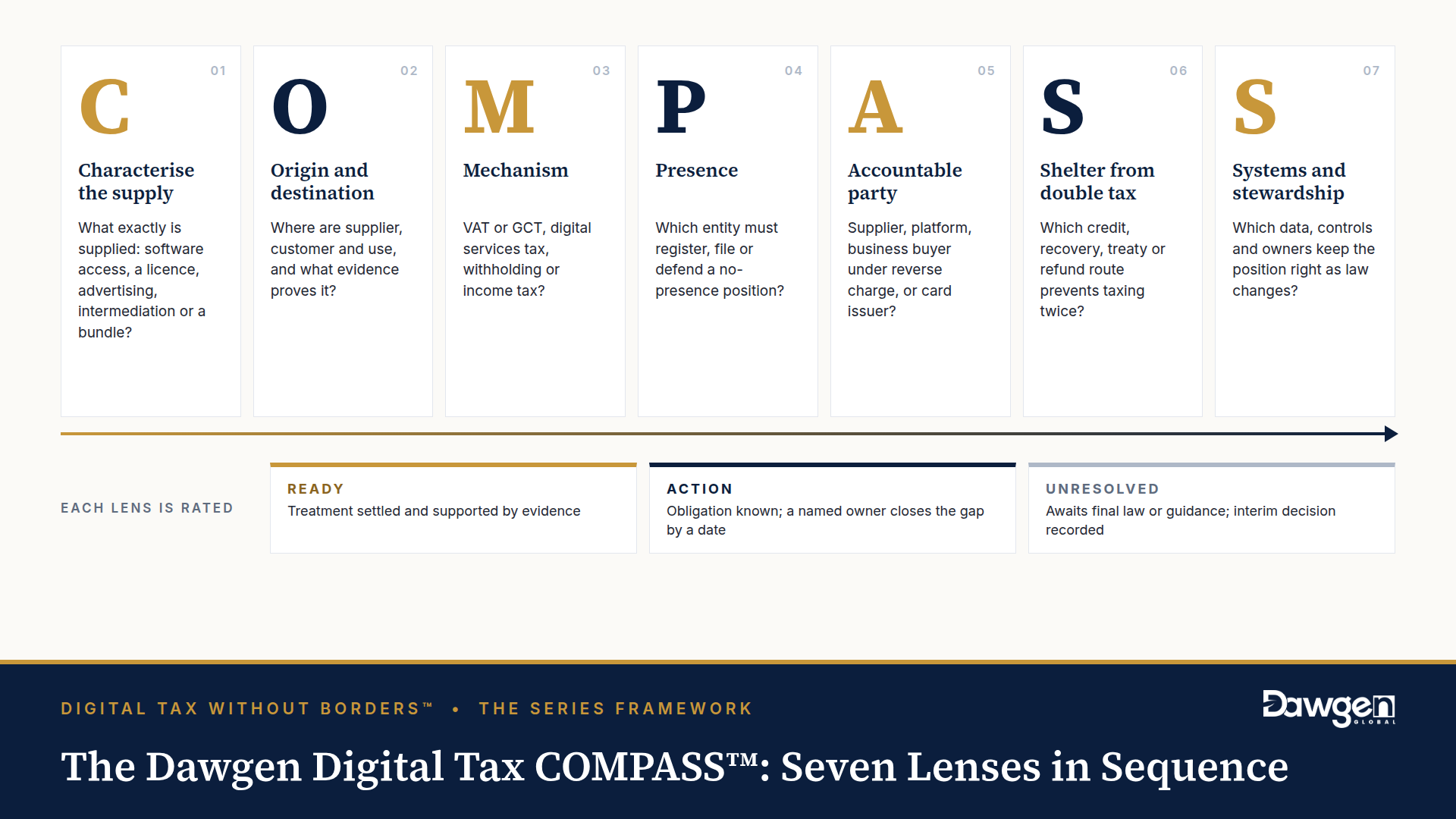
The Dawgen Digital Tax COMPASS™ is the method Dawgen Global uses to turn the broad phrase “digital tax” into specific, answerable questions. It works transaction by transaction, and it applies equally to what a business buys and what it sells. Seven lenses are applied in sequence, because each answer depends on the one before it.
- C — Characterise the supply. What exactly is supplied: access to software, a licence of intellectual property, advertising, intermediation, a professional service delivered remotely, or a bundle of several? The contract and the actual performance decide, not the invoice description.
- O — Origin and destination. Where are the supplier, the customer and the place of use or consumption, and what evidence proves it? Billing address, card country, IP address and contract terms often disagree.
- M — Mechanism. Which tax is in play: VAT or GCT on consumption, a gross-revenue digital services tax, withholding tax on the payment, or income tax on profits? Each has a different taxpayer, base and remedy.
- P — Presence. Which entity has a taxable connection with which jurisdiction, and must it register, file or defend a no-presence position?
- A — Accountable party. Who must actually charge, collect or remit: the supplier, a platform deemed to be the supplier, the business customer under a reverse charge, or a payment intermediary?
- S — Shelter from double taxation. Which credit, input tax recovery, treaty provision or refund route prevents the same value being taxed twice, and is it documented?
- S — Systems and stewardship. Which data fields, controls, owners and monitoring routines keep the position right as volumes grow and the law changes?
Each lens is rated on a simple three-tier scale. Ready means the treatment is settled and supported by evidence. Action means the obligation is known and a named owner is fixing a gap by a date. Unresolved means the answer depends on law or guidance that is not yet final, and an interim commercial decision has been recorded. The output is a transaction-level exposure map and an action plan with owners, not a list of countries. The COMPASS™ identifies and prioritises the questions; each material conclusion is then supported by the law of the jurisdiction concerned.
Applying the COMPASS™ to global policy uncertainty
| Lens | What to ask in this context | Evidence to hold |
| Characterise | Which of our revenue and cost streams would fall within a DST, Amount A, Amount B or a UN services protocol if one applied? | Revenue and cost map by stream and by counterparty |
| Origin and destination | Where are our users, customers and service recipients, and could we prove it for a source-based tax? | Location data by market; data quality assessment |
| Mechanism | For each development, is it law in force, a bill, a proposal or a negotiation, and which tax type is it? | Legal register with status, effective date and last-checked date |
| Presence | Would a significant economic presence or services protocol create a filing obligation where we have no entity? | Market revenue by jurisdiction against any proposed thresholds |
| Accountable party | Who would bear a new tax or benefit from a refund under our contracts: us, the supplier or the customer? | Tax-change and refund clauses in key contracts |
| Shelter | If a source tax applied, would a treaty, the CARICOM agreement or a foreign tax credit prevent double taxation? | Treaty map; foreign tax credit analysis |
| Systems | Is there an owner who reviews the monitoring calendar quarterly and reports scenario changes to the board? | Quarterly report; decision log showing triggers and responses |
Questions for the board
- Does our tax register record the status and effective date of each measure, so that a repeal or a delayed commencement is visible rather than overwritten?
- If a tax we pass through to customers were repealed and refunded, do our contracts say who is entitled to the refund?
- Which of the three scenarios would hurt us most, and what would we do differently if it materialised?
- Are we treating Jamaica’s digital GCT and Grenada’s VAT bill as proposals until the operative instruments are published, while still preparing systems?
- If we are in scope for Pillar Two, have we assessed the side-by-side and simplified ETR safe harbours before the 2026 year-end?
- Does Amount B affect how any of our local distribution margins will be tested?
- Who is following the UN Framework Convention negotiations, and would Protocol 1 change how our cross-border service income or payments are taxed?
- When did management last present the monitoring calendar to this board, and what changed?
How Dawgen Global can help
Dawgen Global’s Caribbean Tax Advisory practice helps boards, finance leaders and owner-managers track global and regional digital tax policy, plan against realistic scenarios and act on the developments that change their obligations. Using the Dawgen Digital Tax COMPASS™, we map digital transactions across the jurisdictions in which you operate, separate law in force from proposals, quantify exposure and help your team put in place the contracts, systems and controls to stay compliant as the rules change. To discuss your organisation’s position, contact us at [email protected] or visit www.dawgen.global/contact-us.
This article provides general information and does not constitute tax or legal advice. The application of tax law depends on specific facts and on the law in force at the relevant date; readers should obtain advice before acting.
Abbreviations used
- CARICOM — Caribbean Community
- COTA — Caribbean Organisation of Tax Administrators
- DST — digital services tax
- ETR — effective tax rate
- FY — fiscal year
- G7 — Group of Seven
- GCT — General Consumption Tax
- IP — Internet Protocol (in “IP address”)
- ITBIS — Impuesto sobre la Transferencia de Bienes Industrializados y Servicios (Dominican Republic VAT)
- OECD — Organisation for Economic Co-operation and Development
- TAJ — Tax Administration Jamaica
- UK — United Kingdom
- UN — United Nations
- UPE — ultimate parent entity
- US — United States
- USTR — US Trade Representative
- VAT — value added tax
Sources
- Department of Finance Canada, “Canada rescinds digital services tax to advance broader trade negotiations with the United States”, 29 June 2025. https://www.canada.ca/en/department-finance/news/2025/06/canada-rescinds-digital-services-tax-to-advance-broader-trade-negotiations-with-the-united-states.html
- Parliament of Canada, LEGISinfo, Bill C-15, Budget 2025 Implementation Act, No. 1 (Royal Assent 26 March 2026). https://www.parl.ca/legisinfo/en/bill/45-1/c-15
- Federal Register, Presidential Memorandum, “Defending American Companies and Innovators From Overseas Extortion and Unfair Fines and Penalties”, 21 February 2025 (published 26 February 2025). https://www.federalregister.gov/documents/2025/02/26/2025-03188/defending-american-companies-and-innovators-from-overseas-extortion-and-unfair-fines-and-penalties
- HM Revenue and Customs, “Check if you need to register for Digital Services Tax”. https://www.gov.uk/guidance/check-if-you-need-to-register-for-digital-services-tax
- Direction générale des Finances publiques, “TSN – Taxe sur les services numériques”. https://www.impots.gouv.fr/professionnel/tsn-taxe-sur-les-services-numeriques
- Jamaica Information Service, “Gov’t projects $29.4B from new revenue measures in fiscal year 2026/27”, February 2026. https://jis.gov.jm/govt-projects-29-4b-from-new-revenue-measures-in-fiscal-year-2026-27/
- KPMG, “Grenada: Nonresident digital services VAT”, May 2026. https://kpmg.com/us/en/taxnewsflash/news/2026/05/grenada-nonresident-digital-services-vat.html
- Diario Libre, “La DGII trabaja propuesta de ITBIS para plataformas digitales”, 20 May 2026. https://www.diariolibre.com/economia/finanzas/2026/05/20/la-dgii-trabaja-propuesta-de-itbis-para-plataformas-digitales/3538742
- Mayer Brown, “OECD Pillar Two: Side-by-Side System and New Safe Harbors”, January 2026. https://www.mayerbrown.com/en/insights/publications/2026/01/oecd-pillar-two-side-by-side-system-and-new-safe-harbors
- United Nations, Model Double Taxation Convention between Developed and Developing Countries, 2021 update. https://financing.desa.un.org/sites/default/files/2023-05/UN%20Model_2021.pdf
- CARICOM, “Double Taxation Agreement” (1994). https://caricom.org/treaties/double-taxation-agreement/
- EY, “UN releases draft Framework Convention on International Tax Cooperation and two early protocols”, 27 July 2026. https://www.ey.com/en_gl/technical/tax-alerts/un-releases-draft-framework-convention-on-international-tax-cooperation-and-two-early-protocols
- UN Department of Economic and Social Affairs, Intergovernmental Negotiating Committee on the UN Framework Convention on International Tax Cooperation, fifth session. https://financing.desa.un.org/inc/fifthsession
- The Gleaner, “Airbnb and short-term rentals to face GCT from April 2027”, 30 April 2026. https://jamaica-gleaner.com/article/news/20260430/airbnb-and-short-term-rentals-face-gct-april-2027
- Ministry of Finance, Trinidad and Tobago, Budget Statement FY2026, October 2025. https://www.finance.gov.tt/wp-content/uploads/2025/10/Budget-Statement-FY-2026-2.pdf
About Dawgen Global
Dawgen Global is an independent, integrated multidisciplinary professional services firm headquartered at 47 Trinidad Terrace, New Kingston, Jamaica, serving more than 15 territories across the Caribbean. Founded and led by Dr. Dawkins Brown, Executive Chairman, the firm is independent and not affiliated with any international network. It delivers a full suite of professional services under one roof: audit and assurance; tax advisory; IT and digital transformation; risk management; cybersecurity; actuarial and insurance regulatory advisory; HR advisory; mergers and acquisitions; corporate recovery; business advisory and strategy; accounting BPO and virtual CFO services; and legal process outsourcing.
The proposition is simple: big-firm capability without the big-firm price. Dawgen Global’s integrated approach is built for the specific complexities and opportunities of the Caribbean market, helping organizations make sharper, better-informed decisions that drive measurable progress.
To explore a partnership, reach out:
- Website: dawgen.global
- Email: [email protected]
- WhatsApp (Global): +1 555-795-9071
- Caribbean offices: +1 876-665-5926 | +1 876-929-3670 | +1 876-926-5210


