
Consumption tax on digital services follows the customer, not the supplier. For Caribbean firms selling across the islands, that principle turns on three practical questions: is the customer a business, where are they, and who collects?
Executive summary
Every Caribbean consumption tax regime for digital services rests on one idea: value added tax (VAT) or General Consumption Tax (GCT) should be paid where the service is consumed. That is the destination principle, set out in the Organisation for Economic Co-operation and Development (OECD) guidelines on VAT and goods and services tax (GST), and now reflected in Barbados, The Bahamas, Suriname, Grenada’s 2026 amendment and Jamaica’s Budget proposal.
The principle is simple; its operation is not. Tax systems distinguish business-to-business (B2B) supplies, normally taxed by reverse charge in the customer’s hands, from business-to-consumer (B2C) supplies, where someone other than the customer must collect. They need evidence of where the customer is, and they must choose who collects: the supplier, a platform, a card issuer or the customer itself. The Caribbean already uses three of those four models, sometimes between neighbouring islands.
This article explains how the principle is made to work, compares collection models, sets out what a Caribbean seller into neighbouring islands must do, and describes what a consumer-facing invoice should show.
The destination principle: tax follows consumption
A consumption tax is meant to fall on final consumption where it happens. For goods, customs collects at the border; services and intangibles cross no border post. A streaming subscription used in Nassau, an online course taken in Paramaribo and a design application used in St George’s are all delivered through a screen.
The OECD’s International VAT/GST Guidelines (2017) set the international answer: cross-border services and intangibles should be taxed in the jurisdiction of consumption [1]. The 2021 VAT Digital Toolkit for Latin America and the Caribbean, published by the OECD, the World Bank, the Inter-American Center of Tax Administrations and the Inter-American Development Bank, translated that answer into practical designs for the region [2].
The alternative, taxing where the supplier sits, produces two bad results. Domestic providers charge local VAT while foreign competitors charge none, and suppliers are rewarded for locating in low-tax jurisdictions. In small Caribbean markets, where a local streaming service, e-learning platform or software reseller competes directly with foreign giants, a 10 to 17.5 per cent price gap is decisive. The destination principle removes it.
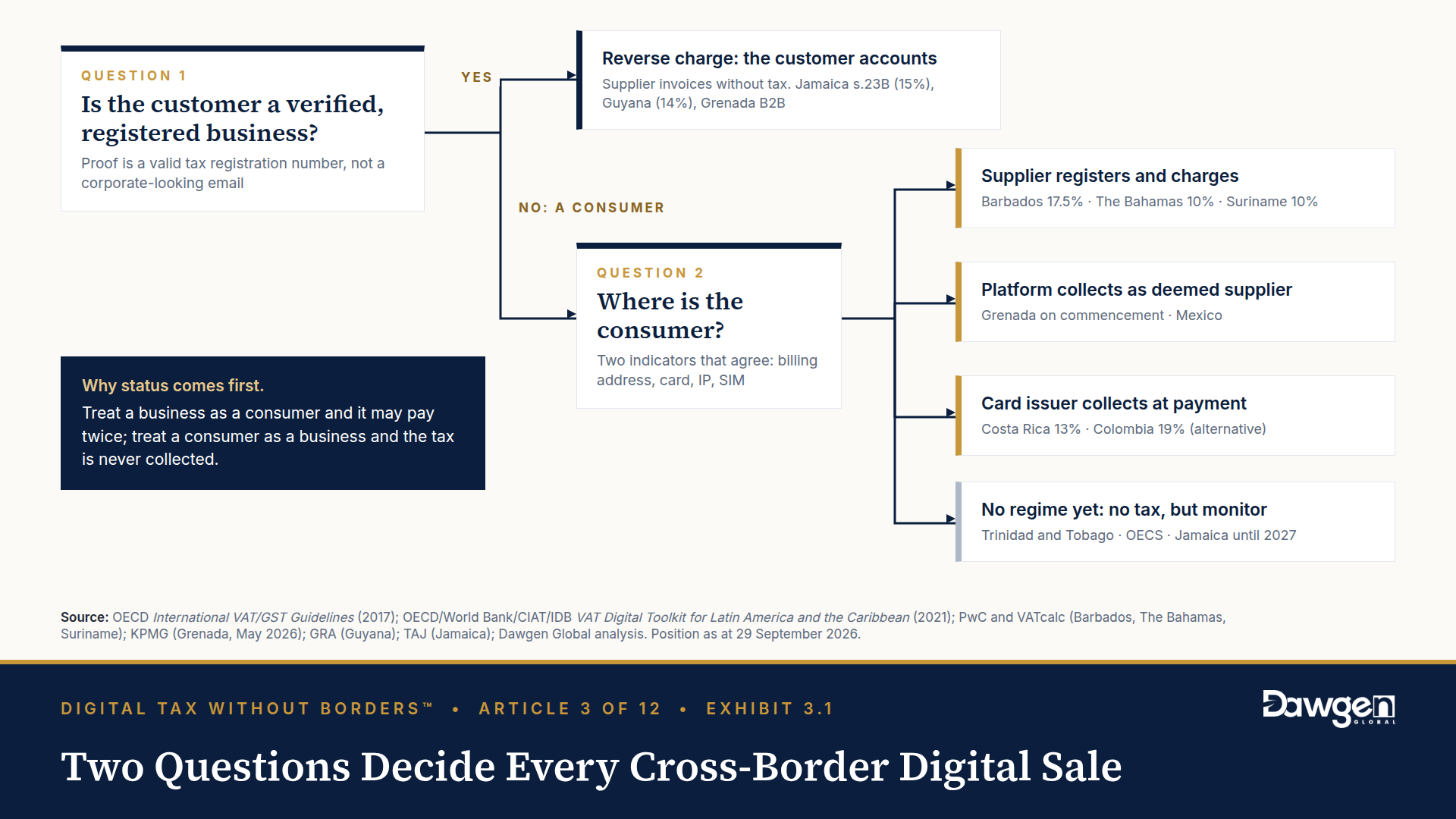
Applying the principle requires three answers for every transaction: whether the customer is a business or a consumer, where the customer is, and who is responsible for collecting the tax.
Two routes: reverse charge for businesses, collection for consumers
B2B: the customer accounts
When the customer is a registered business, the simplest collector is the customer. Under a reverse charge, the foreign supplier invoices without tax and the business customer calculates the VAT or GCT itself, declares it as output tax and, to the extent it makes taxable supplies, recovers it as input tax. The government collects from a known local taxpayer.
Jamaica has operated this way for imported services since GCT Act sections 3(1)(b) and 23B entered the law in 2003, with the operational framework of 2014 and a Tax Administration Jamaica (TAJ) Technical Bulletin of 23 April 2020 [12]. Guyana’s recipients self-account for VAT at 14 per cent on imported services through their Guyana Revenue Authority return [11]. Grenada’s VAT (Amendment) Bill 2026 applies a reverse charge to B2B supplies by non-resident digital suppliers [7].
The reverse charge has one limit that defines the whole policy debate: it cannot reach consumers. A household will not self-account for tax on its streaming subscription, and Jamaica expressly excludes individuals importing for private use, and persons below the J$15 million registration threshold, from its reverse charge [12].
B2C: someone else must collect
For consumer sales, the tax has to be collected by someone the tax authority can reach. The standard answer is to require the foreign supplier to register, charge tax and file returns in the customer’s country. Barbados has done so since 1 December 2019 at 17.5 per cent [8], The Bahamas since its 2019 VAT amendment at 10 per cent [9][10], and Suriname since VAT began on 1 January 2023 at 10 per cent [6]. Grenada will do so once its amendment commences [7], and Jamaica’s Budget proposal for January to March 2027 points the same way [15].
The customer’s B2B or B2C status therefore determines the whole workflow. Get it wrong one way and tax is uncollected; the other way, a registered business pays twice. The proof of status should be a verified tax registration number, not an email address that looks corporate.
Key rule. A registered business customer normally accounts for the tax itself under a reverse charge. A consumer does not, so the supplier, a platform or a payment intermediary must collect. Evidence of the customer’s status comes first; evidence of location comes second.
Proving where the customer is
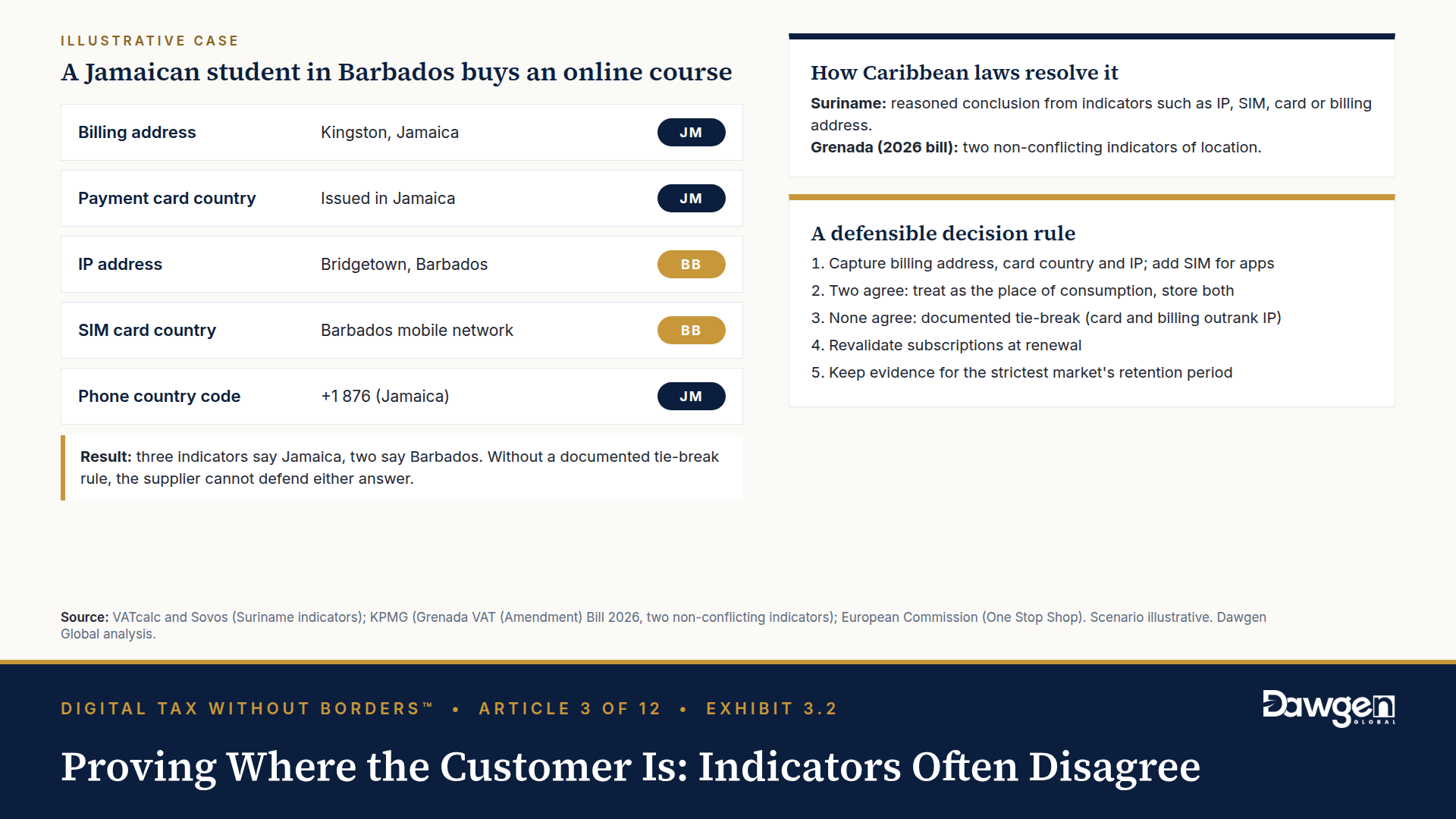
Once the customer is known to be a consumer, the supplier must establish in which country they consume. A supplier with no shop and no local staff has only data: the billing address the customer typed, the country of the payment card, the internet protocol (IP) address of the device, the country of the mobile subscriber identity module (SIM) card, and the country code of the telephone number. These frequently disagree. A Jamaican student in Barbados may pay with a Jamaican card, browse from a Barbadian IP address and give a Kingston billing address.
The region’s laws resolve the conflict in two ways.
Suriname determines customer location using indicators such as IP address, SIM card, payment card or billing address [6]. The supplier uses the indicators available to reach a reasoned conclusion.
Grenada’s amendment requires two non-conflicting indicators of location [7]. If the billing address and the card country both point to Grenada, the customer is in Grenada. If the indicators conflict, the supplier needs a further indicator or a documented rule for resolving the conflict.
A similar evidence approach operates in the European Union, alongside its One Stop Shop (OSS), in operation since 1 July 2021, which allows a supplier to declare tax on B2C sales across all member states in one return while still charging each state’s own rate [3]. For Caribbean suppliers the lesson is that location evidence is not a single field; it is a small decision rule, applied consistently and recorded.
A practical decision rule for a Caribbean seller looks like this:
- Capture at least three indicators at sign-up: billing address, payment card country and IP address. Add SIM or telephone country for mobile applications.
- Where two indicators agree, treat that country as the place of consumption and store both.
- Where no two agree, apply a documented tie-break (for example, card country and billing address outrank IP address, which is easily altered by virtual private networks) and flag the account for review.
- For subscriptions, revalidate at renewal rather than on every access, and keep the evidence available at the date of each supply.
- Retain the evidence for the record-keeping period of the strictest market served, and collect no more personal data than the tax rule needs.
Four collection models compared
Beyond the B2B and B2C split, jurisdictions choose who carries the collection obligation. Four models are in use in the Caribbean and Latin America.
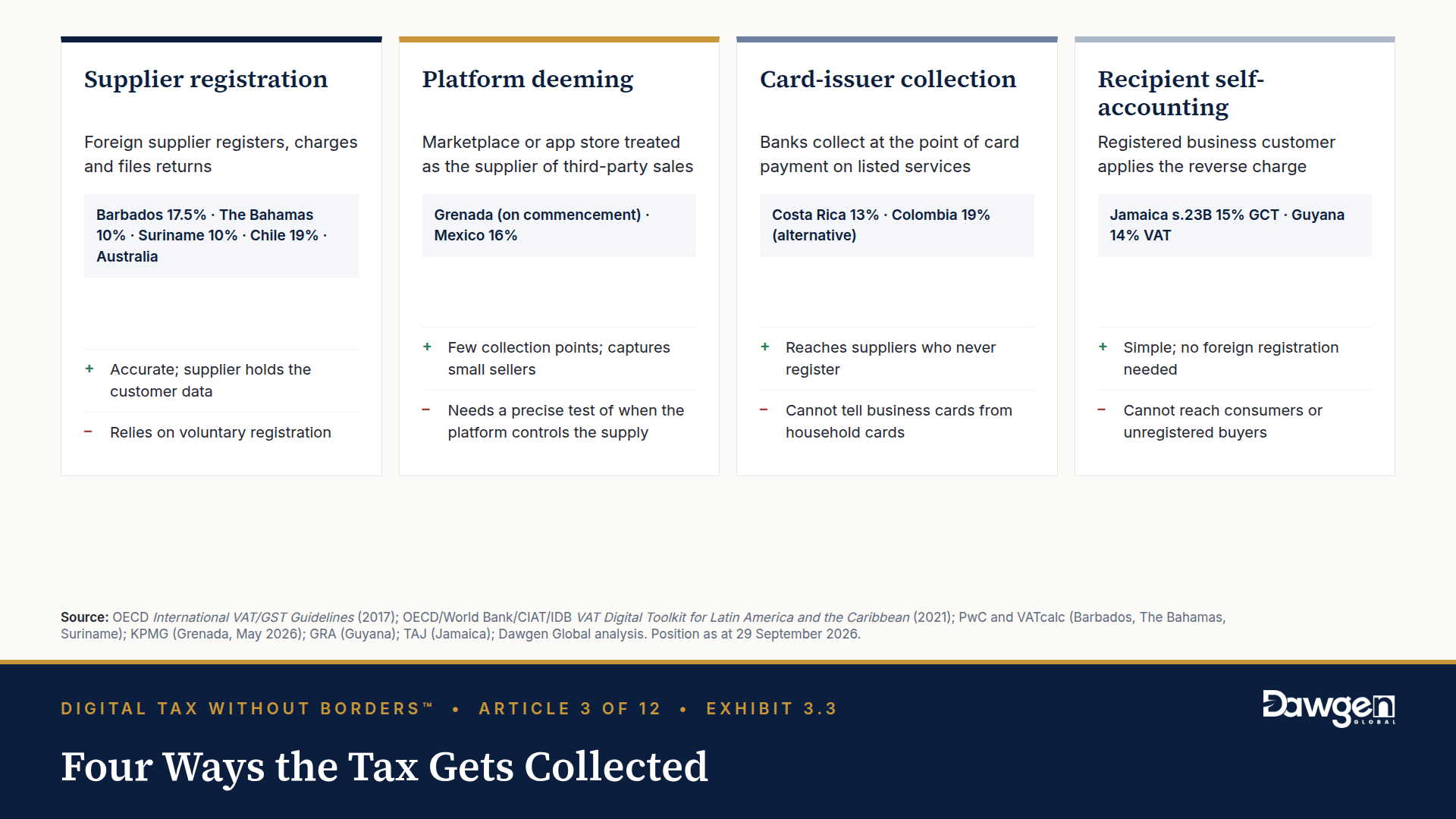
Sources: [2]–[12].
The models are not exclusive. Grenada combines supplier registration for consumers, reverse charge for businesses and platform deeming [7]. Costa Rica pairs card-issuer collection with an optional simplified registration for providers. Chile runs a simplified registration system for foreign providers [5]. Most mature regimes end up as hybrids, because no single collector sees every transaction.
For Caribbean policymakers, the choice has a regional dimension. At the Caribbean Community (CARICOM) and Caribbean Organisation of Tax Administrators (COTA) workshop of 4 March 2026, officials from 13 countries discussed securing VAT on cross-border digital transactions, with Barbados and The Bahamas sharing their experience [14]. A supplier facing five islands with five location rules will prioritise the largest. Shared definitions and a shared location standard would do more for collection in the smaller islands than any single rate decision.
Selling into neighbouring islands: what a Caribbean seller must do
The destination principle cuts both ways. A Kingston e-learning company, a Port of Spain software developer or a Bridgetown design studio selling subscriptions to consumers in other islands is a foreign supplier under the law of each customer’s country.
Illustrative worked example: a Kingston e-learning platform
A hypothetical Kingston-based company sells an online professional certification course at US$120 a year per learner, priced the same across the region. Its sales for the year are shown below. The figures are illustrative; the treatment reflects the law as at 29 September 2026.
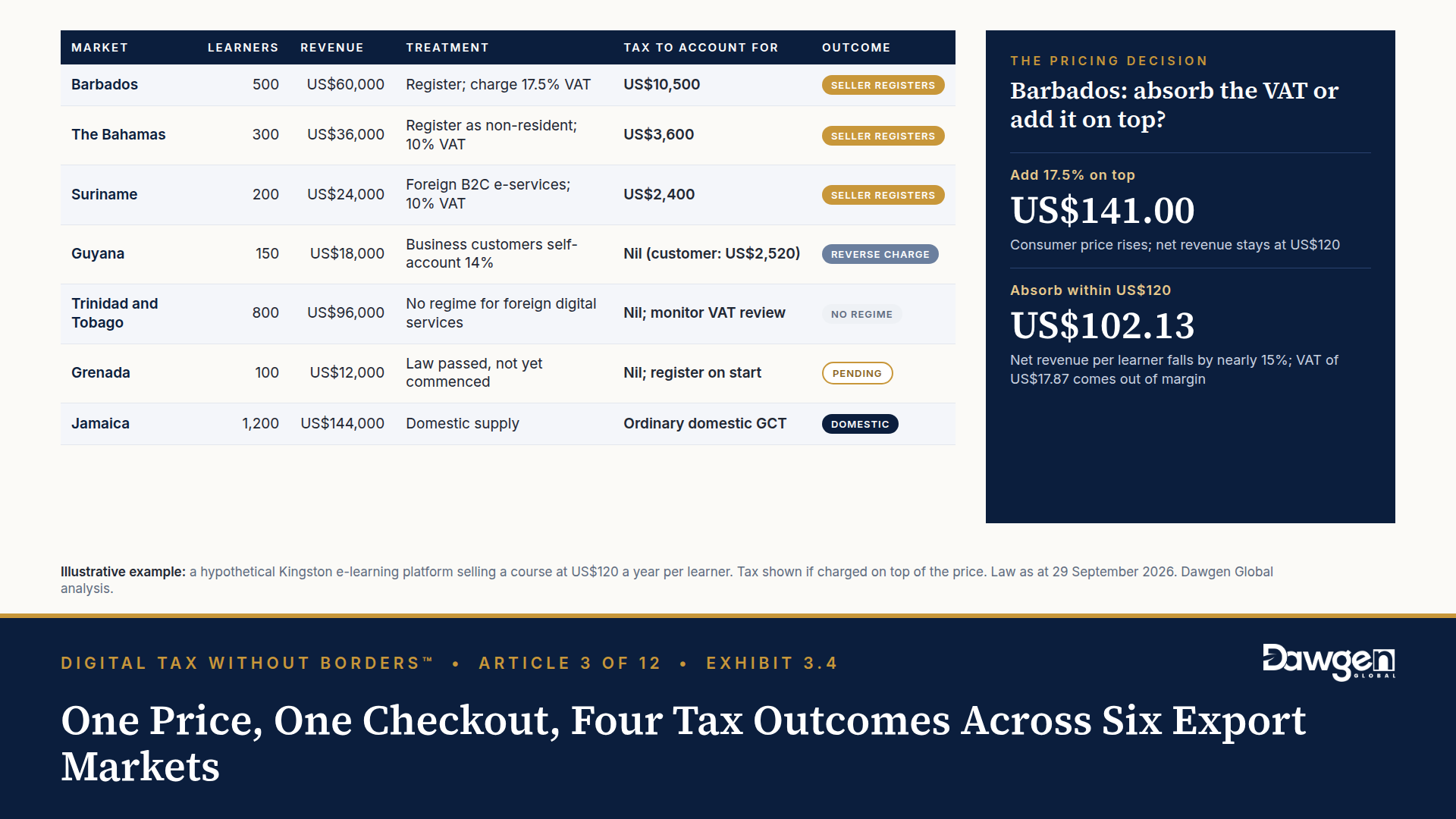
Three conclusions follow. First, a company with a single price and a single checkout faces at least four different tax outcomes in six export markets. Second, pricing matters: in Barbados, absorbing the VAT inside a US$120 price cuts net revenue per learner by nearly 15 per cent, while adding it on top raises the consumer price to US$141. Third, the treatment changes over time: Grenada will move from the “none” column to the “register” column by Gazette notice, and Trinidad and Tobago’s Budget for fiscal year 2026 signalled a review of its VAT system [13][16].
The seller’s checklist
A Caribbean seller of digital services into neighbouring islands should do six things.
- Map revenue by customer country and by customer type, using the location decision rule above.
- Compare each market with its regime: register where required (Barbados, The Bahamas, Suriname now; Grenada on commencement; Jamaica, for non-Jamaican sellers, once its law passes).
- Collect and verify tax registration numbers from business customers, so that B2B sales are correctly left to reverse charge where the law provides for it.
- Decide market by market whether prices are tax-inclusive or tax-exclusive, and change the checkout accordingly.
- Where sales run through an app store or marketplace, confirm whether the platform is deemed the supplier in that market and obtain its reports, so the same sale is not declared twice.
- Set a calendar of return deadlines and currency conversion rules for each registration, and a named owner for each.
What a consumer-facing invoice should show
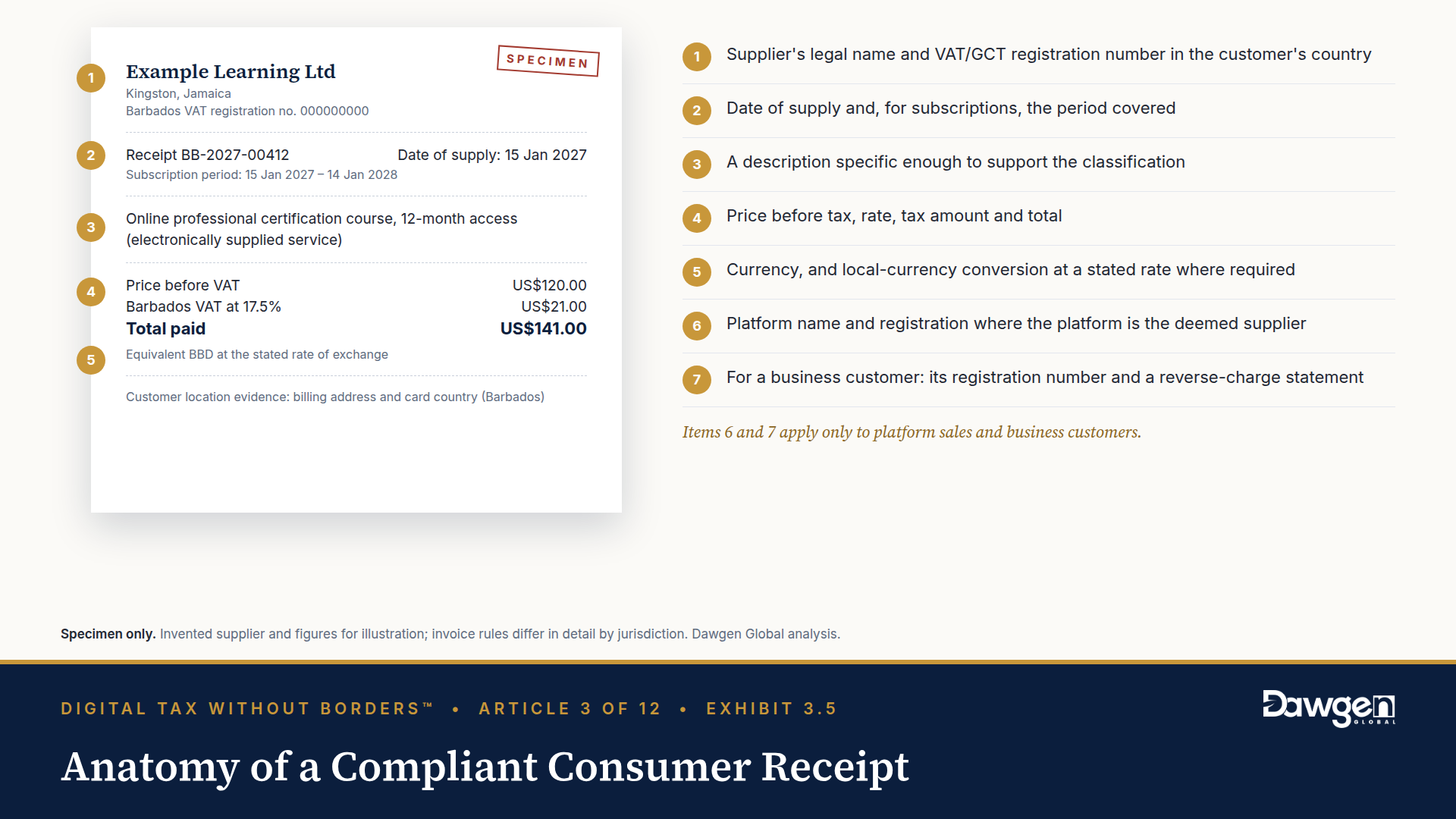
A consumer receipt is usually an email, but it is the supplier’s evidence of what was charged. In the Caribbean regimes, a compliant consumer invoice or receipt for a cross-border digital service should show:
- the supplier’s legal name and its VAT or GCT registration number in the customer’s country;
- the date of supply and, for subscriptions, the period covered;
- a clear description of the service, specific enough to support its classification;
- the price before tax, the rate applied, the tax amount and the total;
- the currency, and where required a conversion to local currency at a stated rate;
- where a platform is the deemed supplier, the platform’s name and registration, not the underlying developer’s;
- for a business customer under reverse charge, the customer’s registration number and a statement that the customer accounts for the tax.
Invoice rules differ in detail between jurisdictions, and a generic global receipt template rarely meets all of them. The supplier should test four transactions in every priority market before launch: a new subscription, a discounted renewal, a refund and a sale through a platform. Refunds are where errors surface.
Transparency at checkout also matters commercially. A tax added at the final step increases abandonment; a tax-inclusive price protects conversion but compresses margin. The decision should be made deliberately, market by market, and recorded alongside the tax treatment.
The Dawgen Digital Tax COMPASS™
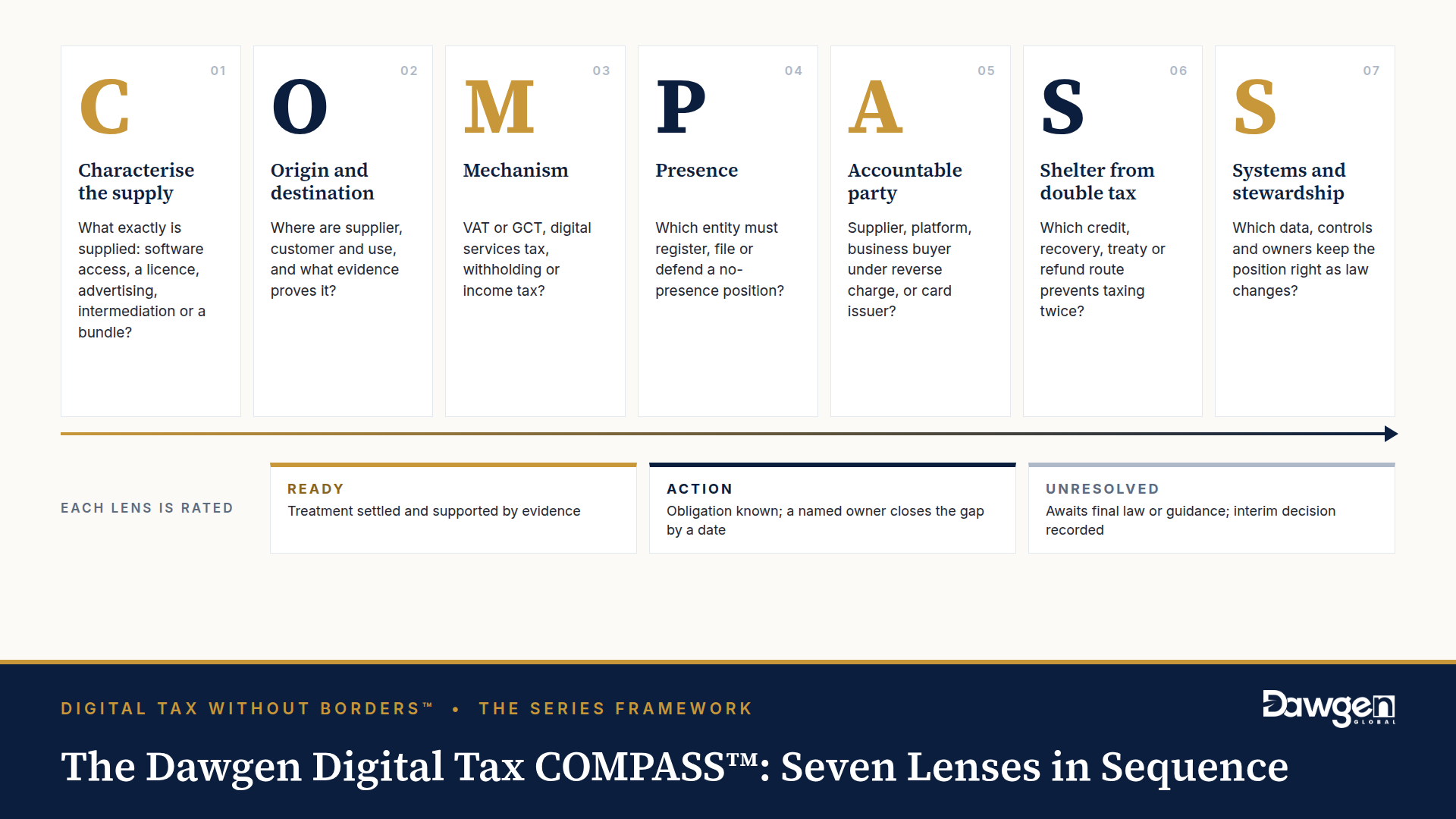
The Dawgen Digital Tax COMPASS™ is the method Dawgen Global uses to turn the broad phrase “digital tax” into specific, answerable questions. It works transaction by transaction, and it applies equally to what a business buys and what it sells. Seven lenses are applied in sequence, because each answer depends on the one before it.
- C — Characterise the supply. What exactly is supplied: access to software, a licence of intellectual property, advertising, intermediation, a professional service delivered remotely, or a bundle of several? The contract and the actual performance decide, not the invoice description.
- O — Origin and destination. Where are the supplier, the customer and the place of use or consumption, and what evidence proves it? Billing address, card country, IP address and contract terms often disagree.
- M — Mechanism. Which tax is in play: VAT or GCT on consumption, a gross-revenue digital services tax, withholding tax on the payment, or income tax on profits? Each has a different taxpayer, base and remedy.
- P — Presence. Which entity has a taxable connection with which jurisdiction, and must it register, file or defend a no-presence position?
- A — Accountable party. Who must actually charge, collect or remit: the supplier, a platform deemed to be the supplier, the business customer under a reverse charge, or a payment intermediary?
- S — Shelter from double taxation. Which credit, input tax recovery, treaty provision or refund route prevents the same value being taxed twice, and is it documented?
- S — Systems and stewardship. Which data fields, controls, owners and monitoring routines keep the position right as volumes grow and the law changes?
Each lens is rated on a simple three-tier scale. Ready means the treatment is settled and supported by evidence. Action means the obligation is known and a named owner is fixing a gap by a date. Unresolved means the answer depends on law or guidance that is not yet final, and an interim commercial decision has been recorded. The output is a transaction-level exposure map and an action plan with owners, not a list of countries. The COMPASS™ identifies and prioritises the questions; each material conclusion is then supported by the law of the jurisdiction concerned.
Applying the COMPASS™ to cross-border digital sales under the destination principle
| Lens | What to ask in this context | Evidence to hold |
| C — Characterise | Is the product an electronically supplied service, a live remote service, or a bundle with goods? | Product catalogue with a tax classification per product |
| O — Origin and destination | In which country is each customer, and do two indicators agree? | Billing address, card country, IP address and SIM data per transaction; tie-break rule |
| M — Mechanism | Which consumption tax applies in each market, at what rate, and is it law in force or a proposal? | Dated regime register by market |
| P — Presence | Must we register in Barbados, The Bahamas, Suriname, Grenada or Jamaica for consumer sales? | Revenue by market and customer type; registration certificates |
| A — Accountable party | For each sale, do we collect, does a platform, or does the business customer under reverse charge? | Verified registration numbers of business customers; platform terms and reports |
| S — Shelter | Are platform-collected and self-declared sales separated so nothing is declared twice? Are refunds adjusted in the right return? | Reconciliation of platform reports to our ledger; refund log by country |
| S — Systems | Does the checkout capture indicators, apply the right rate and issue a compliant receipt in each market? | Test results for new sale, renewal, refund and platform sale per market; named owner |
Questions for the board
- Do we know how much of our digital revenue comes from customers outside our home jurisdiction, by country and customer type?
- Are we registered, or required to register, in Barbados, The Bahamas or Suriname, and are we ready for Grenada’s commencement?
- What evidence do we hold of each customer’s location, and what rule resolves conflicting indicators?
- How do we verify that a customer claiming business status is genuinely registered?
- Are our prices in each market tax-inclusive or tax-exclusive, and what does that do to margin?
- Where we sell through platforms, do we know which sales the platform declares and which we must declare?
- Do our consumer receipts meet the invoice requirements of each market we serve?
- Who monitors changes in Jamaica, Grenada, Trinidad and Tobago and the wider region, and how quickly can our checkout respond?
How Dawgen Global can help
Dawgen Global’s Caribbean Tax Advisory practice helps boards, finance leaders and owner-managers apply the destination principle to digital services sold and bought across Caribbean borders, from customer location evidence to registration and invoicing in each market. Using the Dawgen Digital Tax COMPASS™, we map digital transactions across the jurisdictions in which you operate, separate law in force from proposals, quantify exposure and help your team put in place the contracts, systems and controls to stay compliant as the rules change. To discuss your organisation’s position, contact us at [email protected] or visit www.dawgen.global/contact-us.
This article provides general information and does not constitute tax or legal advice. The application of tax law depends on specific facts and on the law in force at the relevant date; readers should obtain advice before acting.
Abbreviations used
- B2B — business-to-business
- B2C — business-to-consumer
- CARICOM — Caribbean Community
- COTA — Caribbean Organisation of Tax Administrators
- GCT — General Consumption Tax
- GST — goods and services tax
- IP — internet protocol (as in IP address)
- OECD — Organisation for Economic Co-operation and Development
- OSS — One Stop Shop (European Union)
- SIM — subscriber identity module
- TAJ — Tax Administration Jamaica
- VAT — value added tax
Sources
- OECD, International VAT/GST Guidelines, 2017. https://www.oecd.org/en/publications/international-vat-gst-guidelines_9789264271401-en.html
- CIAT, “New toolkit to strengthen value added taxes on e-commerce in Latin America and the Caribbean” (OECD, World Bank, CIAT and IDB VAT Digital Toolkit for Latin America and the Caribbean), 23 June 2021. https://www.ciat.org/new-toolkit-to-strengthen-value-added-taxes-on-e-commerce-in-latin-america-and-the-caribbean/?lang=en
- European Commission, VAT One Stop Shop. https://vat-one-stop-shop.ec.europa.eu/
- Australian Taxation Office, “GST for non-resident businesses”. https://www.ato.gov.au/businesses-and-organisations/international-tax-for-business/gst-for-non-resident-businesses
- Servicio de Impuestos Internos (Chile), “IVA a los servicios digitales — preguntas frecuentes”. https://www.sii.cl/vat/faq1_esp.html
- VATcalc, “Suriname 10% VAT on foreign digital service providers 2023”. https://www.vatcalc.com/suriname/suriname-10-vat-on-foreign-digital-service-providers-2023/
- KPMG, “Grenada: Nonresident digital services VAT”, TaxNewsFlash, May 2026. https://kpmg.com/us/en/taxnewsflash/news/2026/05/grenada-nonresident-digital-services-vat.html
- PwC, Worldwide Tax Summaries, “Barbados — Corporate — Other taxes”. https://taxsummaries.pwc.com/barbados/corporate/other-taxes
- Department of Inland Revenue (The Bahamas), Value Added Tax Act (consolidated). https://inlandrevenue.finance.gov.bs/wp-content/uploads/2024/11/Value-Added-Tax-Act.pdf
- VATcalc, “Bahamas VAT on foreign digital services”. https://www.vatcalc.com/bahamas/bahamas-vat-on-foreign-digital-services/
- Guyana Revenue Authority, “VAT on imported services”. https://www.gra.gov.gy/tax-services/vat-services/imported-services/
- Tax Administration Jamaica, Technical Bulletin, “Accounting for GCT on Imported Services”, 23 April 2020. https://www.jamaicatax.gov.jm/documents/10181/17838406/Technical+Bulletin+(2020)+-+GCT+Imported+Services_23042020.pdf/547fce5a-fa9c-1481-ec55-6d8e40456f08
- Ministry of Finance (Trinidad and Tobago), Budget Statement Fiscal Year 2026. https://www.finance.gov.tt/wp-content/uploads/2025/10/Budget-Statement-FY-2026-2.pdf
- CARICOM Secretariat, “Coordinated approach necessary for consistent application of VAT systems — tax officials”, March 2026. https://caricom.org/coordinated-approach-necessary-for-consistent-application-of-vat-systems-tax-officials/
- EY, “Jamaica proposes extending General Consumption Tax to digitally supplied services and intangibles from abroad”, Tax Alert, 25 February 2026. https://www.ey.com/en_gl/technical/tax-alerts/jamaica-proposes-extending-general-consumption-tax-to-digitally-supplied-services-and-intangibles-from-abroad
- Grant Thornton, Indirect Tax Guide, “Trinidad and Tobago”. https://www.grantthornton.global/en/insights/indirect-tax-guide/indirect-tax—Trinidad_and_Tobago/
About Dawgen Global
Dawgen Global is an independent, integrated multidisciplinary professional services firm headquartered at 47 Trinidad Terrace, New Kingston, Jamaica, serving more than 15 territories across the Caribbean. Founded and led by Dr. Dawkins Brown, Executive Chairman, the firm is independent and not affiliated with any international network. It delivers a full suite of professional services under one roof: audit and assurance; tax advisory; IT and digital transformation; risk management; cybersecurity; actuarial and insurance regulatory advisory; HR advisory; mergers and acquisitions; corporate recovery; business advisory and strategy; accounting BPO and virtual CFO services; and legal process outsourcing.
The proposition is simple: big-firm capability without the big-firm price. Dawgen Global’s integrated approach is built for the specific complexities and opportunities of the Caribbean market, helping organizations make sharper, better-informed decisions that drive measurable progress.
To explore a partnership, reach out:
- Website: dawgen.global
- Email: [email protected]
- WhatsApp (Global): +1 555-795-9071
- Caribbean offices: +1 876-665-5926 | +1 876-929-3670 | +1 876-926-5210


