Most Jamaican businesses already pay GCT on imported services through the reverse charge. The Budget measure is aimed at households and unregistered buyers, and its design will decide whether registered businesses are taxed twice.
Executive summary
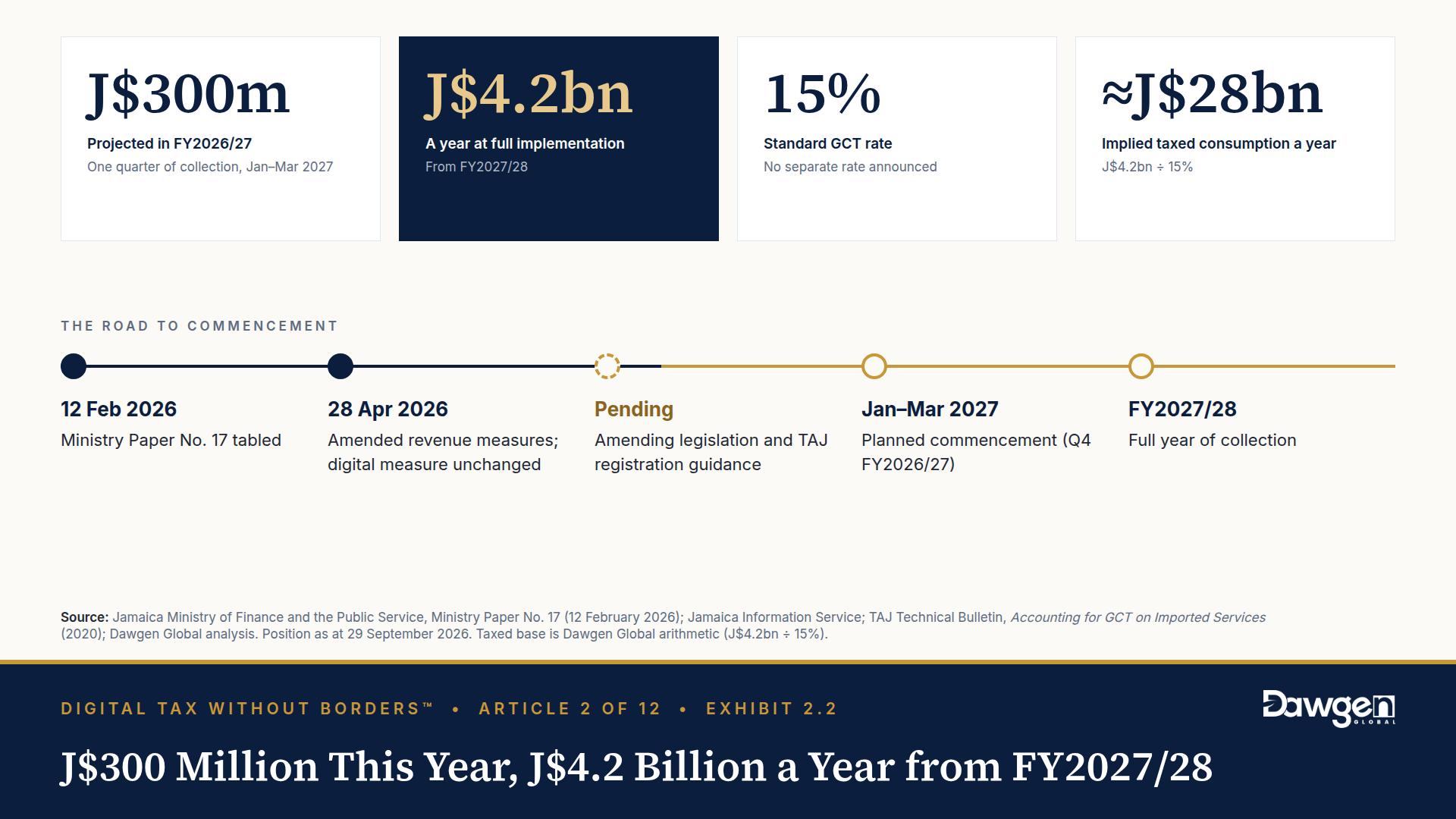
Jamaica’s Budget for fiscal year (FY) 2026/27 proposes to apply General Consumption Tax (GCT) to digital services and intangibles supplied from abroad and consumed in Jamaica. The Ministry of Finance projects J$300 million from January to March 2027 and about J$4.2 billion a year from FY2027/28. No separate rate has been announced, so the standard 15 per cent applies. The legislation and Tax Administration Jamaica (TAJ) guidance have not yet been published.
The headline misleads on one point. Section 23B of the GCT Act already requires GCT-registered businesses to self-account for GCT on imported services. The new measure reaches the household subscription and the business too small to register. That changes the questions that matter: how foreign suppliers will register, whether collection runs through suppliers, card issuers or platforms, and, above all, how the new rules interact with section 23B so that registered businesses are not charged twice. This article explains the existing law and the design choices, works through illustrative figures, and sets out what businesses and foreign suppliers should do before commencement.
What the Budget announced, and what it did not
On 12 February 2026 the Minister of Finance and the Public Service, Fayval Williams, tabled Ministry Paper No. 17, “Revenue Measures for Financial Year 2026/2027” [1][2]. The measure applies GCT to digital services and intangibles supplied from outside Jamaica and consumed here, on the destination principle: tax follows the place of consumption, not the location of the supplier. The examples cited were streaming services, software, apps and e-books [3][4]. It is part of a J$29.4 billion revenue package [1].
The Ministry projects J$300 million in FY2026/27, reflecting implementation in the fourth quarter of the year, and about J$4.2 billion a year at full implementation from FY2027/28 [1]. On our simple arithmetic, J$4.2 billion at 15 per cent implies taxed consumption of around J$28 billion a year. The measure is designed to collect from volume.
What has not been announced matters as much. No separate rate has been proposed, so the standard 15 per cent applies. The collection mechanism, any registration threshold for foreign suppliers, and the treatment of business-to-business (B2B) purchases have not been specified [3]. Amended revenue measures published on 28 April 2026 did not report any change to the digital measure [2]. As far as public sources show, neither the amending legislation nor TAJ guidance had been published by late September 2026.
Law in force vs proposal. Law today: GCT at 15 per cent on imported services, self-accounted by GCT-registered importers under section 23B. Proposal: GCT on foreign digital services consumed by everyone else, due to start between January and March 2027. Until the law passes, no business should pay GCT to a foreign supplier that is not registered to collect it.
A separate Budget measure, the General Consumption Tax (Amendment of Schedules) Order, 2026, brings short-term rental accommodation into GCT from 1 April 2027 [8]. It is a separate change and is not covered here.
Businesses are already in the net: section 23B
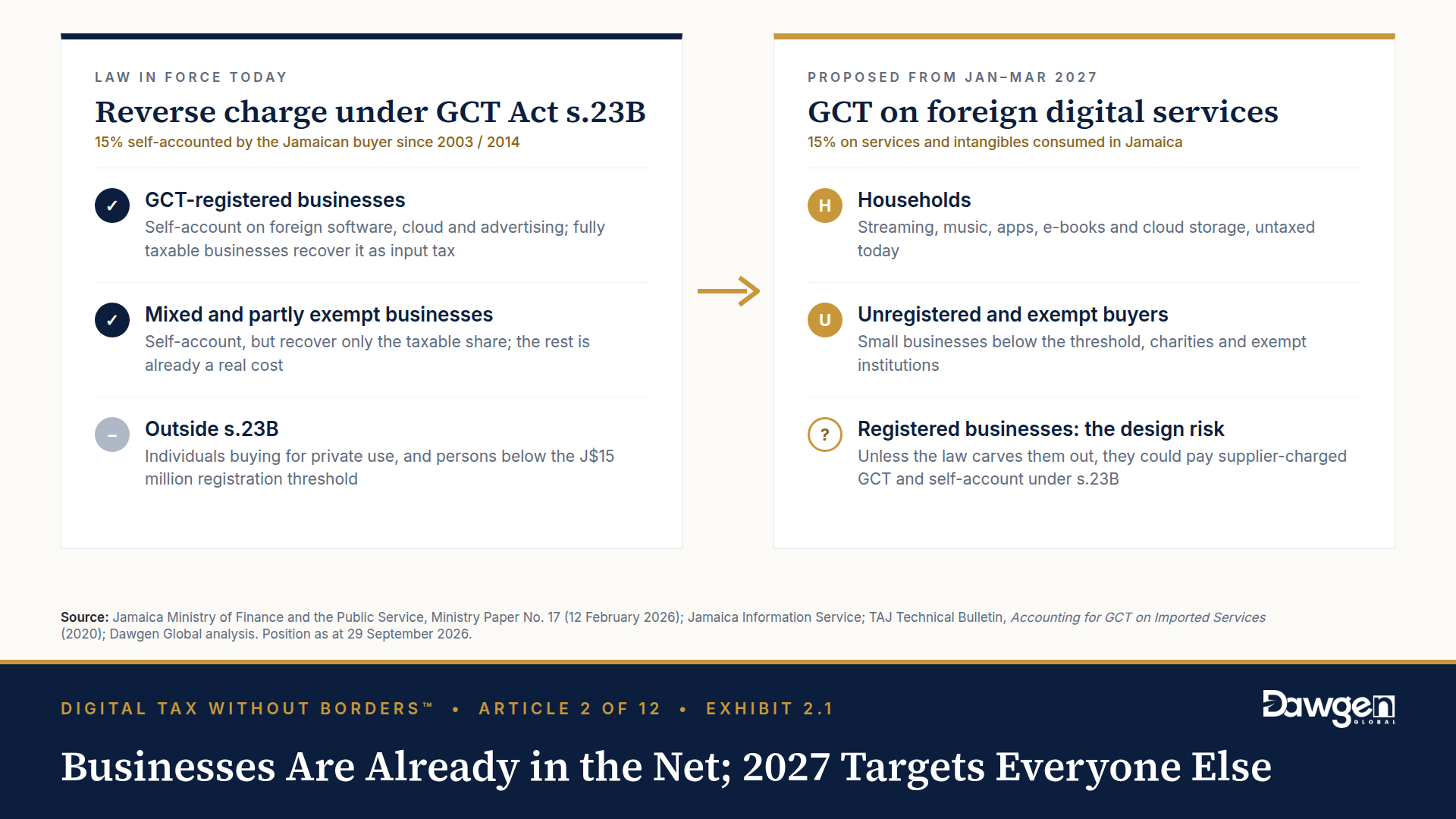
Section 3(1)(b) of the GCT Act imposes GCT on imported services, and section 23B makes the importer, not the foreign supplier, account for it. The provisions entered the Act in 2003, with the operational framework in the Provisional Collection of Tax (GCT) (No. 5) Order 2014, and TAJ explained the mechanics in its Technical Bulletin “Accounting for GCT on Imported Services” of 23 April 2020 [5].
This is a reverse charge. When a GCT-registered Kingston distributor pays a United States software company for a subscription, the distributor calculates 15 per cent on the value, declares it as output tax in its own GCT return and, if it uses the service in making taxable supplies, claims the same amount as input tax, subject to the ordinary rules. For a fully taxable business the net cash effect is nil, but failing to self-account is still an error in the return.
Two groups are outside section 23B. Individuals importing services for private use are excluded, and so are persons below the GCT registration threshold, which has been J$15 million of annual taxable supplies since 1 April 2025 [5][7]. There is also a restriction worth knowing: input credit on services imported from connected parties is limited by conditions relating to market value and the capacity of the supplier to provide the service [5].
The practical insight follows. A registered business correctly applying section 23B already accounts for GCT on its foreign software, cloud and advertising spend. The new measure is aimed at the gap section 23B cannot reach: the household subscribing to a streaming service, the student buying an e-book, the graphic designer below the threshold paying for design software, and the charity or exempt institution that is not registered at all.
GCT is not the only tax on a payment abroad. Royalties and management or service fees paid to non-residents attract withholding tax at 33⅓ per cent under domestic law, reduced to 15 per cent under the Caribbean Community (CARICOM) Double Taxation Agreement and potentially further under treaties such as those with the United States and Canada [6]. That income tax is unaffected by the Budget measure and can apply to the same invoice.
The design questions that will decide the outcome
Four questions will determine how the measure works.
- Will foreign suppliers register, and above what threshold?
The standard international approach, recommended in the Organisation for Economic Co-operation and Development (OECD) guidelines on value added tax (VAT) and the regional VAT Digital Toolkit, is simplified registration for non-resident suppliers of business-to-consumer (B2C) services, with online registration and no requirement to appoint a local agent [14][15]. Barbados, The Bahamas and Suriname already operate this way [11][12][13]. A threshold keeps small foreign suppliers out; setting it too high leaves revenue uncollected, setting it too low discourages compliance. The threshold for foreign suppliers need not match the J$15 million domestic threshold. The Gleaner has argued for a CARICOM-wide design [9]; common rules would lower suppliers’ costs, but Jamaica’s timetable means national rules come first.
- Who collects: supplier, card issuer or platform?
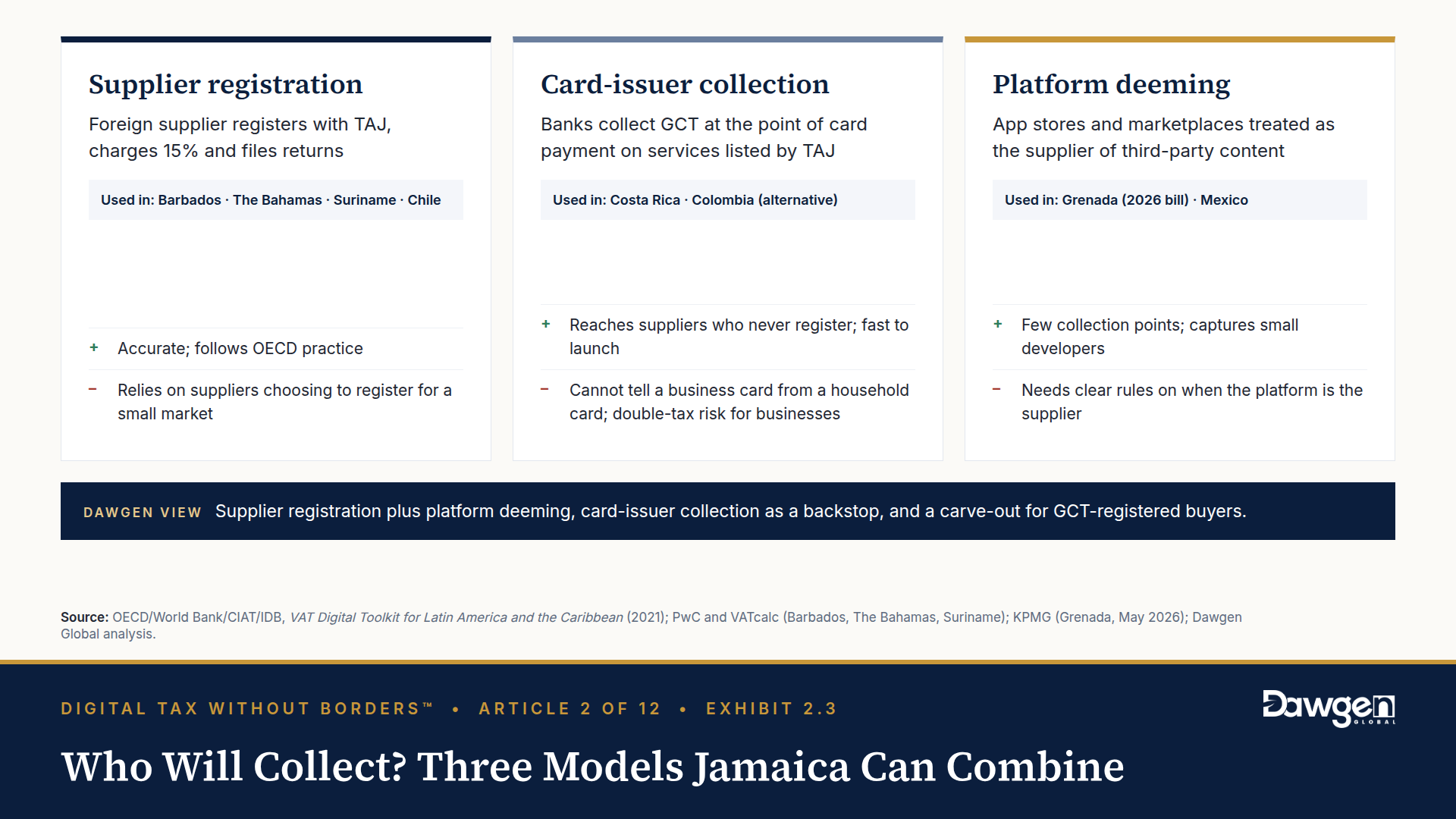
Jamaica can choose among three models, which can be combined.
Costa Rica has required card issuers to collect its 13 per cent VAT on listed cross-border digital services since 1 October 2020, with an optional simplified registration for providers. Colombia offers a card-issuer alternative for its 19 per cent VAT [14]. Grenada’s VAT (Amendment) Bill 2026, passed on 7 May 2026, combines supplier registration for B2C, a reverse charge for B2B and platform deeming [10]. For Jamaica, supplier registration with platform deeming, and card-issuer collection as a backstop for non-compliant suppliers, would reach the base without taxing businesses twice. A pure card-issuer model would be fastest to implement and hardest on registered businesses.
- How will the new rules interact with section 23B?
This is the most important question for business. If a foreign supplier registers under the new regime and charges 15 per cent to every Jamaican customer, a registered buyer will pay GCT on the invoice and, under current law, also be required to self-account under section 23B on the same service. Unless the law says otherwise, the same value is taxed twice.
The clean solution is the one in Grenada’s 2026 bill and in most VAT systems: foreign suppliers charge GCT only to customers who are not GCT-registered, and registered customers continue to self-account under section 23B. That requires a simple test for the supplier: a valid Jamaican Taxpayer Registration Number (TRN) with GCT registration, verifiable online, shifts the supply to reverse charge. Where card-issuer collection is used, a refund or credit route for registered businesses is essential.
- When, and what about contracts already running?
The Ministry’s timing is the fourth quarter of FY2026/27, January to March 2027 [1]. The commencement date, the treatment of annual subscriptions paid before that date but consumed after it, and any transition period for foreign suppliers to register will be set in the law. Grenada’s approach, commencement by Gazette notice with a transition period, is a sensible template [10]. Prepaying subscriptions to avoid the tax is unwise: time-of-supply rules may apportion the charge, and registered businesses already account under section 23B.
Illustrative worked example: three buyers, one measure
The figures below are illustrative. They assume a 15 per cent rate, that foreign suppliers pass the full tax on to customers, and that the law adopts a B2B reverse charge carve-out (Scenario A) or does not (Scenario B).
Buyer (a), a registered retailer. A Kingston-based retailer making only taxable supplies spends J$4,000,000 a year on foreign software, cloud hosting and online advertising. Today it self-accounts J$600,000 under section 23B and claims the same as input tax: net cost nil. Under Scenario A nothing changes. Under Scenario B, suppliers also charge J$600,000 on their invoices; if that is not creditable, it is a new cost.
Buyer (b), a mixed financial services firm. A registered financial services company makes 20 per cent taxable and 80 per cent exempt supplies and spends J$10,000,000 a year on foreign core software and cybersecurity tools. Today it self-accounts J$1,500,000, recovers 20 per cent (J$300,000) and bears J$1,200,000. That cost already exists. Under Scenario B, with non-creditable supplier-charged GCT on top, it could reach J$2,700,000. An affiliate making only exempt supplies, and therefore not registered, is outside section 23B today; on J$2,000,000 of foreign software it would bear J$300,000 for the first time.
Buyer (c), a household. A Mandeville family spends J$5,000 a month on streaming, music, cloud photo storage and apps: J$60,000 a year, untaxed today. From 2027, if suppliers pass the tax through, it pays J$9,000 a year more. Multiply that across households and small unregistered businesses and the J$4.2 billion projection is easy to understand.
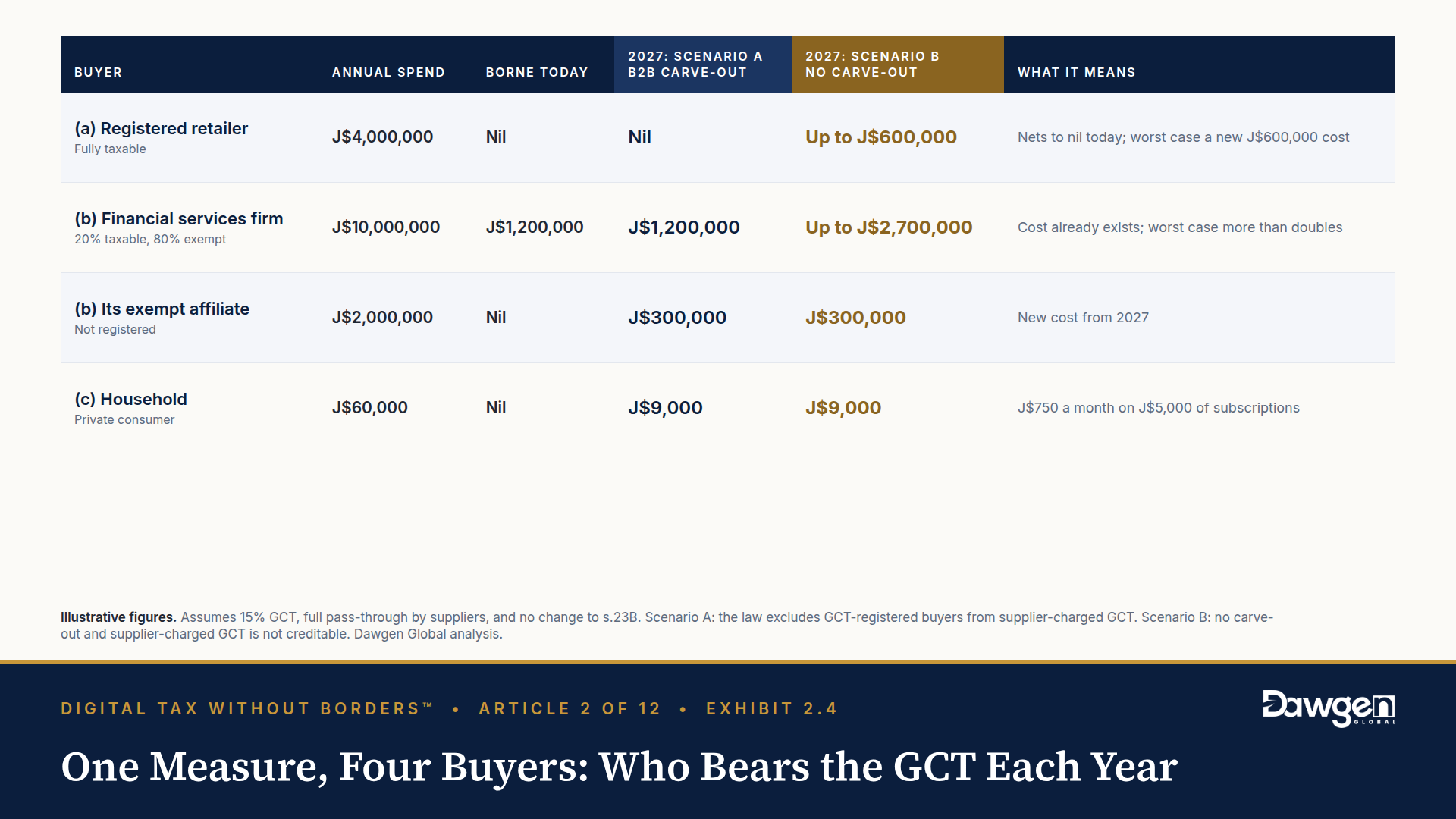
For households and unregistered buyers, the measure is a new 15 per cent cost. For registered businesses it should change nothing; whether it does depends entirely on the drafting.
What Jamaican businesses should do now
- Confirm section 23B compliance. Pull 12 months of payments to foreign suppliers from accounts payable, corporate cards and employee expense claims. Identify every service, check that GCT was self-accounted in the right period, and confirm the input tax claimed. An overlooked section 23B obligation is an existing exposure, independent of the Budget; correct it before TAJ turns its attention to imported services in 2027.
- Check connected-party recharges against the input credit conditions, and document them.
- Map the unregistered and exempt parts of the group. Identify entities below the J$15 million threshold or making exempt supplies, and quantify their foreign digital spend. That is where the new cost will fall.
- Prepare the vendor master and the enterprise resource planning (ERP) system. Add fields for supplier country, whether the supplier is registered for Jamaican GCT, and whether GCT is charged on the invoice. From 2027, accounts payable must tell a supplier-charged GCT invoice from one requiring self-accounting.
- Review contracts at renewal. Check whether supplier contracts are tax-inclusive or tax-exclusive and whether the supplier can add new taxes. Provide your GCT-registered TRN to major suppliers so that, if the law adopts a B2B carve-out, you are treated correctly from day one.
- Model the cost and the price. Local streaming, e-learning and software businesses competing with foreign suppliers will see the price gap narrow. Chief financial officers (CFOs) should model both the cost and the competitive benefit.
What foreign suppliers selling into Jamaica should do now
- Size the Jamaican customer base by type: consumers, small businesses and GCT-registered businesses. The first two are the target.
- Build customer location evidence. Record billing address, payment card country, internet protocol (IP) address and mobile number country. Jamaica has not set its evidence rule; Grenada and Suriname use combinations of these indicators [10][11].
- Capture business status. Collect the customer’s TRN and GCT registration status at sign-up, and verify it. Under a B2B reverse charge, this separates a taxable consumer sale from a business sale.
- Plan pricing and invoicing. Decide whether Jamaican consumer prices will rise by 15 per cent or be held with tax absorbed. Prepare invoices showing GCT separately.
- Watch for the law and register promptly. Monitor the Ministry of Finance and TAJ for the amending law, the commencement notice and the registration process. App-store sellers should ask whether the platform will be deemed the supplier.
This applies to Caribbean small and medium-sized enterprises (SMEs) too: a Barbadian or Trinidadian app developer selling subscriptions to Jamaican consumers will be a foreign supplier under the Jamaican measure.
The Dawgen Digital Tax COMPASS™
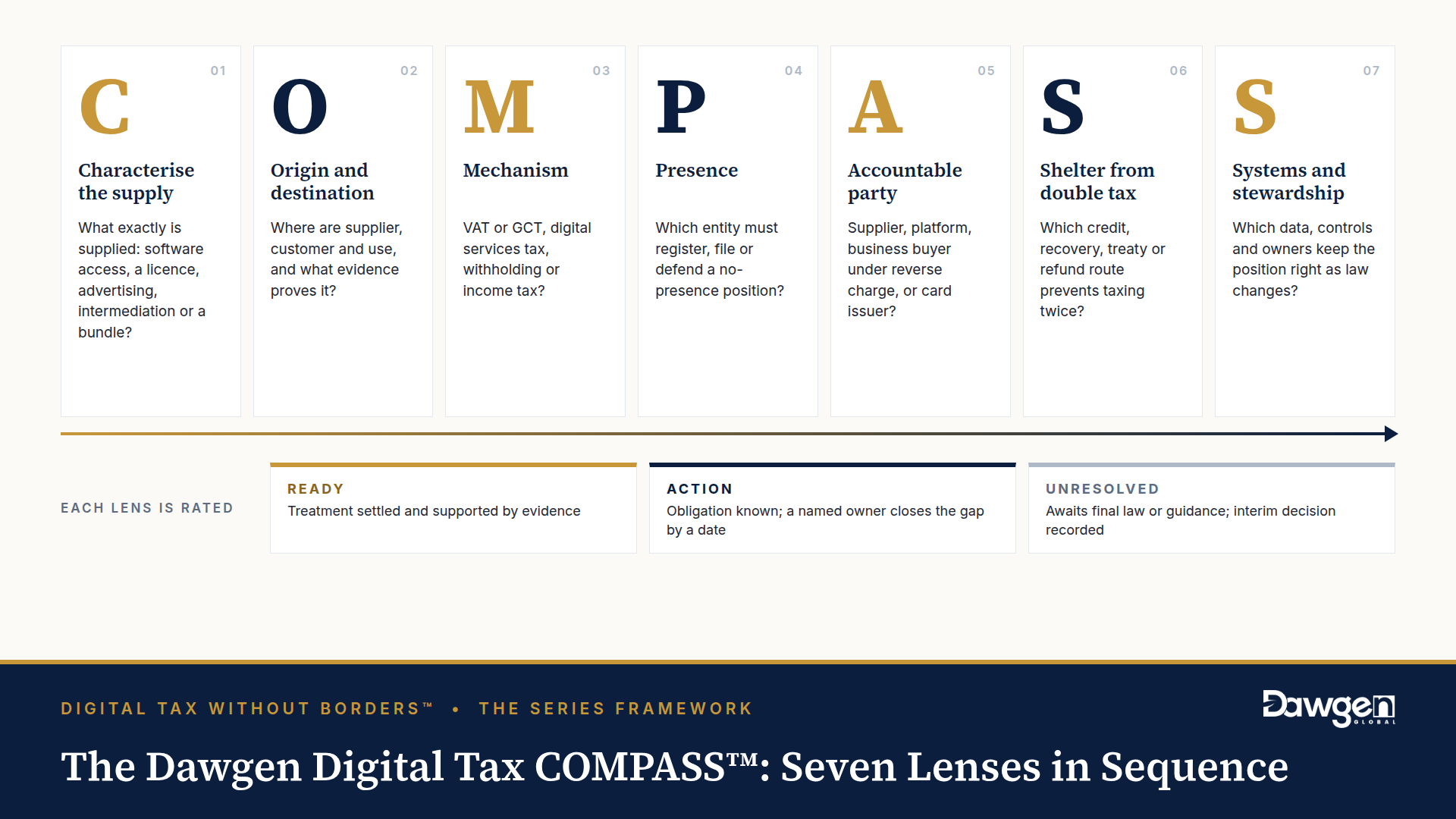
The Dawgen Digital Tax COMPASS™ is the method Dawgen Global uses to turn the broad phrase “digital tax” into specific, answerable questions. It works transaction by transaction, and it applies equally to what a business buys and what it sells. Seven lenses are applied in sequence, because each answer depends on the one before it.
- C — Characterise the supply. What exactly is supplied: access to software, a licence of intellectual property, advertising, intermediation, a professional service delivered remotely, or a bundle of several? The contract and the actual performance decide, not the invoice description.
- O — Origin and destination. Where are the supplier, the customer and the place of use or consumption, and what evidence proves it? Billing address, card country, IP address and contract terms often disagree.
- M — Mechanism. Which tax is in play: VAT or GCT on consumption, a gross-revenue digital services tax, withholding tax on the payment, or income tax on profits? Each has a different taxpayer, base and remedy.
- P — Presence. Which entity has a taxable connection with which jurisdiction, and must it register, file or defend a no-presence position?
- A — Accountable party. Who must actually charge, collect or remit: the supplier, a platform deemed to be the supplier, the business customer under a reverse charge, or a payment intermediary?
- S — Shelter from double taxation. Which credit, input tax recovery, treaty provision or refund route prevents the same value being taxed twice, and is it documented?
- S — Systems and stewardship. Which data fields, controls, owners and monitoring routines keep the position right as volumes grow and the law changes?
Each lens is rated on a simple three-tier scale. Ready means the treatment is settled and supported by evidence. Action means the obligation is known and a named owner is fixing a gap by a date. Unresolved means the answer depends on law or guidance that is not yet final, and an interim commercial decision has been recorded. The output is a transaction-level exposure map and an action plan with owners, not a list of countries. The COMPASS™ identifies and prioritises the questions; each material conclusion is then supported by the law of the jurisdiction concerned.
Applying the COMPASS™ to Jamaica’s GCT on foreign digital services
| Lens | What to ask in this context | Evidence to hold |
| C — Characterise | Is each foreign purchase a digital service or intangible within the measure, a remote professional service, or a bundle? | Contracts; a classification for each material supplier |
| O — Origin and destination | Is the service consumed in Jamaica, or by an affiliate in another island under a group contract? | User allocation by entity; location records for customers if you are a supplier |
| M — Mechanism | Is the item subject to section 23B today, to the new measure from 2027, and separately to withholding tax? | GCT returns showing self-accounted tax; withholding tax workings |
| P — Presence | If you are a foreign supplier, must you register for Jamaican GCT, and from when? | Jamaican revenue by customer type; the commencement notice once published |
| A — Accountable party | Who accounts for GCT on each purchase: you under section 23B, the supplier, a platform or a card issuer? | Supplier invoices showing GCT charged and registration number; platform terms |
| S — Shelter | Is supplier-charged GCT creditable, and is double charge with section 23B avoided? | Input tax workings; evidence of TRN given to suppliers; connected-party files |
| S — Systems | Can accounts payable distinguish supplier-charged GCT from self-accounting, and who monitors the amending law? | Vendor master fields; ERP tax codes; a named owner and review date |
Questions for the board
- Are we self-accounting under section 23B on all imported services today, including card and expense-claim purchases?
- Which entities in our group are below the J$15 million threshold or make exempt supplies, and what will the measure cost them each year?
- If the law does not exclude registered businesses from supplier-charged GCT, what is our worst-case double-tax exposure?
- Have we given our GCT-registered TRN to our major foreign digital suppliers?
- Do our connected-party software recharges satisfy the input credit conditions for imported services?
- Are our supplier contracts tax-inclusive or tax-exclusive, and which renew before March 2027?
- If we compete with foreign digital suppliers for Jamaican consumers, how will our pricing position change?
- If we sell digital services into Jamaica from abroad, can we identify Jamaican consumers and register when the law commences?
How Dawgen Global can help
Dawgen Global’s Caribbean Tax Advisory practice helps boards, finance leaders and owner-managers prepare for Jamaica’s GCT on foreign digital services, from confirming section 23B compliance today to readiness for the 2027 regime. Using the Dawgen Digital Tax COMPASS™, we map digital transactions across the jurisdictions in which you operate, separate law in force from proposals, quantify exposure and help your team put in place the contracts, systems and controls to stay compliant as the rules change. To discuss your organisation’s position, contact us at [email protected] or visit www.dawgen.global/contact-us.
This article provides general information and does not constitute tax or legal advice. The application of tax law depends on specific facts and on the law in force at the relevant date; readers should obtain advice before acting.
Abbreviations used
- B2B — business-to-business
- B2C — business-to-consumer
- CARICOM — Caribbean Community
- CFO — chief financial officer
- ERP — enterprise resource planning
- FY — fiscal year
- GCT — General Consumption Tax
- IP — internet protocol (as in IP address)
- OECD — Organisation for Economic Co-operation and Development
- SMEs — small and medium-sized enterprises
- TAJ — Tax Administration Jamaica
- TRN — Taxpayer Registration Number
- VAT — value added tax
Sources
- Jamaica Information Service, “Gov’t projects $29.4B from new revenue measures in fiscal year 2026/27”, February 2026. https://jis.gov.jm/govt-projects-29-4b-from-new-revenue-measures-in-fiscal-year-2026-27/
- Ministry of Finance and the Public Service (Jamaica), Revenue Measures (Ministry Paper No. 17, “Revenue Measures for Financial Year 2026/2027”, 12 February 2026; amended revenue measures, 28 April 2026). https://www.mof.gov.jm/resources-revenue-measures/
- EY, “Jamaica proposes extending General Consumption Tax to digitally supplied services and intangibles from abroad”, Tax Alert, 25 February 2026. https://www.ey.com/en_gl/technical/tax-alerts/jamaica-proposes-extending-general-consumption-tax-to-digitally-supplied-services-and-intangibles-from-abroad
- Jamaica Observer, “GCT imposed on digital services, intangibles supplied overseas — Williams”, 12 February 2026. https://www.jamaicaobserver.com/2026/02/12/gct-imposed-digital-services-intangibles-supplied-overseas-williams/
- Tax Administration Jamaica, Technical Bulletin, “Accounting for GCT on Imported Services”, 23 April 2020. https://www.jamaicatax.gov.jm/documents/10181/17838406/Technical+Bulletin+(2020)+-+GCT+Imported+Services_23042020.pdf/547fce5a-fa9c-1481-ec55-6d8e40456f08
- PwC, Worldwide Tax Summaries, “Jamaica — Corporate — Withholding taxes”. https://taxsummaries.pwc.com/jamaica/corporate/withholding-taxes
- PwC, Worldwide Tax Summaries, “Jamaica — Corporate — Other taxes”. https://taxsummaries.pwc.com/jamaica/corporate/other-taxes
- The Gleaner, “Airbnb and short-term rentals to face GCT from April 2027”, 30 April 2026. https://jamaica-gleaner.com/article/news/20260430/airbnb-and-short-term-rentals-face-gct-april-2027
- The Gleaner, “Editorial: Get CARICOM digital GCT”, 19 February 2026. https://jamaica-gleaner.com/article/commentary/20260219/editorial-get-caricom-digital-gct
- KPMG, “Grenada: Nonresident digital services VAT”, TaxNewsFlash, May 2026. https://kpmg.com/us/en/taxnewsflash/news/2026/05/grenada-nonresident-digital-services-vat.html
- VATcalc, “Suriname 10% VAT on foreign digital service providers 2023”. https://www.vatcalc.com/suriname/suriname-10-vat-on-foreign-digital-service-providers-2023/
- PwC, Worldwide Tax Summaries, “Barbados — Corporate — Other taxes”. https://taxsummaries.pwc.com/barbados/corporate/other-taxes
- VATcalc, “Bahamas VAT on foreign digital services”. https://www.vatcalc.com/bahamas/bahamas-vat-on-foreign-digital-services/
- CIAT, “New toolkit to strengthen value added taxes on e-commerce in Latin America and the Caribbean” (OECD, World Bank, CIAT and IDB VAT Digital Toolkit for Latin America and the Caribbean), 23 June 2021. https://www.ciat.org/new-toolkit-to-strengthen-value-added-taxes-on-e-commerce-in-latin-america-and-the-caribbean/?lang=en
- OECD, International VAT/GST Guidelines, 2017. https://www.oecd.org/en/publications/international-vat-gst-guidelines_9789264271401-en.html
About Dawgen Global
Dawgen Global is an independent, integrated multidisciplinary professional services firm headquartered at 47 Trinidad Terrace, New Kingston, Jamaica, serving more than 15 territories across the Caribbean. Founded and led by Dr. Dawkins Brown, Executive Chairman, the firm is independent and not affiliated with any international network. It delivers a full suite of professional services under one roof: audit and assurance; tax advisory; IT and digital transformation; risk management; cybersecurity; actuarial and insurance regulatory advisory; HR advisory; mergers and acquisitions; corporate recovery; business advisory and strategy; accounting BPO and virtual CFO services; and legal process outsourcing.
The proposition is simple: big-firm capability without the big-firm price. Dawgen Global’s integrated approach is built for the specific complexities and opportunities of the Caribbean market, helping organizations make sharper, better-informed decisions that drive measurable progress.
To explore a partnership, reach out:
- Website: dawgen.global
- Email: [email protected]
- WhatsApp (Global): +1 555-795-9071
- Caribbean offices: +1 876-665-5926 | +1 876-929-3670 | +1 876-926-5210


