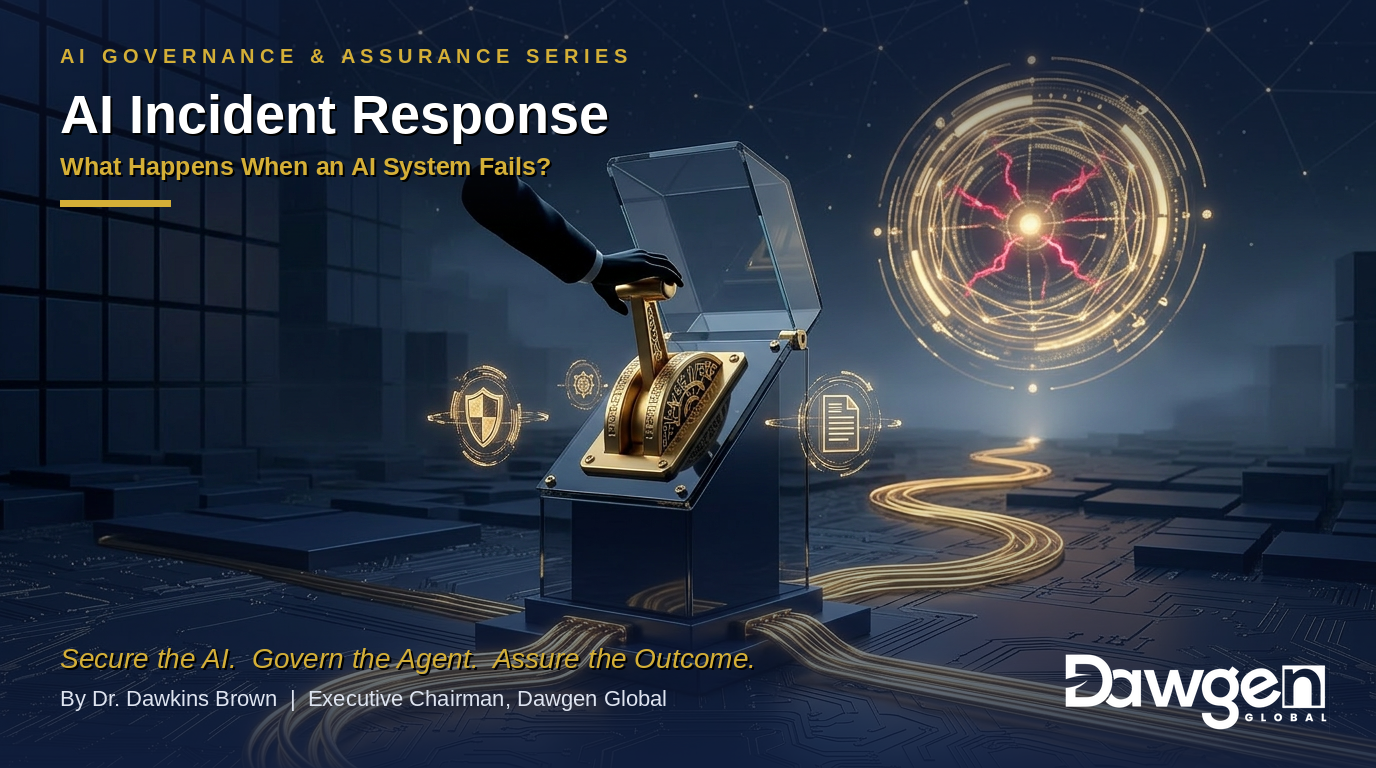
Why organizations need response playbooks before AI failures become legal, operational, and reputational crises
EXECUTIVE SUMMARY
Artificial intelligence governance is often discussed before deployment: policies, vendor reviews, risk assessments, access controls, human oversight, audit trails, and board reporting. But the real test of AI governance comes when something goes wrong. An AI system may leak confidential data, produce a harmful recommendation, trigger an unauthorized workflow, generate misleading customer communication, support a biased decision, expose the organization to regulatory breach, or fail during a critical operation.
At that point, the organization needs more than an AI policy. It needs an AI Incident Response Framework.
This article — the eleventh in Dawgen Global’s AI Governance & Assurance Series — explains why AI incidents are different from traditional cybersecurity or operational incidents, defines the major categories of AI failure, sets out a practical eight-stage AI incident response lifecycle, and provides the board-level questions every organization should ask before an AI failure becomes a crisis.
AI governance is tested when something goes wrong
Most organizations prefer to discuss artificial intelligence in terms of opportunity. AI can improve productivity, accelerate analysis, automate workflows, enhance customer service, support fraud detection, assist compliance, strengthen cybersecurity, and unlock new business value.
That opportunity is real.
But every serious governance system must also ask a harder question: what happens when AI fails?
What happens when an employee enters confidential client data into an unapproved AI tool? What happens when a chatbot provides misleading advice to a customer? What happens when an AI model produces biased recommendations? What happens when an AI agent triggers an unauthorized workflow? What happens when a vendor AI platform changes its model and output quality deteriorates? What happens when AI-generated analysis supports a financial decision that later proves wrong?
These are not theoretical concerns. As AI moves from experimentation into operations, AI incidents will become part of the risk landscape.
The organizations that respond well will be those that prepared before the failure occurred.
Why AI incidents are different
Organizations already have incident response plans for cybersecurity events, data breaches, system outages, fraud, operational failures, business continuity events, and regulatory issues. Those plans remain important. However, AI incidents introduce additional complexity:
- Data entered into or processed by AI systems; outputs that are inaccurate, biased, harmful, or misleading
- Automated recommendations relied on by employees; AI agents acting across multiple systems
- Vendor platforms outside the organization’s direct control; model drift or performance deterioration over time
- Prompt injection or malicious manipulation; weak audit trails that make reconstruction difficult
- Unclear accountability between business, technology, vendor, and user
Traditional incident response often focuses on containing a known event. AI incident response must also determine how the AI behaved, what data it used, what output it produced, who relied on the output, whether a human reviewed the decision, and whether the incident can recur.
The challenge is not only technical. It is governance, legal, operational, ethical, reputational, and evidentiary.
Defining an AI incident
A practical AI Incident Response Framework must begin by defining what counts as an AI incident.
An AI incident may include any event where an AI system, AI-enabled platform, generative AI tool, machine-learning model, or autonomous AI agent causes, contributes to, or increases the risk of harm to the organization, customers, employees, regulators, stakeholders, or the public. Examples include:
- Confidential data entered into an unapproved AI tool; personal data processed in breach of data protection requirements
- AI-generated output used in a decision without proper validation; a chatbot providing inaccurate, misleading, discriminatory, or unauthorized advice
- An AI agent performing an action outside approved authority; prompt injection causing an AI system to ignore instructions or expose data
- AI-generated code introducing security vulnerabilities; a model drifting and producing unreliable outputs
- Vendor AI functionality changing without notice; AI-generated communication damaging customer trust
- Biased AI output affecting hiring, lending, pricing, benefits, or customer treatment; AI-supported financial reporting errors
- AI use without adequate audit trails or approval evidence; AI-enabled social engineering or fraud
If the organization does not define AI incidents clearly, employees may not know when to report them.
The AI incident response lifecycle
Dawgen Global recommends that organizations develop an AI incident response lifecycle around eight practical stages.
1. Preparation
Preparation is the most important stage. Organizations should not wait until an AI failure occurs before deciding who is responsible.
Preparation includes establishing an AI Incident Response Framework, defining AI incident categories, assigning response roles, creating escalation paths, identifying high-risk AI systems, maintaining an AI inventory, documenting vendor contacts, and training employees on what to report.
Preparation also requires integration with existing cybersecurity, data breach, legal, compliance, business continuity, and crisis management procedures. AI incident response should not sit in isolation. It should connect to the organization’s broader enterprise risk and control environment.
2. Detection
AI incidents may be detected through several channels: employee reporting, customer complaints, system alerts, cybersecurity monitoring, audit testing, vendor notifications, model performance dashboards, exception reports, data loss prevention tools, or regulatory inquiries.
The organization should define detection mechanisms for different types of AI use. For generative AI, detection may involve monitoring prompt activity, unapproved tool usage, data leakage indicators, and unsafe outputs. For AI agents, detection may involve reviewing tool calls, access logs, workflow actions, approval bypasses, and abnormal behavior. For models, detection may involve tracking drift, accuracy deterioration, bias indicators, exception rates, and performance thresholds.
If AI is not monitored, incidents may remain invisible until damage has already occurred.
3. Triage and classification
Once a potential AI incident is identified, it must be classified quickly. Key questions include:
- What AI system or vendor platform was involved, and what data was accessed, entered, processed, or exposed?
- Did the incident involve personal, confidential, financial, legal, health, employee, or regulated data?
- Did the AI output influence a decision or action, and was any customer, employee, citizen, patient, regulator, or third party affected?
- Did an AI agent perform an unauthorized action, and is the issue ongoing or contained?
- Are there legal, regulatory, contractual, or reporting obligations?
- What evidence is available, and who needs to be involved immediately?
AI incident severity should be based on impact, data sensitivity, regulatory exposure, operational disruption, decision consequence, reputational risk, and likelihood of recurrence.
4. Containment
Containment aims to stop further harm.
Depending on the incident, containment may include disabling an AI feature, suspending an AI agent, blocking access to a tool, revoking credentials, isolating an integration, pausing a workflow, restricting vendor access, removing unsafe content, stopping customer-facing communication, or reverting to a manual process.
For agentic AI, containment must include practical kill-switch capability — a core guardrail discipline of Dawgen Global’s D-AGENTICA™ methodology. A kill switch should not exist only in policy. It must be tested, assigned, and executable.
The organization should also determine whether temporary business process changes are required while the incident is investigated.
5. Investigation and evidence preservation
AI incidents must be investigated with evidence.
The organization should preserve relevant logs, prompts, inputs, outputs, model versions, workflow records, approvals, user actions, data access records, vendor communications, system configurations, incident timestamps, and decision records. The investigation should establish:
- What happened, when it happened, and which AI system, model, agent, or vendor was involved
- What data was used, what output was generated, and who saw or relied on the output
- Whether there was human review, whether policy was followed, and whether the AI behaved as designed
- Whether the event was caused by user error, model failure, prompt manipulation, integration weakness, vendor change, cyberattack, or control failure
- Whether the incident can happen again
This is where auditability by design — the discipline we set out in article five of this series — becomes critical. If evidence trails were not built before the incident, management may struggle to reconstruct what happened after the fact.
6. Legal, regulatory, and stakeholder assessment
AI incidents may create legal, regulatory, contractual, and stakeholder obligations.
The organization should assess whether the incident involves data protection requirements, customer notification, contractual reporting, regulatory disclosure, employment law, consumer protection, financial reporting, sector regulation, litigation risk, professional standards, or board reporting obligations.
For Caribbean organizations, AI incidents involving personal data may trigger obligations under Jamaica’s Data Protection Act and similar regional data protection regimes. Financial institutions, public bodies, healthcare providers, utilities, BPO operators, and regulated entities may also face sector-specific expectations around technology risk, operational resilience, outsourcing, auditability, and customer protection.
Legal and compliance teams should be involved early, not after communications have already been made.
7. Remediation and control improvement
An AI incident response process should not end with containment. Management must address the underlying control weakness. Remediation may include:
- Updating AI policies and acceptable use rules; strengthening data loss prevention controls
- Improving prompt and output monitoring; revising vendor contract clauses; restricting access rights
- Enhancing human review procedures; revalidating model performance; reconfiguring AI integrations
- Improving audit logging and evidence trails; retraining employees; updating incident response playbooks
- Strengthening board reporting; conducting independent assurance review
The goal is not only to fix the immediate issue. The goal is to prevent recurrence.
8. Reporting and assurance
AI incidents should be reported through the appropriate governance channels.
Management reporting should explain the incident, root cause, impact, response actions, remediation plan, responsible owners, deadlines, and assurance procedures. Boards and audit committees should receive clear reporting for high-risk AI incidents, especially where there is customer impact, regulatory exposure, data leakage, financial reporting risk, operational disruption, or reputational harm.
Internal audit or an independent assurance provider should review whether the incident was handled properly and whether corrective actions are operating effectively.
In the AI era, incident response must be evidenced, not merely described.
AI incident categories boards should understand
Boards do not need to manage every AI incident, but they should understand the major categories — each of which connects to a discipline examined earlier in this series.
Data leakage incidents
These occur when sensitive, confidential, or personal data is entered into or exposed through AI systems without proper approval or protection. This may involve public generative AI tools, vendor platforms, AI integrations, or employee misuse.
Output failure incidents
These occur when AI produces inaccurate, biased, misleading, incomplete, harmful, or unsafe output that is relied upon in business decisions, customer interactions, regulatory submissions, legal conclusions, financial reporting, or operational processes.
Unauthorized action incidents
These occur when an AI agent, automation tool, or integrated AI workflow performs an action beyond approved authority — the defining risk of agentic AI examined in article two. This may include sending communication, retrieving restricted data, triggering a workflow, approving a transaction, modifying records, or escalating a response without proper approval.
Prompt manipulation incidents
These occur when a prompt injection or malicious instruction changes AI behavior, bypasses controls, exposes data, produces prohibited output, or causes an AI agent to act outside policy — the attack pathway detailed in article eight.
Vendor AI incidents
These occur when a third-party AI provider experiences a data breach, model failure, service disruption, unannounced change, security issue, or control weakness that affects the organization — the exposure mapped in articles six and ten.
Model drift incidents
These occur when an AI model deteriorates over time as data, conditions, users, or operating environments change. The system may continue functioning, but its outputs become less reliable — the reason continuous validation, not annual review, is the governing discipline (article four).
AI-enabled fraud and social engineering incidents
These occur when attackers use generative AI to create convincing phishing emails, fake invoices, impersonation attempts, deepfake-style communications, or fraudulent instructions — a category of particular regional concern, given that invoice fraud and business email compromise already rank among the most damaging attacks facing Caribbean businesses.
The role of cybersecurity
Cybersecurity teams must be central to AI incident response.
AI systems can introduce risks through prompt injection, insecure APIs, weak access controls, credential misuse, excessive permissions, data leakage, compromised integrations, malicious content, model manipulation, and vendor exposure.
Cybersecurity teams should help define monitoring rules, containment procedures, kill-switch protocols, evidence preservation standards, and recovery processes.
AI systems and AI agents should be treated as part of the enterprise attack surface. If they are connected to business systems, they must be included in security monitoring and incident response planning.
The role of legal and compliance
Legal and compliance teams must help determine whether an AI incident creates regulatory, contractual, reporting, litigation, employment, customer, or data protection obligations.
They should also assist with communication protocols, evidence preservation, privilege considerations, vendor obligations, board reporting, and remediation commitments.
AI incident response should avoid two common mistakes: delaying legal involvement until too late, or communicating externally before the facts are sufficiently understood.
The role of internal audit
Internal audit should not own AI incident response. That responsibility belongs to management.
However, internal audit should evaluate whether AI incident response arrangements are properly designed and operating effectively. It should review whether AI incidents are defined, escalation paths are clear, evidence is preserved, roles are assigned, vendor obligations are documented, and board reporting is adequate.
Internal audit may also perform post-incident reviews to assess root cause analysis, control remediation, and management accountability.
For many organizations, particularly in the Caribbean, co-sourced internal audit support can provide the specialist AI, cybersecurity, data protection, and assurance skills needed to test incident readiness.
The board’s AI incident response questions
Boards and audit committees should ask management:
- Do we have a defined AI Incident Response Framework?
- What types of AI incidents must employees report?
- Which AI systems, vendors, and agents are high-risk?
- How do we detect data leakage, prompt injection, model failure, unauthorized agent actions, and vendor AI incidents?
- Who has authority to disable an AI tool, suspend an AI agent, or revert to manual processing?
- How do we preserve evidence when an AI incident occurs?
- What legal, regulatory, customer, and contractual reporting obligations may apply?
- Has our AI incident response process been tested through a simulation?
- Does internal audit provide assurance over AI incident readiness?
- What AI incident metrics are reported to the board?
If management cannot answer these questions, the organization is not ready for AI failure.
Testing the AI incident response playbook
A playbook that is not tested is only a document.
Organizations should conduct AI incident response tabletop exercises. These simulations help management test whether roles are clear, escalation works, evidence can be obtained, legal obligations are understood, vendor contacts are available, communications are coordinated, and containment actions can be executed. Practical scenarios include:
- A senior employee uploads confidential client files into an unapproved generative AI tool
- A customer-facing chatbot provides incorrect advice that causes customer harm
- An AI agent retrieves restricted data and sends an unauthorized communication
- A vendor AI platform notifies the organization of a model error affecting prior outputs
- A prompt injection attack causes an internal AI assistant to disclose sensitive information
- AI-generated code introduces a security vulnerability into a production system
- A deepfake-style instruction causes a fraudulent payment attempt
Testing exposes gaps before a real incident exposes the organization.
AI incident response as a trust discipline
AI incident response is not anti-innovation. It is what makes innovation resilient.
Organizations that prepare for AI incidents can adopt AI with greater confidence. They can detect failures faster, contain harm earlier, meet legal and regulatory obligations, preserve evidence, communicate responsibly, and learn from failure.
Organizations that do not prepare may face confusion, delayed response, lost evidence, regulatory breach, customer harm, reputational damage, and board-level scrutiny.
The question is not whether AI will fail. All systems fail in some way. The real question is whether the organization will know quickly, respond effectively, evidence what happened, and improve the control environment afterward.
“AI governance is not proven when everything works. It is proven when something fails and the organization can detect, contain, explain, evidence, and correct it.”
— Dr. Dawkins Brown, Executive Chairman, Dawgen Global
How Dawgen Global can help
Dawgen Global supports organizations across the Caribbean and globally in designing, testing, and strengthening AI Incident Response Frameworks. Our integrated multidisciplinary model brings together cybersecurity, IT audit, internal audit, external audit, risk advisory, data protection, legal and compliance, technology, crisis management, and board advisory expertise — big firm capabilities, Caribbean understanding.
A practical engagement pathway:
- Assess — AI Incident Response Readiness Review; Generative AI Cyber Risk Assessment; AI Governance & Cyber Risk Readiness Assessment; AI Vendor Incident Response Assessment; AI Auditability and Evidence Trail Review
- Design — AI Incident Response Framework; AI Incident Classification Matrix; AI Escalation and Communication Protocols; AI Evidence Preservation Procedures; AI Agent Kill-Switch and Containment Design under D-AGENTICA™; Board and Executive AI Incident Briefings
- Assure continuously — AI Incident Response Tabletop Exercises; Continuous AI Control Monitoring under TRUST360™; Independent AI Assurance Review; Internal Audit Co-Sourcing for AI Incident Readiness
Take the first step
Is your organization using AI, generative AI, AI-enabled vendors, or autonomous agents without a clear incident response playbook?
Dawgen Global can help you prepare for AI failures before they become operational, legal, regulatory, or reputational crises.
Secure the AI. Govern the Agent. Assure the Outcome.
Contact Dawgen Global today to request an AI Incident Response Readiness Review.
Email: [email protected] | Web: dawgen.global
About Dawgen Global
Dawgen Global is an independent, integrated multidisciplinary professional services firm headquartered at 47 Trinidad Terrace, New Kingston, Jamaica, serving more than 15 territories across the Caribbean. Founded and led by Dr. Dawkins Brown, Executive Chairman, the firm is independent and not affiliated with any international network. It delivers a full suite of professional services under one roof: audit and assurance; tax advisory; IT and digital transformation; risk management; cybersecurity; actuarial and insurance regulatory advisory; HR advisory; mergers and acquisitions; corporate recovery; business advisory and strategy; accounting BPO and virtual CFO services; and legal process outsourcing.
The proposition is simple: big-firm capability without the big-firm price. Dawgen Global’s integrated approach is built for the specific complexities and opportunities of the Caribbean market, helping organizations make sharper, better-informed decisions that drive measurable progress.
To explore a partnership, reach out:
- Website: dawgen.global
- Email: [email protected]
- WhatsApp (Global): +1 555-795-9071
- Caribbean offices: +1 876-665-5926 | +1 876-929-3670 | +1 876-926-5210


