The most expensive software in the world is the software that never gets used. Selection is a discipline — and the one party who cannot do it for you is the vendor
The Problem, Lived
“Trevor” runs a building-materials distribution business in Nassau, and somewhere in his office is a folder he cannot look at without wincing. Three years ago, after a genuinely dazzling demonstration, he signed for an ERP system. The demo showed dashboards blooming, inventory reconciling itself, invoices flying out. What followed was two years of implementation grief: a data migration that mangled his stock codes, training that consisted of PDFs, an implementer whose responses stretched from days to weeks, and modules that fought how his business actually works.
Today the system survives as the world’s most expensive invoicing tool. The inventory module was quietly abandoned — the warehouse runs on the spreadsheets it always ran on, now maintained in parallel with the system nobody trusts. And every year, the license and maintenance renewal arrives like a hospital bill for an illness that was never cured.
Now the business has outgrown the spreadsheets for real, and Trevor faces the decision again — this time carrying what every second-time buyer carries: software scar tissue. He is right to be wary. But the lesson of the first failure is not that ERP is a trap. It is that he bought a performance instead of running a process. The demo was the vendor’s audition piece. He never made them audition for his business.
Why It Happens Here
Technology selection fails the same way everywhere, but regional conditions sharpen every failure mode. The buying process is demo-driven — selection by showmanship — against a structural asymmetry: the vendor has sold a hundred systems and you have bought one, so every instinct in the room except yours has been professionally trained. Requirements rarely get defined before the demos begin, so businesses buy features instead of outcomes, and the loudest department’s wish list becomes the decision. Data migration and training — where implementations actually live or die — are underestimated by everyone and priced ambiguously by design.
Then come the regional multipliers. Implementation partners may be thin on the ground, overseas, or a one-person shop wearing a global brand’s logo; when they stumble, there is no bench behind them. Customization — the siren song of “we can make it work exactly like your current process” — creates a bespoke system nobody else can support, welded to the very workflows Article 10 said to fix first. And the true cost hides in plain sight: the license fee that anchors the negotiation is routinely a minority of what the system will actually cost over five years.
| The License Is the Down Payment
Budget rule for any serious system: the software license is typically well under half of the true five-year cost. Implementation, data migration, training, support contracts, customization, upgrades and internal staff time make up the rest. Any comparison built on license prices alone is comparing down payments while ignoring the mortgages. Demand the five-year total cost of ownership, in writing, from every contender — the rankings will rearrange themselves before your eyes. |
Why Generic Advice Fails
The global selection literature offers analyst quadrants that rank vendors for thousand-seat enterprises, and review sites whose ratings are farmed and gamed. Neither answers the question that matters, because it is not “which system is best?” — no system is best. The question is which system, with which implementer, at which true cost, fits this business, in this market, with this team. Fit is not visible in a quadrant or a demo reel. Fit is discovered by process — and the process is the thing nobody sells you, because the parties who know it best are paid by the other side of the table.
The Framework: The ERPSURE™ Selection Discipline — Six Gates, Step by Step
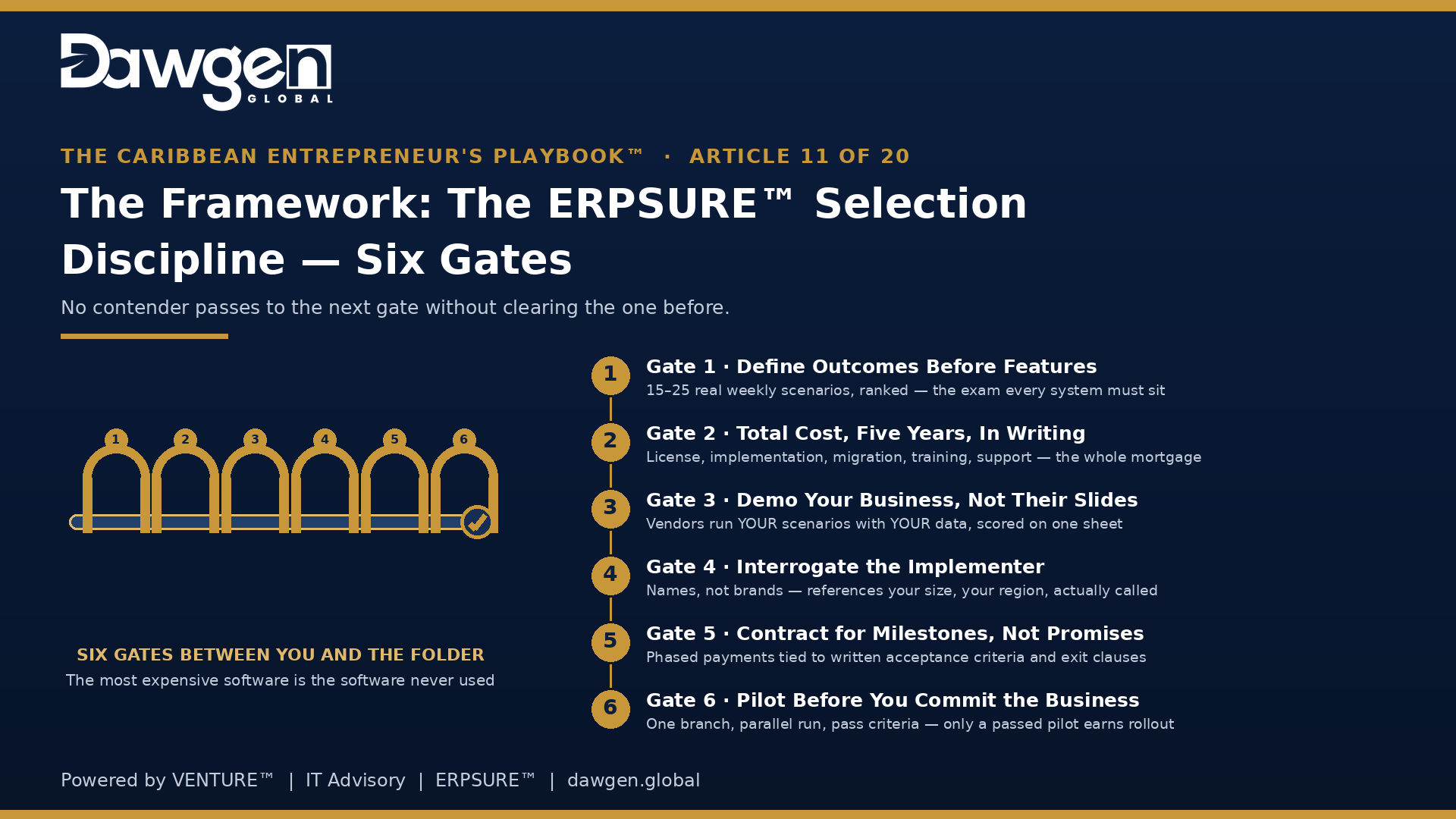
Drawn from Dawgen Global’s ERPSURE™ implementation framework, these six gates stand between your business and the folder Trevor cannot look at. No contender passes to the next gate without clearing the one before:
- Gate 1 · Define Outcomes Before Features — Before meeting any vendor, write your requirements from your workflows — the fifteen to twenty-five critical scenarios your business runs every week: the partial delivery with a backorder, the credit note against a paid invoice, the stock transfer between branches, the month-end close. Rank them must-have, should-have, nice-to-have. This document — not any brochure — is now the exam every system must sit. If you cannot write it, you are not ready to buy; you are ready to be sold.
- Gate 2 · Total Cost, Five Years, In Writing — Require every contender to complete the same five-year cost template: license or subscription, implementation, data migration, training, annual support, expected customization, upgrade costs — plus your own staff hours, honestly estimated. Refusal or vagueness at this gate is itself an answer. The cheapest license is frequently the costliest system; only the five-year number tells the truth.
- Gate 3 · Demo Your Business, Not Their Slides — Never accept the standard demonstration. Issue your Gate 1 scenarios in advance — with your sample data — and require each vendor to run them, live, while your team scores every scenario on the same sheet. The polished canned demo is a performance; your scenarios are the audition. It is remarkable how quickly dashboards stop blooming when the system meets a real partial delivery with a real backorder.
- Gate 4 · Interrogate the Implementer — You are not buying a product; you are hiring a project. The software may be global, but your outcome depends on the specific humans who will configure it. Demand to know exactly who will do the work — names, not brands; require references from businesses of your size, in your region, in your industry, and actually call them; ask what happens when the lead consultant leaves mid-project, because sometimes they do. A strong product with a weak implementer fails. A good product with an excellent implementer succeeds. Weight your decision accordingly.
- Gate 5 · Contract for Milestones, Not Promises — Structure the agreement so money follows proof: phased payments tied to written acceptance criteria — data migrated and verified, scenarios passing, users trained and signed off. Migration and training explicitly in scope, with quantities. Exit and remedy clauses for missed milestones. A vendor confident in delivery will accept milestone terms; a vendor who resists them is telling you, in advance and in writing, how the project will go.
- Gate 6 · Pilot Before You Commit the Business — Go live in one branch or one department first, running parallel with the old system against defined success criteria, with named internal champions trained deep rather than everyone trained thin. Only a passed pilot earns the rollout. This gate feels slow and saves years: it converts the terrifying company-wide leap into a controlled experiment — and it is where the process disciplines of Article 10 pay their compound interest.
The Framework in Action: A Worked Scenario
The following scenario is a fictional composite created for this series to illustrate the framework. It does not depict any actual business or client of the firm.
Trevor’s second attempt runs the gates. Gate 1 produces twenty-two scenarios, written with his warehouse supervisor and accountant at the table — the people the last system was inflicted upon become the people this one must satisfy. At Gate 3, three shortlisted vendors receive the scenarios and his sample data; the scripted demos are unrecognizable from the dazzling performances of memory. One contender’s handling of a partial delivery with a backorder and a credit note is so laboured that the room’s decision makes itself.
Gate 2 rearranges the leaderboard exactly as predicted: the apparent cheapest system carries implementation and support costs that make it the dearest over five years. Gate 4 reference calls to two regional distributors surface the sentence that seals the choice: “they were still answering our calls in year two.” The contract goes milestone-based; the pilot runs at the smallest branch, parallel for six weeks, and passes its criteria. In this illustration, the rollout that follows is undramatic in the best possible sense — and eighteen months later the parallel spreadsheets are gone, not by decree, but because nobody needs them. The folder in Trevor’s office stays where it is. He keeps it, he says, as tuition paid.
Self-Diagnostic: Are You Buying or Being Sold?
One point for every “no”:
- Do you have written, ranked requirements drawn from your actual weekly workflows?
- Do you have a five-year total cost of ownership figure, in writing, from every contender?
- Will every vendor demo your scenarios, with your data, scored on one sheet?
- Have you spoken to reference clients of your size, in your region, about the implementer by name?
- Is your contract structured around milestone payments with acceptance criteria and a pilot?
Two or more points means the selection is currently being run by the sellers. The system you get will fit their quarter better than your business.
When to Call In Help
An independent advisor changes this game for one structural reason: they sit on your side of the table, and no vendor — however sincere — can. Bring one in when the decision is large relative to your revenue; when a previous implementation failed and the scar tissue is clouding judgment in either direction; when nobody internal can technically interrogate the contenders; or when vendors are quoting architectures you cannot evaluate. Selection support typically costs a small fraction of the implementation — and a smaller fraction still of choosing wrong, which is a bill Trevor can quote from memory.
| REQUEST AN ERPSURE™ SELECTION REVIEW
Dawgen Global’s IT Advisory team runs the ERPSURE™ Selection Discipline with you and for you: we build your scenario-based requirements, run the five-year TCO comparison, script and score the vendor auditions, interrogate the implementers, structure the milestone contract and design the pilot — as your independent advisor, on your side of the table from first demo to passed rollout. Contact us today to request your Selection Review, before the next dazzling demonstration. 📩 [email protected] | 📞 876-929-3670 / 876-665-5926 | 🇺🇸 855-354-2447 | 🌐 dawgen.global GET THE FULL PLAYBOOK This is Article 11 of The Caribbean Entrepreneur’s Playbook™ — 20 problems, 20 how-to frameworks, one system. Pre-register at dawgen.global to receive the complete Playbook e-book on release, free. |
About Dawgen Global
Dawgen Global is an independent, integrated multidisciplinary professional services firm headquartered at 47 Trinidad Terrace, New Kingston, Jamaica, serving more than 15 territories across the Caribbean. Founded and led by Dr. Dawkins Brown, Executive Chairman, the firm is independent and not affiliated with any international network. It delivers a full suite of professional services under one roof: audit and assurance; tax advisory; IT and digital transformation; risk management; cybersecurity; actuarial and insurance regulatory advisory; HR advisory; mergers and acquisitions; corporate recovery; business advisory and strategy; accounting BPO and virtual CFO services; and legal process outsourcing.
The proposition is simple: big-firm capability without the big-firm price. Dawgen Global’s integrated approach is built for the specific complexities and opportunities of the Caribbean market, helping organizations make sharper, better-informed decisions that drive measurable progress.
To explore a partnership, reach out:
- Website: dawgen.global
- Email: [email protected]
- WhatsApp (Global): +1 555-795-9071
- Caribbean offices: +1 876-665-5926 | +1 876-929-3670 | +1 876-926-5210


