
The Problem, Lived
“Alicia” runs a catering and events company in St. John’s, Antigua, and her marketing history reads like a drawer of lottery tickets. A boosted post whenever bookings look thin — fifty dollars here, a hundred there, aimed at everyone. A radio spot last Christmas whose results she cannot name. A website that cost real money and receives, by her own checking, almost no visitors. An Instagram feed of genuinely beautiful food that generates compliments and, in an average month, perhaps one enquiry. Meanwhile, a competitor whose food she privately rates below her own keeps winning the corporate contracts — because, as a client once told her with devastating innocence, “everyone knows them.”
Alicia has drawn the conclusion most small owners draw from this experience: marketing is a money game, and she does not have the money. What she cannot see is the asset sitting unworked in her own phone — more than two hundred past clients who loved her food, said so at the event, and were never asked for anything again. No review requested, no referral invited, no photo shared, no follow-up sent. Her competitor is not out-cooking her. Her competitor is out-remembering her: staying present in the small number of minds that decide catering contracts on this island, while Alicia’s excellence evaporates the night each event ends.
The diagnosis, then, is not a budget problem. It is a physics problem. Alicia has been running big-brand marketing — broad awareness, bought attention — in a market whose actual physics reward something else entirely: focus, proof and engineered word-of-mouth. Those weapons are nearly free. They simply have to be picked up.
Why It Happens Here
Small firms learn marketing by watching big ones — the bank’s billboards, the telecom’s radio saturation — and imitate the visible form without the invisible engine: repetition budgets that buy familiarity by force. A boosted post is a billboard shown once; it cannot do what a thousand showings do, and the money is gone either way. Worse, the boosting happens when bookings are slow — which means buying attention at exactly the moment there is least proof to show and most desperation in the caption. The measurement void completes the waste: with no tracking of where enquiries come from, the same dead channels get funded season after season, on vibes.
The irony is that small Caribbean markets are the most favorable terrain on earth for low-budget marketing — because they run on reputation. Buying decisions here travel through recommendation, familiarity and ‘who did your last event?’ — word-of-mouth is not a channel in this region; it is the market. But almost no small firm engineers it. Referrals are left to chance, reviews go unharvested, and the delighted client’s goodwill — the most powerful advertising asset in a small society — expires quietly, unasked.
| The Small-Market Fame Equation
Stop coveting the big brand’s reach. In a market where your entire realistic customer base might be two thousand buyers — many of whom you could nearly list by name — being famous to the right two hundred is total victory. That kind of fame is not bought with media spend. It is built with focus, proof and systematic presence, at a cost measured in discipline rather than dollars. The big brands cannot follow you there; broad players are structurally unable to be famous to two hundred specific people. This is the one battlefield where small wins. |
Why Generic Advice Fails
Global marketing content assumes conditions that do not hold: SEO strategies built for search volumes our islands do not generate; paid-funnel arithmetic priced against customer values in US dollars; growth-hacking playbooks that presume millions of strangers to convert. In a two-thousand-buyer market there are no millions of strangers — there is a knowable community, and the winning playbook looks less like broadcasting and more like deliberately becoming a known, proven, present name inside it. That playbook is what the MARKETPULSE™ framework within Dawgen Global’s VENTURE™ system exists to install.
The Framework: MARKETPULSE™ — The Focused Five™, Step by Step
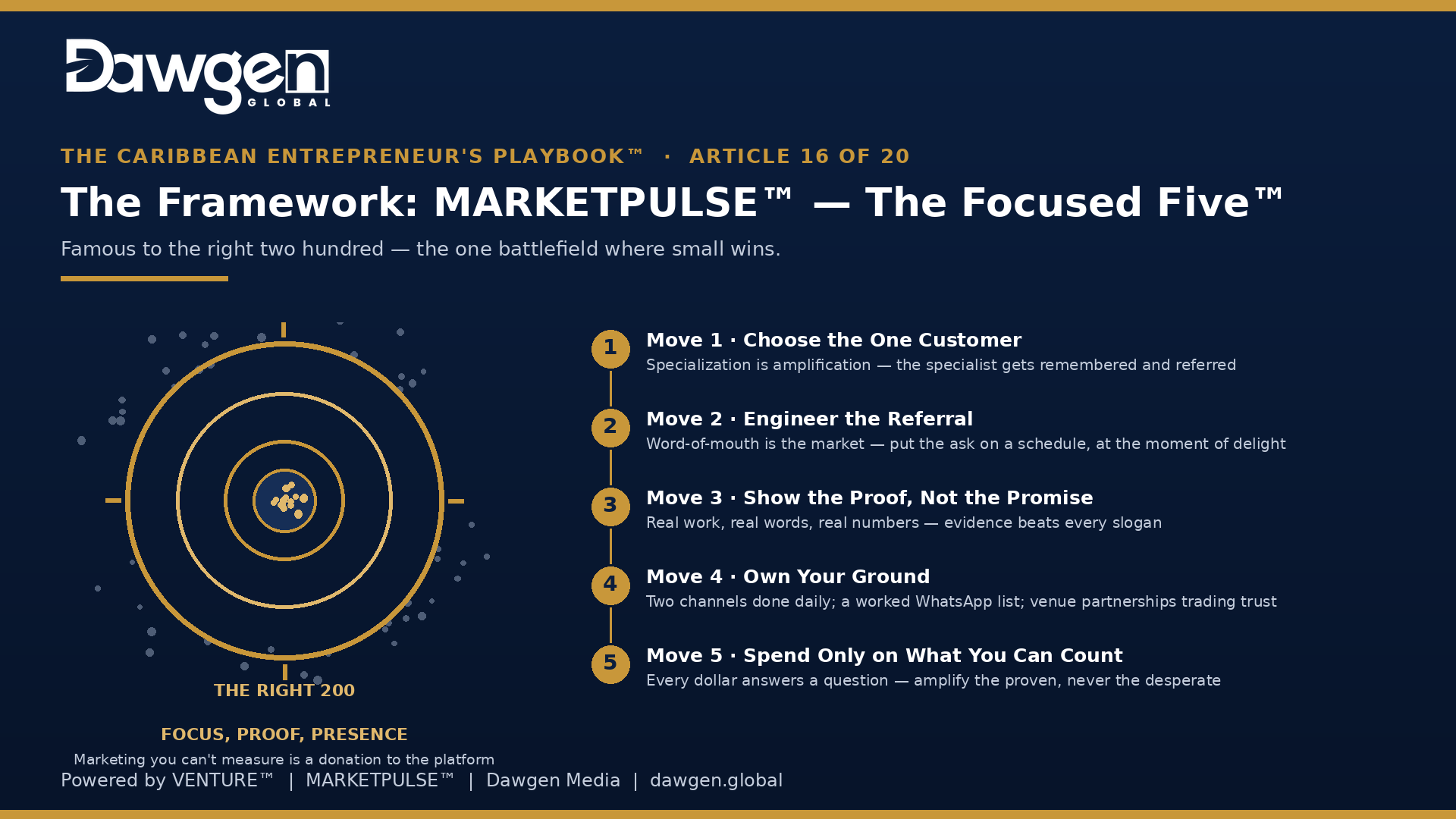
Five moves, each nearly free, each compounding the others:
- Move 1 · Choose the One Customer — Focus is a small firm’s force multiplier. Pick the single customer segment you win most often and most profitably — Article 1’s positioning discipline, now aimed at marketing — and become the specialist: not ‘catering for everyone’ but ‘the corporate lunch caterer,’ not ‘we do events’ but ‘we do conferences.’ In a small market, specialization is amplification: the specialist gets remembered, referred and forgiven on price, while the generalist gets compared and haggled. Everything in the next four moves is aimed at this one customer, which is precisely why a small budget suddenly becomes enough.
- Move 2 · Engineer the Referral — Word-of-mouth is the region’s dominant medium — so put it on a schedule instead of leaving it to chance. Build the ask into the moment of delight: at every successful delivery, a structured request for a review, a referral, or a tagged photo, made warmly and every single time. Add a simple referral thank-you that makes advocates feel seen. Harvest reviews onto the platforms your One Customer checks. None of this costs money; all of it converts the goodwill you already generate — currently evaporating nightly — into the compounding asset it should always have been.
- Move 3 · Show the Proof, Not the Promise — Your content engine is not creativity; it is evidence. Real events, real clients’ words (with permission), real numbers — ‘four hundred plates, served hot, on schedule’ beats any slogan ever written. Post the work itself, consistently, imperfectly: in proof-based marketing, a phone photo of a genuinely happy client outperforms a studio shoot of an empty promise. Alicia’s two hundred delighted clients are two hundred pieces of content waiting to be asked for. The promise is what everyone claims. The proof is what only you can show.
- Move 4 · Own Your Ground — Presence beats reach — be reliably everywhere your One Customer already is, and nowhere else. Two channels done daily beat five done sporadically: typically a properly worked social presence and a WhatsApp broadcast list run like a CRM — segmented, useful, personal, never spammy. Claim and maintain the Google Business profile so you exist at the moment of search. Then add the small market’s secret weapon: partnerships — the venue that recommends the caterer, the planner who recommends the venue, adjacent businesses trading their most valuable possession, which is trust. Your ground is small. That is exactly why it can be owned.
- Move 5 · Spend Only on What You Can Count — Now — and only now — money re-enters, on one condition: every dollar must answer a question. Small tests with tracking (a code, a ‘mention this post,’ a dedicated number), a kill-or-scale rule honestly applied, and boosting reserved for posts that already earned organic enquiries — amplify the proven, never the desperate. Measure enquiries and bookings, not likes; likes are applause, and applause pays no invoices. On this discipline, a small budget outperforms a large careless one — because it never pays twice for the same lesson.
The Framework in Action: A Worked Scenario
The following scenario is a fictional composite created for this series to illustrate the framework. It does not depict any actual business or client of the firm.
Alicia’s rebuild starts with the hard choice: corporate catering becomes the One Customer, and the bio changes to say so in five words. The referral engine goes in next — every event now ends with the structured ask, and the first month’s harvest embarrasses her: eleven glowing reviews and three referrals that were, apparently, sitting there all along, waiting to be requested. Her phone’s archive becomes ninety days of proof-posting: real spreads, client words, plate counts, delivery times.
The WhatsApp broadcast list — her two hundred past clients, segmented corporate and private — sends one genuinely useful message a month, and books two events with the first send. Two venue partnerships form over coffee she pays for; both venues had been quietly wishing for a reliable caterer to recommend. The radio budget dies unmourned, partially reborn as small boosts behind the three posts that had already earned enquiries on their own. In this illustration, six months later corporate enquiries have tripled while total marketing spend has fallen — and the victory arrives, as small-market victories do, as an overheard sentence at a chamber of commerce mixer: ‘For corporate? Everyone uses Alicia.’ Fame among the right two hundred. Total victory, at the price of discipline.
Self-Diagnostic: Are You Broadcasting or Building?
One point for every “no”:
- Can you name, in one sentence, the single customer segment your marketing is aimed at?
- Does every successful delivery trigger a structured ask — review, referral or shareable proof?
- Is most of your content evidence of real work rather than promises and pretty stock?
- Do you run two channels daily — including a worked contact list — rather than five sporadically?
- Can you trace last month’s enquiries to their sources, and did the untraceable spend get cut?
Two or more points means your marketing budget — however small — is currently a donation to the platforms. The good news: the highest-return fixes on this list cost nothing but the asking.
When to Call In Help
Bring in support when the foundations need an outside eye: when you cannot decide which One Customer to choose (a positioning question with real revenue consequences — Articles 1 and 7 both live inside it); when the message needs sharpening from ‘what we do’ to ‘why you specifically’; when the measurement layer needs building so counting becomes possible; or when the system is designed and needs disciplined execution the owner’s week cannot carry. Marketing advice sold as magic should be walked away from. Marketing built as a system — focused, proven, counted — is simply another operating discipline, and it is installable.
| BOOK A MARKETPULSE™ MARKETING STRATEGY SESSION
The MARKETPULSE™ programme within Dawgen Global’s VENTURE™ Business Coaching System delivers the Focused Five™ as a working system: your One Customer defined with data, the referral engine and proof-content calendar built, your two channels and partnership map designed, and the measurement layer installed so every dollar answers a question — with Dawgen Media’s content capability behind you when production support helps. Famous to the right two hundred. Contact us today to book your session. 📩 [email protected] | 📞 876-929-3670 / 876-665-5926 | 🇺🇸 855-354-2447 | 🌐 dawgen.global GET THE FULL PLAYBOOK This is Article 16 of The Caribbean Entrepreneur’s Playbook™ — 20 problems, 20 how-to frameworks, one system. Pre-register at dawgen.global to receive the complete Playbook e-book on release, free. |
About Dawgen Global
Dawgen Global is an independent, integrated multidisciplinary professional services firm headquartered at 47 Trinidad Terrace, New Kingston, Jamaica, serving more than 15 territories across the Caribbean. Founded and led by Dr. Dawkins Brown, Executive Chairman, the firm is independent and not affiliated with any international network. It delivers a full suite of professional services under one roof: audit and assurance; tax advisory; IT and digital transformation; risk management; cybersecurity; actuarial and insurance regulatory advisory; HR advisory; mergers and acquisitions; corporate recovery; business advisory and strategy; accounting BPO and virtual CFO services; and legal process outsourcing.
The proposition is simple: big-firm capability without the big-firm price. Dawgen Global’s integrated approach is built for the specific complexities and opportunities of the Caribbean market, helping organizations make sharper, better-informed decisions that drive measurable progress.
To explore a partnership, reach out:
- Website: dawgen.global
- Email: [email protected]
- WhatsApp (Global): +1 555-795-9071
- Caribbean offices: +1 876-665-5926 | +1 876-929-3670 | +1 876-926-5210


