| IN BRIEF
Parametric cover pays on a measured index rather than on an assessment of damage. That is what makes it fast, and it is also the source of every difficulty it creates. An earlier article in this series dealt with how much risk to retain, insure or leave unfunded. This one is about the instrument itself: how a trigger is designed, and how to find out whether it would have worked before you rely on it. The central discipline is historical back-testing — running a proposed trigger against twenty years of actual events and comparing what it would have paid against what the organisation actually needed. In the worked example here, a wind-only trigger would have paid US$9.0 million against US$12.1 million of need, and its largest single failure was a flood the trigger could not see. Adding a second measurement cut the unmet need by about sixty per cent. That is a decision with a price attached. Without the back-test it is a guess. |
What You Are Actually Buying
A conventional indemnity policy pays for the loss you can prove. A parametric policy pays a pre-agreed amount when a measured parameter reaches an agreed level, regardless of what happened to your property. The two are different products answering different questions.
The parametric contract has four moving parts, and all four are negotiable. There is the index it reads — a wind speed, a rainfall total, an earthquake magnitude, a modelled loss estimate. There is the source of that measurement — a named weather station, a satellite dataset, a national meteorological service, a modelling agency. There is the threshold at which it begins to respond. And there is the payout formula that converts the reading into money.
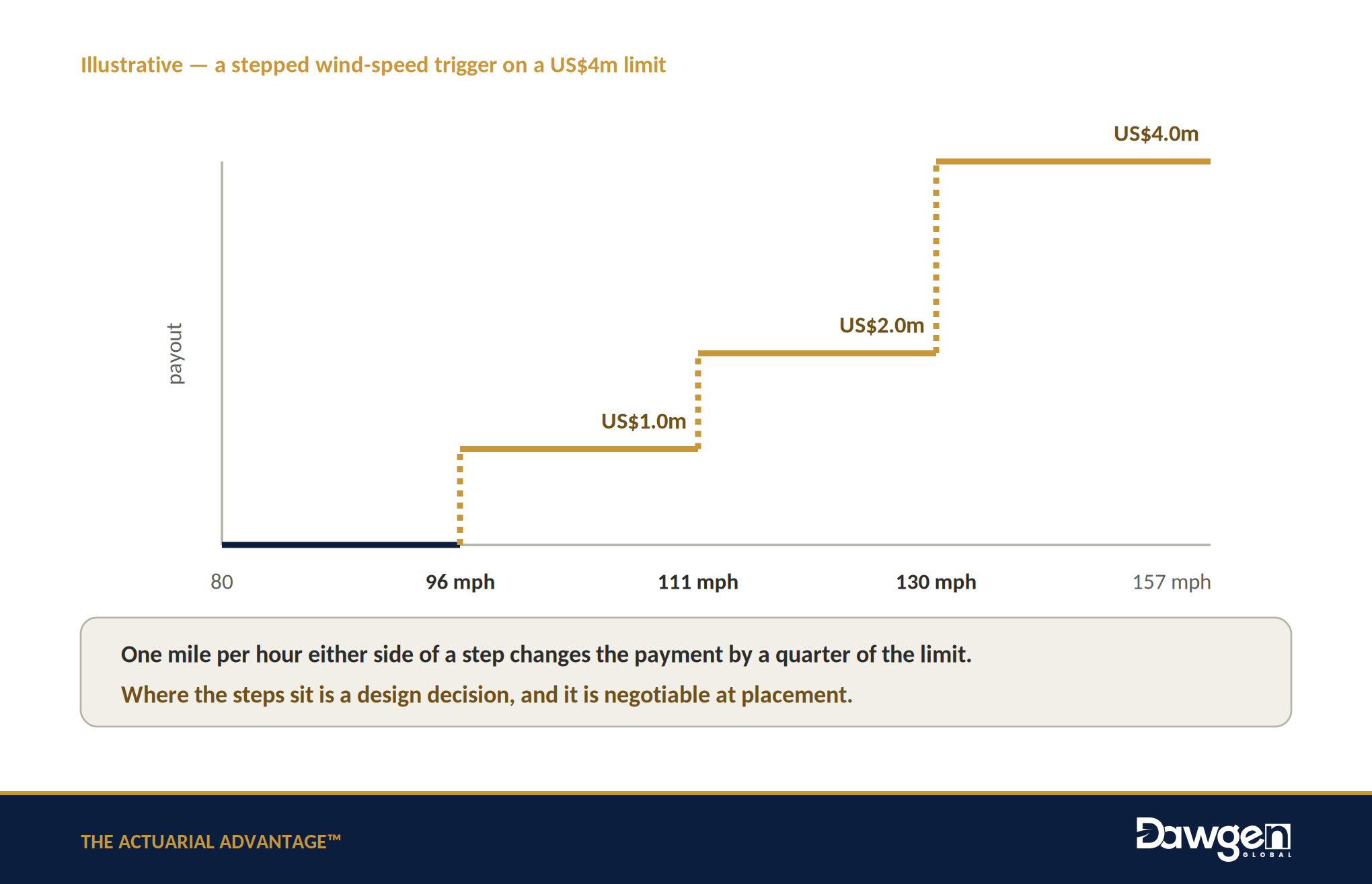
One mile per hour either side of a step changes the payment by a quarter of the limit. Figures illustrative.
A stepped structure of this kind is the most common design and the easiest to administer, because the payment is unambiguous once the reading is published. It is also where a great deal of unrecognised risk sits. An event recording 110 miles per hour pays a quarter of the limit; an event recording 111 pays half. The physical difference between those two storms is immaterial. The financial difference is a million dollars.
| The steps are not a feature of the weather. They are a commercial decision someone made, and they can be moved. |
The Question to Ask Before Buying
Basis risk is the gap between what the trigger pays and what the organisation actually loses. It is inherent to the product and it cannot be eliminated — but its size can be estimated in advance, and that estimate is the single most useful piece of analysis available before placement.
The discipline is historical back-testing. Take the proposed structure, apply it to every relevant event in the historical record, and ask four questions of each: what would the trigger have recorded, what would the formula have paid, what did the organisation actually need in the weeks that followed, and what was the difference?
Consider a regional distributor operating across three islands. It has property and business-interruption cover, but has identified a liquidity gap: after a major hurricane it would need roughly US$4 million within the first thirty days for emergency payroll, generator fuel, site clearance, temporary premises and supplier prepayments — well before any indemnity settlement arrives. A US$4 million parametric layer on a wind trigger is proposed.
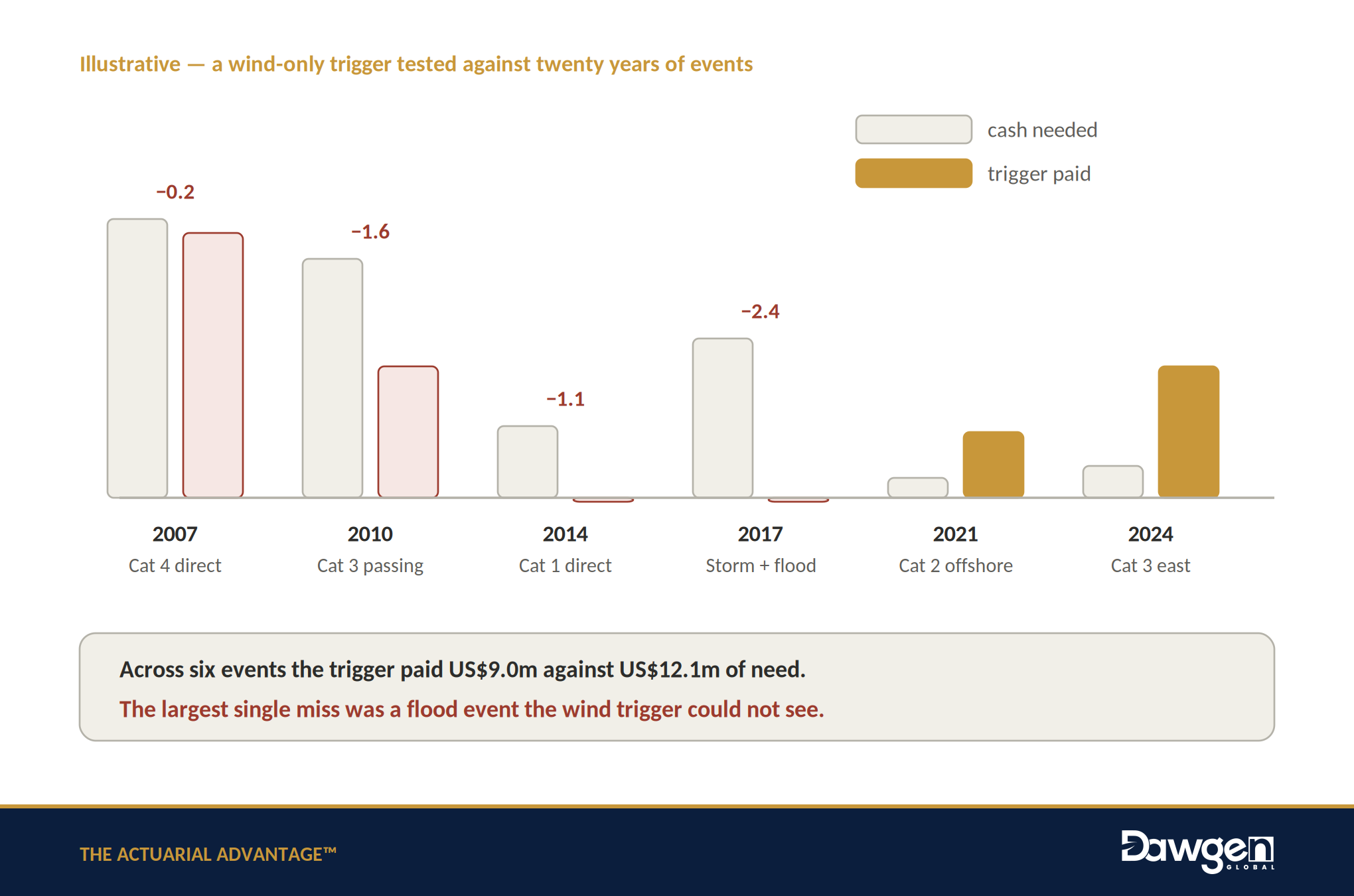
Across six events the trigger paid US$9.0m against US$12.1m of need. Figures illustrative.
The back-test is not flattering, and that is its value. The trigger performs well on the direct severe hit it was designed around. It underpays on a strong storm that passed at distance, misses a Category 1 direct hit entirely because the reading fell below the threshold, and fails completely on a tropical storm whose damage came from flooding rather than wind. It also overpays twice — once on a storm that recorded high wind at the station while the assets were largely spared.
None of this makes the cover unsuitable. It makes it a known quantity. An organisation that has seen this table before signing is buying a defined instrument; one that has not is buying a hope with a premium attached.
When One Measurement Is Not Enough
The largest failure in the back-test was a flood. Wind speed explains structural damage well and explains water damage not at all, and in the Caribbean a substantial share of loss arrives as rainfall, surge and the interruption that follows.
Multi-trigger structures address this by reading more than one index — wind speed with storm proximity, rainfall with river level, earthquake magnitude with ground acceleration. Re-running the same twenty years with a rainfall trigger alongside the wind trigger changes the picture materially.
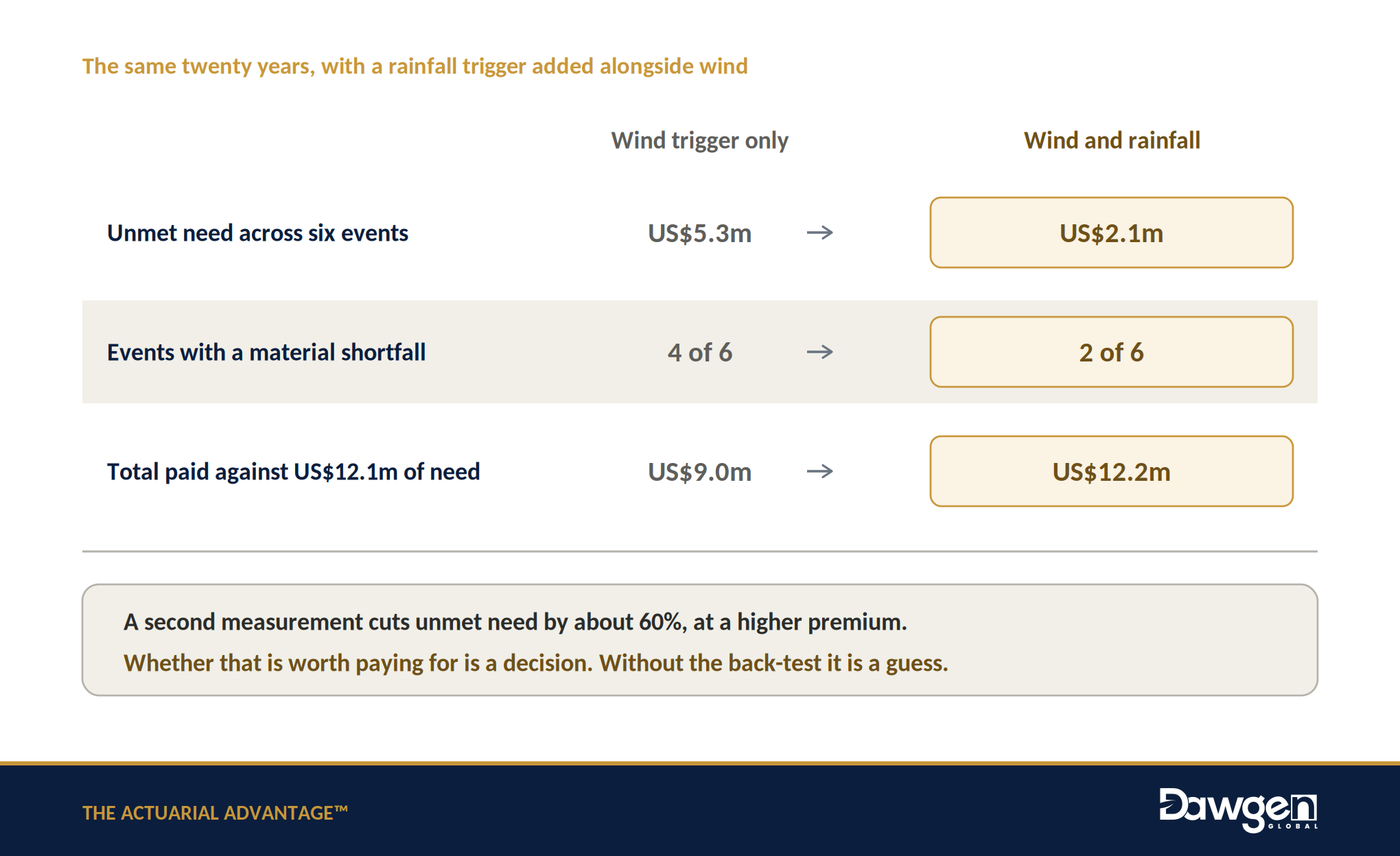
A second measurement cuts unmet need by about 60%, at a higher premium. Figures illustrative.
Complexity is not free. Every additional index requires its own data source, its own threshold, its own contract wording and its own dispute risk. The right structure is not the most sophisticated one available; it is the simplest one that responds reliably to the loss drivers the organisation actually faces.
The point of quantifying the improvement is that it converts a technical argument into a commercial one. The broker proposing a dual trigger and the board resisting the additional premium are no longer exchanging opinions. They are looking at what the second index would have been worth across twenty years of events.
Three Levers, All Negotiable
Basis risk is often discussed as though it were a fixed property of parametric cover. It is not. It is largely determined by three design choices, and all three are open at placement.
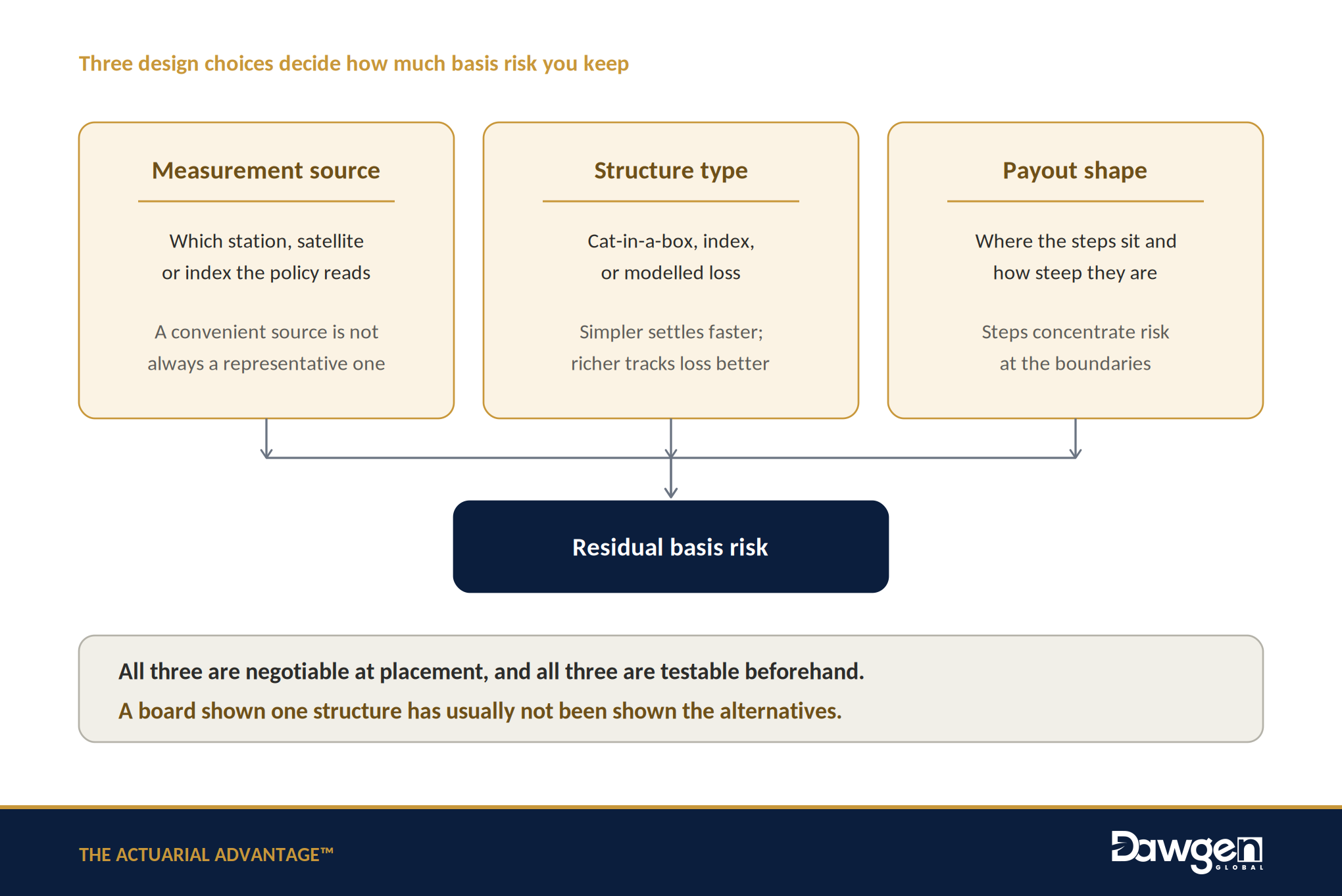
All three are negotiable at placement, and all three are testable beforehand.
The measurement source
The nearest weather station is convenient. Whether it is representative depends on where the organisation’s value actually sits. A group with warehouses on three islands, revenue concentrated in one of them and a single critical distribution site may be poorly served by a station chosen because it is close to head office. The design exercise should start from an exposure map — property, inventory, revenue by location, critical sites, utility and port dependencies — and select the measurement to match, rather than the reverse.
The structure type
A cat-in-a-box structure pays when a storm of defined intensity passes through a defined geographic area, and is simple and fast. An index structure reads a continuous measurement and can track severity more finely. A modelled-loss structure applies an agreed model to event parameters and tracks actual loss most closely of the three — at the cost of slower settlement and greater dependence on the model. The trade is consistently the same: speed and certainty against sensitivity to the real loss.
The payout shape
Steps are easy to administer and concentrate risk at their boundaries. More gradual formulas reduce that cliff effect but are harder to verify. Where the first step attaches determines whether moderate events are covered at all, and moderate events are more frequent than severe ones.
The Premium Is Not the Whole Price
Comparing parametric quotations on premium alone is the most common error in placement, because two structures at the same price can carry materially different residual exposure.
| What to compare | Why it matters |
| Premium as a percentage of limit | The visible cost, and the only one usually compared |
| Modelled expected payout | What the structure is actuarially worth, which tells you the loading you are paying |
| Residual unmet need in the back-test | The exposure you retain after the policy responds — the number the premium comparison hides |
| Frequency of a nil payout in damaging events | How often you would suffer a loss and receive nothing |
| Frequency of payment without loss | Value received but not needed, which is not free — you paid for it |
| Speed of settlement after the index publishes | The reason for buying the product in the first place |
| Dependence on a single data source | Concentration risk in the contract itself, including what happens if a station fails |
| Multi-year and reinstatement terms | Whether the cover survives an active season, or is exhausted by the first event |
Two structures at the same premium can leave very different amounts of risk with the buyer.
One further item belongs on that list and is regularly overlooked. A parametric payment is not an indemnity, so its accounting and tax treatment can differ from an insurance recovery — and a payment received without a corresponding assessed loss may be taxable in ways an indemnity settlement is not. That should be established before placement, in the relevant territory, rather than discovered at year end.
It Is Not Set and Forget
A parametric structure is calibrated to an exposure profile at a point in time. Both the exposure and the measurement infrastructure move.
New sites open and old ones close. Revenue shifts between locations. A supplier concentration emerges. Meanwhile the reference station may be relocated, decommissioned or replaced with a different instrument; a satellite dataset may be reprocessed on a revised methodology; the agency publishing the index may change its definitions. Any of these can quietly alter what the contract means without a word of it changing.
The annual review should therefore re-run the back-test against the current exposure map and the current data source, not simply renew last year’s terms. That is a modest exercise and it is the only thing that keeps the instrument matched to the risk it was bought for.
Eight Questions Before Signing
- What index does this policy read, and from which specific source?
- How far is that measurement point from where our value and our revenue actually sit?
- Has this structure been back-tested against the historical record, and may we see the results?
- In how many damaging events would it have paid nothing?
- What is the modelled expected payout, and what loading are we paying over it?
- Would a second index materially reduce our unmet need, and at what additional premium?
- What happens if the reference station fails, is moved, or the methodology changes?
- How will a payment be treated for accounting and tax in each territory where we receive it?
| IF THE BACK-TEST HAS NOT BEEN DONE
It can be. The historical event record is available, the exposure data sits within the organisation, and the exercise takes a matter of weeks. It is considerably cheaper than discovering the answer during an event. |
Where This Work Leads
A trigger design finding rarely stops with the placement. The exposure map leads to business continuity and site strategy. The residual unmet need leads to treasury, contingent facilities and the wider risk-financing structure. The tax and accounting treatment leads to financial reporting and tax advisory in each territory. The data-source dependency leads to contract wording and legal review.
Dawgen Global’s Caribbean Integrated Borderless Delivery model exists so that the analysis and everything that follows sit within one engagement, across multiple Caribbean jurisdictions. Capability is held by the firm and delivered by a team rather than vested in an individual — which matters for a structure reviewed at every renewal.
The Point of All This
Parametric cover does something no indemnity policy can: it puts money in the account within days, at the moment when payroll, fuel and clearance costs arrive and no assessor has yet visited. For an organisation whose principal exposure is a liquidity gap rather than a solvency gap, that is a genuinely valuable instrument.
| The product is sound. What is usually missing is the evidence that this particular trigger would have responded to this particular organisation’s events. |
That evidence is not difficult to produce. The events are on the record, the readings are published, and the organisation knows what it needed and when. Running the comparison takes weeks and settles a question that would otherwise be answered, expensively, by an actual hurricane.
A board asked to approve a parametric placement should ask to see the back-test. If one has not been done, that is the first piece of work — not the placement.
How Dawgen Global Can Help
Our Actuarial & Insurance Regulatory Advisory practice works on the financing and structuring side of catastrophe exposure — the questions this article addresses:
- Parametric feasibility assessment and trigger design review
- Historical back-testing of proposed structures against the event record
- Basis-risk quantification and multi-trigger comparison
- Exposure mapping to inform measurement-point selection
- Risk-financing structure and layer analysis: retention, deductibles and limits
- Contingency reserve, contingent facility and liquidity modelling
- Business-interruption quantification and claim preparation support
- Accounting, tax and disclosure treatment of parametric recoveries
- Board and audit committee briefings on the quantified position
Catastrophe and hazard modelling itself — wind and flood hazard sets, vulnerability curves and physical exposure modelling — is a distinct specialism, and we resource it through our associate network. Delivery is coordinated within the same engagement, so the client retains one relationship and one point of accountability.
| REQUEST AN ACTUARIAL RISK DISCOVERY SESSION
A structured half-day session with your board or executive team, followed by a short written output: your liquidity requirement in the first thirty days after a severe event, how your current or proposed structure would have responded across the historical record, and where the residual exposure sits. Fixed scope. Fixed fee. Delivered within three weeks. Email: [email protected] · Telephone: 876-929-3670 or 876-665-5926 · US toll free: 855-354-2447 Contact form: www.dawgen.global/contact-us/ |
| This article is published as part of The Actuarial Advantage™, a Dawgen Global editorial series on risk quantification, insurance and long-term financial decision-making in the Caribbean. It is general commentary and does not constitute actuarial, accounting, legal, tax or investment advice. All figures, events and back-test results are illustrative and are used to demonstrate method; they are not estimates of any organisation’s exposure and should not be relied upon as benchmarks. Modelled results depend on the hazard data and assumptions used and will differ between providers. |
About Dawgen Global
Dawgen Global is an independent, integrated multidisciplinary professional services firm headquartered at 47 Trinidad Terrace, New Kingston, Jamaica, serving more than 15 territories across the Caribbean. Founded and led by Dr. Dawkins Brown, Executive Chairman, the firm is independent and not affiliated with any international network. It delivers a full suite of professional services under one roof: audit and assurance; tax advisory; IT and digital transformation; risk management; cybersecurity; actuarial and insurance regulatory advisory; HR advisory; mergers and acquisitions; corporate recovery; business advisory and strategy; accounting BPO and virtual CFO services; and legal process outsourcing.
The proposition is simple: big-firm capability without the big-firm price. Dawgen Global’s integrated approach is built for the specific complexities and opportunities of the Caribbean market, helping organizations make sharper, better-informed decisions that drive measurable progress.
To explore a partnership, reach out:
- Website: dawgen.global
- Email: [email protected]
- WhatsApp (Global): +1 555-795-9071
- Caribbean offices: +1 876-665-5926 | +1 876-929-3670 | +1 876-926-5210


