
Why artificial intelligence is the first major technology most organizations buy by the unit — and what finance has to do about it
Emerging Risk & Transformation Services • 2026
Executive Summary

Most organizations can say what they spend on their accounting system. Far fewer can say what they spend on artificial intelligence (AI), and almost none can say what a single AI-assisted outcome costs them.
This is not carelessness. It is a structural consequence of how AI is purchased. Enterprise software has historically been bought as a licence: a negotiated price, a contract, a renewal date, a line in the budget. AI is bought by consumption. The bill is assembled from millions of small events — each question asked, each document processed, each step an automated agent takes — across vendors, departments, embedded product features and individual employees’ own accounts.
The result is a spending category that grows without a purchase decision ever being made. The 2026 Verizon Data Breach Investigations Report found that 45% of employees are now regular users of AI tools at work, up from 15% a year earlier, and that 67% of users accessing AI services on corporate devices were doing so through non-corporate accounts. The report treats this as a data-loss problem, which it is. It is also a financial control problem: consumption that no budget holder approved, no contract governs, and no forecast anticipated.
This article sets out how to bring AI spending under financial discipline without slowing the organization down — how to find it, attribute it, price it per outcome, compare it honestly against the human baseline, and put controls in place that reduce cost without reducing capability.
1. AI Is the First Major Technology Most Organizations Buy by the Unit

Utilities are metered. Telecommunications are metered. But those are supporting services with predictable patterns, and finance teams have decades of experience with them.
AI is different in three ways. Consumption is driven by employee behaviour rather than by a fixed process, so it can double in a month without anyone deciding anything. The unit of consumption is invisible to the person consuming it — nobody watching a document being summarized has any sense of what that summarization cost. And the same task can cost ten times more or less depending on choices made by a developer, a vendor or a default setting that nobody reviewed.
That combination — variable, invisible and highly sensitive to configuration — is unusual, and it defeats the controls most finance functions already have.
2. Why the Software Licence Mental Model Fails

The licence model assumes that cost is a function of how many people have access. Budget by headcount, negotiate at renewal, and the year is predictable.
Consumption pricing breaks every part of that. Cost is a function of how intensively the tool is used, not how many people hold a licence. A department of five heavy users can outspend a department of fifty occasional ones. There is no renewal moment at which the commercial relationship is naturally reviewed. And because the charge arrives monthly in arrears, the organization learns what it spent only after it has spent it.
Finance functions that treat AI as a licence line will be surprised, repeatedly, in the same direction.
3. What Actually Drives the Bill
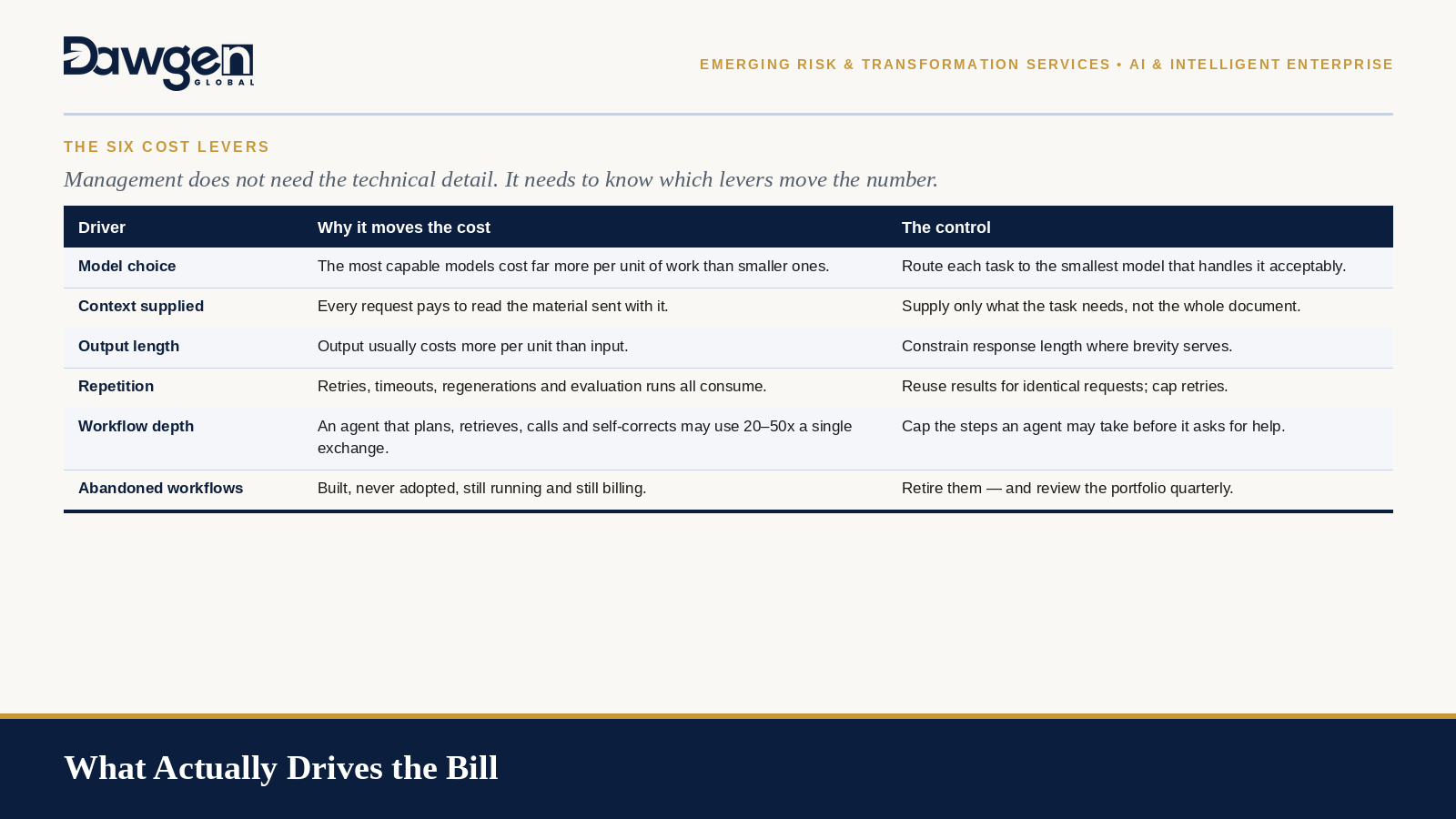
Management does not need to understand the technology in detail, but it does need to know which levers move the cost. In broad terms:
Which model is used. The most capable models cost substantially more per unit of work than smaller ones. Many tasks — classification, extraction, routine drafting — do not need the most capable model. Using one everywhere is the single most common source of avoidable cost.
How much context is supplied. Every request carries the material the model must read. Sending an entire policy manual when three paragraphs would do multiplies the cost of every single request in that workflow.
How much output is produced. Output typically costs more per unit than input. A workflow that generates long responses where short ones would serve is paying for verbosity.
How often the work is repeated. Failed requests, retries, timeouts and regenerated answers all consume. So do testing and evaluation runs, which can quietly exceed production consumption during development.
How many steps the workflow takes. This is the one that changes the arithmetic most, and it deserves its own section.
4. Agentic Workflows Change the Cost Curve

A single question and a single answer is one unit of consumption. An agent that plans, retrieves information, calls a system, evaluates the result, corrects itself and tries again may consume twenty or fifty times as much to complete one task — and each of those steps may carry the full accumulated context of everything that came before it.
This is not a defect. It is what makes agents useful. But it means that the cost of an agentic workflow is not proportional to the number of customers served; it is proportional to how much work the agent does per customer, which is a design decision, not a volume assumption.
It also means cost becomes genuinely unpredictable at the moment of design. Two agents built to do the same job, by two different teams, can differ in running cost by an order of magnitude — with no difference in output quality that a user would notice. Nobody in the organization is currently accountable for that difference.
5. Shadow AI Is Uncosted Spend

When employees use personal accounts for work tasks, the organization loses more than data control. It loses the ability to see its own consumption.
Some of that spending sits on personal credit cards and never reaches the organization at all, which looks like a saving and is actually an unrecorded subsidy that will disappear the moment the employee does. Some arrives through expense claims, categorized as software or professional development, invisible as AI. And some sits inside tools the organization already pays for, where an AI feature was switched on by default and is now metered separately.
The first task in any AI economics engagement is not optimization. It is discovery.
6. You Cannot Manage What You Cannot Attribute

Even where spending is visible in total, it is frequently unattributable in detail. A single vendor invoice may cover a dozen use cases across five departments with no breakdown.
Attribution requires deliberate design: separate keys or projects per use case, consistent tagging, and an owner recorded against each. This is unglamorous work, and it is the difference between a number that can be managed and a number that can only be reported. Retrofitting it is considerably harder than building it in, which is an argument for doing it now, while the portfolio is still small.
7. Unit Economics: Cost per Outcome, Not Cost per Seat

The question that matters is not what AI costs per month. It is what it costs per thing it does.
Cost per resolved customer query. Cost per invoice processed. Cost per document reviewed. Cost per report drafted. These are the numbers that let management compare one use case against another, decide what to scale, and recognize when something has quietly become uneconomic.
They also expose a pattern that monthly totals conceal: within any AI portfolio, a small number of use cases usually consume a disproportionate share of spend, and they are frequently not the ones creating the most value. Without unit economics, that mismatch is invisible, because the expensive use case and the valuable one appear on the same invoice.
8. The Human Comparator

A unit cost means little without something to compare it to. The honest comparator is what the same outcome cost before, fully loaded — not just salary, but supervision, error correction, rework, delay and the cost of the work not done because capacity was consumed.
Two cautions. Organizations tend to overstate the human baseline, because the work being replaced is rarely the whole of a role. And they tend to understate the AI figure, because the visible consumption charge omits the human review the workflow still requires, the engineering time to build and maintain it, the evaluation runs, and the cost of the occasional wrong answer.
A comparison that omits review time and error cost is not a business case. It is a sales pitch.
9. Time Saved Is Not Money Saved

This is where most AI business cases quietly fail.
An organization calculates that a tool saves each of four hundred employees twenty minutes a day, multiplies by the loaded hourly rate, and reports a large annual saving. But twenty minutes returned to four hundred people is not a cost reduction. It is four hundred slightly less pressured days. The saving becomes real only if that reclaimed capacity is deliberately redirected — into work that was previously deferred, into volume growth without corresponding hiring, into reduced overtime, or into a genuine reduction in headcount that the organization has actually decided to make.
None of those happen by themselves. Benefit realization is a management act, not an arithmetic consequence, and the AI business case should say explicitly which of those routes it depends on. A case that cannot name its route is claiming a saving it has no mechanism to collect.
10. Commercial Terms and Vendor Dependency

Consumption pricing shifts commercial risk onto the buyer, and several terms deserve attention that they rarely receive.
Committed spend arrangements can reduce unit rates but create an obligation to consume. Published rates can change, and an organization whose business case depends on current pricing is carrying a risk it has not quantified. Models are deprecated, and a workflow tuned to a specific model may require rework when that model is withdrawn. Rate limits can constrain the throughput a business case assumed. And the practical cost of moving a workflow from one provider to another — re-tuning, re-testing, re-validating — is usually far higher than the apparent portability of the underlying technology suggests.
For Caribbean organizations, one further term matters more than the rest: almost all of this is priced in United States dollars, against revenue that frequently is not.
11. Controls That Reduce Cost Without Reducing Capability

The point of AI cost governance is not to spend less. It is to stop spending on things that do not need the spending, so that the budget goes to the work that matters.
The measures that reliably pay for themselves are unglamorous. Route each task to the smallest model that handles it acceptably, rather than defaulting to the most capable one. Supply only the context a task actually needs. Reuse results for repeated identical requests. Set explicit consumption budgets per workflow, with alerts before they are breached rather than invoices after. Cap how many steps an agent may take before it stops and asks for help. Remove workflows that were built, never adopted, and are still running.
Each of these is a design decision that someone has to own. In most organizations today, nobody does.
12. Budgeting, Showback and Approval Gates

Three governance mechanisms convert visibility into discipline.
Showback reports each department’s AI consumption to that department, without moving the charge. It changes behaviour on its own, because most overconsumption is not deliberate.
Chargeback moves the cost to the consuming budget. It is more effective and more contentious, and it should not be introduced before attribution is trustworthy.
Approval gates require a new AI use case to state its expected consumption, its owner and its intended benefit before it goes live — and to be reviewed against those statements afterwards. The review matters more than the approval. An organization that approves business cases and never revisits them is running an AI portfolio on forecasts it has never tested.
13. The Caribbean Context

Caribbean organizations face the same AI economics as larger markets, with four differences that work against them.
Spending is in United States dollars while revenue is often in local currency, so every depreciation increases the real cost of the same workflow. Volumes are too small to command negotiated rates, meaning regional organizations generally pay published prices while larger competitors do not. Specialist engineering capacity to optimize workflows is scarce and expensive, so inefficient implementations tend to stay inefficient. And where a group operates across several territories, consumption is frequently spread across separate entities and invoices, obscuring both the total and any leverage the group might have had by aggregating it.
That last point is often the quickest win available to a regional group: not optimizing anything, simply seeing the whole of it in one place for the first time.
14. Composite Caribbean Case Study

A composite Caribbean financial-services group had adopted AI across three business units over eighteen months. Finance reported total AI spend as a single technology line and regarded it as modest.
A structured review found consumption in four places the line did not capture: a vendor invoice covering several use cases with no breakdown, an AI feature metered separately inside an existing platform, expense claims from employees using personal accounts, and a development environment where evaluation runs had continued after the project concluded.
The consolidated figure was materially higher than reported. More usefully, unit costing showed that one document-processing workflow accounted for a substantial share of consumption while delivering the least measured benefit of the three business cases — it had been built with the most capable model, the full document supplied on every request, and no limit on retries.
The group did not stop using AI. It introduced attribution by use case, per-workflow consumption budgets, model routing, approval gates for new cases and quarterly reporting to the finance committee. Consumption fell while the number of active use cases rose.
This is an anonymized composite illustration drawn from patterns commonly observed in the region. It does not describe any specific Dawgen Global client.
15. A Practical AI Economics Framework
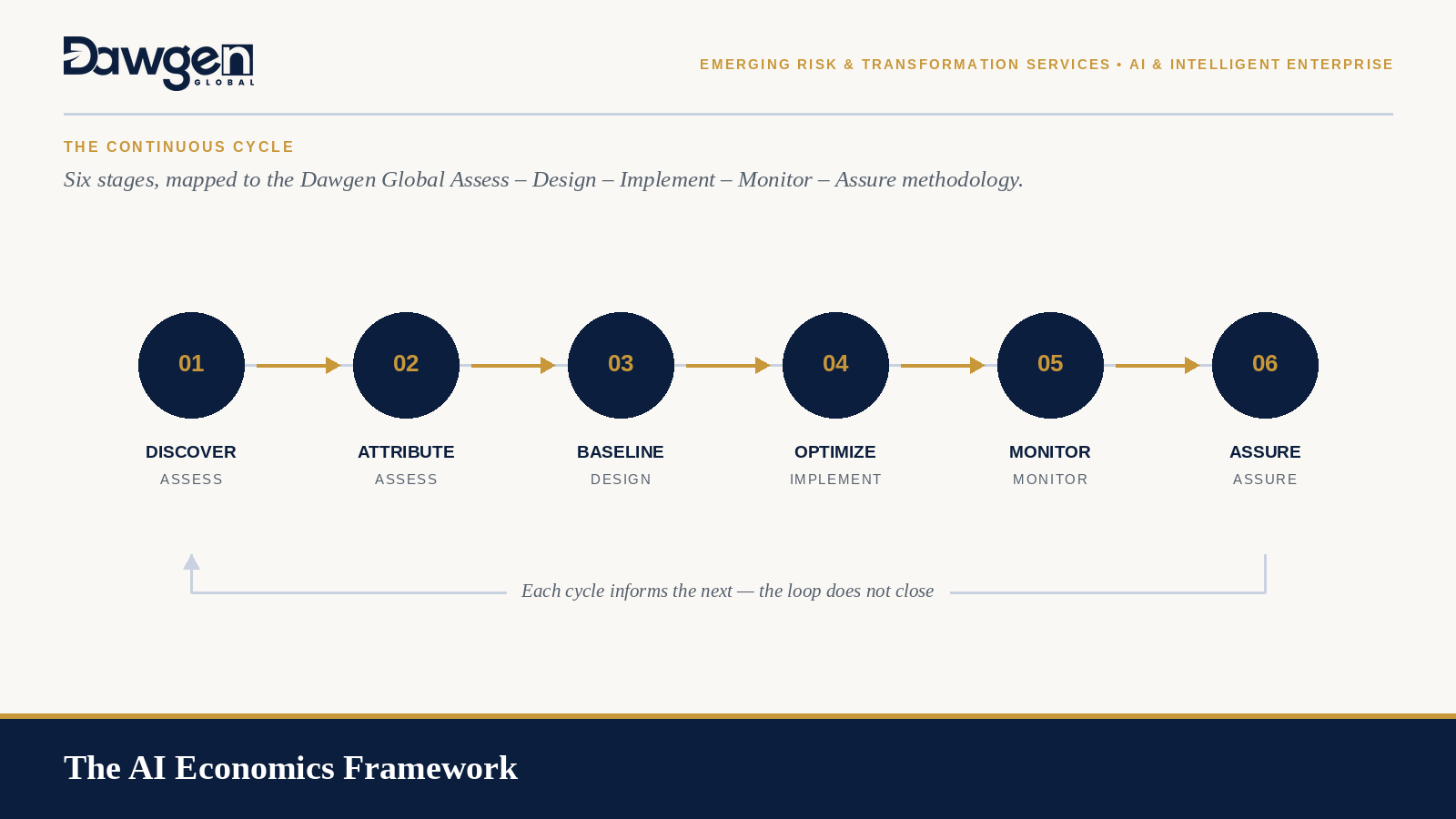
Six stages, delivered within the Dawgen Global Assess – Design – Implement – Monitor – Assure methodology.
DISCOVER. Find all AI consumption — contracted, embedded, departmental and shadow.
ATTRIBUTE. Allocate spending to use cases, owners and cost centres, with the tagging to sustain it.
BASELINE. Establish unit economics per outcome and an honest human comparator.
OPTIMIZE. Apply model routing, context discipline, reuse, consumption budgets and step limits; renegotiate commercial terms.
MONITOR. Track consumption, variance against forecast, unit cost trend and benefit realization.
ASSURE. Test whether claimed benefits were actually realized and whether the controls operate.
16. What the Chief Financial Officer and Board Should See
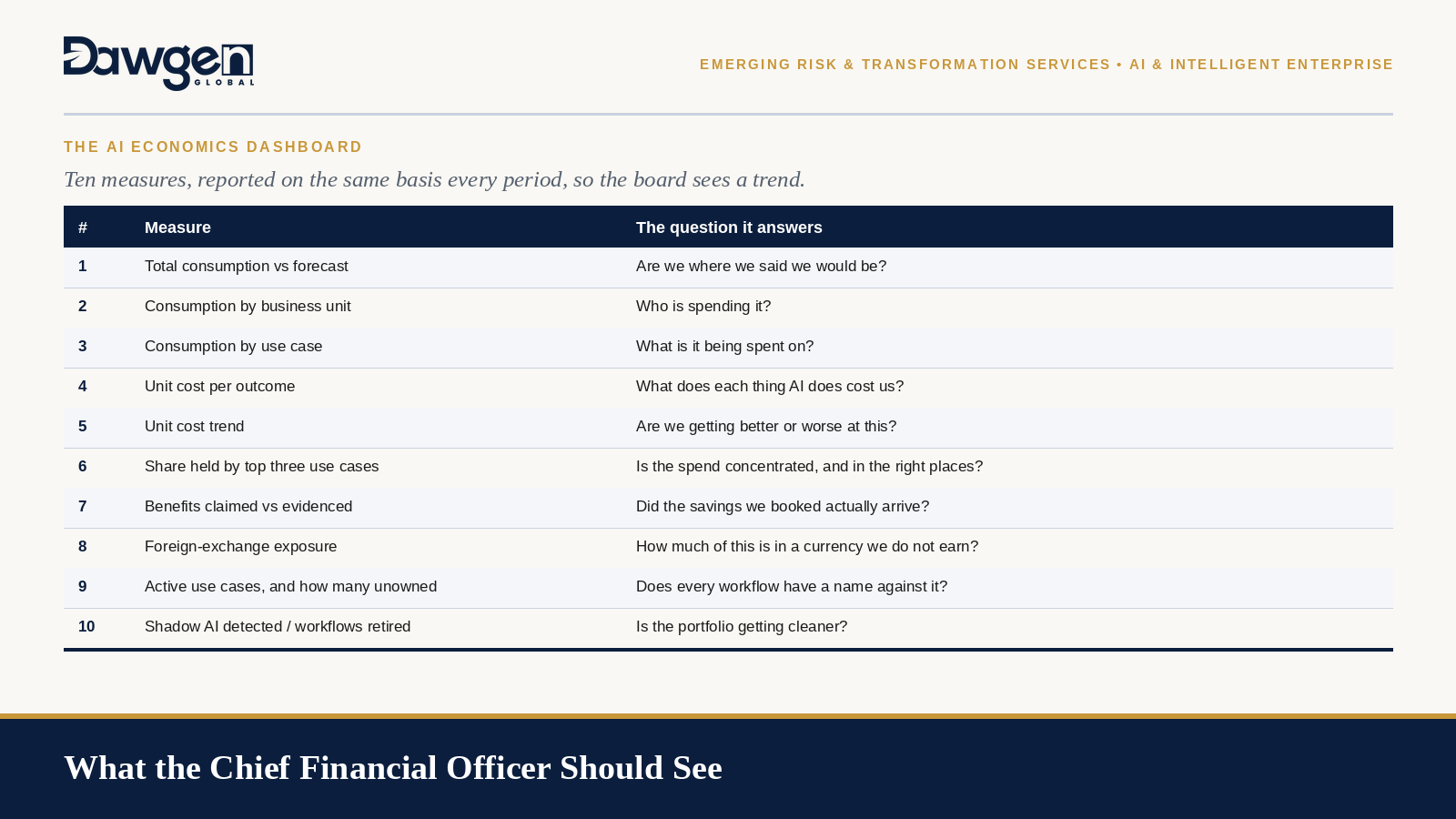
Ten measures, reported on the same basis every period so that the picture is a trend rather than a new list:
total AI consumption and variance against forecast; consumption by business unit and by use case; unit cost per outcome for each material use case; unit cost trend; the share of spend held by the top three use cases; benefits claimed against benefits evidenced; foreign-exchange exposure on AI commitments; the number of active use cases and how many are unowned; shadow AI detected and brought under management; and workflows retired.
17. Questions Boards and Executives Should Ask
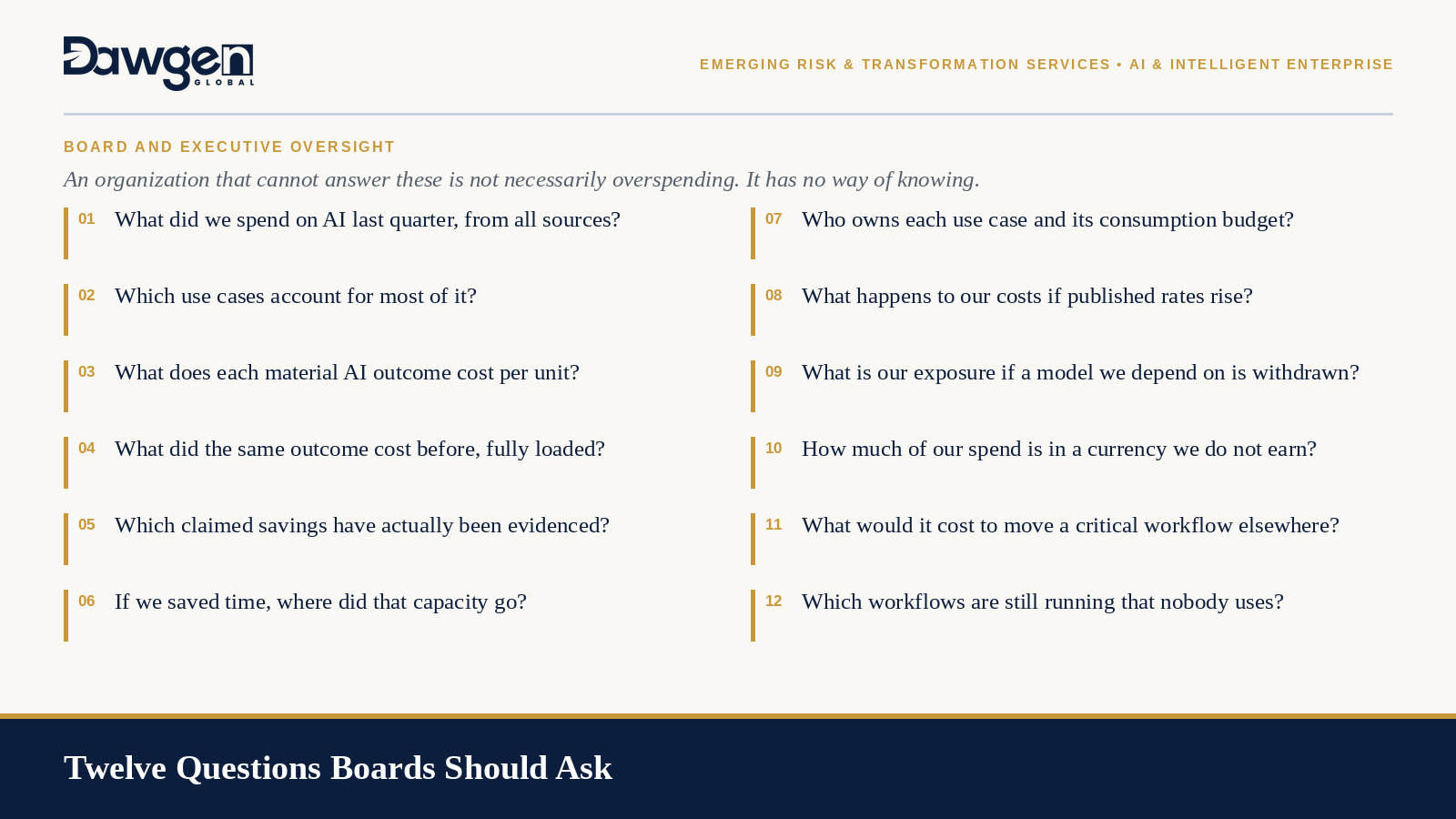
- What did we spend on AI last quarter, in total, from all sources?
- Which use cases account for most of it?
- What does each material AI-assisted outcome cost us per unit?
- What did the same outcome cost before, fully loaded?
- Which business cases claimed savings, and have those savings been evidenced?
- If we saved time, where did that capacity go?
- Who owns each AI use case and its consumption budget?
- What happens to our costs if published rates rise?
- What is our exposure if a model we depend on is withdrawn?
- How much of our AI spend is in a currency we do not earn?
- What would it cost us to move a critical workflow to another provider?
- Which workflows are still running that nobody uses?
An organization that cannot answer these is not necessarily overspending. It simply has no way of knowing.
18. The Dawgen Global Perspective

AI cost governance is frequently framed as a procurement exercise or a technical optimization problem. It is neither. It is a financial control problem with a technical surface, and it sits squarely in the finance function’s mandate.
The organizations that will get the most from AI over the next several years are not those that spend the least on it. They are those that can tell which of their spending is producing value, redirect the rest, and defend the resulting investment case to a board with evidence rather than enthusiasm. That is ordinary financial discipline, applied to an unfamiliar cost structure.
19. How Dawgen Global Can Help
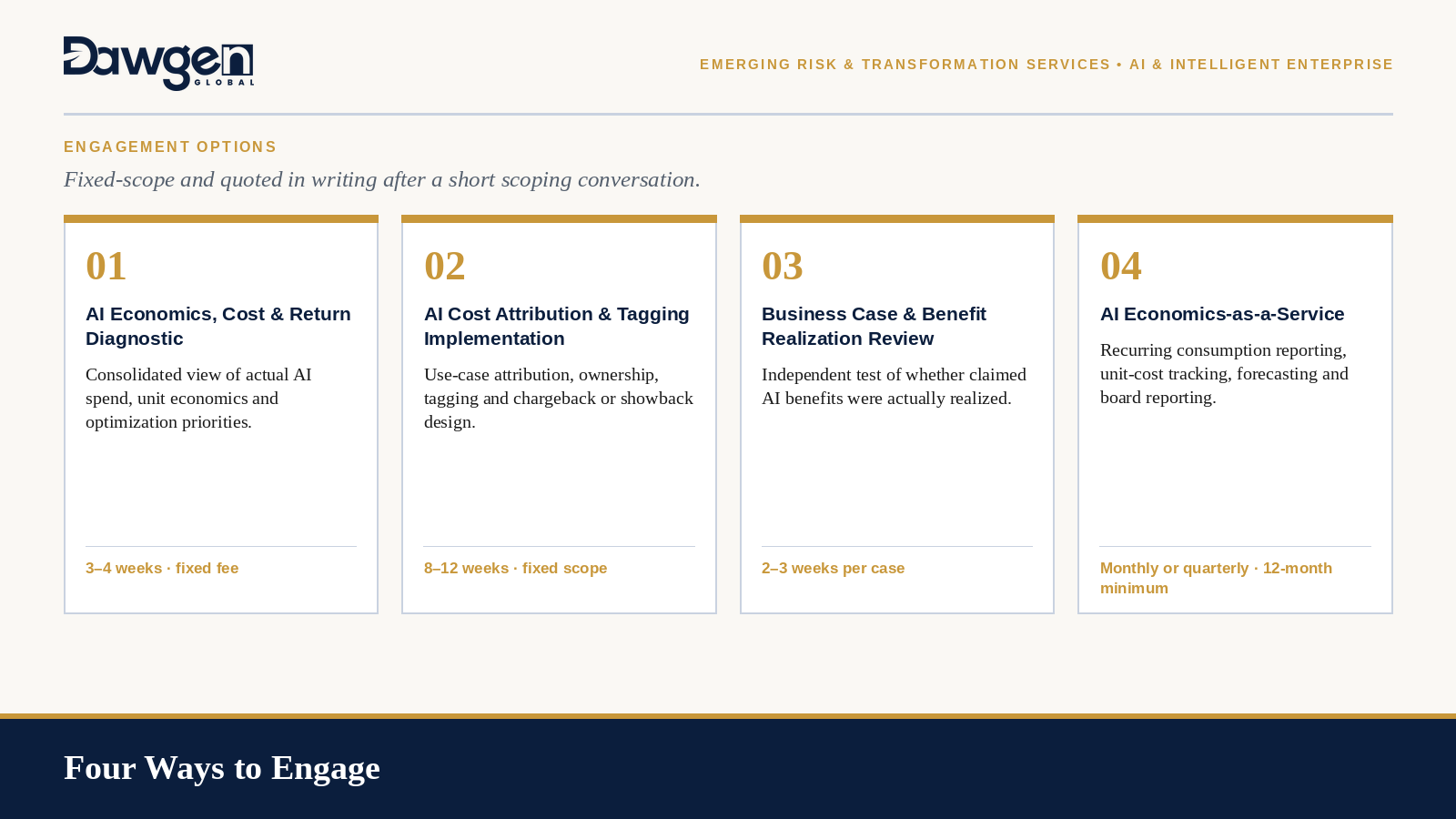
We help organizations establish visibility over AI consumption, attribute it to owners and use cases, build defensible unit economics, optimize what is worth optimizing, and report to management and the board on a consistent basis — with an independent view of whether claimed benefits were realized.
Conclusion

AI spending is unlikely to fall. It is likely to become a permanent and growing operating cost, embedded in workflows the organization depends on.
The question is not whether to spend. It is whether the organization can say what it is spending, on what, to what effect — and whether anyone owns the answer. At present, in most organizations, nobody signed a contract for this, and nobody is accountable for it either. Both of those are management choices, and both can be changed this quarter.
Start with the Dawgen AI Economics, Cost & Return Diagnostic
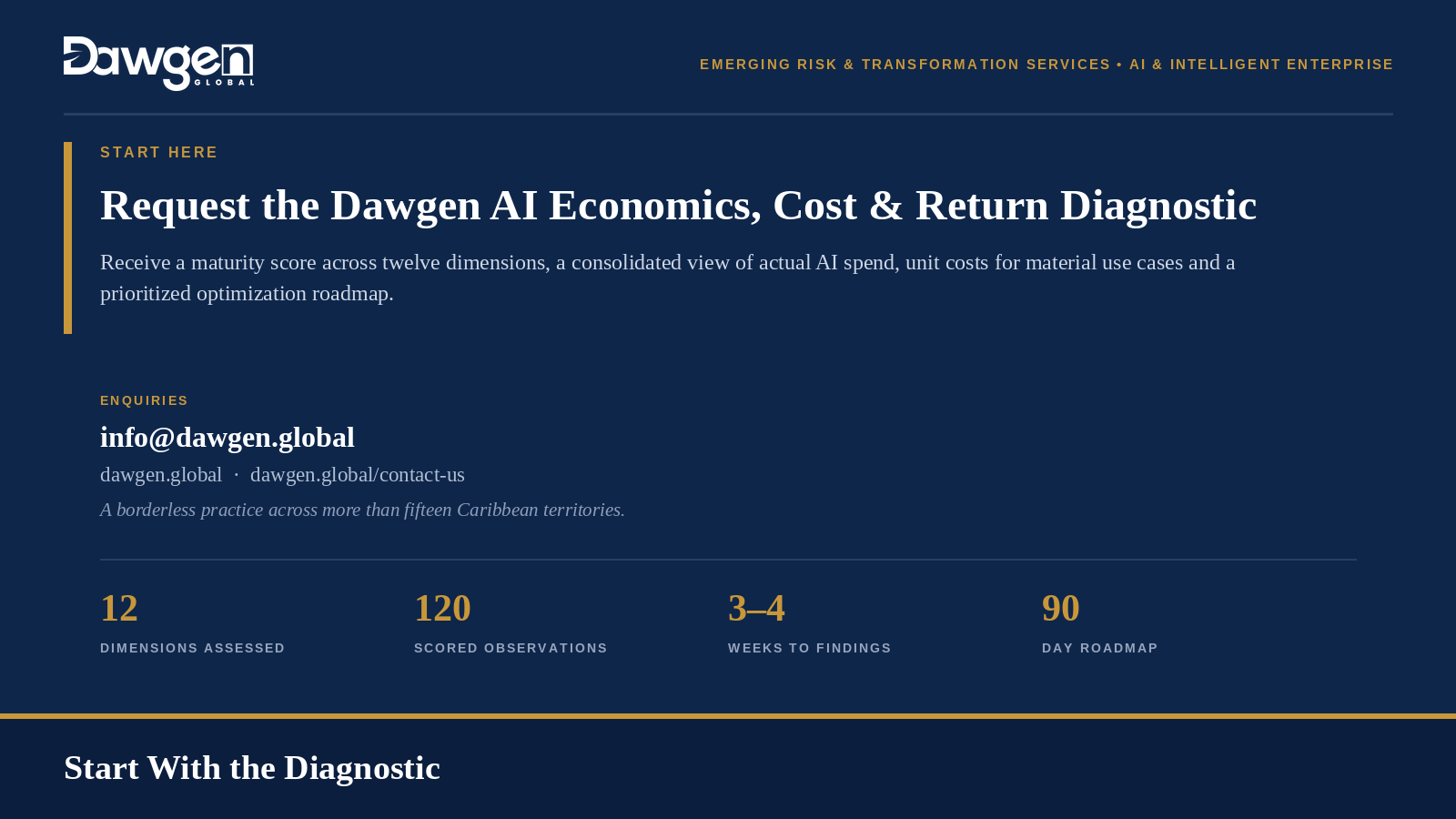
The Diagnostic assesses spend discovery, attribution and tagging, unit economics, business-case quality, benefit realization, model and workflow efficiency, agentic cost control, commercial terms and vendor dependency, foreign-exchange exposure, budgeting and approval governance, shadow AI, and management reporting — across 12 dimensions and 120 scored observations. The result is a maturity score, a consolidated view of actual AI spend, unit costs for material use cases, and a prioritized optimization roadmap.
Typical duration. 3–4 weeks. Delivery model. Remote, hybrid or on-site across the Caribbean. Fees. Fixed-scope and quoted in writing after a short scoping conversation.
Dawgen Global helps organizations make Smarter and More Effective Decisions.
Contact
Email [email protected]
Web dawgen.global
Enquiries dawgen.global/contact-us
Dawgen Global operates as a borderless practice across more than fifteen Caribbean territories. Enquiries arising from this publication are handled by email and routed to the relevant service line, wherever the client and the specialist happen to sit.
Sources
- 2026 Data Breach Investigations Report. 19 May 2026. Cited for workplace AI adoption (45% of employees regular users, up from 15%) and non-corporate account usage (67%).
Important Notices
Client acceptance. All requests for Dawgen Global services are subject to the firm’s client acceptance procedures, including an independence and conflict-of-interest check, before any engagement is accepted.
Independence and scope of service. Where Dawgen Global or an associated firm provides audit or other assurance services to an entity, the services described in this article are provided only to the extent permitted by applicable ethical and independence requirements, including the International Code of Ethics for Professional Accountants issued by the International Ethics Standards Board for Accountants (IESBA). Advisory, design and implementation services are not provided in a manner that would create a self-review threat to an assurance engagement.
Nature of the work. Unless an engagement letter expressly provides otherwise, the services described here are advisory in nature. They are not an audit, review or assurance engagement performed under International Standards on Auditing or International Standard on Assurance Engagements 3000 (Revised), and no assurance opinion or conclusion is expressed.
No pricing advice. Vendor rates, commercial terms and model availability change frequently and differ by contract. Nothing in this article states or implies the current pricing of any provider, and figures used for illustration are not quotations.
Third-party research. Statistics attributed to third parties are taken from the sources listed and have not been independently verified by Dawgen Global.
Illustrative material. Case studies are anonymized composite illustrations drawn from patterns commonly observed in the region and do not describe any specific Dawgen Global client.
General information only. This article is general in nature, does not take account of the circumstances of any particular organization, and should not be relied upon as professional advice.
Dawgen Global is an independent, integrated multidisciplinary professional services firm and is not a member of any international network.
© 2026 Dawgen Global. All rights reserved.
About Dawgen Global
Dawgen Global is an independent, integrated multidisciplinary professional services firm headquartered at 47 Trinidad Terrace, New Kingston, Jamaica, serving more than 15 territories across the Caribbean. Founded and led by Dr. Dawkins Brown, Executive Chairman, the firm is independent and not affiliated with any international network. It delivers a full suite of professional services under one roof: audit and assurance; tax advisory; IT and digital transformation; risk management; cybersecurity; actuarial and insurance regulatory advisory; HR advisory; mergers and acquisitions; corporate recovery; business advisory and strategy; accounting BPO and virtual CFO services; and legal process outsourcing.
The proposition is simple: big-firm capability without the big-firm price. Dawgen Global’s integrated approach is built for the specific complexities and opportunities of the Caribbean market, helping organizations make sharper, better-informed decisions that drive measurable progress.
To explore a partnership, reach out:
- Website: dawgen.global
- Email: [email protected]
- WhatsApp (Global): +1 555-795-9071
- Caribbean offices: +1 876-665-5926 | +1 876-929-3670 | +1 876-926-5210


