

A leverage covenant can be breached without borrowing a dollar. It breaches because earnings fell — and then it accelerates the obligation at the precise moment the company cannot meet it.
The Endurance Capital Series, Part Six · The Dawgen Endurance Capital Framework™
A company has a difficult year. Revenue holds but margin compresses, a major customer stretches payment, and earnings finish forty per cent below the prior year. This is not a catastrophe. It is a bad year of the sort most businesses have three or four times in a working lifetime, and the company trades through it with cash in the bank.
It is also, under a conventional covenant package, an event of default — and the reason has almost nothing to do with anything the company did.
Look at the leverage covenant. Net debt to earnings before interest, tax, depreciation and amortisation, capped at three times. The company has borrowed nothing new; it has in fact repaid principal for three years and its debt is lower than the day it drew down. But the denominator fell forty per cent, so the ratio went from 2.08 times to 3.47.
The covenant breached because earnings fell. It could not have been complied with by any action available to the company, because the only variable that moved was the one the covenant was measuring.
The debt service covenant fails at the same moment and for a related reason: it is tested on total debt service including principal, and the amortisation schedule does not fall when earnings do. Then the cross-default clause carries the failure into the overdraft and the trade lines. Within one reporting quarter, a company that is trading, solvent and paying its suppliers is in default across its entire funding structure.
The framework this belongs to
This article is about the covenant architecture of a specific instrument, and the instrument is worth setting out for readers meeting it here for the first time.
Across Jamaica and the wider Caribbean, enterprises are built from sweat equity and personal savings, and then grown on borrowed money that was never designed for the purpose to which it is put. A company borrows to build a warehouse, a plant or a piece of land that will produce economic value for thirty years or more. It repays that money in five to seven, because five to seven years is what a commercial bank funded by short deposits can prudently write. The repayment schedule bears no relationship to the life of the thing it financed, or to the maturity of the earnings that must service it. It reflects the maturity of the lender’s deposit book. And the security is most often the founder’s residential home, because that is the only titled property with clean unencumbered value the company can offer.
Endurance Capital™ is the alternative: long-dated capital, secured on a qualifying appreciating asset, serviced by interest alone through a defined growth phase, sized so that interest remains covered after a fifty per cent decline in earnings, and conditioned on a binding compact governing what leaves the business for the life of the instrument.
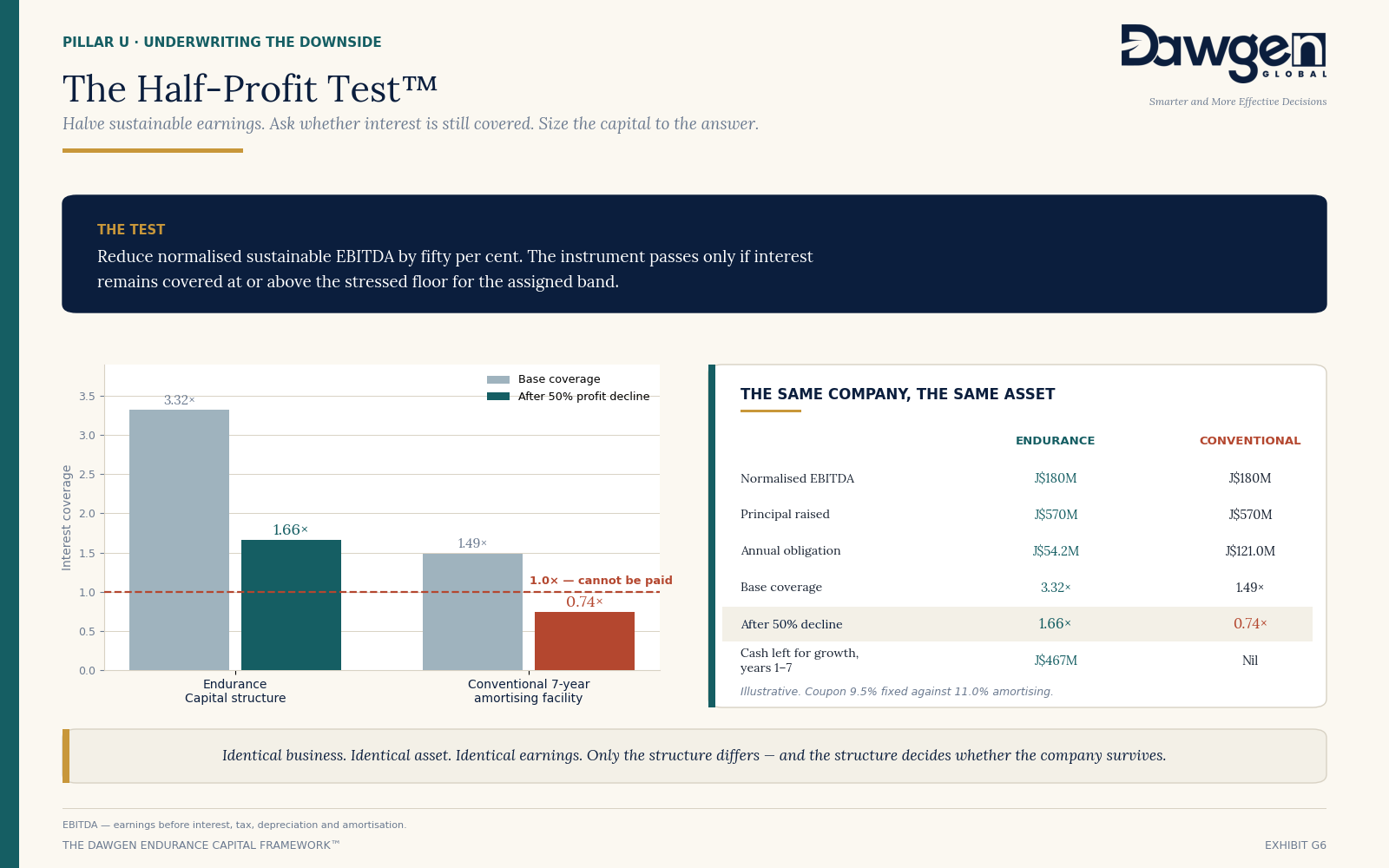
The arithmetic is worth seeing once. Take a composite distributor with normalised earnings before interest, tax, depreciation and amortisation (EBITDA) of J$180 million and a commercial property independently valued at J$1.2 billion, needing J$570 million to expand. Raised conventionally — seven years, amortising, at 11 per cent — annual debt service is about J$121 million, which is coverage of 1.49 times. Halve the earnings and coverage is 0.74 times: arithmetically impossible.
Raised as endurance capital — fifteen years against the same property, interest only for twelve — the annual obligation is J$54.2 million. Coverage today is 3.32 times, and after the same halving it is 1.66 times. The company pays its interest and keeps trading.
The framework is organised as six pillars, under the acronym ENDURE: the eligible asset base, normalised earnings capacity, duration architecture, underwriting the downside, the redemption runway, and an enforceable governance compact.
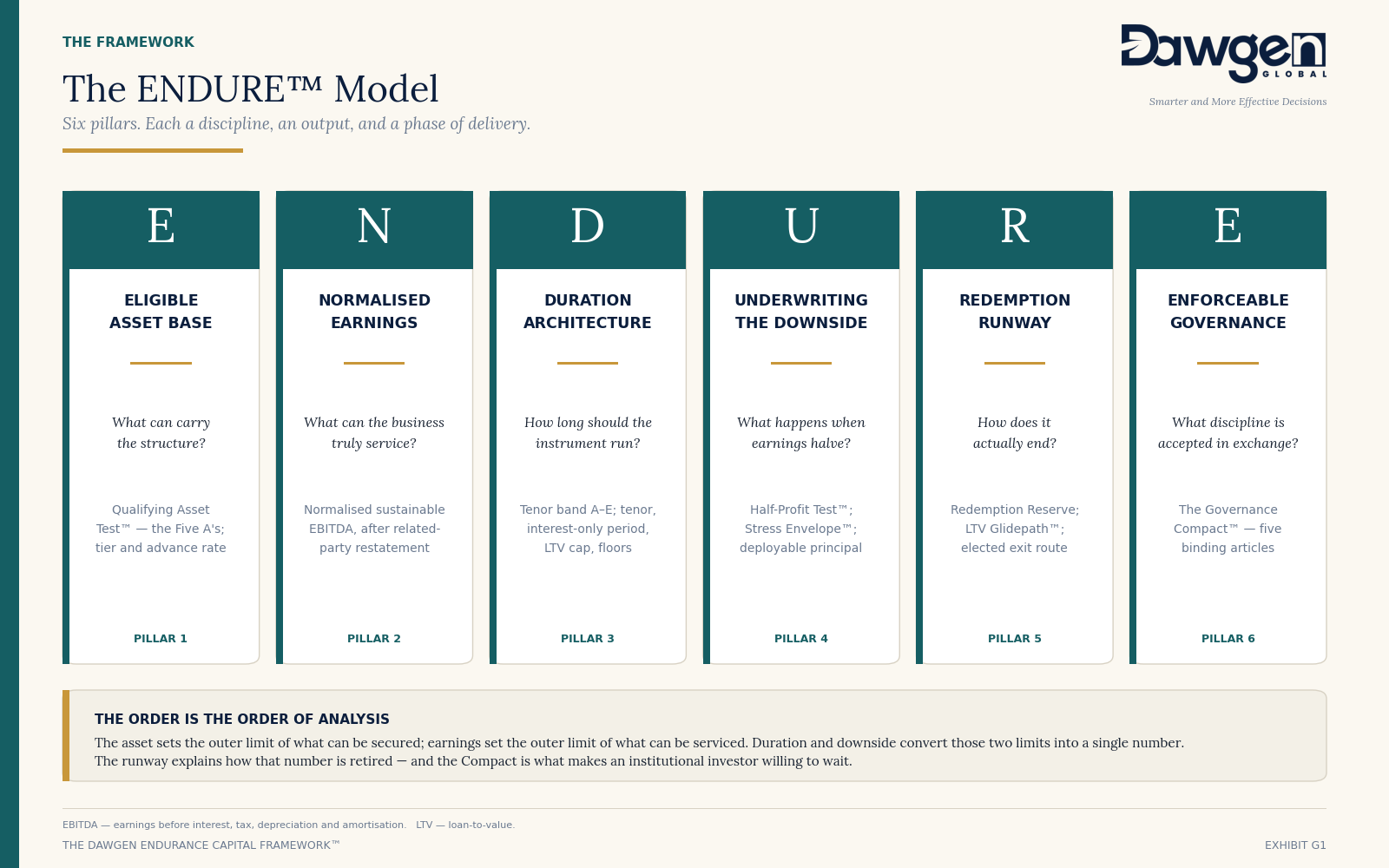
The covenant package sits in the sixth pillar, and it is where a great many otherwise sound long-dated instruments have failed. Getting the tenor right and then borrowing a bank’s covenant schedule reintroduces, through the back door, precisely the fragility the tenor was designed to remove.
Why a leverage covenant amplifies the cycle
The defect is structural rather than a matter of where the threshold is set, and it is worth being precise about the mechanism.
A ratio of debt to earnings has a numerator the company controls and a denominator it does not. In good conditions both move gently and the ratio behaves. In a downturn the denominator falls sharply while the numerator, on an amortising facility, falls only by the scheduled principal repayment. The ratio therefore deteriorates fastest exactly when the business is least able to respond — and the only remedies available are to repay debt, which requires cash the company does not have, or to raise earnings, which is what it is already trying to do.
A covenant that can only be cured by the thing that is going wrong is not a covenant. It is a trigger with a delay on it.
The same objection applies to a debt service coverage ratio tested on total service. Including principal in the denominator means the test is measuring the amortisation schedule as much as the business, and the amortisation schedule was set by reference to the lender’s funding profile rather than to anything about the borrower.
None of this is a criticism of banks. These covenants are appropriate to short, amortising, relationship-managed lending where the lender expects to sit down with the borrower, waive, reset and re-document — and where, if the position deteriorates, a shorter tenor limits the exposure. They are being asked to do a different job when they are pasted into a fifteen-year instrument held by an investor who has no relationship with the borrower, no appetite to renegotiate, and a trustee board to answer to.
What replaces them
The framework tests three things on an ongoing basis, and none of them is a leverage multiple.
Stressed interest coverage. Current earnings, halved, divided by interest. It is tested against a floor that varies by tenor band — 2.00 times for the earliest stage, falling to 1.25 for an institutional issuer. Because it measures interest rather than total service, it is a test of the business rather than of the repayment schedule, and because the stress is built into the measure rather than bolted on, the threshold does not need to be tightened to be prudent.
Loan-to-value. Principal against an independently assessed asset value not more than twenty-four months old, tested against the band cap. On an interest-only structure with an appreciating asset this ratio improves every year without the company doing anything, which means it is a covenant the borrower passes by continuing to exist — the opposite of a leverage multiple.
Reserve position. The Debt Service Reserve at six months of interest, and the Redemption Reserve on or ahead of its schedule. These are the tests that give early warning, because a company under pressure draws on reserves well before it misses a coverage threshold.
Together with the compliance and information requirements, these form the Four Gates™ — all four of which must be open before any discretionary distribution leaves the business.
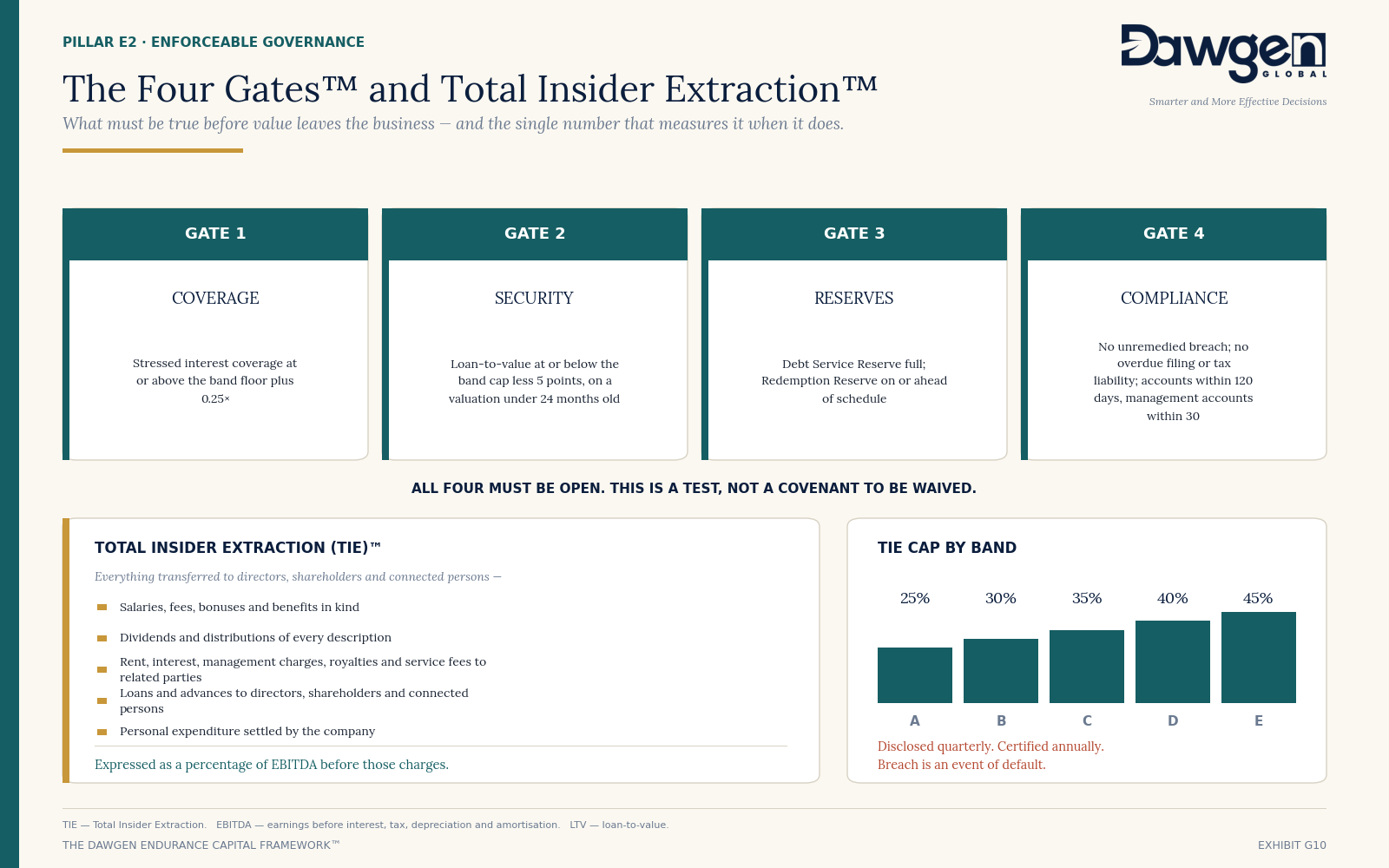
The same bad year, run through both

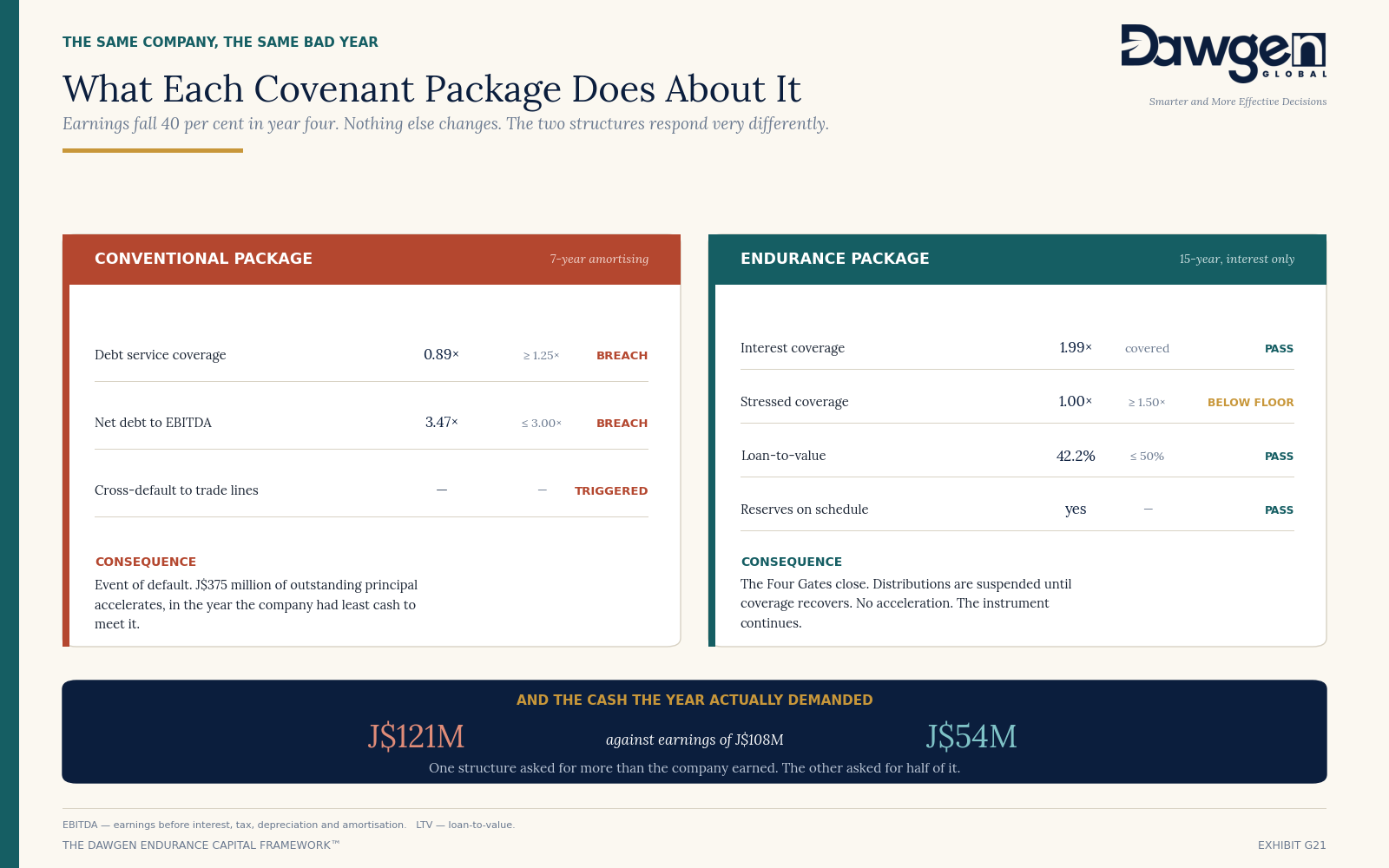
Take the composite company through the forty per cent decline in year four, with everything else held constant.
Under the conventional package, debt service coverage is 0.89 times against a covenant of 1.25, and leverage is 3.47 times against a cap of 3.00. Both breach. The cross-default provision carries the failure to the trade lines. Three hundred and seventy-five million dollars of outstanding principal accelerates, in the year the company had least capacity to meet it.
Under the endurance package, interest is covered 1.99 times — comfortably — and loan-to-value is 42.2 per cent against a cap of 50, because the asset has been appreciating while the principal stayed flat. But stressed coverage is 1.00 against a floor of 1.50, and that matters.
The endurance structure is not unscathed. Its gates close, and no dividend, bonus or discretionary payment leaves the business until coverage recovers. What does not happen is acceleration.
And the underlying cash position tells the same story more plainly than any ratio. In that year the company earned J$108 million. The conventional facility required J$121 million — more than the business produced. The endurance structure required J$54 million, leaving half the year’s earnings inside the company to trade through the difficulty that caused the problem in the first place.
Two classes of breach
This brings us to a distinction that the framework applies and that most covenant packages do not draw at all: the difference between something that happened to the business and something that was done by the people running it.
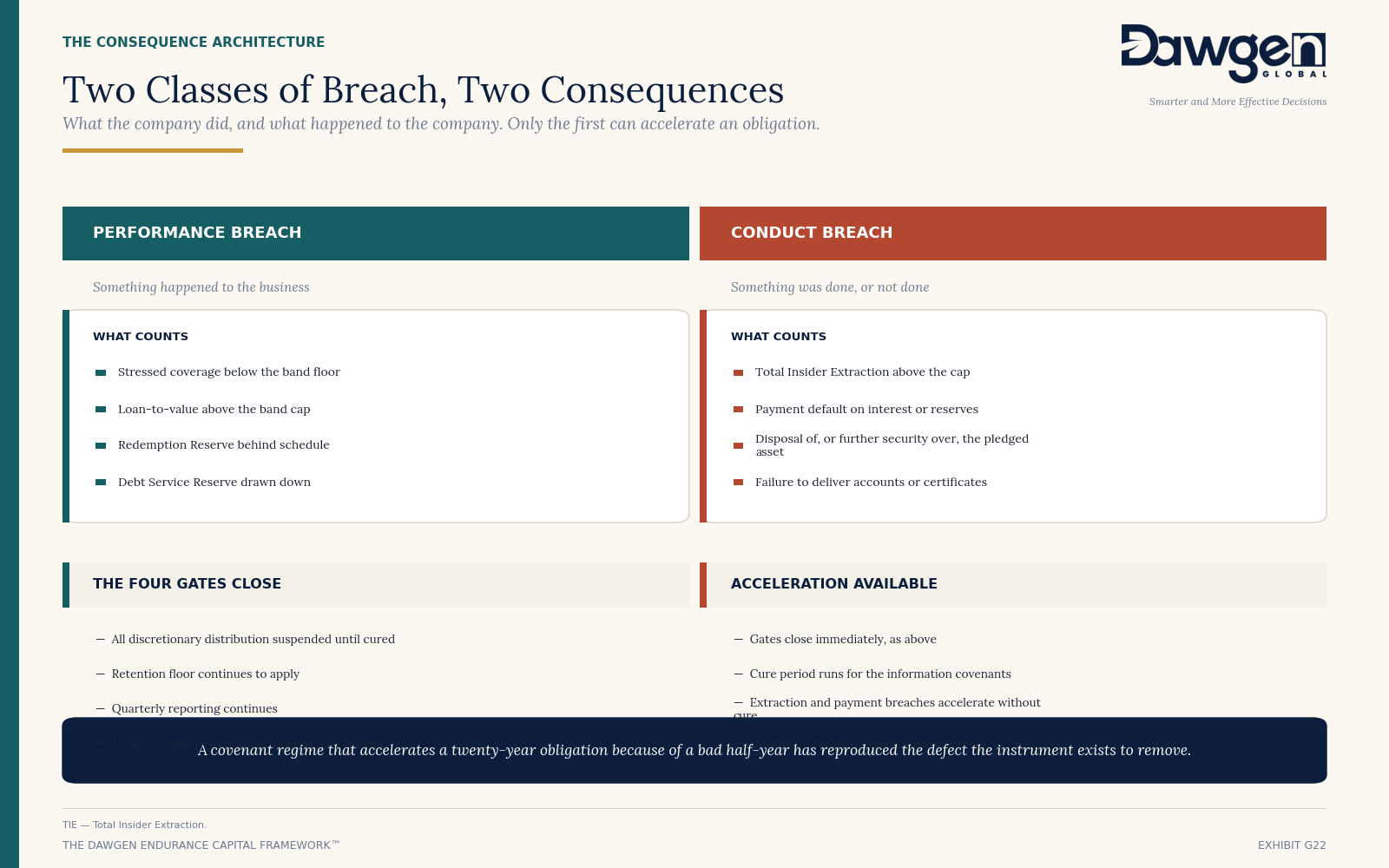
A performance breach is a fact about conditions. Stressed coverage below the floor, loan-to-value above the cap, a reserve behind schedule. The company did not choose these and in most cases cannot immediately reverse them. The consequence is that the Four Gates close and every discretionary distribution stops until the position is cured. That is a real and immediate constraint on the owners, and it is the correct one — the cash stays in the business, which is what a business under pressure needs. A performance breach does not accelerate. Not at one quarter, and not at eight.
A conduct breach is a fact about behaviour. Extraction above the cap, a payment default, disposal of or further security over the pledged asset, failure to deliver accounts or certificates. These are things the company chose to do or chose not to do, and they are within its control in every state of the world. Acceleration is available here, immediately for extraction and payment breaches, and after a defined cure period for the information covenants.
| The rule
A performance breach closes the Four Gates™ and suspends every discretionary distribution until it is cured. It does not accelerate the obligation — not at one quarter, and not at eight. Acceleration is available only on a conduct breach: extraction above the cap, payment default, insolvency events, disposal of or further security over the pledged asset, and failure to deliver the required accounts and certificates within their cure period. |
The practical consequence of the distinction is that a board can tell in advance which category any given deterioration falls into, and therefore what it is facing. Under a conventional package that clarity does not exist, because the covenants make no distinction and everything resolves into the same undifferentiated event of default.
Why an investor agrees to this
The reasonable objection at this point is that no lender would accept it. Give up acceleration on any breach caused by conditions, and you have handed the borrower a fifteen-year obligation with no enforcement behind it until he stops paying. Put that way it sounds like a concession no credit committee would make.
It is not a concession, and the reason is worth stating carefully, because it is the argument on which the whole covenant architecture rests.
Acceleration in a downturn was never a real remedy. A lender who accelerates against a company that has just lost forty per cent of its earnings is not going to be repaid. He is going to enforce against security in a soft market, at cost, over a period of years, and recover less than he would have recovered by waiting. Acceleration is a right that is most available precisely when it is least worth exercising — which is why, in practice, conventional lenders so often waive rather than accelerate, and charge a fee for doing so. The framework does not give up a remedy. It gives up a bargaining position, and takes something more useful in exchange.
What it takes instead operates immediately. Closing the gates stops every dividend, bonus, discretionary payment and connected-party distribution from the quarter the breach is recorded. That is cash retained inside the business, from the first bad quarter, without negotiation, waiver fee or a meeting. An accelerating lender has a claim. A lender under this package has the money staying where it can service him.
And the security position keeps improving while he waits. On an interest-only structure secured against an appreciating asset, every quarter the instrument remains outstanding is a quarter in which the loan-to-value ratio falls. A conventional lender waiting out a difficult period watches his exposure sit flat against a stressed asset value. An endurance holder waiting out the same period watches his cover improve.
The bargain is that the investor exchanges a remedy he could not profitably use for a discipline that operates from the first bad quarter, on an exposure that strengthens with time.
That is why the extraction cap sits on the conduct side of the line rather than the performance side. It is the one thing the investor cannot afford to have suspended pending recovery, because value leaving the business toward its owners in a downturn is the specific event that turns a recoverable position into an unrecoverable one. Everything else can wait. That cannot.
Curing, and what recovery looks like
A closed gate is not a permanent condition and the route out is defined rather than negotiated.
Coverage is cured by recovery in earnings, tested quarterly on a trailing basis so that a single strong quarter does not reopen the gates prematurely. Loan-to-value is cured by a fresh valuation, by partial prepayment, or by the passage of time on an appreciating asset. Reserves are cured by contribution, which is straightforward once distributions have stopped — the suspension itself generates the cash that rebuilds them.
That last point is the design working as intended. The consequence of the breach produces the cure. Under an amortising structure the consequence of the breach is a demand for cash, which makes the position worse.
The test of a covenant package is not whether it detects trouble. It is whether what it does upon detecting trouble makes the trouble better or worse.
What to look for in any long-dated term sheet
An owner or a finance director reviewing a proposed instrument of any tenor beyond five years can apply five tests without specialist assistance.
- Is coverage tested on interest, or on total debt service? If it includes principal, the covenant is measuring the amortisation schedule as much as the business.
- Is there a leverage multiple? If so, model it at a forty per cent earnings decline with no new borrowing. If it breaches, the covenant will breach in a bad year no matter how the company is run.
- Does the package distinguish between performance and conduct? If every breach produces the same consequence, the consequence will be calibrated to the worst case.
- What is the cure, and does it require cash the company will not have? A cure that demands liquidity in a liquidity event is not a cure.
- What cross-defaults, and to what? A fifteen-year obligation that can be triggered by a trade facility dispute is a fifteen-year obligation in name only.
None of these requires modelling software or a rating agency methodology. They require one spreadsheet, one bad-year assumption, and a willingness to read the schedule rather than the term sheet summary.
Where to start
- Take your existing facilities and model a forty per cent decline in earnings, holding debt constant. Note which covenants breach and what each breach entitles the lender to do.
- For each breach, ask whether any action available to you in that year would have prevented it. Where the answer is no, you are carrying a trigger rather than a covenant.
- Check the cross-default provisions in every facility, including the ones you think of as operational. The overdraft is usually the shortest fuse in the structure.
- Establish what the cure period is, and whether the cure requires cash. Most do.
The framework, and the hundred-point Endurance Readiness Score™ that accompanies it, set out the full method — the qualifying asset test, the normalisation of earnings, the tenor bands, the sizing rule and the redemption architecture. But this exercise can be done against your current financing this month, and it will tell you whether the structure you already have is one you could survive a bad year inside.
This is the sixth article in the Endurance Capital Series. The first, A Seven-Year Loan Against a Thirty-Year Asset, sets out the framework in full.
| Client acceptance and conflict of interest
Every request for Dawgen Global services is subject to the firm’s standard client acceptance and continuance procedures before any engagement is accepted. Those procedures include an independence assessment and a conflict-of-interest check across the firm and its member practices. Where a conflict is identified that cannot be managed by safeguards, the engagement is declined. |
The Dawgen Endurance Capital Framework™ is proprietary to Dawgen Global. All figures in this article are illustrative and constructed to demonstrate the methodology. They are not drawn from any client engagement and do not represent market pricing. The framework is reviewed and updated periodically; readers should ensure they are working from the current version. Covenant thresholds are framework parameters to be applied with professional judgement; nothing in this article constitutes legal or investment advice, and the terms of any particular instrument are a matter for its documentation.
About Dawgen Global
Dawgen Global is an independent, integrated multidisciplinary professional services firm headquartered at Dawgen Towers, 47-49 Trinidad Terrace, Kingston 5, Jamaica, serving more than 15 territories across the Caribbean. Founded and led by Dr. Dawkins Brown, Executive Chairman, the firm is independent and not affiliated with any international network. It delivers a full suite of professional services under one roof: audit and assurance; tax advisory; IT and digital transformation; risk management; cybersecurity; actuarial and insurance regulatory advisory; HR advisory; mergers and acquisitions; corporate recovery; business advisory and strategy; accounting BPO and virtual CFO services; and legal process outsourcing.
The proposition is simple: big-firm capability without the big-firm price. Dawgen Global’s integrated approach is built for the specific complexities and opportunities of the Caribbean market, helping organizations make sharper, better-informed decisions that drive measurable progress.
To explore a partnership, reach out:
- Website: dawgen.global
- Email: info@dawgen.global
- WhatsApp (Global): +1 555-795-9071
- Caribbean offices: +1 876-929-3670 | +1 876-926-5210


