| IN BRIEF
IFRS 17 was implemented as a reporting obligation. What it actually built, in most insurers, is a management information system that nobody has been asked to use. Three things the standard produces were not previously visible: how much unearned profit is stored in the existing book, which products are losing money at the moment they are written, and whether experience is running as assumed. This article works through one Caribbean life insurer to show what those three numbers look like and what they tell management — a contractual service margin of US$44.7 million, a credit life product recognising a US$0.9 million loss at inception, and lapse experience running US$1.2 million worse than assumed. The test of whether the investment paid for itself is simple, and uncomfortable. Has any pricing, product or reinsurance decision changed because of information the standard produced? |
The Question Worth Asking Now
Implementation is behind the region. Systems were built, models were rebuilt, transition balances were struck and auditors signed. The programme consumed budget, senior attention and a great deal of finance and actuarial capacity for several years.
The question that follows is not whether the numbers are correct. It is whether anyone is using them.
| If pricing, product design, reinsurance structure and capital allocation look exactly as they did before adoption, then a substantial investment produced a compliance output and nothing else. |
That is not a criticism of the finance teams who delivered it. Implementation was scoped as a reporting project because that is what the deadline demanded, and the people who built it were measured on producing an auditable number on time. The management value was always going to be a second phase, and in most organisations the second phase has not been commissioned.
Three outputs are worth examining, because each answers a question insurers previously could not answer at all.
How Much Profit Is Stored in the Book?
The contractual service margin (CSM) is the unearned profit an insurer holds on contracts already written. It is recognised in earnings as the service is delivered, which means the balance is, in effect, a measure of future profit already contracted for and not yet reported.
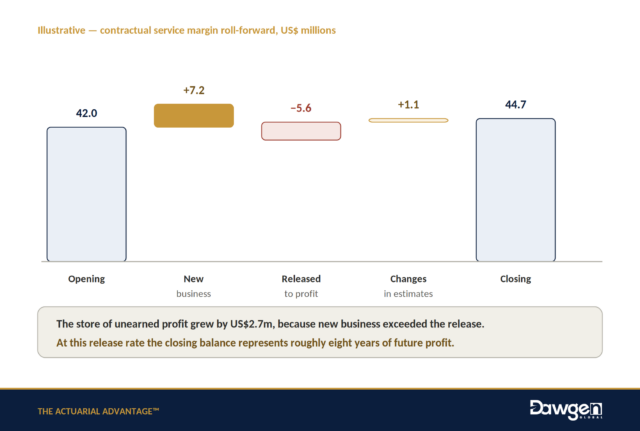
No previous standard produced that figure. Consider a Caribbean life insurer with a CSM balance of US$42 million at the start of the year.
The store of unearned profit grew by US$2.7m, because new business exceeded the release. Figures illustrative.
Read as a balance, US$44.7 million is an accounting figure. Read as a roll-forward, it is a management report. New business added US$7.2 million to the store while US$5.6 million was released into earnings, so the book is replenishing faster than it is being consumed. Changes in estimates added a further US$1.1 million.
Three questions follow directly, and none of them was answerable before. At the current release rate the closing balance represents roughly eight years of future profit — is that the runway management believed it had? New business must at least match the release for reported profit to be sustained; is the sales plan calibrated to that, or to premium volume? And when the release rate changes, is it because the book is maturing or because assumptions moved?
An insurer that reports the CSM balance to its board without the roll-forward has published the least informative version of the number it has.
Which Products Are Losing Money Today?
The second output is the more uncomfortable one. Under IFRS 17 a group of contracts expected to be unprofitable is onerous, and the expected loss is recognised immediately — at inception, not as it emerges.
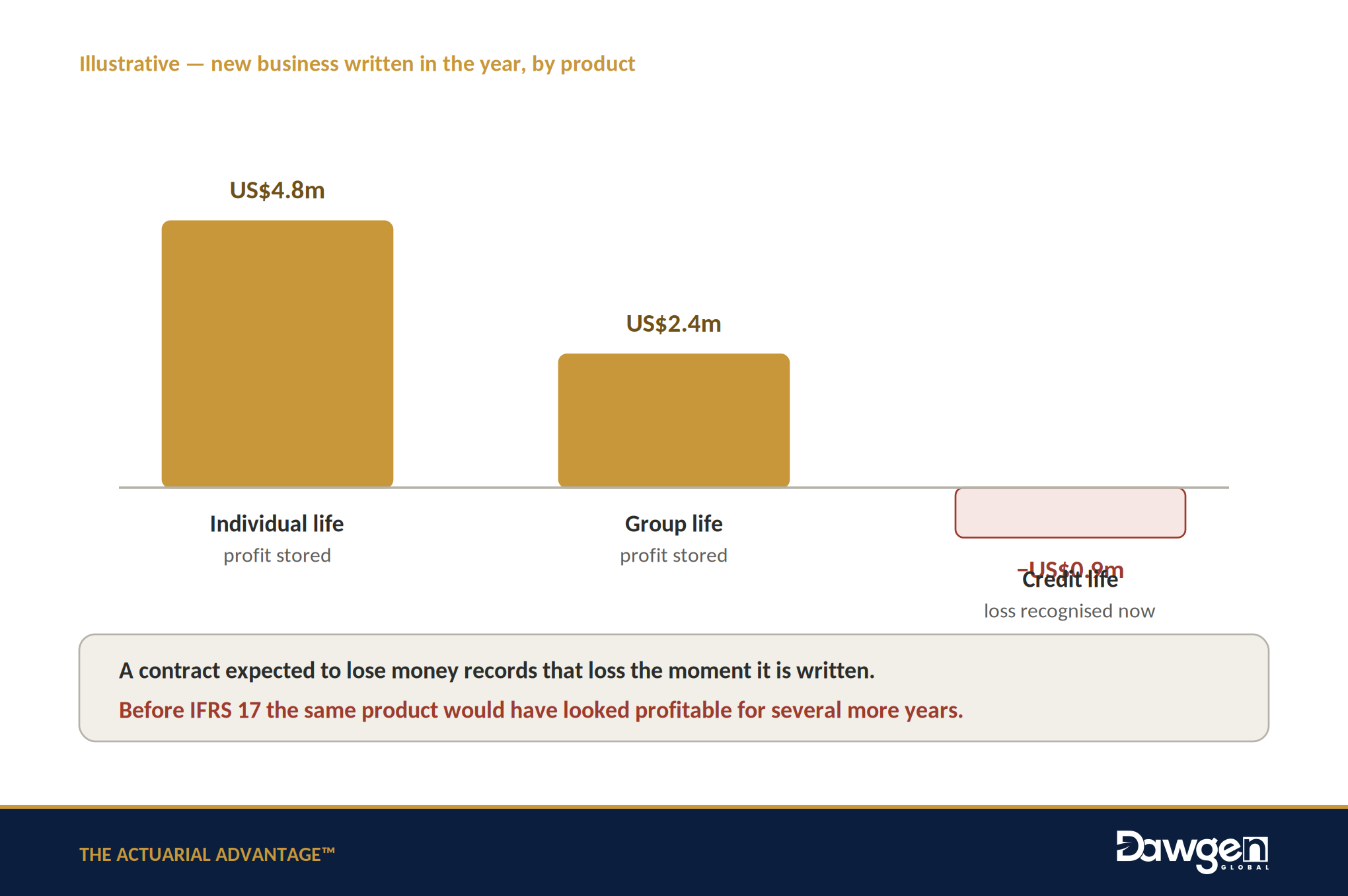
A contract expected to lose money records that loss the moment it is written. Figures illustrative.
In this insurer, individual life and group life both store profit as expected. Credit life does not: the group is onerous, and a US$0.9 million loss component goes straight to the income statement in the year the business is written.
Under the previous basis, that product would have looked acceptable for several more years, with losses emerging gradually as claims developed. The standard has converted a slow, invisible problem into an immediate, visible one — which is precisely what makes it useful.
The management response is where the value sits, and it is a sequence of questions rather than an accounting entry. Is the pricing wrong, or is the expense allocation loading costs onto this product that belong elsewhere? Is the assumption set too conservative? Is the distribution cost sustainable? Is the product being sold to support a banking relationship rather than on its own merits — and if so, is that trade being made deliberately?
| A loss recognised at inception is not bad news. It is the earliest warning the accounting has ever been able to give. |
Is Experience Running as Assumed?
The third output is the feedback loop. IFRS 17 requires assumptions to be reviewed at each reporting date, which means the insurer now holds, every period, a comparison between what it assumed would happen and what did.
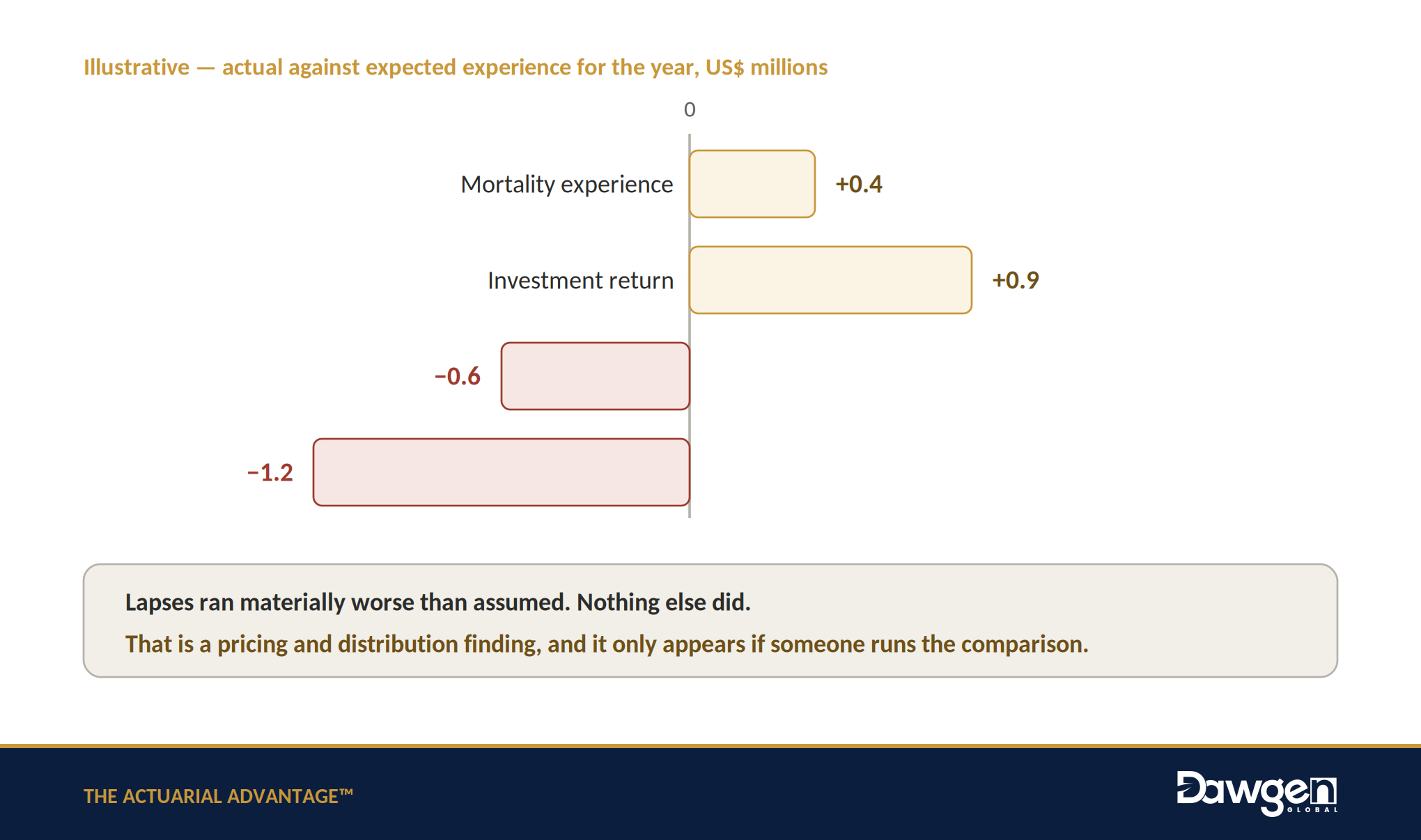
Lapses ran materially worse than assumed. Nothing else did. Figures illustrative.
Mortality and investment return came in slightly favourable. Expenses ran modestly over. Lapses ran US$1.2 million worse than assumed, and that single item drives the whole result.
The accounting consequence is an adjustment. The management consequence is a set of questions that belong to distribution and pricing, not to finance: which products and which channels are lapsing, at what policy duration, and does the commission structure encourage business that does not persist? Persistency assumptions feed directly into pricing, so an insurer that reprices without correcting them will simply write the same problem again at a different premium.
Actual-versus-expected analysis is not required by the standard in this form. It is what turns a compliance calculation into an early-warning system, and it is the single cheapest piece of additional work available to an insurer that has already built the model.
Why the Numbers Are Not Being Used
Where IFRS 17 output is not informing decisions, the cause is usually one of four things, and each has a different remedy.
| The obstacle | What it looks like | What it takes to fix |
| The close is too slow | Results arrive weeks after the period, by which time the decisions they might have informed have been taken | Process redesign, automation of manual steps, earlier data cut-offs — speed is a precondition for relevance |
| Nobody can explain the movement | The result is produced but management cannot say why it changed without going back into the model | Analysis of change built into the reporting pack rather than reconstructed on request |
| The output is not in decision terms | Board reporting presents the disclosure format rather than profitability by product and channel | Management reporting designed separately from statutory disclosure |
| Finance and actuarial still operate as two functions | Four handoffs and a reconciliation at each boundary | A single operating model with shared data, shared calendar and shared ownership of the result |
None of these is a technical accounting problem, which is why they persist after a technically successful implementation.
Underneath all four sits data. Grouping, cohort allocation, cash-flow attribution and expense allocation all depend on the underlying policy data, and weaknesses there propagate into every number the model produces. In most insurers the data problems identified during implementation were worked around under deadline pressure rather than resolved, and the workarounds are still in place.
Where Insurers Actually Are
It is useful to be honest about the distance between compliance and value, because the gap is wider than most boards assume.
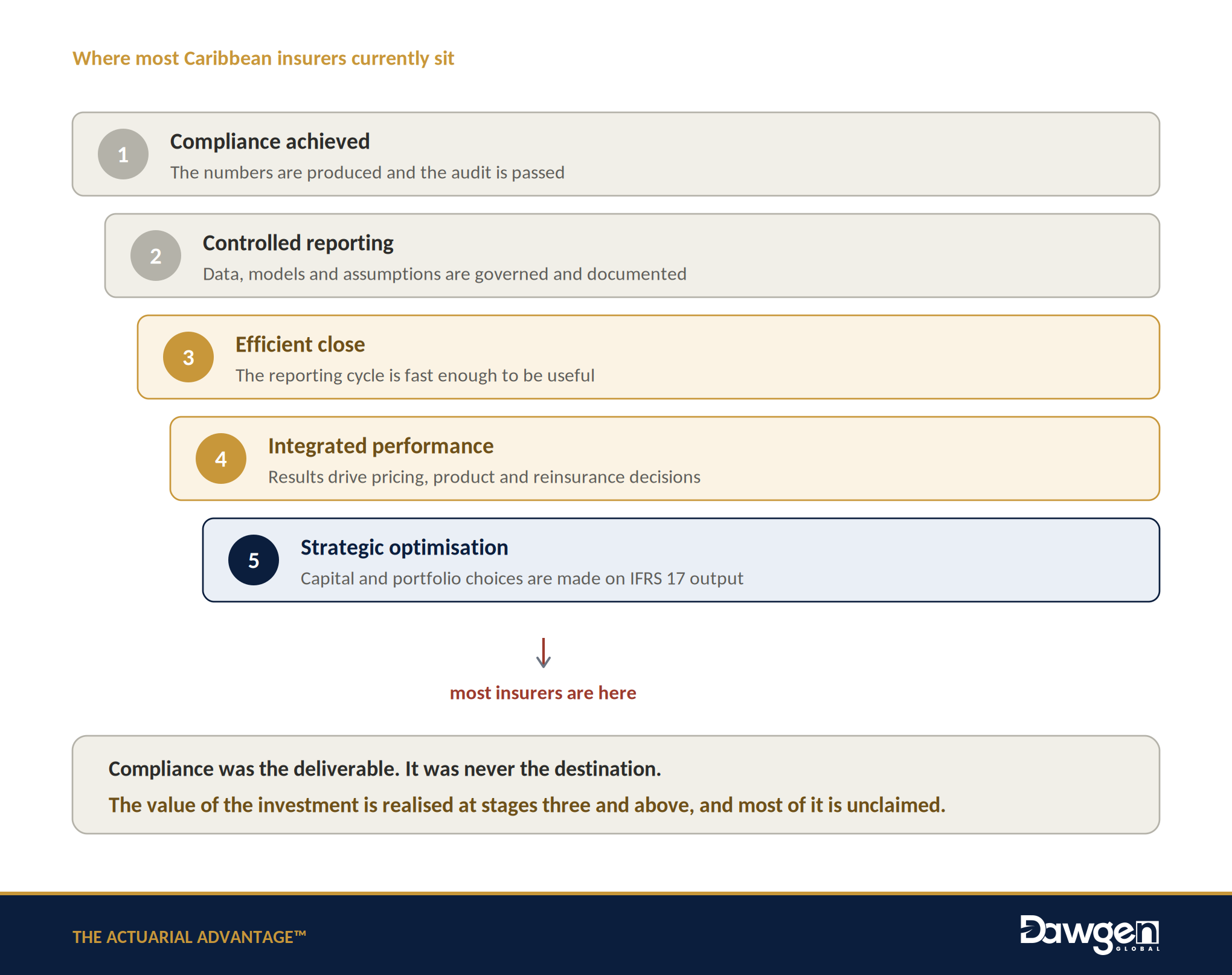
Compliance was the deliverable. It was never the destination.
Reaching stage two — governed data, documented models, controlled assumptions — is largely a matter of finishing work that was deferred. Stage three requires process investment. Stages four and five require something different: a decision that IFRS 17 output belongs in the pricing committee and the board pack, not only in the financial statements.
Each step is incremental and each has a defined cost. What does not work is treating the whole distance as a single programme, because that reproduces the conditions of the original implementation — a large project with a compliance framing and no owner once it closes.
Eight Questions for Boards and Audit Committees
- What is our CSM balance, how did it move this year, and how many years of future profit does it represent?
- Did new business add more to the CSM than we released, and is our sales plan calibrated to that?
- Which of our product groups are onerous, and what have we decided to do about each?
- Where did actual experience differ most from assumed, and who owns the response?
- How long after period end do we have results, and what decisions are we taking without them?
- Can management explain the movement in the insurance service result without recourse to the model?
- Which data workarounds from implementation are still in place?
- Name one decision — pricing, product, reinsurance or capital — that changed because of IFRS 17 output.
| THE LAST QUESTION IS THE TEST
If it cannot be answered, the standard is being complied with rather than used. That is a recoverable position, and the work required is materially smaller than the implementation that has already been paid for. |
Where This Work Leads
An effectiveness review rarely ends in accounting. An onerous product finding leads to pricing, distribution and product design. A data finding leads to systems, records and internal audit. A close-cycle finding leads to process, technology and resourcing. An assumption governance finding leads to model risk and independent validation. A reinsurance finding leads to treaty structure and retention strategy.
Dawgen Global’s Caribbean Integrated Borderless Delivery model exists so that the review and everything that follows sit within one engagement, across multiple Caribbean jurisdictions. Capability is held by the firm and delivered by a team rather than vested in an individual — which matters for work revisited at each reporting cycle.
One point on independence. Where we audit an insurer, the independence standards constrain what non-assurance work we may provide to it, and an effectiveness review of this kind will frequently be prohibited. We test that at acceptance before any proposal work, and where a prohibition applies we decline rather than restructure around it. For insurers audited by other firms, we can also act as independent reviewer or as the auditor’s actuarial expert.
The Point of All This
IFRS 17 was the largest reporting change the insurance industry has faced in a generation, and the region delivered it. That is a genuine achievement and it should be recognised as one.
| The standard did not merely change how insurance profit is reported. It changed what insurers can know about their own business — and most are not yet asking. |
An insurer now holds, as a by-product of compliance, the stored profit in its book, the products that are losing money as they are written, and a period-by-period comparison of assumption against experience. Those three things were not previously available in any form. They were bought and paid for during implementation.
The work to start using them is not another implementation. It is a review of what the existing model already produces, an honest assessment of what management does with it, and a decision about which of those numbers belongs in front of the people making pricing and capital decisions.
How Dawgen Global Can Help
IFRS 17 effectiveness review is core work for our Actuarial & Insurance Regulatory Advisory practice, delivered alongside colleagues in assurance, technology, data and risk:
- IFRS 17 post-implementation effectiveness review across data, models, assumptions, controls and reporting
- CSM analysis, roll-forward design and profit-emergence reporting
- Onerous contract testing, loss component analysis and product profitability review
- Actual-versus-expected frameworks and experience analysis
- Assumption governance, model documentation and independent model validation
- Finance–actuarial operating model design and close-cycle acceleration
- Management and board reporting design, distinct from statutory disclosure
- Reinsurance measurement review and net profitability analysis
- Data quality assessment, reconciliation and remediation
- Audit readiness support, and actuarial expert support to other professional firms
| REQUEST AN IFRS 17 EFFECTIVENESS REVIEW
A structured assessment of what your IFRS 17 model already produces and what management is doing with it: data, model and control gaps, close-cycle performance, and a prioritised set of actions with indicative cost. Fixed scope. Fixed fee. Typically three to five weeks. Email: [email protected] · Telephone: 876-929-3670 or 876-665-5926 · US toll free: 855-354-2447 Contact form: www.dawgen.global/contact-us/ |
| This article is published as part of The Actuarial Advantage™, a Dawgen Global editorial series on risk quantification, insurance and long-term financial decision-making in the Caribbean. It is general commentary and does not constitute actuarial, accounting, legal or audit advice. All figures are illustrative and are used to demonstrate method; they are not estimates of any insurer’s position and should not be relied upon as benchmarks. IFRS 17 measurement depends on the model, grouping and assumptions applied and will differ between entities. |
About Dawgen Global
Dawgen Global is an independent, integrated multidisciplinary professional services firm headquartered at 47 Trinidad Terrace, New Kingston, Jamaica, serving more than 15 territories across the Caribbean. Founded and led by Dr. Dawkins Brown, Executive Chairman, the firm is independent and not affiliated with any international network. It delivers a full suite of professional services under one roof: audit and assurance; tax advisory; IT and digital transformation; risk management; cybersecurity; actuarial and insurance regulatory advisory; HR advisory; mergers and acquisitions; corporate recovery; business advisory and strategy; accounting BPO and virtual CFO services; and legal process outsourcing.
The proposition is simple: big-firm capability without the big-firm price. Dawgen Global’s integrated approach is built for the specific complexities and opportunities of the Caribbean market, helping organizations make sharper, better-informed decisions that drive measurable progress.
To explore a partnership, reach out:
- Website: dawgen.global
- Email: [email protected]
- WhatsApp (Global): +1 555-795-9071
- Caribbean offices: +1 876-665-5926 | +1 876-929-3670 | +1 876-926-5210


