| IN BRIEF
A strategic plan is a set of assumptions with a financial statement attached. The assumptions are usually reasonable. The problem is that they are recorded as inputs rather than as uncertainties, and once a number enters the model nobody revisits who chose it or what it would take to be wrong. This article works through a single plan — a three-year growth programme funded partly by debt — and asks the question boards rarely put: not what we expect to happen, but what would have to be true for this to fail. The answer is usually uncomfortable in a specific way. Each assumption individually can move a long distance before the plan is in trouble. The plan breaks on modest movement in two at once, which is how plans actually fail. It ends with the artefact that fixes this: a Strategic Assumption Register, in which every material assumption carries a tested range, a named owner, a threshold and an action agreed before it is needed. |
What Would Have to Be True for This Plan to Fail?
Consider a Caribbean distribution and light manufacturing group with revenue of US$42 million. The board has approved a three-year plan to reach US$58 million, supported by a US$9 million capital programme, of which US$5 million is debt funded. Gross margin is assumed to hold at 34 per cent. Fixed overhead is budgeted at US$12.5 million. Annual debt service after the programme is US$1.6 million, and the facility carries a covenant requiring earnings before interest, tax, depreciation and amortisation of at least 1.25 times that figure.
On plan, year three produces US$19.7 million of gross profit, US$7.2 million of EBITDA and coverage of 4.5 times. That is a comfortable plan, and the board approved it on that basis.
A conventional sensitivity analysis now flexes one variable at a time and reports that the plan is robust. It is robust, one variable at a time. Reverse stress testing asks a different question: rather than starting from the assumptions and calculating the outcome, it starts from failure and calculates backwards to the conditions that produce it.
Coverage of 1.25 times requires EBITDA of US$2.0 million, which requires gross profit of US$14.5 million. At the planned 34 per cent margin that implies revenue of US$42.6 million — in other words, the plan tolerates three years of no growth whatsoever. At a 31 per cent margin it implies revenue of US$46.8 million, or growth of about 3.7 per cent a year instead of 11.4. At 29 per cent it implies US$50.0 million, or growth of about 6 per cent.
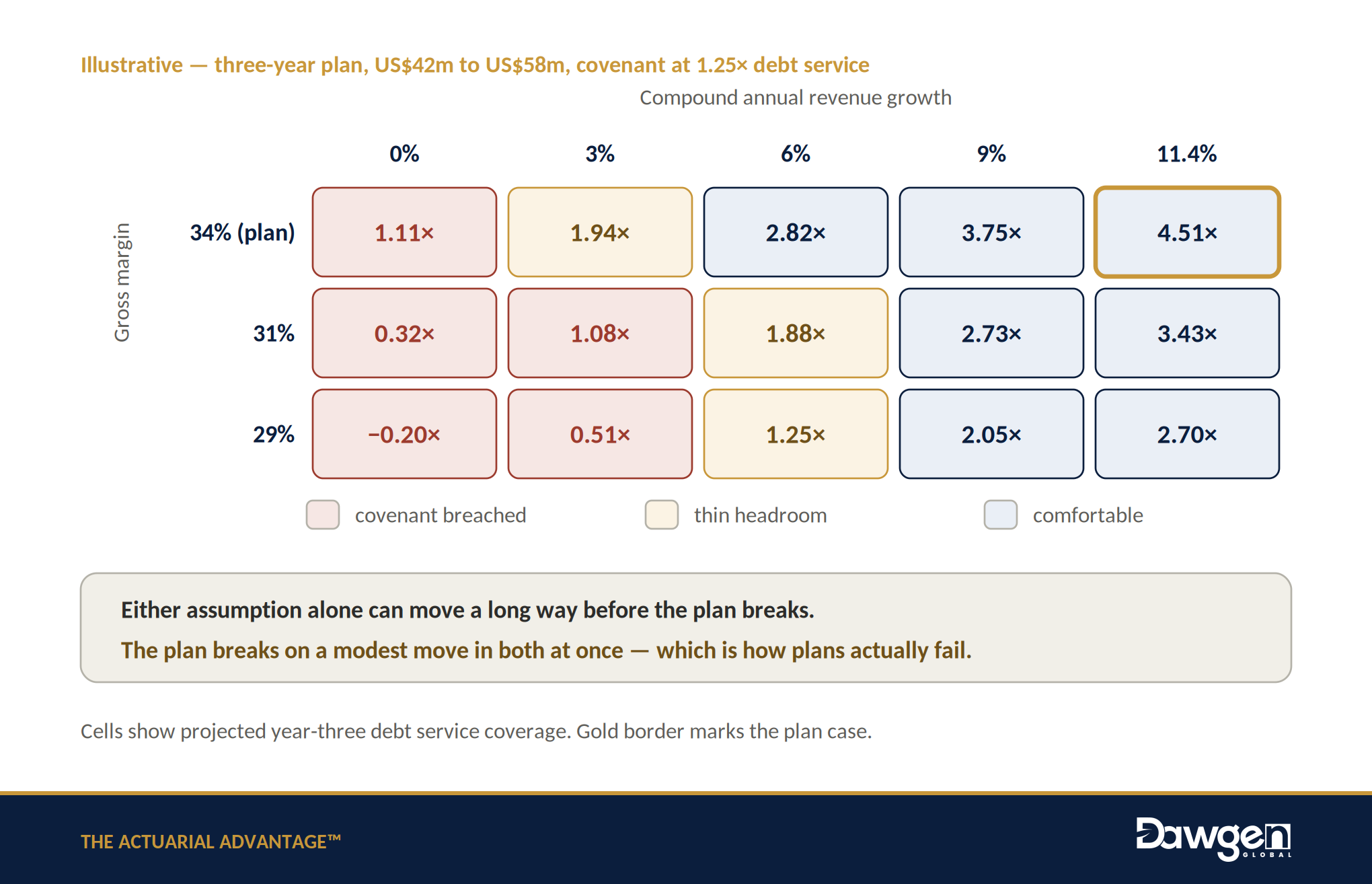
Either assumption alone can move a long way. The plan breaks on a modest move in both. Figures illustrative.
| Nothing in this plan fails. Two things in it are simply less good than assumed, at the same time. |
That is the finding worth taking to a board. Growth at six per cent instead of eleven is a disappointing year, not a crisis. A margin of 31 per cent instead of 34 is a competitive squeeze, not a catastrophe. Either would be discussed at a board meeting and absorbed. Together they breach the covenant, and the covenant breach is what actually damages the organisation — through repricing, restricted facilities, and the loss of discretion over the capital programme at precisely the moment discretion is most valuable.
Which Assumptions Actually Carry the Plan?
A plan of this kind rests on perhaps thirty assumptions. Two or three carry most of the outcome, and they are not always the ones that received most attention during planning.
Ranking them is straightforward. Define a single adverse but plausible movement for each, hold everything else at plan, and measure the effect on the same output — here, year-three EBITDA.
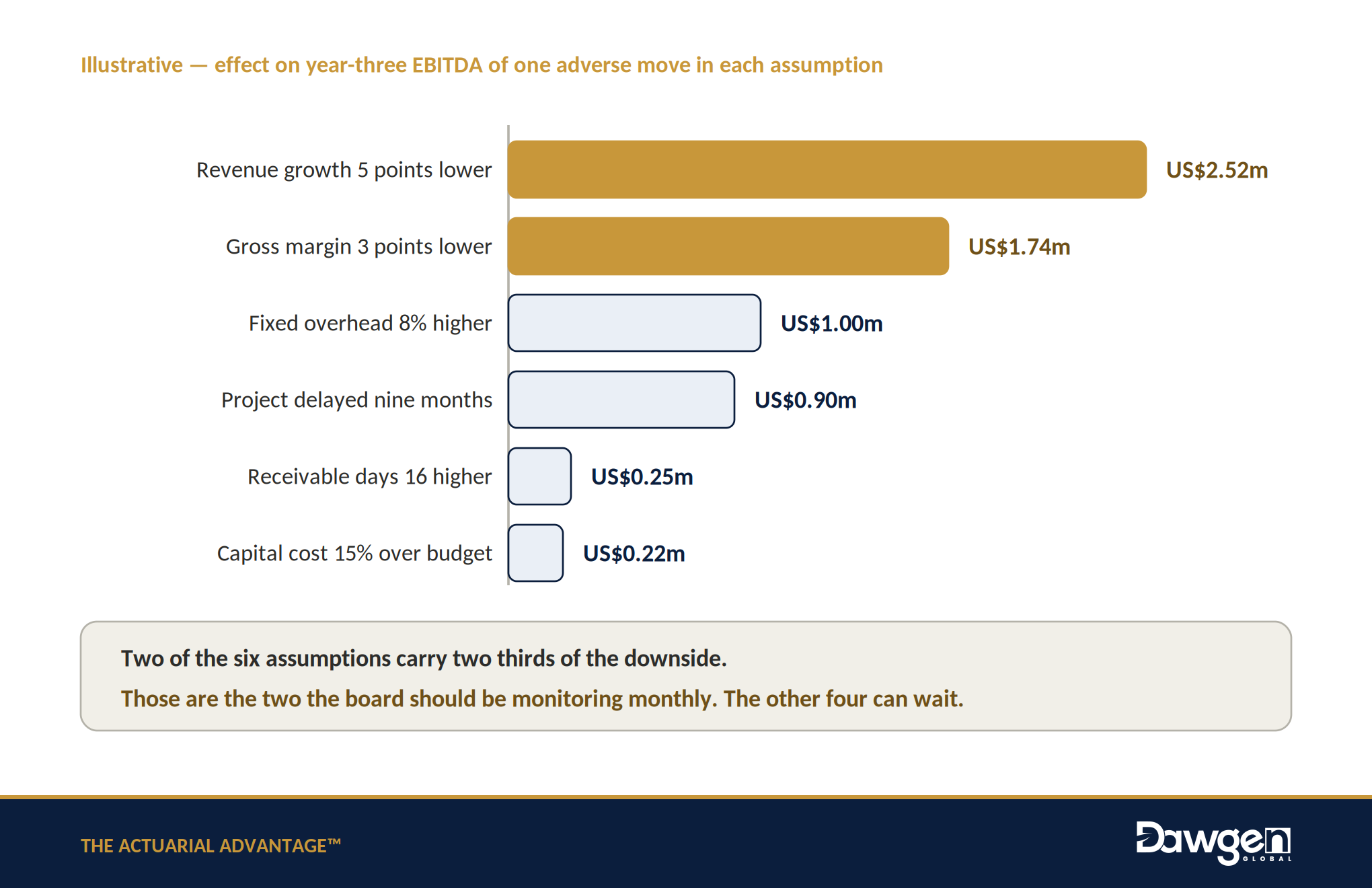
Two of six assumptions carry two thirds of the downside. Figures illustrative.
Revenue growth and gross margin between them account for roughly two thirds of the downside. Receivable days and capital cost overruns — both of which typically consume a great deal of management attention — account for under eight per cent.
This has a direct governance consequence. If the board monitors twelve indicators with equal weight, it is spending most of its attention on variables that cannot materially change the outcome, and is likely to notice the two that can only when they appear in the annual result. A ranked sensitivity turns board reporting from a comprehensive dashboard into a short list of things that actually matter.
Facts, Estimates and Hopes
Before a plan can be tested, its contents have to be sorted. Every material line falls into one of three categories, and the discipline of labelling them is more valuable than the modelling that follows.
| Category | What it means | Examples from this plan | How it should be treated |
| Fact | Contracted, known and verifiable. It could still change, but not without a counterparty and a document. | Debt service of US$1.6m; lease commitments; the signed order book; committed capital contracts | Recorded once, monitored for change, not modelled as uncertain |
| Estimate | Supported by evidence and capable of a defensible range. | Gross margin at 34 per cent; receivable days at 52; overhead at US$12.5m; the capital programme at US$9m | Given a tested range, an owner, and a threshold that triggers action |
| Hope | Asserted without data. Frequently reasonable, and frequently the reason plans fail. | Competitors will not respond to our pricing; the operations director will still be here; the system will go live in month nine; the top four customers will renew | Named as a hope in the plan document, so that a reader can see what the plan is resting on |
Hopes are not prohibited. They are simply not permitted to look like estimates.
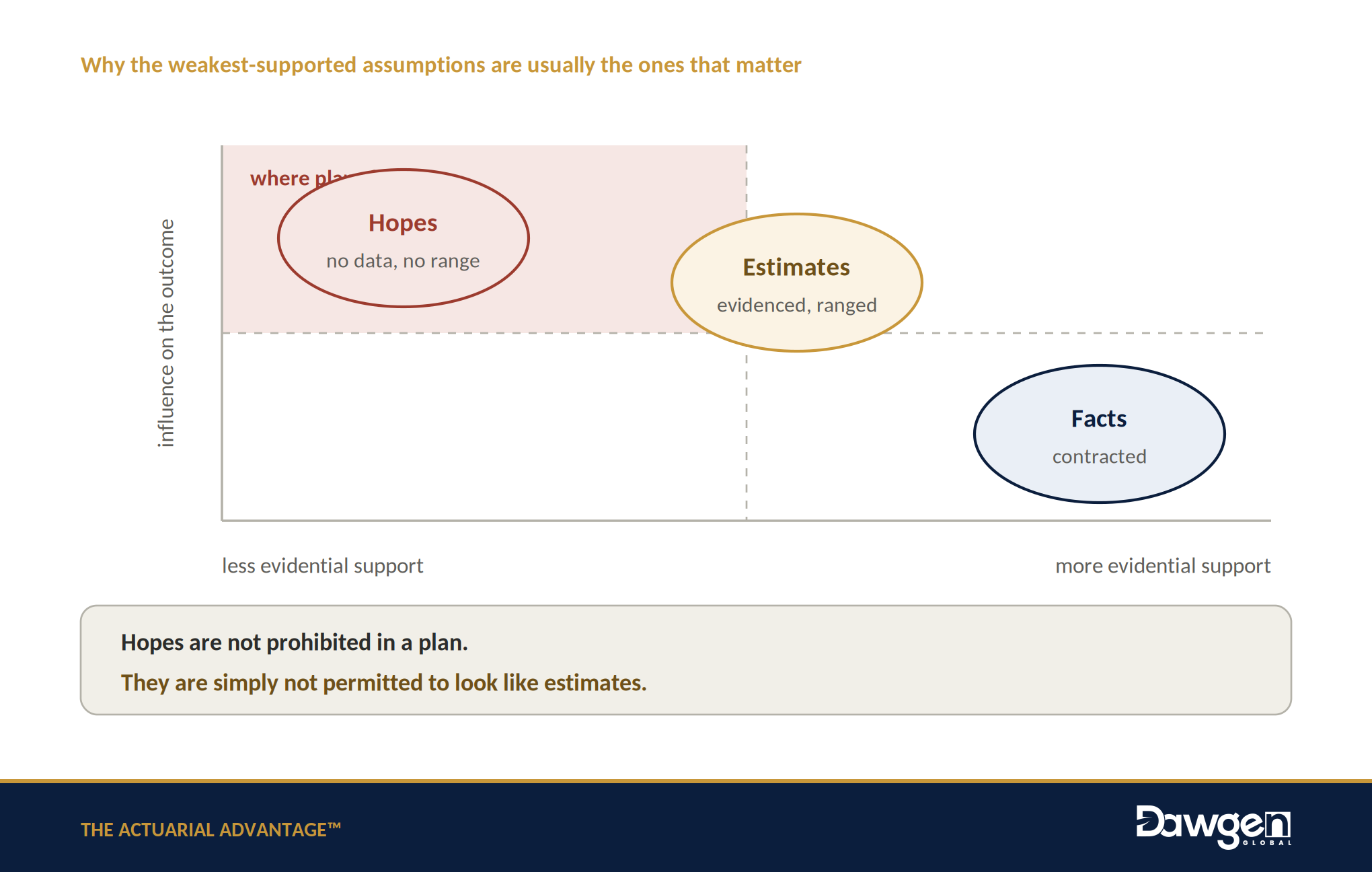
Most strategic plans contain more hopes than their authors would admit, and the hopes are usually the assumptions carrying the highest sensitivity — because the things that cannot be evidenced tend to be the things that matter and are hardest to control. A plan that labels them honestly is not a weaker plan. It is a plan whose reader knows where to look.
The Strategic Assumption Register
The output of this work is not a report. It is a register that outlives the planning cycle and is maintained alongside the plan itself.
| Assumption | Type | Range tested | Owner | Trigger |
| Revenue growth of 11.4% a year | Estimate | 3% to 13% | Chief Commercial Officer | Below 6% annualised for two consecutive quarters |
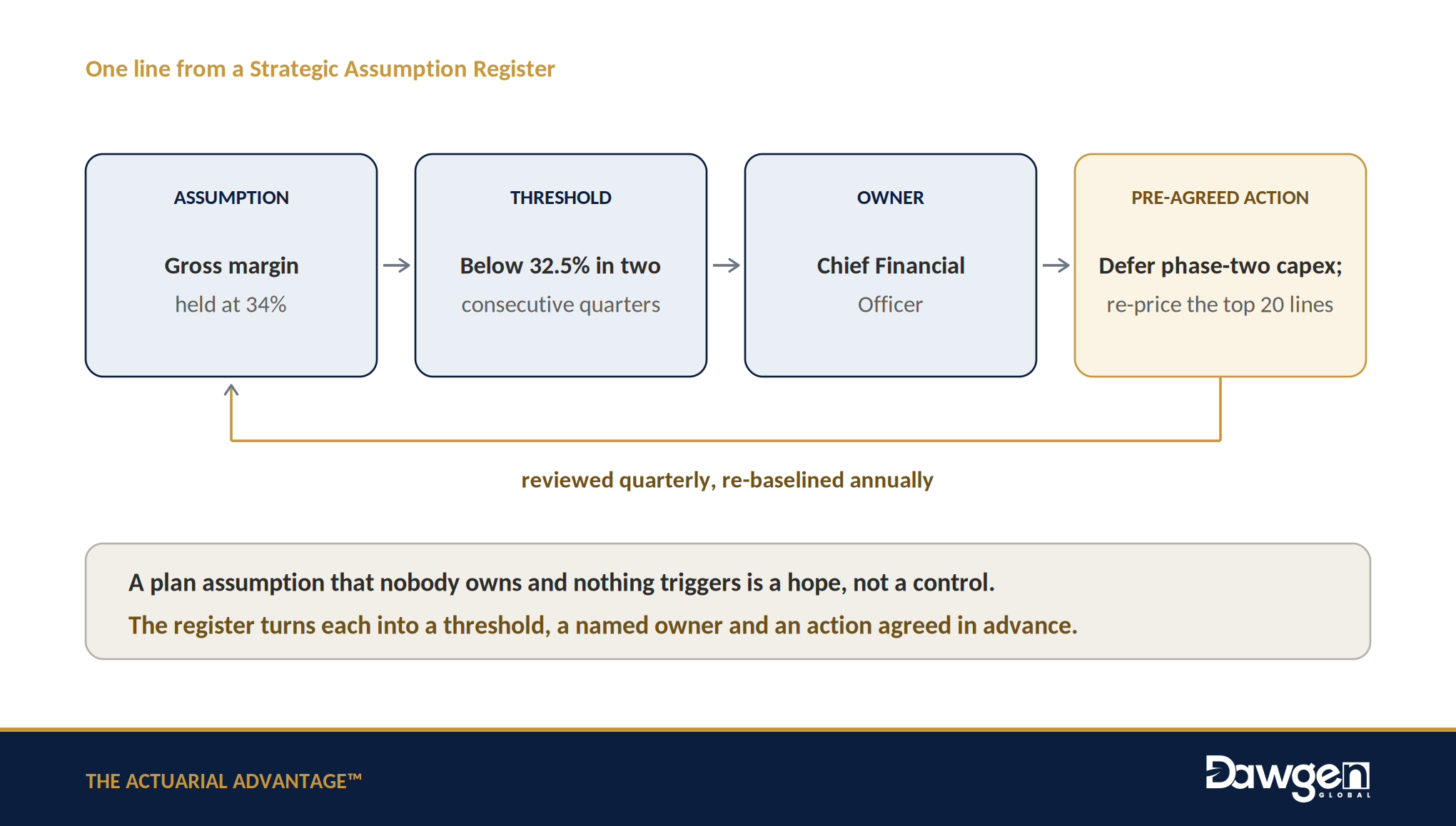
| Gross margin held at 34% | Estimate | 29% to 35% | Chief Financial Officer | Below 32.5% for two consecutive quarters |
| Fixed overhead of US$12.5m | Partly controllable | ± 8% | Chief Financial Officer | Run rate above US$13.0m |
| Capital programme of US$9m | Estimate | up to 15% over | Project sponsor | Committed cost above US$9.8m |
| Receivable days at 52 | Estimate | 52 to 70 | Financial Controller | Above 60 days for one quarter |
| Annual debt service of US$1.6m | Fact — contracted | fixed to reset date | Treasurer | Rate reset above 10% |
| Top four customers renew (38% of revenue) | Hope | loss of one modelled | Chief Commercial Officer | Any top-four account under tender or review |
Illustrative. A register of this kind typically runs to twelve or fifteen lines, not thirty.
Three things about this table matter more than its contents. Every assumption has one named owner, not a committee. Every estimate has a range that somebody had to defend rather than a single figure that arrived without provenance. And every line has a threshold defined before the plan started, at a moment when nobody had yet invested reputation in the outcome.
From Assumption to Trigger
A threshold is only useful if something happens when it is crossed. The mechanism has to be agreed in advance, because the point at which an assumption fails is exactly the point at which the organisation is least willing to act on it.
A plan assumption that nobody owns and nothing triggers is a hope, not a control.
The reason for pre-agreeing the response is behavioural rather than analytical. When margin slips below 32.5 per cent in the second consecutive quarter, there will be an explanation — a competitor promotion, a freight spike, an unusual product mix — and the explanation will be plausible. Deferring the capital programme at that moment will feel like an overreaction to a temporary condition. It will feel the same way in the third quarter, and in the fourth.
A trigger agreed twelve months earlier, by the same people, in calmer conditions, does not remove the judgement. It changes the default. Instead of requiring someone to argue for action, it requires someone to argue for inaction — and to do so on the record.
What Changes at Board Level
The purpose of all this is not a better forecast. Forecasts do not become accurate through effort. What changes is the quality of four specific board decisions.
- The board approves a plan knowing the combination of conditions under which it fails, and how far current performance sits from that combination. It is approving a risk position, not a target.
- Capital structure. The covenant analysis converts an abstract financing decision into a specific question: how much headroom is this capital structure buying, and is that headroom worth its cost in a market where refinancing is not always available on demand?
- Board reporting narrows to the assumptions that carry the outcome, with thresholds attached, instead of a dashboard weighted equally across everything measurable.
- When conditions deteriorate, the discussion is about executing a decision already taken rather than reaching one under pressure and with incomplete information.
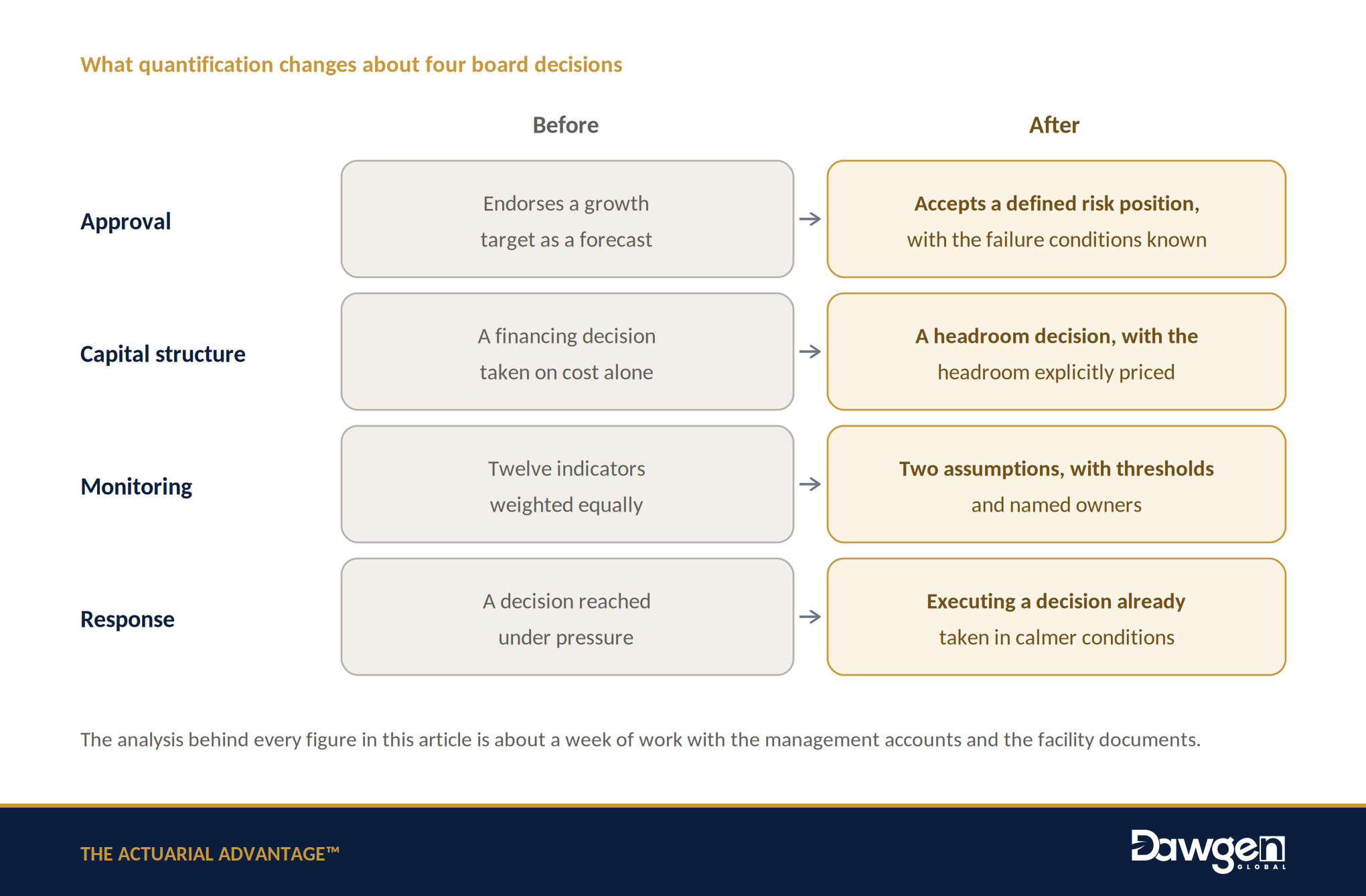
None of that requires a large modelling exercise. The analysis behind every figure in this article would take a competent analyst a week with the organisation’s own management accounts and facility documents.
Seven Questions Before Approving the Next Plan
- What would have to be true for this plan to fail, and how far is current performance from that point?
- Which two assumptions carry most of the downside, and who owns each of them by name?
- Which lines in this plan are facts, which are estimates, and which are hopes?
- What range was tested around each estimate, and who set the range?
- In which quarter, under the adverse combination, does a covenant or liquidity constraint bind?
- What have we agreed in advance to do when a threshold is crossed?
- Who is responsible for telling this board that an assumption has stopped holding, and how quickly?
| IF THE ANSWERS ARE NOT READILY AVAILABLE
That is the ordinary position rather than a failure of governance. None of these figures is produced by conventional planning or financial reporting, and none is difficult to establish from information the organisation already holds. It becomes a failure of governance only once the questions have been asked and left unanswered. |
Why the Delivery Model Matters
The findings in an exercise of this kind rarely stay within one discipline. A covenant analysis leads to treasury and financing. A margin threshold leads to pricing, procurement and product mix. A capital overrun trigger leads to project controls and contract terms. A customer concentration hope leads to commercial strategy and credit policy.
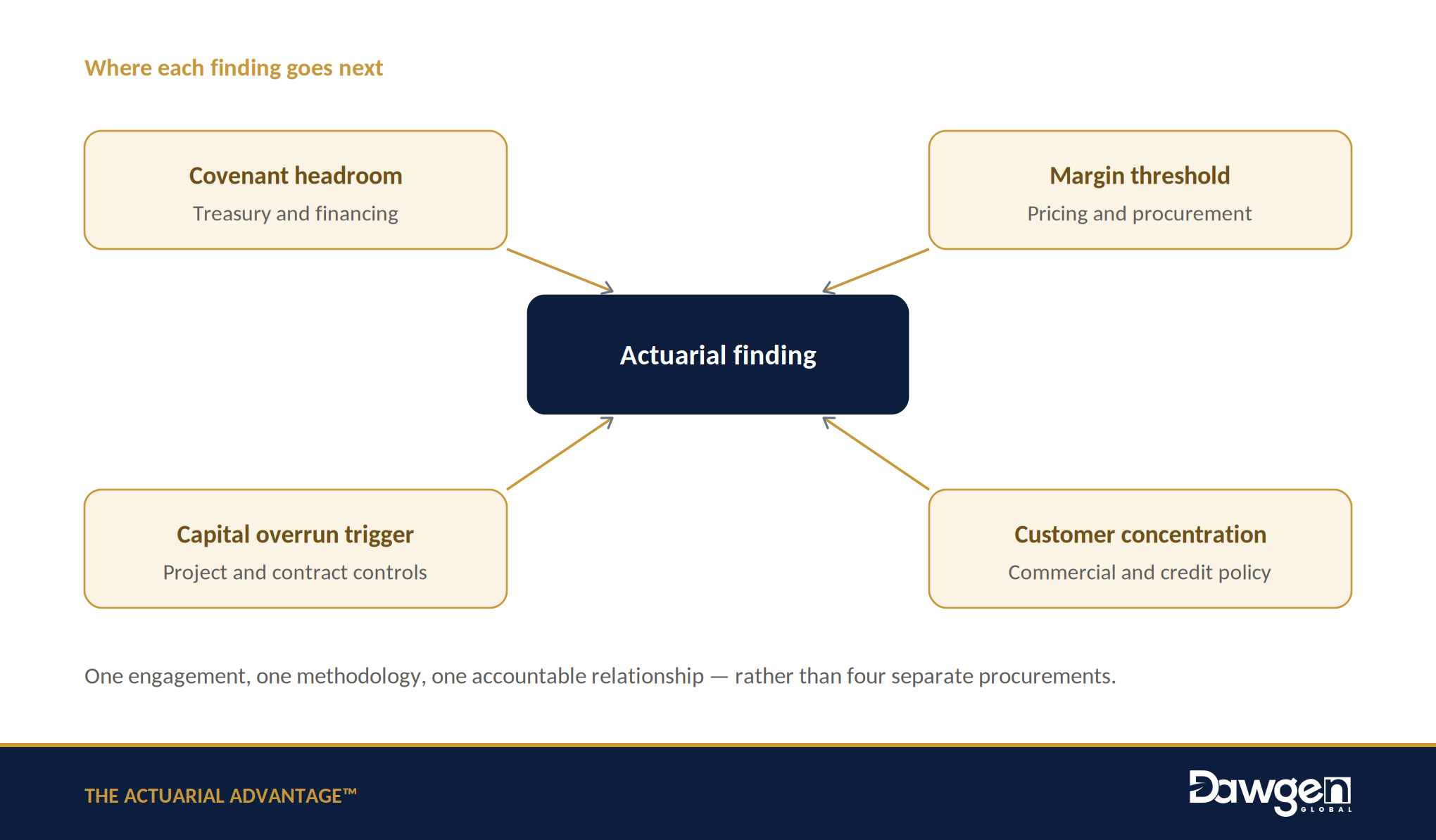
Dawgen Global’s Caribbean Integrated Borderless Delivery model exists so that the analysis and the response sit within one engagement. Actuarial professionals work alongside colleagues in accounting and financial reporting, audit and assurance, enterprise risk, internal audit, technology and data, tax, human resources, corporate finance and transactions — under one methodology and one accountable relationship, across multiple Caribbean jurisdictions.
Capability is held by the firm and delivered by a team rather than vested in an individual. For a register that is maintained across planning cycles and revisited annually, continuity of method matters more to a client than any single practitioner’s availability.
The Point of All This
Strategic plans are not usually wrong because their authors were careless. They are wrong because a plan is a single path drawn through a space of possible outcomes, and drawing it well does not make the rest of the space disappear.
| The risks in a plan do not become smaller by remaining unquantified. They become invisible, which is different. |
Quantifying them changes what the board is doing when it approves. It is no longer endorsing a forecast. It is accepting a defined risk position, with the failure conditions written down, the two or three assumptions that matter identified and owned, and the response to deterioration agreed while everyone is still calm.
That is a modest amount of additional work at the point of approval, and it is the difference between a plan the organisation is executing and a plan the organisation is hoping about.
How Dawgen Global Can Help
Dawgen Global helps organisations across the Caribbean quantify uncertainty, strengthen financial resilience and convert analysis into decisions. Our Actuarial & Insurance Regulatory Advisory practice works across:
- Strategic assumption review, reverse stress testing and scenario modelling
- Enterprise risk quantification, cash-flow-at-risk and covenant headroom analysis
- Capital and liquidity stress testing, and solvency modelling
- Customer and supplier concentration analysis, and credit exposure modelling
- Pricing, product profitability, and warranty and guarantee exposure
- Actuarial model design, migration, independent validation and assumption governance
- Life and health insurance reserving, pricing and IFRS 17 effectiveness review
- Reinsurance structuring and retention strategy
- Actuarial due diligence and transaction support
- Independent actuarial review and specialist expert support to other professional firms
Where an engagement calls for specialist capability outside that core — including pension and employee-benefit valuation, and catastrophe and climate modelling — we resource it through our associate network and coordinate delivery within the same engagement, so the client retains one relationship and one point of accountability.
| REQUEST AN ACTUARIAL RISK DISCOVERY SESSION
A structured half-day session with your board or executive team, followed by a short written output: the conditions under which your current plan fails, the assumptions carrying most of the downside, and a first draft of a Strategic Assumption Register with owners and thresholds. Fixed scope. Fixed fee. Delivered within three weeks. Email: [email protected] · Telephone: 876-929-3670 or 876-665-5926 · US toll free: 855-354-2447 Contact form: www.dawgen.global/contact-us/ |
Dawgen Global — Smarter and More Effective Decisions.
| This article is published as part of The Actuarial Advantage™, a Dawgen Global editorial series on risk quantification, insurance and long-term financial decision-making in the Caribbean. It is general commentary and does not constitute actuarial, accounting, legal or investment advice. All figures are illustrative and are used to demonstrate method; they are not estimates of any organisation’s position and should not be relied upon as benchmarks. |
About Dawgen Global
Dawgen Global is an independent, integrated multidisciplinary professional services firm headquartered at 47 Trinidad Terrace, New Kingston, Jamaica, serving more than 15 territories across the Caribbean. Founded and led by Dr. Dawkins Brown, Executive Chairman, the firm is independent and not affiliated with any international network. It delivers a full suite of professional services under one roof: audit and assurance; tax advisory; IT and digital transformation; risk management; cybersecurity; actuarial and insurance regulatory advisory; HR advisory; mergers and acquisitions; corporate recovery; business advisory and strategy; accounting BPO and virtual CFO services; and legal process outsourcing.
The proposition is simple: big-firm capability without the big-firm price. Dawgen Global’s integrated approach is built for the specific complexities and opportunities of the Caribbean market, helping organizations make sharper, better-informed decisions that drive measurable progress.
To explore a partnership, reach out:
- Website: dawgen.global
- Email: [email protected]
- WhatsApp (Global): +1 555-795-9071
- Caribbean offices: +1 876-665-5926 | +1 876-929-3670 | +1 876-926-5210


