| IN BRIEF
Caribbean organisations cannot influence how often hurricanes form or how intense they become. That is the part of climate risk most discussion concentrates on, and it is the only part that is not a management decision. What is decided — deliberately or by default — is what the organisation owns and where, how well it withstands an event, and how the resulting loss is financed. This article is about the third of those, because it is the one most often left to a renewal conversation. It works through a single case: a hotel group with US$85 million of insured assets, a modelled average annual loss of US$1.9 million, and an insurance programme that stops responding somewhere between a one-in-a-hundred and a one-in-250-year event. It also asks the question boards rarely put before buying parametric cover: what proportion of damaging events would fail to trigger it? The answer is calculable in advance, and it is usually about one in five. |
Only One of These Is Not a Decision
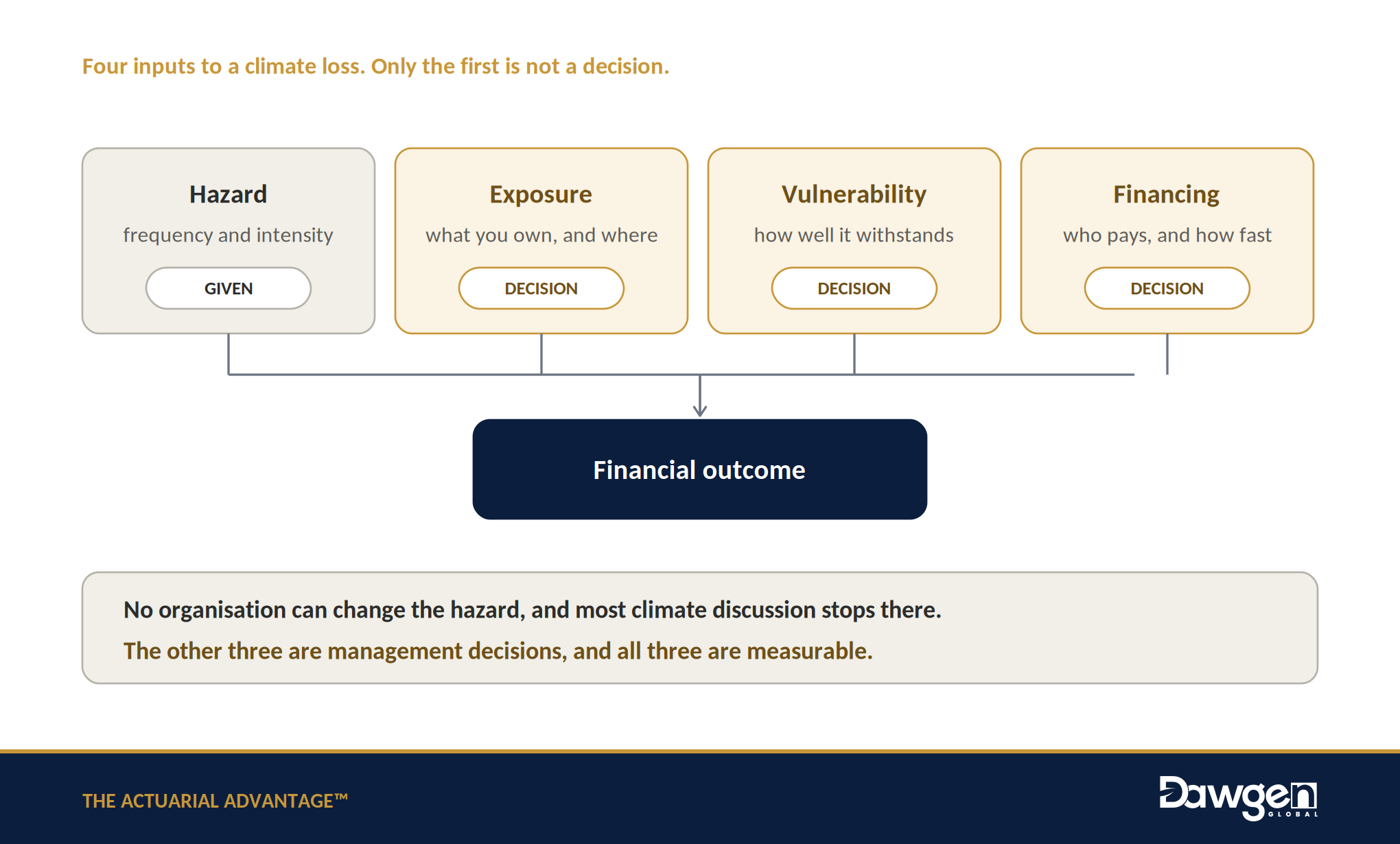
A climate loss is the product of four things. The hazard is the frequency and intensity of the event itself. Exposure is what the organisation owns and where it stands. Vulnerability is how well those assets and operations withstand the event when it arrives. Financing determines who absorbs the resulting cost, and how quickly the money appears.
No organisation can change the hazard. The other three are management decisions, and all three are measurable.
Most climate discussion in boardrooms concentrates on the first, which is the one nobody controls, and treats the fourth as a procurement matter handled at renewal. That allocation of attention is precisely inverted. Hazard is an input to be modelled. Financing structure is a decision with a price attached, and it can be improved this year without waiting for anything to change in the atmosphere.
Vulnerability and exposure sit in between. Both are addressed through capital expenditure and operational choices, both take years to change, and both were covered in an earlier article in this series. What follows concentrates on the financing question, because it is the one that can be changed before the next season and the one most often left unexamined.
How Much of This Are You Already Carrying?
Consider a Caribbean hotel group with three properties and US$85 million of insured asset value. Catastrophe modelling produces a modelled average annual loss from windstorm and associated flood of US$1.9 million, with a one-in-fifty-year loss of US$14 million, a one-in-hundred of US$22 million and a one-in-250 of US$34 million.
The current programme carries a US$2.5 million deductible and a US$25 million limit, at an annual premium of US$2.1 million. Described that way it sounds like a decision about insurance. Described as a set of layers, it is a decision about how US$34 million of potential loss has been divided between the organisation, its insurer, and nobody at all.
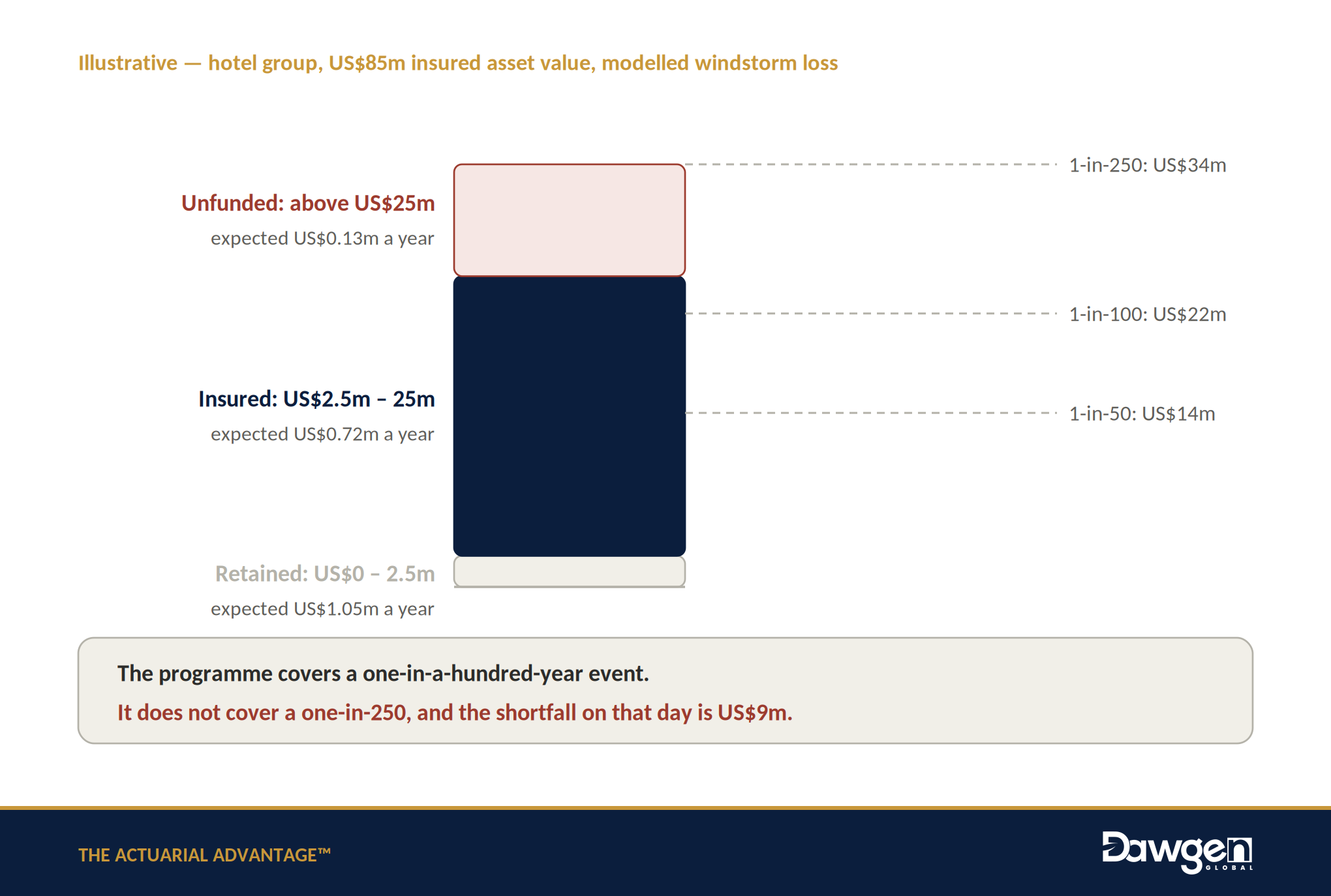
The programme covers a one-in-a-hundred-year event. It does not cover a one-in-250. Figures illustrative.
Three observations follow, none of which is visible in a renewal summary. Most of the expected annual loss — US$1.05 million of the US$1.9 million — sits below the deductible and is therefore already being paid for, in cash, every year, by the organisation itself. The insured layer costs US$2.1 million of premium against an expected recovery of about US$0.72 million, which is what catastrophe cover costs and is not in itself unreasonable. And the layer above US$25 million is not insured, not reserved and not financed. It has simply not been assigned to anyone.
| An uninsured top layer is not a decision the board took. It is the residue of a limit chosen years ago and rolled forward. |
Would the Parametric Actually Pay?
Parametric cover is frequently proposed as the answer to the top layer, and it has a genuine advantage: it settles on a measured index rather than an assessment of damage, so money arrives in days rather than months. That advantage is real and, in a Caribbean recovery, sometimes decisive.
It also carries a specific cost that is rarely quantified before purchase. Because the policy responds to a measured parameter and not to the loss, it is possible for the organisation to suffer serious damage and receive nothing, because the wind speed at the reference point fell just below the trigger. That is basis risk, and its size is a modelling question with an answer.
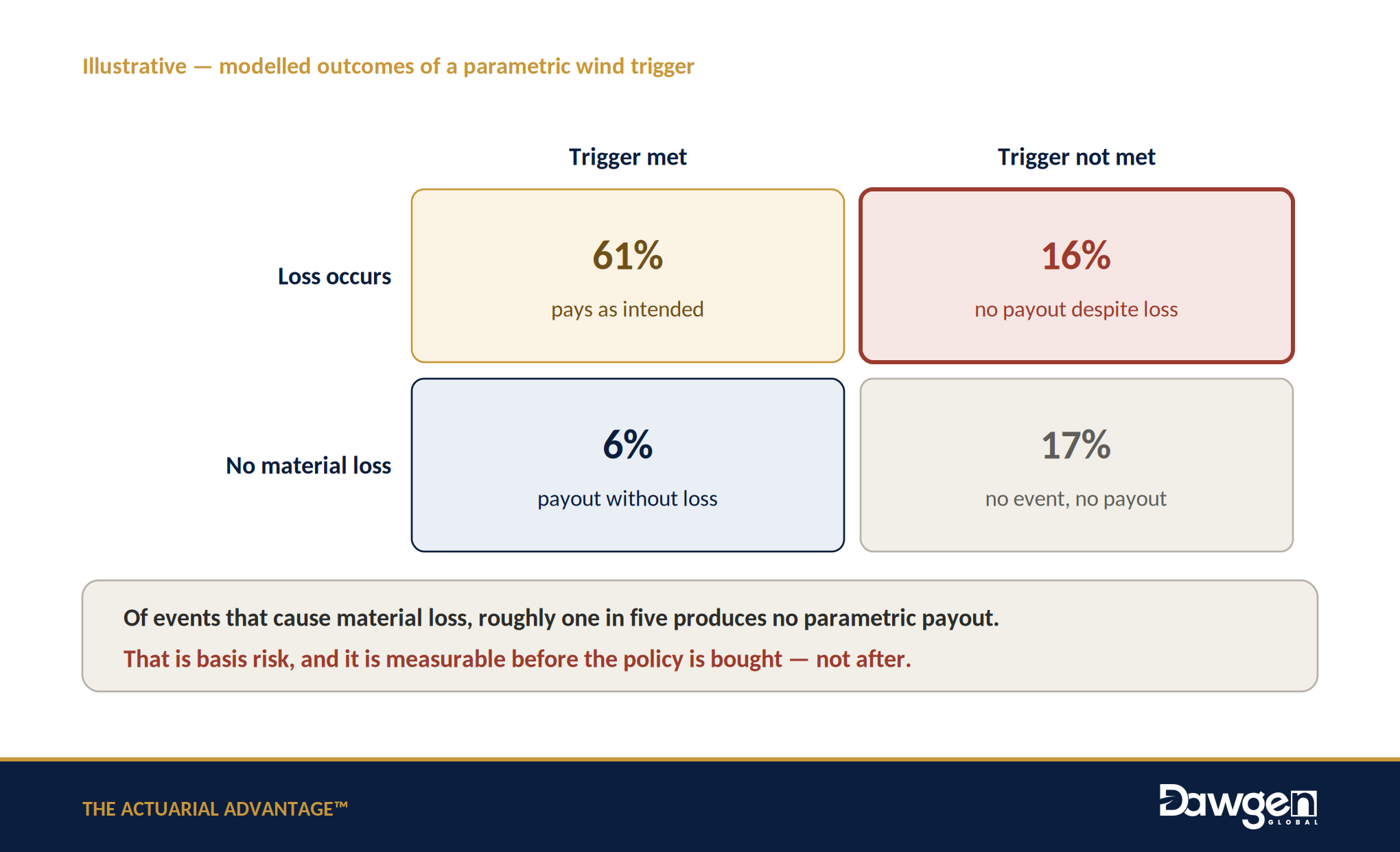
Of events causing material loss, roughly one in five produces no parametric payout. Figures illustrative.
On the modelled distribution for this group, of the events that cause material loss, about four in five would trigger the policy and about one in five would not. That is a usable number. It does not mean the cover is unsuitable; it means the cover is worth roughly four fifths of what an equivalent indemnity limit would be worth, before allowing for the value of speed — and that is the comparison a board should be shown before signing.
The corresponding question, asked less often, is how the trigger was chosen. Moving the attachment point, changing the reference location, or using a multi-station index rather than a single measurement all change the basis risk materially, and all are negotiable at placement. A board that has been shown one structure has usually not been shown the alternatives.
What a Restructured Programme Costs
Layer analysis makes an alternative visible. Raise the deductible from US$2.5 million to US$5 million, which reduces the premium to about US$1.5 million and increases retained expected loss by about US$0.3 million. Add a US$6 million parametric layer at a premium of US$0.62 million. Arrange a US$10 million contingent credit facility at a commitment fee of about US$45,000 a year.
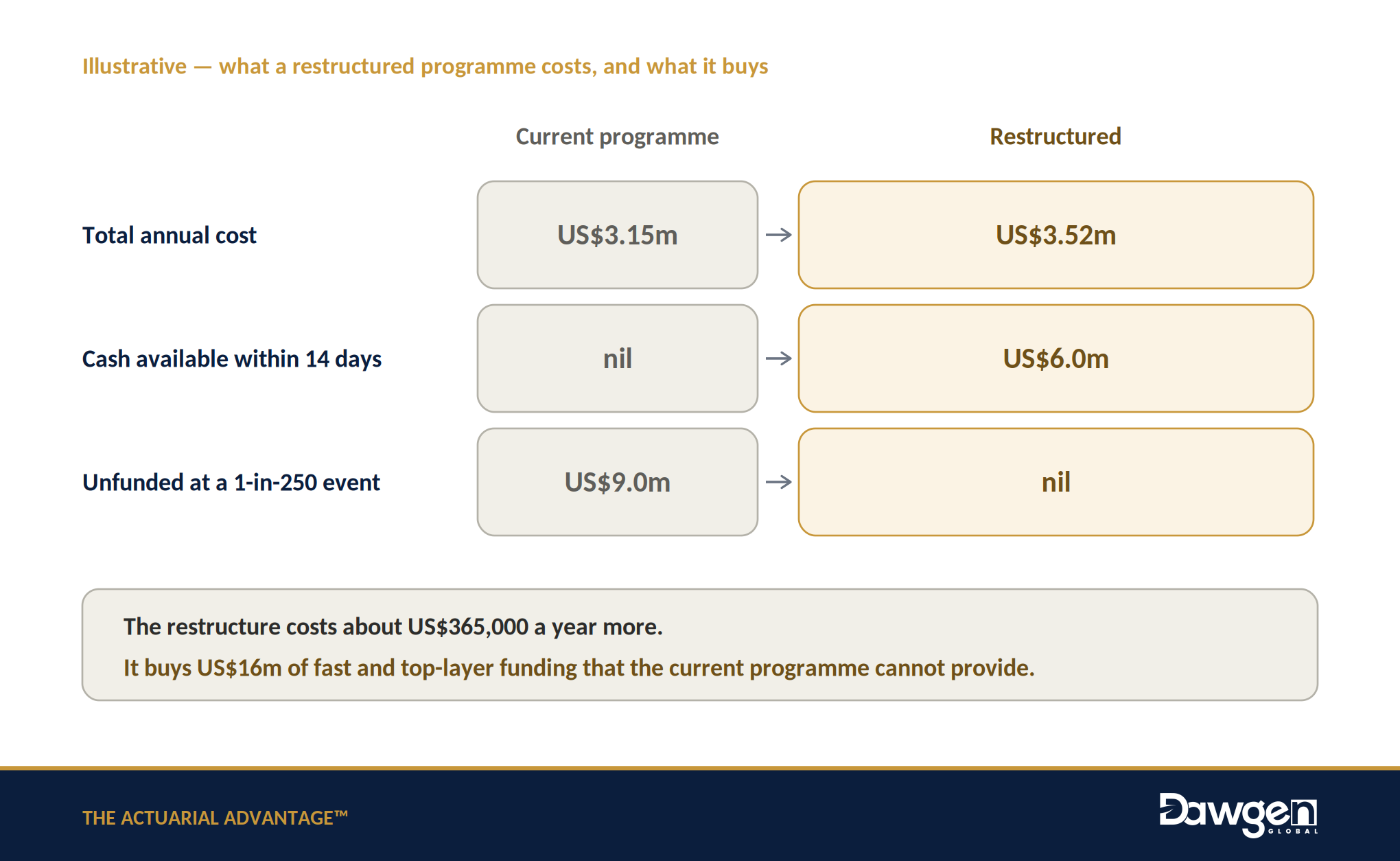
The restructure costs about US$365,000 a year more, and buys US$16m of fast and top-layer funding. Figures illustrative.
This is not a saving, and it should not be presented as one. The restructured programme costs about US$365,000 a year more than the current one. What it buys is US$6 million available within a fortnight when the current programme would deliver nothing for months, and the elimination of a US$9 million hole at the one-in-250 level.
Whether that trade is worth making is a board judgement about liquidity, covenant headroom and appetite. The point of the analysis is not to reach the answer. It is to convert a renewal into a decision with a price on both sides of it.
Where the Event Lands in the Accounts
An event that damages a business also produces a reporting problem, and the two are usually handled by different people at different times. Quantifying the exposure in advance means the financial consequences are anticipated rather than discovered during the year-end audit.
| Where it lands | The question that arises | What advance quantification provides |
| Property, plant and equipment | Is carrying value still supportable, and is insured value adequate? | Replacement cost against insured value, and impairment indicators identified before the event rather than after |
| Inventory | What was lost, and at what value? | A basis for loss quantification and claim preparation agreed with the insurer in advance |
| Receivables | Can customers still pay? | Expected credit loss reassessed for a shock that hits the organisation and its customers simultaneously |
| Provisions and contingencies | What obligations does the event create? | Restoration commitments, contractual penalties and clean-up costs estimated from the scenario |
| Insurance recoveries | When can a recovery be recognised, and when will the cash arrive? | The timing gap between recognition and receipt — frequently several months, and frequently a surprise |
| Going concern and liquidity | Can the recovery be funded? | A cash-flow path under the event scenario, week by week, rather than an annual figure |
| Climate-related disclosure | What must users of the accounts be told? | A quantified basis for disclosure rather than narrative description of a risk that has not been measured |
The reporting consequences are a second exposure, and they are quantifiable on the same modelling.
Eight Questions Before the Season
- What is our modelled average annual loss, and how does it compare with what we spend on insurance?
- At what loss size does our programme stop responding, and what return period is that?
- How much cash could we access within fourteen days of a severe event?
- If we hold parametric cover, what proportion of damaging events would fail to trigger it?
- How much of our expected annual loss sits below the deductible, and is that the cheapest place to carry it?
- Which of our customers would be impaired by the same event that damages us?
- What would a severe event do to our covenant position, not merely to our reported profit?
- Who is authorised to draw a contingent facility, and how quickly can it be done?
| IF THESE CANNOT BE ANSWERED BEFORE THE SEASON
They will be answered during it, under conditions in which the answers cannot be changed. Every one of them is calculable in advance from information the organisation already holds, together with catastrophe modelling that is commercially available. |
Why the Delivery Model Matters
An exercise of this kind ends in several places at once. The layer analysis leads to insurance placement and broker instruction. The contingent facility leads to treasury and lender negotiation. The retained layer leads to reserving policy and tax treatment. The reporting consequences lead to financial reporting, audit evidence and disclosure. The customer impairment finding leads to credit policy.
Dawgen Global’s Caribbean Integrated Borderless Delivery model exists so that the analysis and everything that follows from it sit within one engagement. Actuarial professionals work alongside colleagues in accounting and financial reporting, audit and assurance, enterprise risk, internal audit, technology, tax, human resources, corporate finance and transactions — under one methodology and one accountable relationship, across multiple Caribbean jurisdictions.
Capability is held by the firm and delivered by a team rather than vested in an individual, which matters for work that is revisited at every renewal and after every event.
The Point of All This
Resilience is usually discussed as a matter of construction — stronger roofs, elevated equipment, redundant power. Those things matter and they are expensive, and an earlier article in this series set out how to appraise them.
| Financial resilience is cheaper, faster to arrange, and almost always further from optimal, because nobody has been asked to optimise it. |
The hotel group in this article did not make a bad decision. It made a series of reasonable ones, at different times, each in isolation: a limit set when the asset base was smaller, a deductible chosen to manage premium, a renewal accepted because the terms were similar to last year. Considered together, as a single structure, the result is that most of the expected loss is being paid in cash each year while the largest loss is not financed at all.
That is not unusual. It is the ordinary outcome of treating a financing decision as a procurement exercise — and it is correctable before the next season, at a price the board can see.
How Dawgen Global Can Help
Our Actuarial & Insurance Regulatory Advisory practice works on the financing and reporting side of climate exposure — the questions this article addresses:
- Risk-financing structure and layer analysis: retention, deductibles, limits and the cost of each layer
- Insurance adequacy and retention reviews against modelled loss
- Parametric feasibility, trigger design and basis-risk quantification
- Contingency reserve, contingent facility and liquidity modelling
- Business-interruption quantification and claim preparation support
- Climate-related credit and customer-concentration exposure
- Balance-sheet, provisioning, impairment and disclosure consequences
- Board and audit committee briefings on the quantified position
Catastrophe and hazard modelling itself — wind and flood hazard sets, vulnerability curves and physical exposure modelling — is a distinct specialism, and we resource it through our associate network. Delivery is coordinated within the same engagement, so the client retains one relationship and one point of accountability across both the modelling and everything that follows from it.
| REQUEST AN ACTUARIAL RISK DISCOVERY SESSION
A structured half-day session with your board or executive team, followed by a short written output: how your current programme divides your modelled exposure between retained, insured and unfunded layers, where the gaps sit, and what a restructured programme would cost. Fixed scope. Fixed fee. Delivered within three weeks. Email: [email protected] · Telephone: 876-929-3670 or 876-665-5926 · US toll free: 855-354-2447 Contact form: www.dawgen.global/contact-us/ |
Dawgen Global — Smarter and More Effective Decisions.
| This article is published as part of The Actuarial Advantage™, a Dawgen Global editorial series on risk quantification, insurance and long-term financial decision-making in the Caribbean. It is general commentary and does not constitute actuarial, accounting, legal or investment advice. All figures are illustrative and are used to demonstrate method; they are not estimates of any organisation’s exposure and should not be relied upon as benchmarks. Modelled loss figures depend on the catastrophe model and assumptions used and will differ between providers. |
About Dawgen Global
Dawgen Global is an independent, integrated multidisciplinary professional services firm headquartered at 47 Trinidad Terrace, New Kingston, Jamaica, serving more than 15 territories across the Caribbean. Founded and led by Dr. Dawkins Brown, Executive Chairman, the firm is independent and not affiliated with any international network. It delivers a full suite of professional services under one roof: audit and assurance; tax advisory; IT and digital transformation; risk management; cybersecurity; actuarial and insurance regulatory advisory; HR advisory; mergers and acquisitions; corporate recovery; business advisory and strategy; accounting BPO and virtual CFO services; and legal process outsourcing.
The proposition is simple: big-firm capability without the big-firm price. Dawgen Global’s integrated approach is built for the specific complexities and opportunities of the Caribbean market, helping organizations make sharper, better-informed decisions that drive measurable progress.
To explore a partnership, reach out:
- Website: dawgen.global
- Email: [email protected]
- WhatsApp (Global): +1 555-795-9071
- Caribbean offices: +1 876-665-5926 | +1 876-929-3670 | +1 876-926-5210


