
The chain will always out-spend you. It does not have to out-know you — and in a local market, knowing is the higher ground.
The Problem, Lived
“Rohan” has run a supermarket in Georgetown for sixteen years — two floors, forty staff, a name his parish trusts. Four months ago, a regional chain announced a superstore ten minutes up the road: forty thousand square feet, a produce hall, prices backed by procurement power he cannot imagine. Since the announcement, Rohan has cycled through every reflex of the outgunned: a price war he began sketching before his accountant showed him the arithmetic of losing it slowly; a renovation loan to ‘modernize’ before knowing what modernizing should mean; and long nights on the sales floor, watching customers he has known for a decade, wondering which of them will leave.
In one of those nights comes the more uncomfortable realization. He is about to fight a company with data teams, market analysts and a playbook refined across territories — and his own strategy is built on anecdote, instinct and the last conversation he happened to have. His point-of-sale system has been recording every transaction for six years; he has never once read it as anything but a cash-up. He believes he knows his customers, but he could not say which two hundred of them drive most of his revenue, what his true best-sellers earn, or what the chain’s opening playbook did to independents in the last three towns it entered. He is not out-resourced yet. He is out-informed — and that part, unlike the procurement power, is entirely fixable.
Because here is the asymmetry the panic obscures: the chain has more data about everywhere. Rohan can have better intelligence about here — this parish, these customers, this street — than any head office will ever assemble. The contest is not spend versus spend. It is standardization versus knowing, and knowing is the ground a small firm can actually hold.
Why It Happens Here
Most Caribbean small firms fly instrumentless, for understandable reasons. The data they own goes unread — POS records used only for cash-up, invoices filed rather than analyzed — because nobody was ever shown that reading them is a fifteen-minute skill, not a data-science degree (Article 10’s Win 5 was building exactly this foundation). ‘I know my customers’ functions as folklore rather than measurement, and it is precisely the businesses most confident in the folklore that get surprised. Competitor knowledge arrives by accident — a customer’s remark, a cousin’s report — rather than by routine. And market intelligence itself is assumed to be a big-company luxury: consultants, subscriptions, dashboards.
Meanwhile the ground is shifting faster than the instincts calibrated to an older market: regional chains expanding, buying habits migrating online, new entrants arriving with playbooks already written. The bitter irony is that the small firm holds the superior sensing position and rarely uses it. The owner is on the floor; the head office is in another country. The staff hear what customers mutter; the chain reads what surveys sanitize. Every supplier rep, delivery driver and regular customer is a sensor already reporting — to anyone who has built a way to listen. Big reads reports. Small can read faces. Unused, that advantage is worth nothing; systematized, it is the whole game.
| The Asymmetry, Stated Plainly
Scale buys the chain procurement power, marketing budgets and analysts — and it costs them speed, locality and permission to deviate. Their branch manager cannot change the range, honor an informal arrangement, or approve a Tuesday idea by Tuesday; the playbook is written elsewhere, for everywhere. You can sense on Monday and move on Tuesday. Intelligence plus speed is the small firm’s entire military doctrine — but only the systematic version counts. Instinct is intelligence without discipline, and against a playbook, undisciplined loses. |
Why Generic Advice Fails
Search this problem and you will find two useless genres: business-intelligence content selling platforms that presume analysts to run them, and motivational content advising you to ‘differentiate’ without a method for discovering — rather than guessing — what your differentiation should be. Differentiation is not a slogan choice. It is a conclusion, drawn from evidence about what your customers value, what your rival cannot or will not do, and what you alone are positioned to deliver. The evidence is lying around unclaimed. What the small firm needs is not a platform. It is a routine — five lenses, checked on a rhythm.
The Framework: The Five Lenses™, Step by Step
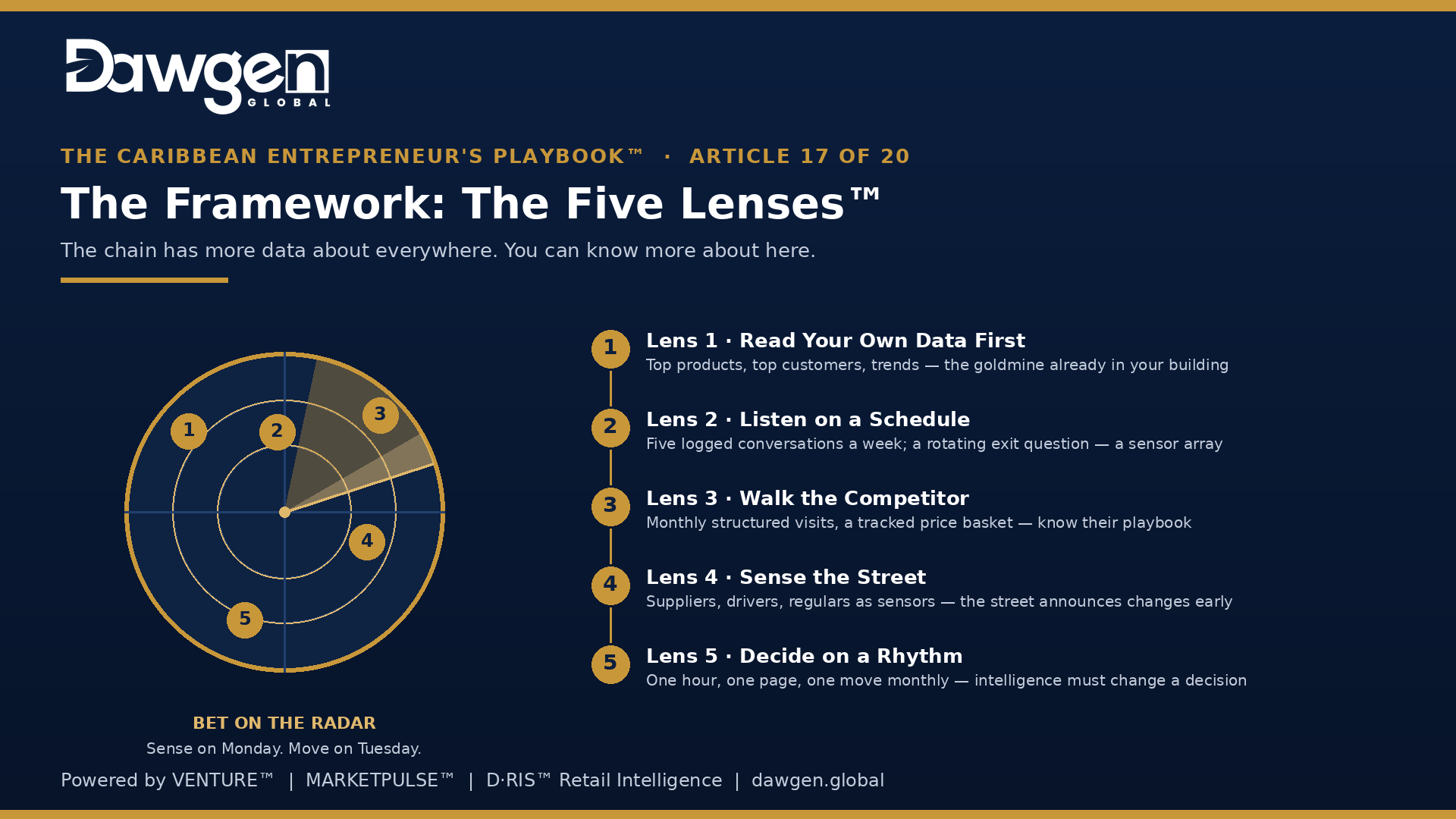
Drawn from the MARKETPULSE™ programme and our D·RIS™ retail intelligence work, the Five Lenses™ turn scattered signals into decisions:
- Lens 1 · Read Your Own Data First — The richest intelligence source about your market is already in your building. One afternoon a month with your own sales records answers questions the chain would pay dearly to know about your parish: which products truly drive profit (not just volume — Article 7’s costing applies), which two hundred customers drive revenue (Article 16’s arithmetic again), what moves at which hours, what quietly died. For retailers, this is the heart of our D·RIS™ discipline — but every business owns this goldmine, and most have never opened the door.
- Lens 2 · Listen on a Schedule — Convert your proximity into a system: five deliberate customer conversations a week, logged in a sentence each; one exit question at the counter that changes monthly; your WhatsApp list (Article 16) polled occasionally with one useful question; reviews — yours and your rival’s — mined monthly for the complaints that are really unmet demands. The owner’s closeness to customers is the moat the chain cannot dig. Unscheduled, it is a pleasant habit. Scheduled, it is a sensor array.
- Lens 3 · Walk the Competitor — Once a month, visit your rival as a customer — legally, ethically, using only what any shopper can see — with a structured eye: a tracked basket of twenty comparison prices, range and stock observations, service quality, promotion patterns, what is emphasized and what is neglected. Within a quarter you will know their local playbook better than their own branch manager, who merely executes it. You are not looking for reasons to despair; you are looking for the gaps a standardized model necessarily leaves — because standardization always leaves them, and they are exactly the shape of your opportunity.
- Lens 4 · Sense the Street — Widen the aperture to leading indicators: construction and hiring in the area, port and supply patterns your reps mention, community events, regulatory murmurs, who is quietly struggling and who is expanding. Formalize the informal network — the supplier reps who visit everyone, the drivers who see every loading bay, the regulars who know the district — by asking them one good question, regularly. None of this is espionage; all of it is attention. The street announces most changes months early, to whoever is listening on purpose.
- Lens 5 · Decide on a Rhythm — Intelligence only counts when it changes a decision. Once a month, one hour, one page: what changed across the four lenses, what it means, and one move — with an owner and a date. This is the discipline that separates knowing from dithering, and it is where the speed advantage becomes real: the chain’s response to your Tuesday move must travel to a head office and back through a quarter of approvals. Your response to theirs is a conversation and a decision. In a contest between a playbook and a radar, bet on the radar — provided it actually gets read.
The Framework in Action: A Worked Scenario
The following scenario is a fictional composite created for this series to illustrate the framework. It does not depict any actual business or client of the firm.
Rohan has six months before the superstore opens, and he spends them looking instead of panicking. Lens 1 delivers its customary shocks: just over two hundred households drive a decisive share of his revenue; his fresh produce and his pharmacy counter earn far more of his profit than their shelf space suggests; and a slice of his range exists mainly to tie up cash (Article 6 nodded knowingly). Lenses 2 and 4 tell him what the spreadsheets cannot: his customers name the same three things again and again — the credit arrangements, the delivery boy, being greeted by name — and his supplier reps, who have watched the chain enter three towns, describe its opening playbook almost to the week: deep promotions for a quarter, then normalization; a standardized range; a famously thin fresh section in its first year.
So Rohan repositions before opening day rather than after. The top two hundred households get a named loyalty programme and WhatsApp ordering with delivery. The range narrows, freeing cash and shelf for a doubled-down fresh and local section — the chain’s known soft flank. The pharmacy adds consultation hours no superstore counter will match. When the superstore opens, his monthly competitor walks confirm the reps’ forecast — spectacular promotions, weak fresh, stockouts by week six — and his one-page intelligence hour amplifies exactly there. In this illustration, his revenue dips modestly for two quarters, then recovers above its old baseline while two unprepared independents in the district do not survive the year. The chain out-spent everyone. It simply never out-knew the one competitor who had turned knowing into a system.
Self-Diagnostic: Are You Informed or Just Experienced?
One point for every “no”:
- Have you read your own sales data — top products, top customers, trends — in the last month?
- Do you run scheduled customer listening — logged conversations, a rotating exit question?
- Have you done a structured competitor visit, with a tracked price basket, in the last quarter?
- Could you name three street-level changes coming to your market in the next year?
- Does a monthly intelligence hour produce one page and one move, with an owner and a date?
Two or more points means you are competing on memory against opponents competing on method. Experience is priceless — but only intelligence tells you when your experience has expired.
When to Call In Help
Bring in support when the stakes or the setup exceed the owner’s hour: a major competitor entering your market (the repositioning window closes at their opening, not yours); own-data that needs its first proper excavation and a repeatable reading routine — for retailers, our D·RIS™ Retail Intelligence Suite exists precisely for this; a differentiation decision that will direct real capital and deserves evidence rather than instinct; or an intelligence rhythm you know you need and will not sustain alone. The engagement is not the intelligence — it is the installation of the system that keeps producing it after we leave.
| REQUEST A COMPETITIVE INTELLIGENCE BRIEFING
Dawgen Global’s Business Advisory team, through the MARKETPULSE™ programme and the D·RIS™ Retail Intelligence Suite, installs the Five Lenses™ as a working system: your own data excavated and turned into a monthly reading routine, customer listening and competitor tracking structured, street-level sensing organized, and the decision rhythm that converts it all into moves — built for the fight you are actually in, including the one where the superstore has already broken ground. Contact us today to request your briefing. 📩 [email protected] | 📞 876-929-3670 / 876-665-5926 | 🇺🇸 855-354-2447 | 🌐 dawgen.global GET THE FULL PLAYBOOK This is Article 17 of The Caribbean Entrepreneur’s Playbook™ — 20 problems, 20 how-to frameworks, one system. Pre-register at dawgen.global to receive the complete Playbook e-book on release, free. About Dawgen GlobalDawgen Global is an independent, integrated multidisciplinary professional services firm headquartered at 47 Trinidad Terrace, New Kingston, Jamaica, serving more than 15 territories across the Caribbean. Founded and led by Dr. Dawkins Brown, Executive Chairman, the firm is independent and not affiliated with any international network. It delivers a full suite of professional services under one roof: audit and assurance; tax advisory; IT and digital transformation; risk management; cybersecurity; actuarial and insurance regulatory advisory; HR advisory; mergers and acquisitions; corporate recovery; business advisory and strategy; accounting BPO and virtual CFO services; and legal process outsourcing. The proposition is simple: big-firm capability without the big-firm price. Dawgen Global’s integrated approach is built for the specific complexities and opportunities of the Caribbean market, helping organizations make sharper, better-informed decisions that drive measurable progress. To explore a partnership, reach out:
|


