Hurricane Melissa’s US$8.8 billion impact on Jamaica in October 2025 was not an anomaly. It was a data point in a clear and intensifying trend. The Caribbean’s climate risk is no longer a long-term planning consideration — it is a current-period enterprise risk that demands measurement, governance, and strategic response with the same rigour applied to financial and operational risk.
CARISK™ Series — Article 6 of 10 | April 2026
CARISK™ CARIBBEAN CLIMATE RISK TAXONOMY — DOMAIN 5 DEEP DIVE
| Risk Type | Risk Category | Caribbean Severity | Primary Enterprise Impact |
| Physical | Acute — Hurricanes & Tropical Storms | CRITICAL | Asset damage, business interruption, supply chain failure, insurance cost surge |
| Physical | Acute — Flooding & Storm Surge | HIGH | Facility inundation, logistics disruption, agricultural losses, infrastructure damage |
| Physical | Acute — Drought & Water Stress | HIGH | Operational continuity for water-intensive industries; agricultural production loss |
| Physical | Chronic — Sea-Level Rise | HIGH | Long-term asset value erosion; coastal infrastructure viability; insurance withdrawal |
| Physical | Chronic — Ocean & Reef Degradation | HIGH | Tourism asset base erosion; fisheries collapse; coastal protection loss |
| Physical | Chronic — Temperature Increase | MODERATE | Labour productivity decline; cooling cost increase; agricultural yield reduction |
| Transition | Policy & Regulation — Carbon Pricing | MODERATE | Operating cost increase for energy-intensive businesses; supply chain carbon costs |
| Transition | Market — ESG Investor & Lender Requirements | HIGH | Access to capital conditions; cost of borrowing; investor eligibility criteria |
| Transition | Reputational — Climate Disclosure Obligations | MODERATE | TCFD/ISSB reporting requirements; lender and partner disclosure demands |
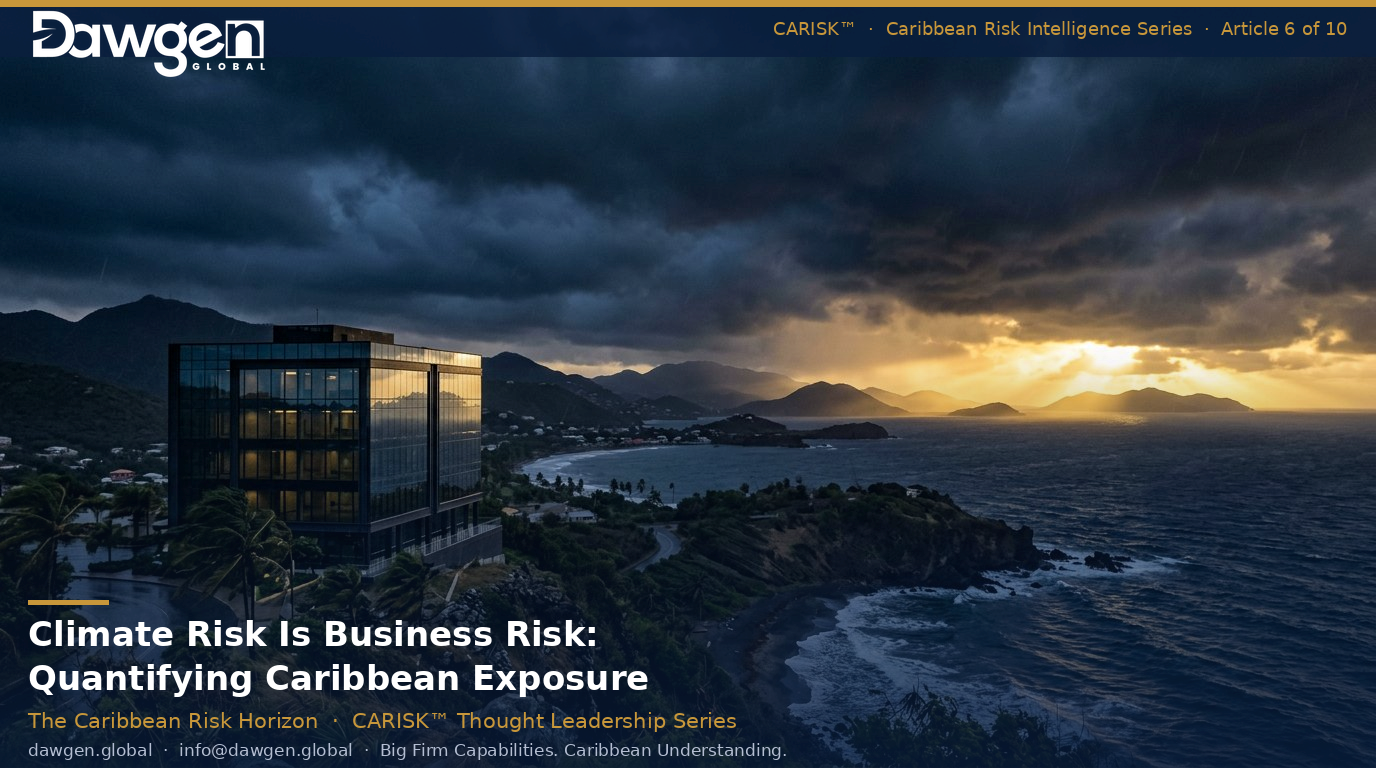
The glass building in the image that opens this series is not incidental. It is standing on a cliff above a Caribbean bay, under a sky that is half storm and half gold — darkness arriving from one side, light holding on the other. That image captures the position of every serious Caribbean enterprise in 2026 with respect to climate risk: operating in an environment of intensifying physical threat, with the strategic question being not whether the storm will arrive but whether the organisation is built to withstand it and recover from it when it does.
Hurricane Melissa’s direct landfall on Jamaica on 28 October 2025 as a Category 5 storm — the strongest ever to strike the island, with sustained winds of 185 miles per hour and total damage estimated by the World Bank at US$8.8 billion — has reset the Caribbean climate risk baseline in ways that will shape enterprise risk management, insurance markets, infrastructure planning, and investment decisions for the next decade. Melissa was not a once-in-a-century event in the sense that makes it safe to plan around as an outlier. It was the leading edge of a risk trajectory that climate science has been projecting for years and that the Atlantic hurricane data is now confirming: more intense storms, more rapid intensification, and greater damage potential from individual events.
This article, the sixth in the CARISK™ series, examines Caribbean climate risk as a business risk — quantifying it, categorising it across the CARISK™ taxonomy, and translating it into the enterprise governance and risk management disciplines that Caribbean boards must now implement. Climate risk is no longer a government problem or a long-term planning consideration. It is a board-level strategic risk that demands the same rigor of assessment, the same discipline of management, and the same quality of disclosure that organisations apply to their financial and operational risk.
Understanding the Two Dimensions of Caribbean Climate Risk
The CARISK™ climate risk framework distinguishes between two fundamentally different categories of climate risk — physical risk and transition risk — that create different types of enterprise exposure and require different management responses. Both are present in the Caribbean, and both are intensifying. Conflating them or managing them as a single undifferentiated risk category is a governance error that produces inadequate responses to each.
Physical Risk: The Storms, the Seas, and the Heat
Physical climate risk arises from changes in the climate system that create direct physical impacts on assets, operations, supply chains, and revenue streams. Physical risk has two sub-categories: acute risks — single discrete events such as hurricanes, floods, and droughts — and chronic risks — long-term gradual changes such as sea-level rise, ocean temperature increase, coral reef degradation, and average temperature increase.
For the Caribbean, acute physical risks dominate the near-term enterprise risk landscape. The Atlantic hurricane season — which runs from June through November — creates an annual window of elevated risk during which any Caribbean enterprise with significant physical assets is exposed to the possibility of catastrophic damage from a single weather event. The post-Melissa context has sharpened this awareness considerably: before October 2025, many Caribbean boards treated major hurricane risk as a known but manageable tail risk. After Melissa, it is clear that the tail is fatter than the pre-2025 risk models assumed, and that the maximum probable loss from a single Caribbean hurricane event is substantially larger than many organisations’ insurance coverage was designed to address.
Chronic physical risks are less immediately dramatic but are structurally eroding the asset and revenue base of Caribbean economies in ways that compound over time. Sea-level rise — projected at between 0.3 and 1.0 metres by 2100 under current emissions trajectories, with higher scenarios possible — is gradually increasing the flood exposure of coastal properties, reducing the effectiveness of natural coastal protection systems, and accelerating the erosion of beaches that are the foundation of the region’s tourism economy. Ocean warming and acidification are bleaching and killing coral reefs at rates that are outpacing natural recovery, reducing the coastal protection and biodiversity services that reefs provide and degrading the marine environments that underpin fishing industries and dive tourism. Average temperature increases are reducing outdoor labour productivity, increasing cooling costs, and affecting agricultural yields across the region.
“Physical climate risk in the Caribbean is not one risk. It is six intersecting risks — hurricanes, flooding, drought, sea-level rise, reef degradation, and temperature increase — each of which creates distinct enterprise exposure that requires distinct assessment and management.”
Transition Risk: The Cost of Decarbonisation
Transition risk arises not from physical climate changes but from the policy, market, and technological changes that are driven by the global effort to reduce greenhouse gas emissions and decarbonise the economy. In the Caribbean, transition risk has historically received less attention than physical risk — understandably, given the immediacy and severity of physical climate exposure. But transition risk is growing in strategic importance for Caribbean enterprises, particularly those in energy-intensive sectors, those seeking international financing, and those operating in value chains with international partners who are subject to stringent climate requirements.
The most immediately material transition risk for Caribbean enterprises is access to capital and markets. International development finance institutions — the IDB, CDB, IFC, European Investment Bank, and others — are progressively incorporating climate risk assessment and climate disclosure requirements into their lending criteria. Green bond frameworks require certified environmental credentials. International private lenders are incorporating ESG covenants into loan agreements. And institutional investors in the Caribbean’s capital markets are beginning to apply climate-related screens to their portfolio decisions. Caribbean enterprises that cannot demonstrate climate risk awareness, management, and disclosure are finding their access to international capital progressively more constrained.
A second transition risk is the carbon cost exposure of Caribbean supply chains. As major economies implement carbon pricing mechanisms — the EU’s Carbon Border Adjustment Mechanism being the most immediately relevant for Caribbean exporters — the carbon intensity of Caribbean production processes becomes a direct cost factor for exports to regulated markets. Caribbean manufacturers, agri-processors, and other exporters whose production processes are carbon-intensive face a growing cost disadvantage relative to lower-carbon competitors, and the organisations that understand and begin addressing this transition risk now will be better positioned than those that encounter it as a market surprise.
The Post-Melissa Insurance Market Dislocation
No discussion of Caribbean climate risk as a business risk can be complete without examining the insurance dimension — which is, in the post-Melissa environment, the most immediately material financial expression of climate risk for Caribbean enterprises and institutions.
Hurricane Melissa’s October 2025 impact on Jamaica produced insured losses that will rank among the largest in Caribbean history. The global reinsurance market — which underwrites the risk capacity that makes Caribbean property insurance available — has responded to Melissa in ways that directly affect every Caribbean enterprise carrying property and business interruption insurance. Property catastrophe reinsurance premiums for Caribbean risk have risen substantially in the post-Melissa renewal cycle. Some reinsurers have reduced their Caribbean risk appetite. Insurers that had been offering broad coverage terms at competitive premiums have tightened both their coverage terms and their pricing.
The practical consequences for Caribbean businesses are concrete and immediate. Organisations that held Caribbean property insurance prior to the post-Melissa renewal cycle will find, at their next renewal, that they face materially higher premiums for the same coverage, reduced coverage for the same premium, or both. Businesses with significant coastal property or infrastructure exposure — hotels, resorts, port facilities, coastal manufacturing plants — are experiencing the most acute repricing. And in some sub-regions and risk categories, insurers are withdrawing coverage entirely, creating uninsurable gaps in Caribbean risk management programmes.
| Sector / Asset Type | Pre-Melissa Risk Profile | Post-Melissa Market Impact | Enterprise Action Required |
| Coastal Hotels & Resorts | Moderate–High; broadly insurable | SEVERE REPRICING | Coverage adequacy review; asset resilience investment; self-insurance assessment |
| Agricultural Operations | High; parametric products available | PREMIUM SURGE | CCRIF parametric review; crop diversification; irrigation investment |
| Port & Logistics Facilities | Moderate; specialist market | CAPACITY REDUCTION | Engineering resilience assessment; business continuity planning |
| Inland Commercial Property | Low–Moderate; competitive market | MODERATE INCREASE | Replacement value verification; premium benchmarking |
| Government & Public Assets | CCRIF parametric primary tool | COVERAGE GAP RISK | CCRIF payout modelling vs. actual loss scenarios; contingency financing |
| Financial Sector Assets | Moderate; regulated minimum levels | UPWARD REPRICING | Regulatory capital stress testing for climate scenarios |
The insurance market response to Caribbean climate risk creates a structural enterprise planning challenge that goes beyond simply absorbing higher premiums. In the medium term, as climate risk continues to intensify and reinsurance markets continue to reprice, some categories of Caribbean asset will become effectively uninsurable at commercially viable premium levels. This trajectory — which has already been observed in parts of Florida, Australia, and other high-climate-risk property markets — creates a fundamental question for Caribbean organisations with long-lived physical assets: how do they manage assets that the insurance market can no longer price at terms that support their commercial viability?
The answers to this question include physical resilience investment — hardening assets against climate events to reduce their expected loss frequency and severity; parametric insurance instruments — the CCRIF model, which pays out based on the occurrence and characteristics of a weather event rather than on assessed losses, avoiding the moral hazard and adjustment cost issues of indemnity insurance; geographic diversification of asset portfolios to reduce concentration in the highest-risk locations; and explicit self-insurance through reserves for organisations with the balance sheet capacity to hold risk internally. Boards that are not actively engaging with this question are managing their organisation’s climate risk exposure less thoughtfully than the current insurance market reality demands.
TCFD and the Climate Disclosure Imperative
The Task Force on Climate-related Financial Disclosures (TCFD) framework — developed under the auspices of the Financial Stability Board and now embedded in regulatory disclosure requirements across major economies — has established the global standard for how organisations should identify, assess, manage, and disclose climate-related risks and opportunities. TCFD reporting is now mandatory for listed companies in the UK, required for large companies and financial institutions in the EU under the Corporate Sustainability Reporting Directive, and under regulatory development in multiple other jurisdictions.
For Caribbean enterprises, the TCFD framework matters in two distinct ways. First, for the growing number of Caribbean organisations that are accessing international capital markets, partnering with international institutions, or operating in value chains with international counterparties subject to TCFD requirements, TCFD disclosure is effectively becoming a market prerequisite even where it is not yet legally mandated. The IDB, IFC, and other major development finance institutions incorporate TCFD alignment into their environmental and social due diligence processes. International private equity and institutional investors apply TCFD screens to their portfolio companies. And international corporate partners — particularly in tourism, retail, and manufacturing — are cascading TCFD-aligned climate disclosure requirements down their supply chains.
Second, even for Caribbean organisations that are not directly subject to TCFD requirements today, the TCFD framework provides the most rigorous and widely adopted methodology for systematically assessing and managing climate risk at the enterprise level. Implementing TCFD — working through its four pillars of Governance, Strategy, Risk Management, and Metrics and Targets — is not primarily a disclosure exercise. It is a risk management discipline that produces genuinely useful intelligence about the organisation’s climate exposure and the robustness of its responses.
The Four TCFD Pillars: What Caribbean Boards Must Address
Governance: The board’s oversight of climate-related risks and opportunities, and management’s role in assessing and managing them. For Caribbean boards, this means formally incorporating climate risk into board-level risk oversight — not as a standalone sustainability discussion, but as an integrated component of the organisation’s risk governance framework. It means designating board-level responsibility for climate risk oversight, receiving regular management reporting on climate risk developments and management actions, and ensuring that climate risk considerations are integrated into the board’s strategic decision-making process.
Strategy: The actual and potential impacts of climate-related risks and opportunities on the organisation’s businesses, strategy, and financial planning, including the organisation’s resilience under different climate scenarios. This is the most analytically demanding TCFD pillar and the one where most Caribbean organisations have the greatest gap. Scenario analysis — assessing the organisation’s strategic and financial position under at least a 1.5°C and a 4°C warming scenario — requires both climate science input and business modelling capability. For most Caribbean organisations, this will require external advisory support to implement rigorously.
Risk Management: The processes the organisation uses to identify, assess, and manage climate-related risks, and how these processes are integrated into the organisation’s overall risk management. This is the pillar most directly connected to the CARISK™ EORM framework: climate risk should be a formally assessed component of the enterprise risk register, with identified risks scored for impact and likelihood, assigned to risk owners, and tracked through the risk committee reporting cycle. The post-Melissa risk environment makes this integration not a best practice but an operating necessity for Caribbean enterprises with significant climate exposure.
Metrics and Targets: The metrics and targets used to assess and manage relevant climate-related risks and opportunities, including greenhouse gas emissions if relevant. At minimum, Caribbean enterprises should be measuring and tracking their physical climate exposure metrics — the geographic distribution of their assets relative to hurricane risk zones, flood plains, and sea-level rise projections; the proportion of their revenue dependent on climate-sensitive sectors; and their insurance coverage ratio relative to the maximum probable loss scenario for their asset portfolio.
Sector-Specific Climate Risk: What Different Caribbean Industries Face
The climate risk landscape varies significantly by sector, and the CARISK™ enterprise-level assessment applies sector-specific risk weighting to reflect these differences. The following analysis covers the five sectors where climate risk is most material and most directly actionable.
Tourism and Hospitality
The Caribbean tourism sector faces the most direct and multidimensional climate risk of any Caribbean industry. Physical asset risk — from hurricane damage to hotel stock, beach erosion, and coral reef degradation — combines with revenue risk from climate-driven tourist demand disruption, regulatory risk from emerging climate disclosure and sustainability performance requirements from international hotel brands and booking platforms, and reputational risk from association with a destination that is perceived as increasingly climate-vulnerable.
The post-Melissa data from Jamaica is instructive: Sangster International Airport saw a 48 percent decline in air traffic in December 2025 compared to the prior year, and 40 to 50 percent of Jamaica’s hotel stock sustained damage. For hotel operators, resort developers, and tourism-linked businesses, the climate risk management imperative includes: asset hardening to Category 5 standards where economically viable; business interruption insurance reviewed at post-Melissa market terms; destination resilience narrative developed for marketing purposes; and sustainability performance credentials built to meet international partner requirements.
Agriculture and Food Processing
Caribbean agriculture faces a three-dimensional climate risk: hurricane damage to crops and infrastructure, drought and water stress affecting yields and water availability, and long-term temperature increases affecting the viability of specific crops in specific locations. The 2025 combination of Melissa’s direct agricultural devastation in Jamaica’s western parishes — St. Elizabeth, known as Jamaica’s breadbasket, was among the hardest-hit areas — and broader regional drought impacts illustrates the compounding nature of Caribbean agricultural climate risk.
For agricultural businesses and food processors, climate risk management requires: crop insurance reviewed for adequacy against post-Melissa pricing; irrigation infrastructure investment to reduce drought vulnerability; crop diversification to reduce single-crop climate concentration; geographic diversification of sourcing to reduce single-location exposure; and supply chain contingency arrangements that activate when climate events disrupt primary sourcing.
Financial Services
Caribbean financial institutions face climate risk through multiple channels: direct physical risk to their own facilities and infrastructure; credit risk from climate-exposed borrowers whose assets and cash flows are affected by climate events; market risk from climate-driven repricing of real estate and other collateral; liquidity risk from post-disaster claims on insurance and deposit withdrawals; and regulatory risk from emerging climate risk disclosure and stress testing requirements from Caribbean financial regulators.
The credit risk channel is perhaps the most strategically significant and least well-managed in the Caribbean financial sector. Loan portfolios secured by coastal real estate — hotels, residential properties, commercial properties — carry embedded climate risk that is not currently reflected in the credit risk assessment frameworks of most Caribbean financial institutions. As physical climate risk intensifies and insurance costs rise, the collateral values underpinning these loans may decline faster than amortisation schedules reduce the outstanding balances, creating negative equity positions and credit losses that current credit models do not fully anticipate.
Manufacturing and Distribution
Caribbean manufacturers and distributors face climate risk primarily through supply chain disruption, facility damage, and logistics network vulnerability. The post-Melissa experience in Jamaica — where western parishes lost telecommunications for extended periods and road networks were severely damaged, creating distribution disruption that lasted for weeks — illustrates the operational continuity risk that Caribbean manufacturers face when a major climate event strikes their territory.
Business continuity planning for climate events is a specific and practically important risk management discipline for Caribbean manufacturers. Plans should address: alternative sourcing arrangements for inputs where primary suppliers are in high-risk locations; off-site data backup and IT recovery capabilities; alternative distribution routes that do not depend on infrastructure that is most vulnerable to climate damage; and communication protocols that function when normal telecommunications infrastructure is disrupted.
The CARISK™ Climate Risk Governance Standard for Caribbean Boards
Based on the CARISK™ assessment of climate risk across Caribbean territories and sectors, the following governance standards define what a climate-risk-ready Caribbean board looks like in the post-Melissa environment.
- Formal climate risk incorporation into the enterprise risk register: Climate risk — across the physical and transition categories relevant to the organisation — must be formally included in the enterprise risk register, with impact and likelihood scores, risk owners, and mitigation actions tracked through the risk committee reporting cycle. Climate risk should not be a standalone environmental report; it should be integrated into the organisation’s core risk governance framework.
- Post-Melissa insurance adequacy review: Every organisation with significant Caribbean physical assets should conduct an immediate review of its property and business interruption insurance coverage in the post-Melissa pricing environment. The review should assess coverage limits against current replacement values, review business interruption coverage terms against a realistic worst-case scenario, and identify any coverage gaps created by post-Melissa policy changes or premium-driven coverage reductions.
- Physical climate risk mapping of the asset portfolio: Boards should receive a formal assessment of the geographic distribution of the organisation’s physical assets relative to identified climate hazard zones — hurricane risk corridors, flood plains, coastal inundation projections, and drought-vulnerable agricultural zones. This assessment provides the foundation for targeted resilience investment and insurance prioritisation.
- Climate scenario analysis for strategic planning: The organisation’s medium-term strategic plan should incorporate at least two climate scenarios: a managed transition scenario (Paris Agreement aligned, approximately 1.5–2°C warming) and a higher-warming scenario (3–4°C, reflecting current policy trajectory). Each scenario should be assessed for its impact on the organisation’s revenues, costs, asset values, and market conditions, and the strategic plan should identify the adaptations required under each scenario.
- TCFD-aligned climate disclosure preparation: Organisations accessing international capital, partnering with international institutions, or operating in internationally integrated value chains should implement TCFD-aligned climate risk reporting. Even where mandatory disclosure is not yet required, voluntary TCFD disclosure signals governance maturity and positions the organisation ahead of requirements that are progressively moving from voluntary to mandatory across global markets.
Climate risk is not waiting for Caribbean organisations to decide how to respond to it. It is arriving on a schedule set by atmospheric physics, not by corporate planning cycles. The boards and executives that engage with Caribbean climate risk now — measuring it, governing it, disclosing it, and managing it with strategic seriousness — are the ones building organisations that will be standing when the next Melissa comes.
In Article 7 of this series, we examine the risk domain that is expanding fastest in terms of threat sophistication and organisational exposure: Cyber Risk. From ransomware to state-sponsored intrusion, from BPO sector data breach to financial sector operational disruption — we examine what Caribbean cyber risk looks like in 2026 and what the governance response must be.
| REQUEST YOUR CARISK™ CLIMATE RISK ASSESSMENT
Plan effectively with Dawgen Global’s expert analysis on the climate risk factors affecting your Caribbean strategy. From physical asset vulnerability mapping and post-Melissa insurance adequacy reviews to TCFD disclosure support and climate scenario analysis, our Operational Risk service provides the tools to confidently anticipate, quantify, and mitigate Caribbean climate risk. Request a complimentary CARISK™ Climate Risk Intelligence Briefing today.
|
Next in the Series
Article 7 — Cyber Threats in the Caribbean: A Risk Matrix Every Leader Must See. From ransomware to nation-state intrusion, from BPO sector data exposure to financial sector operational disruption — the Caribbean cyber threat landscape in 2026 is more sophisticated, more targeted, and more costly than most boards appreciate.
About Dawgen Global
“Embrace BIG FIRM capabilities without the big firm price at Dawgen Global, your committed partner in carving a pathway to continual progress in the vibrant Caribbean region. Our integrated, multidisciplinary approach is finely tuned to address the unique intricacies and lucrative prospects that the region has to offer. Offering a rich array of services, including audit, accounting, tax, IT, HR, risk management, and more, we facilitate smarter and more effective decisions that set the stage for unprecedented triumphs. Let’s collaborate and craft a future where every decision is a steppingstone to greater success. Reach out to explore a partnership that promises not just growth but a future beaming with opportunities and achievements.
 Email: [email protected]
  Visit: Dawgen Global Website

 WhatsApp Global Number : +1 555-795-9071
Caribbean Office: +1876-6655926 / 876-9293670/876-9265210  WhatsApp Global: +1 5557959071
USA Office: 855-354-2447
Join hands with Dawgen Global. Together, let’s venture into a future brimming with opportunities and achievements


