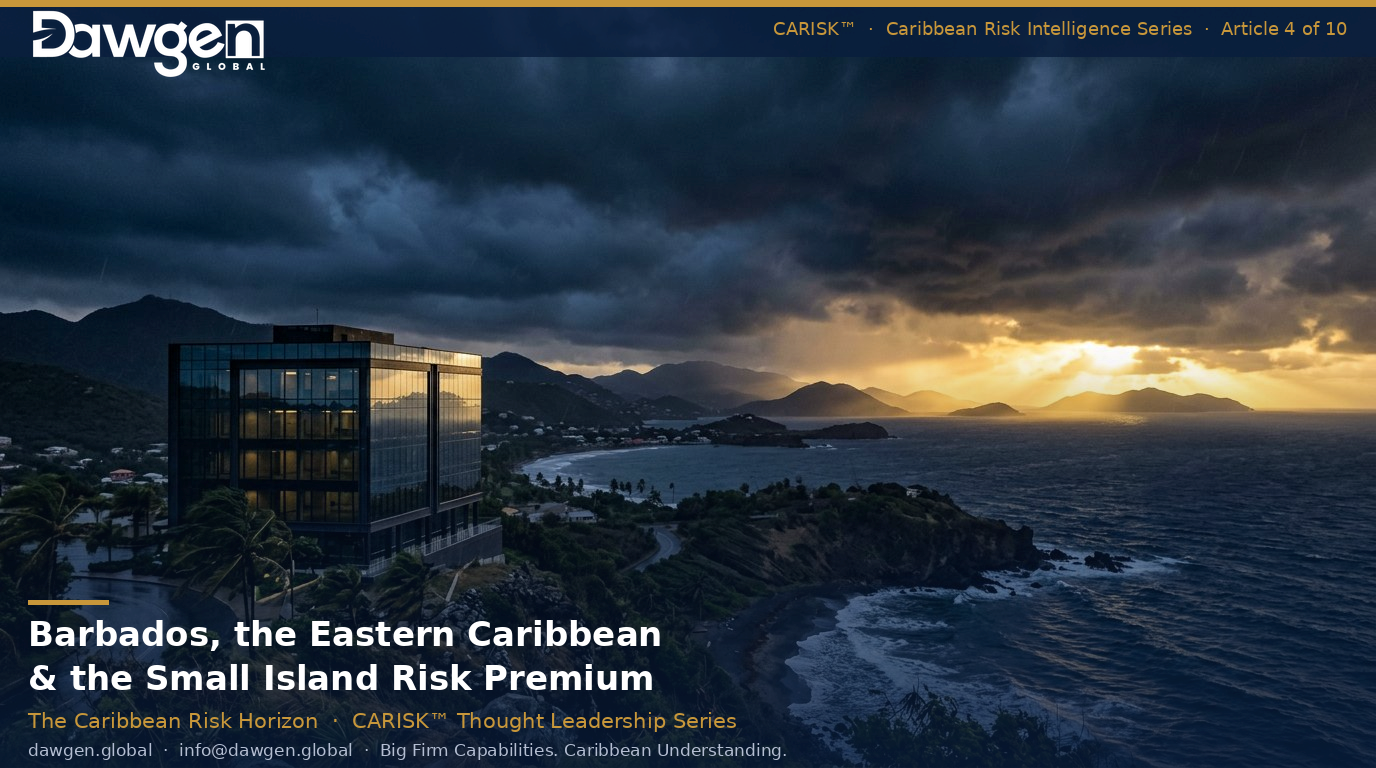
Barbados has built the Caribbean’s most sophisticated regulatory brand. The OECS states face fiscal fragility, climate existentialism, and the paradox of smallness — open enough to absorb every global shock, too small to fully absorb any of them. This is the risk landscape of the Eastern Caribbean, examined with the rigour it demands.
CARISK™ BARBADOS COUNTRY RISK INTELLIGENCE SCORECARD — 2026
| Risk Domain | CRI Rating | Primary Risk Driver |
| Political & Governance Risk | LOW | Strong democratic institutions; high rule-of-law scores; effective anti-corruption framework |
| Macroeconomic & Fiscal Risk | MODERATE | Post-IMF adjustment success offset by tourism concentration vulnerability and high debt legacy |
| Regulatory & Compliance Risk | MODERATE | International Business Company sector under EU/OECD pressure; substance requirements intensifying |
| Social & Security Risk | LOW-MOD | Low violent crime by Caribbean standards; drug transshipment risk creeping upward |
| Climate & Environmental Risk | HIGH | Acute hurricane exposure; coral reef degradation; sea-level rise risk to coastal economic infrastructure |
| Digital & Cyber Risk | LOW-MOD | Relatively mature digital governance; offshore financial sector creates high-value cyber target profile |
| COMPOSITE COUNTRY RISK INDEX | LOW-MODERATE | Score: 32/100 | Regional Rank: 2nd of 15 territories assessed |
CARISK™ OECS CLUSTER RISK INTELLIGENCE SCORECARD — 2026 (Composite Average)
| Risk Domain | CRI Rating | Primary Risk Driver |
| Political & Governance Risk | LOW-MOD | Democratic stability; limited institutional capacity and fiscal-political stress in smaller states |
| Macroeconomic & Fiscal Risk | HIGH | Debt-to-GDP ratios among highest in Western Hemisphere; ECCB constraint limits monetary policy flexibility |
| Regulatory & Compliance Risk | MODERATE | CBI programme integrity risk in several states; FATF compliance pressure; financial sector regulation evolving |
| Social & Security Risk | MODERATE | Generally lower violent crime than larger islands; youth unemployment and social exclusion as latent risk |
| Climate & Environmental Risk | VERY HIGH | Highest per-capita climate risk on earth; post-Melissa insurance market dislocation; existential sea-level risk |
| Digital & Cyber Risk | MODERATE | Limited national cybersecurity capacity; digital adoption outpacing defensive infrastructure |
| COMPOSITE CLUSTER RISK INDEX | HIGH | Score: 58/100 | Significant inter-territory variance across the cluster |
The Eastern Caribbean encompasses two of the most distinct risk profiles in the entire Caribbean basin. Barbados — sophisticated, regulatory-forward, stable, and increasingly positioned as the region’s premier international business and wealth management jurisdiction — presents a risk profile that in several dimensions approaches the standards of advanced economies, with governance quality and rule-of-law scores that rival OECD members. The OECS states — Antigua and Barbuda, St. Lucia, St. Kitts and Nevis, Grenada, Dominica, St. Vincent and the Grenadines, and their smaller dependencies — present something altogether different: a cluster of small island states whose economic fragility, fiscal vulnerability, and catastrophic climate exposure combine to create a risk environment that global risk frameworks consistently underestimate.
Understanding the Eastern Caribbean risk landscape requires holding both of these realities in view simultaneously, and understanding that they are related: the regulatory sophistication of Barbados and the acute vulnerability of the OECS cluster are both expressions of the same underlying condition — smallness, openness, and the particular challenges of building institutional resilience in economies where the margin for error is structurally thin.
This article presents the CARISK™ Country Risk Intelligence assessments for both Barbados and the OECS cluster, examines the specific risk dynamics that define each, and translates both assessments into enterprise risk implications for organisations operating across the Eastern Caribbean.
Part I: Barbados — The Caribbean’s Regulatory Benchmark
Barbados has spent the past two decades deliberately constructing a regulatory and institutional reputation that distinguishes it from the rest of the Caribbean. The island’s ambition — articulated explicitly in its national development strategy and reflected in its legislative programme — is to become the jurisdiction of choice for international business, wealth management, and professional services in the Western Hemisphere: a Caribbean equivalent of Singapore or Luxembourg, where the combination of political stability, legal sophistication, regulatory quality, and quality of life creates a location premium for mobile capital and talent.
That ambition is not merely aspirational. Barbados has made measurable progress toward it. The island consistently ranks at or near the top of Caribbean governance indicators, including Transparency International’s Corruption Perceptions Index, the World Bank’s Governance Indicators, and the World Justice Project’s Rule of Law Index. Its financial regulatory architecture — overseen by the Financial Services Commission of Barbados — is among the most technically sophisticated in the region. Its legal system, grounded in English common law and supplemented by a well-developed body of commercial legislation, provides the contractual certainty that international businesses and investors require.
The IBC Regulatory Transformation
The most significant recent risk development in Barbados has been the transformation of its International Business Company (IBC) and offshore financial sector in response to OECD and EU pressure around economic substance and harmful tax practices. Barbados was included on the EU’s list of non-cooperative jurisdictions for tax purposes in 2017, triggering a programme of legislative reform that has substantially changed the nature of the international business operating in Barbados.
The substance requirements introduced in response to this pressure have transformed Barbados from a jurisdiction where international structures could be established with minimal physical presence into one where genuine economic activity — real staff, real management, real operations — is required to justify the tax treatment claimed. This transformation has filtered the international business sector: entities that could not meet the substance requirements have relocated, while those that can have invested in genuine Barbados operations. The result is a smaller but more credible international business sector that is better positioned to withstand future international regulatory pressure.
For businesses considering Barbados as a base for regional operations, holding company structures, wealth management, or professional services, this regulatory evolution has important practical implications. The compliance costs associated with genuine substance are real and should be modelled accurately. However, the reputational and regulatory stability benefits of operating from a jurisdiction that has demonstrated the capacity and willingness to reform are equally real and increasingly valuable in a world where the provenance of international structures attracts growing scrutiny from tax authorities, correspondent banks, and institutional investors.
The Post-IMF Macroeconomic Position
Barbados’s macroeconomic trajectory represents one of the Caribbean’s more encouraging recent stories. Following its 2018 debt restructuring and engagement with the IMF under the Extended Fund Facility, Barbados implemented a programme of fiscal consolidation and structural reform that has substantially improved its public debt profile and restored credibility with international lenders. The restructuring — which involved significant haircuts for domestic and international creditors — was painful but effective, and the subsequent commitment to fiscal discipline has been maintained with greater consistency than many observers anticipated.
The primary fiscal surplus has been maintained, public debt has been declining as a share of GDP, and Barbados’s investment grade credit rating — briefly lost during the restructuring — has been partially restored as the fiscal trajectory has improved. The economy’s post-COVID tourism recovery has been strong, with visitor numbers and revenues returning to and in some periods exceeding pre-pandemic levels.
The residual macroeconomic risk lies in the structural concentration of Barbados’s economy in tourism and the international business sector — both of which are sensitive to external conditions that Barbados cannot control. A significant deterioration in UK or North American economic conditions, a major hurricane event, or a further round of international regulatory pressure on the IBC sector could each deliver a substantial shock to Barbados’s economic position. The post-IMF fiscal discipline provides a better buffer against these shocks than existed before the restructuring, but the underlying concentration risk remains.
Barbados’s Climate Risk: The Coral Reef Economy
Barbados faces significant and intensifying climate risk, despite its political and governance strengths. The island’s coral reef system — which provides coastal protection, supports the fishing industry, and underpins the beach quality that drives its premium tourism positioning — is under acute threat from ocean warming, ocean acidification, and the mechanical damage caused by increasingly intense storm events. The degradation of Barbados’s coral reefs is not a future risk scenario; it is an ongoing process that is already reducing coastal protection and threatening the natural asset base on which the tourism economy depends.
Sea-level rise poses a long-term threat to Barbados’s coastal infrastructure, including the Bridgetown port, the Grantley Adams International Airport runway (which runs parallel to the coast), and the significant proportion of the island’s tourism accommodation that sits in close proximity to the shoreline. Insurance markets are beginning to reprice these risks, with Caribbean coastal property insurance premiums rising substantially following Hurricane Melissa’s 2025 impact on Jamaica and the broader reassessment of Caribbean hurricane risk that Melissa’s record-breaking intensity has prompted.
“Barbados has built the Caribbean’s most credible regulatory brand. The climate risk to the physical environment that underpins its economic model is the risk that its governance sophistication cannot fully offset.”
Part II: The OECS Cluster — The Small Island Risk Premium
The Organisation of Eastern Caribbean States encompasses a group of small island economies that share a common currency — the Eastern Caribbean dollar, managed by the Eastern Caribbean Central Bank — a common appeal court, and several other regional institutions, but face risk environments that vary considerably across the cluster. What unites them is the structural condition of smallness: economies where the population base is measured in tens of thousands rather than millions, where the GDP is measured in hundreds of millions of USD rather than billions, and where the margin between economic stability and economic crisis is routinely narrower than global risk frameworks are calibrated to assess.
The Fiscal Fragility Dimension
The OECS states carry some of the highest public debt-to-GDP ratios in the Western Hemisphere. Several OECS members have debt-to-GDP ratios exceeding 80 percent, and some have historically exceeded 100 percent. In small island economies with limited revenue bases, high debt service costs crowd out public investment, constrain social service delivery, and leave minimal fiscal space to respond to the external shocks that small open economies face with disproportionate frequency and severity.
The Eastern Caribbean Central Bank’s common currency arrangement provides monetary stability — the EC dollar has been pegged to the USD at EC$2.70:US$1 since 1976 — but removes individual country monetary policy as a tool for macroeconomic adjustment. When an OECS economy faces a negative shock, the adjustment must come through fiscal policy (which is constrained by debt levels) or through the real economy (which means lower wages, higher unemployment, and emigration). This structural constraint makes the fiscal position of OECS governments a direct enterprise risk factor for every business that depends on government payments, operates in a government-regulated market, or employs workers who may choose to emigrate if economic conditions deteriorate.
Citizenship by Investment: Opportunity and Risk
Several OECS states — Antigua and Barbuda, St. Kitts and Nevis, Grenada, St. Lucia, and Dominica — operate Citizenship by Investment (CBI) programmes that sell citizenship in exchange for qualifying investments or donations. These programmes generate significant fiscal revenues that contribute materially to government finances and enable public investment that would otherwise be unaffordable. For the territories that operate them, well-managed CBI programmes are a legitimate and important revenue source in economies with limited alternative income streams.
The risk, however, is both reputational and operational. CBI programmes have been subject to increasing international scrutiny from the United States, European Union, and UK, which have raised concerns about the due diligence standards applied to applicants and the potential use of Caribbean passports to circumvent financial crime controls or immigration restrictions. The visa-free access that Caribbean CBI passports provide to EU and Schengen countries has been a recurring source of diplomatic tension, and the EU has taken steps to restrict or suspend visa-free access for certain CBI jurisdictions at various points.
For businesses operating in OECS states that depend on CBI revenues — construction, real estate, financial services, legal and advisory services — the regulatory risk associated with the sustainability of CBI programmes is a material strategic risk. A significant reduction in CBI revenues, whether through international pressure, programme suspension, or reputational damage from high-profile due diligence failures, would reduce government revenues, constrain public investment, and affect demand in the sectors most directly linked to CBI-funded activity.
The Climate Existential: What Post-Melissa Means for the OECS
The climate risk facing the OECS states is, without qualification, the most severe climate risk facing any group of economies in the Caribbean — and Hurricane Melissa’s catastrophic impact on Jamaica in October 2025 has fundamentally reset the regional climate risk baseline for insurers, governments, and businesses alike. The OECS states sit in the path of the Atlantic hurricane track, and several of them have experienced direct major hurricane impacts within living memory that have set back their economic development by years or decades.
Dominica — which was devastated by Category 5 Hurricane Maria in 2017, with damage estimated at 226 percent of GDP — has been rebuilding toward its stated ambition of becoming the world’s first climate-resilient nation. The reconstruction programme, while supported by international partners, has proceeded more slowly than projected, and Dominica’s exposure to another major hurricane event before its resilience-building programme is complete represents a genuine existential risk for the island’s economic viability. St. Vincent and the Grenadines has faced compounding disasters — the April 2021 eruption of La Soufrière volcano and subsequent hurricane-related flooding events — that have tested the limits of small-state recovery capacity.
The insurance implications of OECS climate risk are becoming increasingly acute. In the wake of Hurricane Melissa, global reinsurance markets are repricing Caribbean risk exposure, with Caribbean property catastrophe reinsurance premiums rising substantially. For OECS governments — which depend on CCRIF parametric insurance as a primary post-disaster financing mechanism — and for private sector businesses that carry property insurance on OECS assets, the cost and availability of adequate coverage is a risk management issue of the first order. Businesses with significant physical assets in OECS territories should conduct an urgent review of their insurance coverage adequacy in the post-Melissa pricing environment.
“The OECS climate risk is not a risk that can be fully managed away. It can be partially transferred, partially mitigated, and it must be explicitly priced into every strategic decision about asset commitment in the Eastern Caribbean.”
The OECS Economic Opportunity Alongside the Risk
A complete risk assessment of the OECS cluster must acknowledge that the same factors that create risk also create opportunity. The OECS states have some of the world’s most attractive natural environments, sustainable tourism assets, and quality-of-life offerings for high-net-worth individuals, digital nomads, and businesses seeking Caribbean bases. The growth of remote work has increased demand for Caribbean residency that is only partially captured by CBI programmes. The renewable energy transition creates investment opportunities in solar, wind, and geothermal development that are well-suited to small island geographies. And the OECS states’ generally low crime environments, relative to the larger Caribbean islands, make them increasingly attractive for businesses and individuals who factor personal security in their location decisions.
The CARISK™ OECS assessment does not conclude that the OECS states are environments to avoid. It concludes that they are environments that require a specific category of strategic discipline: clear-eyed assessment of climate exposure, realistic insurance and contingency planning, and investment structures that do not assume the continuity of the current risk environment without explicitly planning for disruption.
The Cluster Comparison: What CARISK™ Tells Us
| Risk Domain | Barbados | OECS Cluster | Key Differentiator |
| Political & Governance | LOW | LOW-MOD | Barbados’s institutional quality is materially superior to OECS average |
| Macroeconomic & Fiscal | MODERATE | HIGH | OECS debt levels and ECCB constraint create structural adjustment vulnerability |
| Regulatory & Compliance | MODERATE | MODERATE | CBI integrity risk in OECS; IBC substance requirements in Barbados |
| Social & Security | LOW-MOD | MODERATE | Both below larger island peers; OECS youth unemployment a latent risk |
| Climate & Environmental | HIGH | VERY HIGH | OECS existential hurricane exposure; Barbados coral reef and sea-level risk |
| Digital & Cyber | LOW-MOD | MODERATE | Barbados more advanced digital governance; OECS capacity more limited |
| COMPOSITE INDEX | 32/100 | 58/100 | 26-point spread reflects the regulatory vs. climate-fiscal risk trade-off |
Enterprise Imperatives: Operating Across the Eastern Caribbean
The CARISK™ Eastern Caribbean assessment — encompassing both Barbados and the OECS cluster — produces a specific set of risk management imperatives for organisations operating across the sub-region.
- Conduct a post-Melissa insurance adequacy review: The repricing of Caribbean property catastrophe insurance following Hurricane Melissa means that coverage purchased before October 2025 should be reviewed against current market pricing, updated replacement values, and the evolved understanding of maximum probable loss in the Caribbean hurricane environment. Organisations with significant Eastern Caribbean physical assets should engage their brokers for an urgent coverage adequacy assessment.
- Assess your IBC or offshore structure’s substance position: Organisations using Barbados or OECS-based international structures should verify that their current operations meet the substance requirements applicable in the jurisdiction. Structures that were compliant under pre-reform standards may not meet current requirements. Non-compliant structures carry regulatory, reputational, and tax authority challenge risk that should be assessed and remediated proactively.
- Build CBI revenue concentration risk into your OECS strategy: Businesses with significant revenue exposure to CBI-linked activity in OECS states should formally assess the scenario in which CBI revenue declines materially — whether through international pressure, programme suspension, or applicant volume reduction. This scenario should be modelled against the organisation’s revenue projections and cost structure to identify the threshold at which the business model becomes unviable.
- Monitor ECCB and OECS fiscal policy closely: The OECS fiscal environment is evolving, with increasing pressure on member state governments to reduce debt and improve fiscal sustainability. Changes in OECS government expenditure patterns, tax policy, or import licencing regimes can have direct and rapid effects on the business environment. Maintain a structured monitoring capability for OECS fiscal and policy developments relevant to your sector.
- Price the small-island risk premium explicitly: Every financial model and investment appraisal for OECS-based assets should include an explicit small-island risk premium that reflects the higher probability of severe disruption — from climate events, fiscal crises, or external shocks — relative to larger economies. This premium is not a reason to avoid OECS investment; it is a necessary input to pricing that investment correctly.
In Article 5 of this series, we examine the risk domain that is expanding most rapidly across every Caribbean territory: Regulatory & Compliance Risk. From FATF pressure to OECD tax transparency requirements to domestic regulatory acceleration, the compliance landscape is reshaping the risk environment for Caribbean enterprises in ways that demand proactive, structured management.
| REQUEST YOUR CARISK™ EASTERN CARIBBEAN RISK BRIEFING
Plan effectively with Dawgen Global’s expert analysis on the risk factors affecting your Eastern Caribbean strategy. From detailed CARISK™ assessments of Barbados and the OECS cluster to customisable enterprise risk matrices, insurance adequacy reviews, and IBC compliance assessments, our Operational Risk service provides the tools to confidently anticipate and mitigate risk across the Eastern Caribbean. Request a complimentary 60-minute CARISK™ Eastern Caribbean Intelligence Briefing today.
|
About the Author
Dr. Dawkins Brown is the Executive Chairman and Founder of Dawgen Global, the Caribbean’s leading multidisciplinary professional services firm. He is the creator of the CARISK™ framework and publishes the Caribbean Boardroom Perspectives newsletter on LinkedIn and the Caribbean Advisory Brief on the Dawgen Global company page. Dawgen Global operates across 15+ Caribbean territories under the tagline: “Big Firm Capabilities. Caribbean Understanding.”
Next in the Series
Article 5 — The Regulatory Risk Explosion: Why Compliance Is Now a Strategic Function. FATF, the OECD, the EU, and domestic regulators are all tightening simultaneously. We examine the compliance risk landscape across Caribbean territories and the management disciplines required to stay ahead of it.
About Dawgen Global
“Embrace BIG FIRM capabilities without the big firm price at Dawgen Global, your committed partner in carving a pathway to continual progress in the vibrant Caribbean region. Our integrated, multidisciplinary approach is finely tuned to address the unique intricacies and lucrative prospects that the region has to offer. Offering a rich array of services, including audit, accounting, tax, IT, HR, risk management, and more, we facilitate smarter and more effective decisions that set the stage for unprecedented triumphs. Let’s collaborate and craft a future where every decision is a steppingstone to greater success. Reach out to explore a partnership that promises not just growth but a future beaming with opportunities and achievements.
 Email: [email protected]
  Visit: Dawgen Global Website

 WhatsApp Global Number : +1 555-795-9071
Caribbean Office: +1876-6655926 / 876-9293670/876-9265210  WhatsApp Global: +1 5557959071
USA Office: 855-354-2447
Join hands with Dawgen Global. Together, let’s venture into a future brimming with opportunities and achievements


