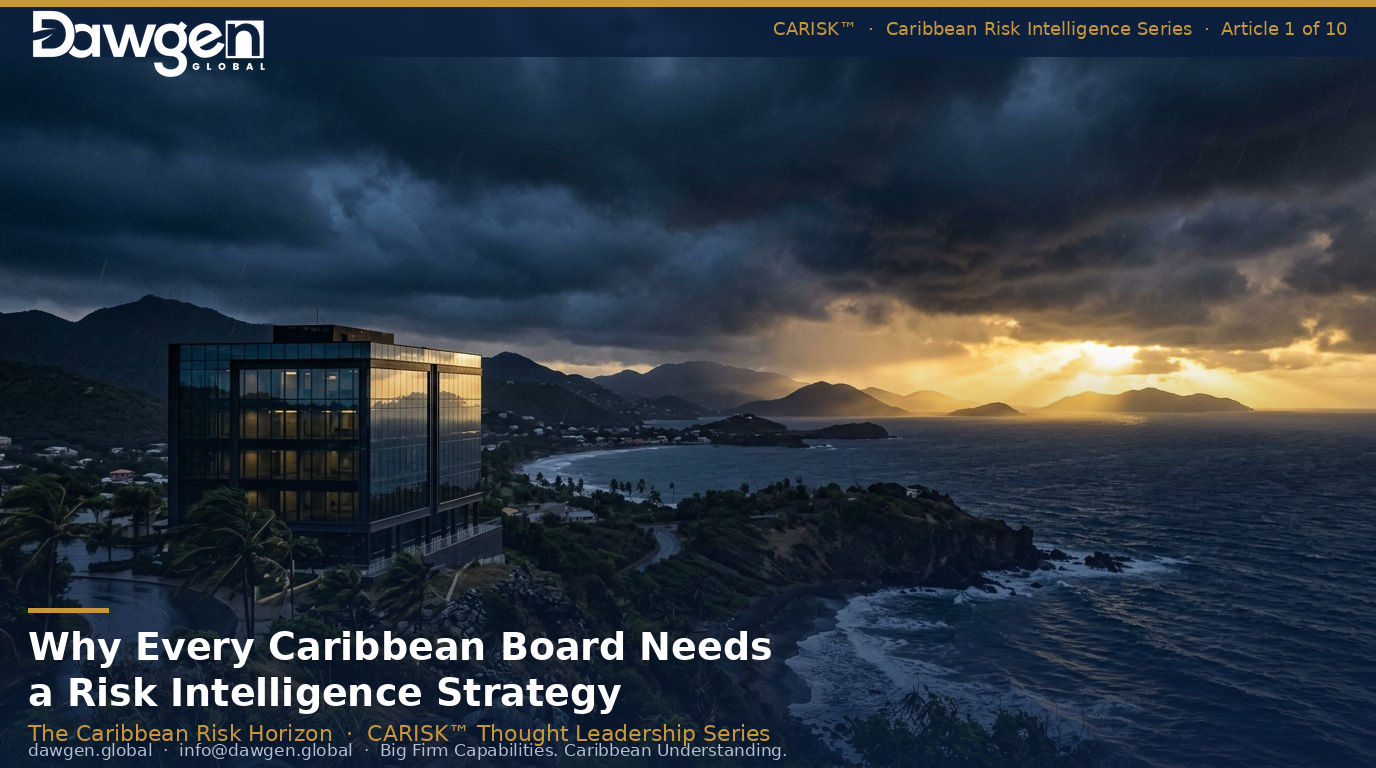
The cost of unstructured risk is not hypothetical. It is measured in shuttered businesses, derailed strategies, and squandered opportunity. Caribbean boards that govern without systematic risk intelligence are not being prudent — they are being exposed.
In September 2017, Hurricane Maria made landfall on the island of Dominica with wind speeds exceeding 160 miles per hour. Within twenty-four hours, the storm had destroyed or damaged ninety percent of the island’s structures, eliminated its primary agricultural exports, severed road networks, collapsed the telecommunications infrastructure, and set back the nation’s economic development by an estimated twenty years. Dominica’s government, businesses, households, and institutions were not simply unprepared for that specific storm. They were unprepared for the category of risk it represented — the kind of low-probability, catastrophic-impact event that changes the trajectory of an economy in a single day.
The Dominica example is extreme in its severity but not in its type. Across the Caribbean, organisations of every size and sector are regularly confronted with risk events — political transitions that rewrite the regulatory landscape, currency devaluations that destroy import-dependent margins, cybersecurity breaches that compromise client data and institutional reputation, regulatory actions that suspend operating licences, social unrest that disrupts supply chains and deters investment, and yes, storms, floods, and droughts that damage facilities and interrupt operations. What distinguishes organisations that navigate these events successfully from those that do not is rarely luck. It is preparation, and preparation begins with intelligence.
This article opens the CARISK™ Thought Leadership Series — Dawgen Global’s ten-part examination of risk intelligence for Caribbean enterprises and institutions. The series introduces the CARISK™ framework: the Caribbean Operational Risk Intelligence System, a proprietary two-level risk assessment platform developed specifically for the Caribbean context. Over the course of the series, we will examine the six risk domains that CARISK™ assesses, explore the risk profiles of primary Caribbean territories, and make the case for why structured operational risk management is not a luxury reserved for large corporations with dedicated risk functions but a strategic necessity for every organisation that operates in this region.
We begin where every serious risk conversation must begin: with the question of why structured risk intelligence matters, and what the absence of it costs.
The Board’s Risk Blind Spot
In the course of Dawgen Global’s advisory work across the Caribbean, one pattern recurs with striking consistency across sectors and territories: organisations that face risk events almost always had some awareness that the risk existed. The cyber breach was preceded by IT warnings about system vulnerabilities that went unaddressed. The regulatory penalty followed years of compliance gaps that were never formally assessed. The contractual dispute arose from provisions in agreements that no one had reviewed in the context of a changing legal environment. The cash flow crisis arrived after quarters of warning signs in financial data that were not structured into a risk monitoring framework.
The problem, in most cases, is not the absence of information about risk. It is the absence of a structured system for converting that information into governance action. Caribbean boards frequently possess — in aggregate, across their members and management teams — substantial knowledge of the risk landscape facing their organisations. What they typically lack is a methodology for surfacing that knowledge, assessing it systematically, prioritising it clearly, and translating it into board-level oversight and management-level action.
“Risk is not managed by intuition. It is managed by intelligence — structured, scored, and acted upon with the same rigour that organisations bring to their financial and operational planning.”
This gap has several causes, all of them understandable and none of them excusable. Caribbean organisations have historically operated in markets with limited formal competition for governance quality. Regulatory requirements for risk management have been unevenly enforced. The cultural preference for relationship-based business — where trust between known parties substitutes for formal systems — has slowed the adoption of structured risk frameworks. And the perceived cost of professional risk management has been seen as disproportionate to its perceived benefit, particularly among smaller organisations.
All three of these conditions are changing rapidly, and the organisations that recognise this shift earliest will hold a significant strategic advantage over those that continue to govern by instinct.
Why the Caribbean Risk Landscape Is More Complex Than It Appears
One of the most common misunderstandings about Caribbean risk management is the assumption that the Caribbean’s small scale implies manageable complexity. The opposite is closer to the truth. The Caribbean’s risk landscape is characterised by a set of structural features that, in combination, create a risk environment of exceptional complexity relative to the scale of the economies and institutions navigating it.
Structural Openness and External Shock Transmission
Caribbean economies are among the most open in the world, with trade-to-GDP ratios that reflect their deep integration with global markets. This openness is a source of economic dynamism — it enables access to capital, technology, tourism revenues, and consumer goods that would be unavailable in closed economies. But it also means that external shocks transmit rapidly and forcefully into Caribbean economic conditions. The COVID-19 pandemic, which destroyed Caribbean tourism revenues virtually overnight in 2020, demonstrated the existential vulnerability that comes with an economic model heavily concentrated in a single sector dependent on international travel. The Russia-Ukraine conflict’s impact on global commodity prices transmitted directly into Caribbean fuel import costs, food prices, and inflationary pressures. The United States Federal Reserve’s interest rate cycle has direct implications for Caribbean governments’ debt servicing costs and access to international capital markets.
Caribbean enterprises cannot control these external forces. But they can systematically assess their exposure to them and build the resilience strategies that reduce impact when shocks arrive. Structured risk intelligence is the starting point for that process.
The Small-State Fiscal Constraint
The majority of Caribbean governments operate with limited fiscal space — the result of high public debt, constrained revenue bases, high per-capita service delivery costs in small-population jurisdictions, and the recurring demand for post-disaster reconstruction expenditure. When governments face fiscal pressure, the consequences ripple through the enterprise environment in ways that compound operational risk: public sector payment delays affect cash flow for government contractors; reduced public investment affects infrastructure quality and logistics costs; policy reversals in response to fiscal crises create regulatory uncertainty; and the risk of sovereign credit downgrades affects the cost and availability of financing for private sector borrowers.
The fiscal risk of Caribbean governments is therefore not a matter solely for public sector institutions. It is a significant enterprise risk factor for any organisation with meaningful exposure to public sector contracts, government-administered markets, or imported goods subject to policy-driven tariff and licensing decisions.
Regulatory Acceleration
The pace of regulatory change across the Caribbean has accelerated dramatically in the past decade, driven by a combination of international compliance requirements and domestic institutional development. The FATF’s enhanced scrutiny of Caribbean financial centres has driven structural regulatory reform in Barbados, Cayman Islands, Belize, and other offshore jurisdictions. The EU’s blacklisting and grey-listing processes have created compliance imperatives that have reshaped the financial services landscape across the region. Domestic regulators in banking, telecommunications, energy, and other sectors are increasingly sophisticated and increasingly enforcement-oriented. Data protection legislation modelled on the GDPR is moving through legislative processes across multiple territories.
For Caribbean enterprises, particularly those in financial services, professional services, and technology-dependent sectors, this regulatory acceleration creates a compliance risk environment that requires systematic monitoring and proactive management. The organisations that discover regulatory requirements after they have been breached are the organisations that face enforcement action, reputational damage, and in extreme cases, loss of operating licences.
The Climate Risk Imperative
The Caribbean’s climate risk exposure is unambiguous and intensifying. The scientific consensus on the trajectory of Atlantic hurricane intensity, sea-level rise, and temperature increase has clear implications for every Caribbean organisation that operates physical assets, depends on agricultural production, relies on tourism revenues, or holds insurance policies that will be repriced as climate risk is more accurately reflected in premium structures. The Caribbean Catastrophe Risk Insurance Facility (CCRIF) has been tracking the financial cost of Caribbean climate events for nearly two decades, and the trend line is unmistakable.
Climate risk is no longer a long-term strategic consideration for Caribbean organisations. It is a current-period operational planning requirement. Boards that have not formally assessed their organisation’s physical climate risk exposure — its facilities, supply chains, revenue streams, and insurance coverage — are not governing the organisation’s actual risk landscape. They are governing an idealised version of it that the climate is actively revising.
The Cyber Threat Escalation
Caribbean organisations have adopted digital technology at a pace that has, in many cases, outstripped the development of their cybersecurity capabilities. Online banking, digital payments, cloud-based business systems, remote working infrastructure, and e-government services have all expanded rapidly, creating new attack surfaces that the region’s cyber defence capabilities have not yet fully addressed. The Caribbean’s financial centres — which handle significant volumes of international transactions and hold sensitive client financial information — are particularly high-value targets for sophisticated cyber threat actors. But the threat is not limited to financial services: healthcare institutions, educational organisations, utilities, and government agencies have all been subject to ransomware and data breach incidents across the region in recent years.
The cost of a significant cybersecurity incident extends well beyond the immediate financial loss. Reputational damage, regulatory investigation, client notification obligations, and operational disruption combine to make a serious cyber incident a potentially existential event for smaller Caribbean organisations and a major strategic setback for larger ones.
What Risk Intelligence Actually Means
The term ‘risk management’ is often understood, particularly in smaller Caribbean organisations, as a compliance exercise — a requirement to produce a risk register for the auditors or a risk section for the annual report. This understanding is both limited and dangerous, because it creates the appearance of risk management without the substance of it.
Genuine risk intelligence is something fundamentally different. It is the systematic collection, analysis, and application of information about the risk factors affecting an organisation’s strategy, operations, and financial position — structured in a way that enables boards and executives to make better decisions, not simply to document the decisions they have already made.
Effective risk intelligence has five characteristics that distinguish it from compliance-oriented risk listing.
- Forward-looking: Risk intelligence is concerned with risks that have not yet materialised, not with a historical record of events that have already occurred. It assesses the risk environment that the organisation will face, not the one it has already navigated.
- Scored and prioritised: Not all risks are equal. Risk intelligence quantifies the relative severity of different risks — their likelihood of occurrence and their potential impact — to enable rational prioritisation of management attention and mitigation resources.
- Actionable: Risk intelligence connects identified risks to specific management responses. It does not stop at identification; it drives to the question of what the organisation will do about each material risk, and by when, and who owns the response.
- Integrated: Risk intelligence is integrated into the organisation’s strategic planning, financial planning, and operational management processes — not maintained as a separate document that bears no relationship to how the organisation actually makes decisions.
- Dynamic: Risk intelligence is continuously updated as the risk landscape evolves. A risk register produced two years ago and not revisited is not risk intelligence; it is a historical artefact.
The CARISK™ framework is designed to deliver all five characteristics of genuine risk intelligence, adapted to the specific conditions of the Caribbean operating environment.
The CARISK™ Approach: Two Levels, One System
Dawgen Global’s CARISK™ — the Caribbean Operational Risk Intelligence System — addresses the Caribbean risk intelligence gap through a two-level assessment framework that operates from territory-level risk conditions down to enterprise-specific risk matrices.
At the country level, CARISK™ produces scored Country Risk Intelligence (CRI) assessments across six domains: Political & Governance Risk, Macroeconomic & Fiscal Risk, Regulatory & Compliance Risk, Social & Security Risk, Climate & Environmental Risk, and Digital & Cyber Risk. Each domain is scored on a structured methodology calibrated for Caribbean conditions, producing a domain-level score and a composite Country Risk Index for each assessed territory. CRI assessments are updated quarterly and supplemented by real-time event analysis when significant risk-triggering events occur.
At the enterprise level, CARISK™ deploys the Enterprise Operational Risk Matrix (EORM) — a structured assessment process that translates country-level risk signals into organisation-specific risk registers, impact-likelihood matrices, control gap analyses, and prioritised mitigation roadmaps. The EORM is structured across five operational risk pillars: Strategic & Reputational Risk, Financial & Liquidity Risk, Operational & Process Risk, Regulatory & Legal Risk, and Environmental, Social & Governance (ESG) Risk.
The two levels are connected through the CARISK™ Intelligence Dashboard — an ongoing advisory engagement through which Dawgen Global delivers updated intelligence, event briefings, and board-ready risk reporting to client organisations throughout the year.
| CARISK™ Component | What It Delivers | Who It Is For |
| Country Risk Intelligence (CRI) | Scored assessments of political, economic, regulatory, social, climate, and cyber risk across 15+ Caribbean territories | Boards and executives making market entry, investment, financing, or strategic decisions |
| Enterprise Operational Risk Matrix (EORM) | Organisation-specific risk register, heat map, control gap analysis, and mitigation roadmap across five operational risk pillars | Risk committees, CFOs, COOs, and boards requiring structured enterprise risk governance |
| CARISK™ Intelligence Dashboard | Quarterly CRI updates, real-time event alerts, sector risk monitoring, and board-ready risk reporting | Organisations requiring ongoing risk intelligence rather than a single-point-in-time assessment |
The Business Case for Structured Risk Intelligence
Some Caribbean boards approach risk management as a cost — a regulatory obligation or a governance formality that consumes resources without generating returns. This framing is both analytically incorrect and strategically costly.
Structured risk intelligence generates measurable returns across three dimensions. First, it reduces the frequency and severity of risk events that materialise into financial losses, operational disruptions, and reputational damage. Organisations with mature risk management frameworks experience materially lower losses from operational risk events than organisations operating without formal risk frameworks — a finding that is consistent across global risk management research and that reflects the straightforward logic that risk events identified and managed proactively cause less damage than risk events that arrive without warning.
Second, structured risk intelligence enables better strategic decisions. Organisations that understand their risk landscape make better capital allocation decisions — investing in markets, products, and capabilities where the risk-adjusted return is favourable and avoiding or appropriately pricing exposures where it is not. Caribbean organisations that have conducted rigorous country risk assessments before entering new territory markets consistently make better entry decisions, with more realistic assumptions about operating costs, regulatory complexity, and market development timelines, than organisations that enter on the basis of surface-level market research.
Third, and increasingly important in the current Caribbean environment, structured risk intelligence enhances access to capital and partnerships. International investors, development finance institutions, correspondent banks, and joint venture partners are all applying progressively more demanding governance standards to the organisations they engage with. An organisation that can demonstrate a structured, board-governed risk management framework — one that systematically identifies, assesses, and mitigates material risks — is a fundamentally more attractive counterparty than one that cannot. In an environment where Caribbean organisations are competing for international capital and partnerships, governance quality is a competitive differentiator.
“The question is not whether your organisation faces material risk. Every organisation in the Caribbean does. The question is whether you are managing it with intelligence or navigating it by instinct.”
The Competitive Landscape: What Caribbean Risk Management Currently Looks Like
To understand the opportunity that CARISK™ represents, it is worth being frank about the current state of risk management practice across Caribbean organisations. The landscape is highly uneven.
At one end of the spectrum, the Caribbean’s largest financial institutions — major commercial banks, insurance companies, and the region’s more sophisticated state-owned enterprises — have developed risk management functions that in some respects approach international standards. These organisations have dedicated risk teams, formal risk committee structures, documented risk appetites, and regular reporting to boards. Even within this group, however, gaps are common: cyber risk frameworks that have not kept pace with the digital transformation of financial services; climate risk assessments that remain qualitative rather than quantified; and country risk monitoring that relies on third-party global indices rather than Caribbean-specific analysis.
At the other end of the spectrum, the majority of Caribbean’s small and medium enterprises — which collectively account for the largest share of Caribbean employment and economic activity — operate with essentially no formal risk management framework. Risk is managed by the judgment of the founder or CEO, by the instincts of experienced staff, and by the cultural knowledge embedded in long-standing business relationships. This approach has served many Caribbean businesses well in stable conditions. It is increasingly inadequate in the conditions that the Caribbean now faces.
Between these poles sits a large group of mid-market Caribbean enterprises, family businesses, professional services firms, co-operative credit unions, NGOs, and government agencies that have some risk management awareness but no systematic risk framework. These organisations recognise that structured risk management would benefit them; they lack either the internal capacity to implement it or the access to regionally-appropriate frameworks and advisory support to guide the implementation.
CARISK™ is designed specifically for organisations in this middle group — organisations that are ready to govern their risk environment with the rigour that the current Caribbean landscape demands, and that need a Caribbean-built, professionally-delivered framework to do it.
The Ten-Article Series: What to Expect
This article has made the foundational case for why Caribbean organisations need structured risk intelligence. The remaining nine articles in the CARISK™ series will build systematically on this foundation, moving from the theoretical to the highly specific.
| # | Article Title | Focus |
| 1 | Why Every Caribbean Board Needs a Risk Intelligence Strategy | The foundational case for structured risk intelligence — this article |
| 2 | Jamaica’s Risk Profile: What the Data Is Telling Your Business | Deep-dive CRI assessment for Jamaica across all six risk domains |
| 3 | Trinidad & Tobago: Energy Dependency, Fiscal Stress, and What Comes Next | CRI assessment for T&T with focus on post-energy transition risk |
| 4 | Barbados, the Eastern Caribbean, and the Small Island Risk Premium | CRI cluster assessment for OECS and Barbados |
| 5 | The Regulatory Risk Explosion: Why Compliance Is Now a Strategic Function | Regulatory and compliance risk across all Caribbean territories |
| 6 | Climate Risk Is Business Risk: Quantifying Caribbean Exposure | Physical and transition climate risk for Caribbean enterprises |
| 7 | Cyber Threats in the Caribbean: A Risk Matrix Every Leader Must See | Cyber risk landscape and EORM digital risk assessment |
| 8 | Political Risk, Social Instability, and the Board’s Blind Spot | Governance and political risk assessment for Caribbean boards |
| 9 | Building Your Enterprise Risk Matrix: The CARISK™ Methodology | How to apply the EORM framework to your organisation |
| 10 | From Risk Exposure to Strategic Advantage: The Caribbean Risk-Ready Enterprise | Integrating CARISK™ intelligence into strategy, financing, and governance |
What Risk-Ready Caribbean Organisations Look Like
The CARISK™ series will build toward a detailed picture of what a risk-ready Caribbean organisation looks like at the board and management level. But it is worth sketching that picture here, at the outset, to orient the conversation that follows.
A risk-ready Caribbean organisation has a board that has formally approved a Risk Appetite Statement — a document that defines the types and levels of risk the organisation is willing to accept in pursuit of its strategic objectives, and the types of risk it will not accept under any circumstances. This statement is not a formality; it is a governing document that defines the boundaries within which management makes operational decisions.
It has a risk committee — or, in smaller organisations, a board with a formal risk agenda item that receives structured risk reporting at every meeting. The risk committee reviews the organisation’s risk register quarterly, tracks the status of mitigation actions, and receives immediate alerts when significant risk events occur in the territories and sectors relevant to the organisation.
It has a current, maintained risk register — not a document produced for the last audit and not revisited since, but a living instrument that is updated regularly and that reflects the current risk landscape the organisation actually faces. The risk register is structured across the key risk domains relevant to the organisation’s operations, with each risk scored for impact and likelihood, assigned to an owner, and tracked for mitigation progress.
It has country risk intelligence for every territory in which it operates or is considering operating — an understanding of the political, economic, regulatory, social, climate, and cyber risk conditions that will shape its operating environment in each market. This intelligence informs strategic decisions about market entry, capital allocation, pricing, and risk transfer through insurance or contractual mechanisms.
And it has a Mitigation Roadmap — a documented programme of actions to reduce its exposure to each material risk identified, with timelines, resource requirements, and ownership clearly assigned and monitored.
This is not an idealised vision of governance. It is a practical, achievable standard that Caribbean organisations of all sizes can work toward — and that CARISK™ is designed to help them reach.
Conclusion: The Case for Acting Now
The Caribbean risk landscape is not becoming simpler. Every structural trend — regulatory intensification, climate risk escalation, cyber threat expansion, fiscal constraint, and the accelerating pace of global economic change — is moving in the direction of greater complexity, not less. The organisations that invest in structured risk intelligence now are the ones that will be best positioned to navigate that complexity with confidence.
The cost of structured risk intelligence is modest relative to the cost of the risk events it helps prevent and the strategic value it generates through better decision-making and enhanced access to capital. For Caribbean organisations operating in a genuinely complex risk environment, structured risk management is not an overhead; it is a competitive asset.
CARISK™ exists because the Caribbean deserves a risk intelligence system built for Caribbean conditions — one developed by professionals who understand the region’s unique risk landscape, calibrated to the specific dynamics of Caribbean territories and sectors, and delivered through an ongoing advisory relationship that keeps risk intelligence current as the environment evolves.
Over the next nine articles, we will demonstrate precisely what that intelligence looks like — for individual territories, for specific risk domains, and ultimately for your organisation. The Caribbean Risk Horizon is not a stable one. Navigating it successfully requires intelligence that is equally dynamic.
“Plan effectively with Dawgen Global’s expert analysis and data on the risk factors affecting your strategy. CARISK™ provides the tools needed to confidently anticipate and mitigate risk.”
| REQUEST YOUR CARISK™ RISK INTELLIGENCE BRIEFING
Plan effectively with Dawgen Global’s expert analysis and data on the risk factors affecting your strategy. From detailed Caribbean country risk assessments across crucial operational categories to customisable risk matrices and real-time event analysis, our Operational Risk service provides you with the tools needed to confidently anticipate and mitigate risk. Request your complimentary 60-minute CARISK™ Intelligence Briefing today.
|
About the Author
Dr. Dawkins Brown is the Executive Chairman and Founder of Dawgen Global, the Caribbean’s leading multidisciplinary professional services firm. With decades of advisory experience across financial services, audit and assurance, risk management, and corporate governance, Dr. Brown leads Dawgen Global’s thought leadership programme and is the creator of the CARISK™ framework. He publishes the Caribbean Boardroom Perspectives newsletter on LinkedIn and the Caribbean Advisory Brief on the Dawgen Global company page. Dawgen Global operates across 15+ Caribbean territories under the tagline: “Big Firm Capabilities. Caribbean Understanding.”
About the CARISK™ Series
The Caribbean Risk Horizon is a ten-part thought leadership series introducing CARISK™ — the Caribbean Operational Risk Intelligence System — Dawgen Global’s proprietary framework for country-level and enterprise-level risk assessment across the Caribbean. Articles are published under Dr. Brown’s Caribbean Boardroom Perspectives newsletter on LinkedIn and cross-published on the Dawgen Global company page. To receive the full series and access the CARISK™ framework documentation, contact [email protected].
About Dawgen Global
“Embrace BIG FIRM capabilities without the big firm price at Dawgen Global, your committed partner in carving a pathway to continual progress in the vibrant Caribbean region. Our integrated, multidisciplinary approach is finely tuned to address the unique intricacies and lucrative prospects that the region has to offer. Offering a rich array of services, including audit, accounting, tax, IT, HR, risk management, and more, we facilitate smarter and more effective decisions that set the stage for unprecedented triumphs. Let’s collaborate and craft a future where every decision is a steppingstone to greater success. Reach out to explore a partnership that promises not just growth but a future beaming with opportunities and achievements.
 Email: [email protected]
  Visit: Dawgen Global Website

 WhatsApp Global Number : +1 555-795-9071
Caribbean Office: +1876-6655926 / 876-9293670/876-9265210  WhatsApp Global: +1 5557959071
USA Office: 855-354-2447
Join hands with Dawgen Global. Together, let’s venture into a future brimming with opportunities and achievements


