Every organisation that carries financial risk sits somewhere on a five-stage continuum — usually without having chosen its position. Knowing where you are, and what it would take to climb, is the first strategic decision a board should make.
There is a tendency, in boardrooms and management teams alike, to think of actuarial work as something an organisation either has or does not — a service bought when the regulator requires it and ignored the rest of the year. That binary view is the single most expensive misconception in the field. Actuarial value is not a switch; it is a continuum. Almost every insurer, pension fund, credit union and risk-bearing corporate occupies a position on it, and the great majority arrived at their position by default rather than by design — accepting whatever level of actuarial engagement their compliance obligations happened to demand, and never asking whether a higher level might be worth far more than it costs.
The FORESIGHT™ Actuarial Value Continuum exists to replace that accidental position with a deliberate one. It describes five stages of maturity — Comply, Quantify, Optimise, Foresee and Transform — and, more importantly, the distinct value each stage creates and the discipline required to reach it. Understanding the continuum is not an academic exercise. It is the framework through which a board can answer the only two questions that ultimately matter: where are we now, and what would it take to move up?
The FORESIGHT™ Actuarial Value Continuum — five stages from regulatory compliance to embedded strategic intelligence.
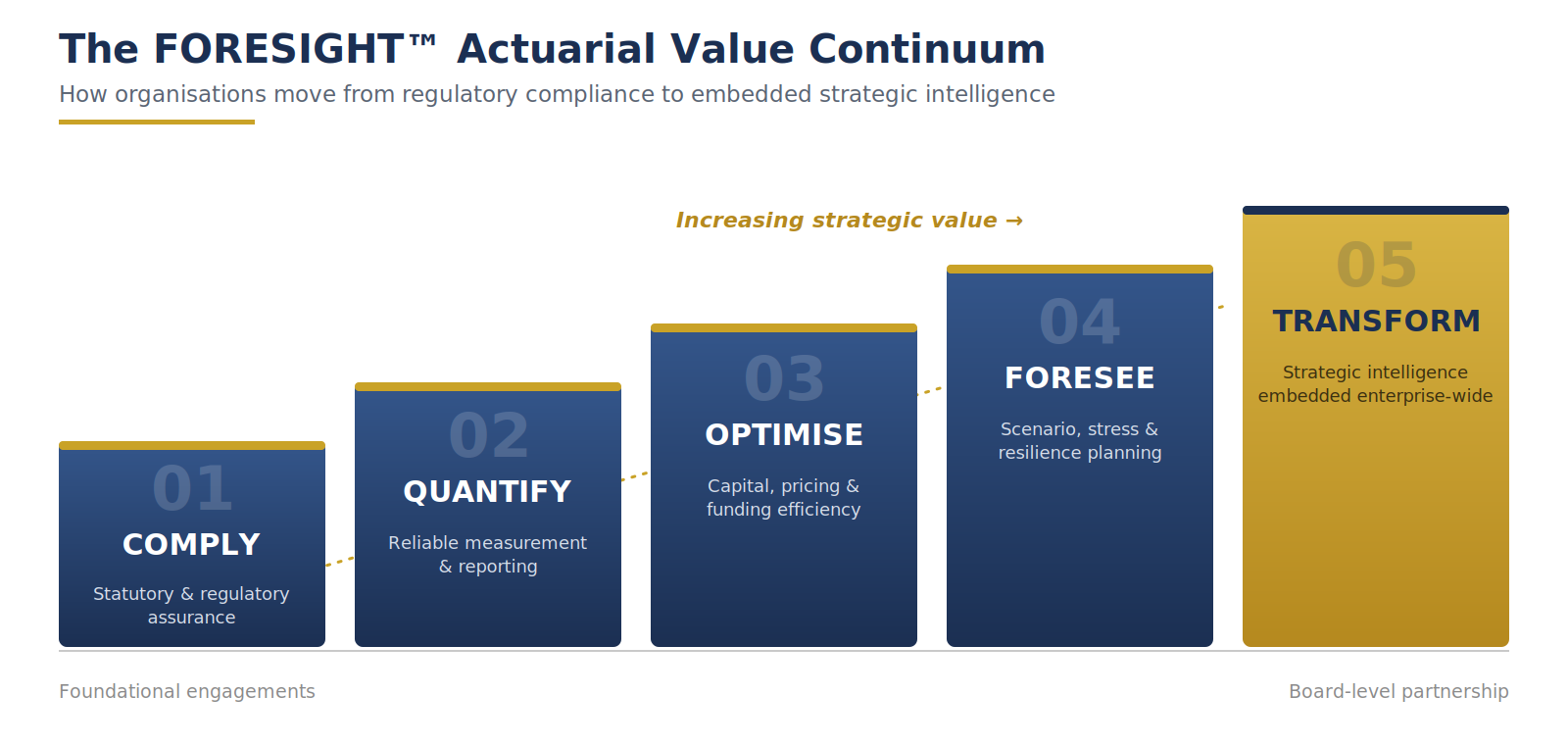
A maturity model is useful precisely because it separates two things organisations habitually confuse — the cost of actuarial work and the value of it. Climbing the continuum does not mean buying more reports; it means extracting more decisions from analysis you are, in many cases, already paying to produce. Each stage builds on the one below, so the journey is cumulative rather than a series of disconnected purchases. With that in mind, consider each stage in turn.
Stage one — Comply: the licence to operate
At the foundation of the continuum, actuarial work exists to satisfy the law and the supervisor. This is the appointed actuary’s certification, the statutory valuation, the reserve opinion, the disclosures demanded by accounting standards. The value at this stage is the most basic and the least negotiable: without it, an organisation cannot lawfully carry the risks it carries. A regulated insurer that fails to produce a credible statutory valuation does not have a strategy problem; it has an existence problem.
The danger of Comply is not that it is unimportant — it is essential — but that so many organisations stop here. They invest considerable money and effort to produce numbers for an outside party, file them, and never look at them again. The analysis that consumed the actuarial budget becomes a regulatory artifact rather than a management tool. The clearest sign that an organisation is stuck at Comply is simple: its board sees actuarial output only when the regulator requires it, and treats the assumptions behind that output as the actuary’s concern rather than its own.
Stage two — Quantify: numbers you can believe
The second stage is reliable measurement. Reserves, expected credit losses, embedded values and experience studies are produced with enough rigour, consistency and transparency that the board, the auditor and investors can genuinely trust them. This sounds modest, but it is the foundation of everything above it, because a decision is only as good as the numbers beneath it. An organisation that cannot trust its own estimates is not managing risk; it is guessing with a spreadsheet.
What separates Quantify from Comply is a shift in audience and intent. At Comply, the numbers are produced for the regulator; at Quantify, they are produced to be believed and used internally. Good practice here means assumptions grounded in the organisation’s own experience rather than borrowed averages, estimates expressed with an honest sense of their uncertainty, and a process robust enough that the figures survive scrutiny without a last-minute scramble. The leap to this stage is often the most valuable an organisation ever makes, because it converts actuarial work from a cost into a dependable source of management information.
Stage three — Optimise: from measuring to improving
At the third stage, the discipline turns outward — from describing the business to improving it. The same models that measure reserves and capital are now used to sharpen pricing, to direct capital toward the activities that earn the most, to structure reinsurance for efficiency, and to set pension funding on a sustainable path. The value becomes tangible and recurring: stronger margins, a lower cost of risk, and more efficient use of the scarcest resource any risk-bearer holds, which is capital.
This is the stage at which actuarial advice most visibly pays for itself. An insurer that learns which products genuinely earn their cost of capital can redirect effort toward the profitable ones; a pension sponsor that understands its funding sensitivities can avoid both reckless contribution holidays and needless over-funding; an organisation that optimises its reinsurance can release capital without taking on more risk. Optimise is where the boardroom question changes from “are our numbers right?” to “what should we do differently because of them?”
Stage four — Foresee: managing the future, not just the present
The fourth stage is forward-looking. Stress and scenario testing, own-risk-and-solvency assessment, and catastrophe and climate modelling allow an organisation to ask not only what its position is today but what it would be if several things went wrong at once. The value is resilience — the capacity to anticipate shocks, buffer against them, and set strategy with a clear view of the risks ahead rather than a glance in the rear-view mirror.
In a region defined by hurricanes, concentrated economies and exposure to global capital flows, this stage is not a luxury. The organisations that survive a bad year are almost always those that imagined it in advance — that knew, before the storm, how much capital and liquidity they would need on the other side. Foresee is also where actuarial work begins to shape strategy directly, because a board that can see its exposures under stress makes different and better decisions about growth, capital and risk appetite.
Stage five — Transform: foresight as a way of operating
At the summit, actuarial intelligence is no longer a function consulted at intervals; it is embedded in how the organisation thinks. It informs capital allocation, product design, the evaluation of acquisitions and the setting of risk appetite, all through a shared language of risk-adjusted return that lets very different opportunities be compared on consistent terms. Predictive analytics sharpen decisions once made on instinct, and the actuary sits where those decisions are made rather than being consulted after they are taken.
The value of Transform is durable competitive advantage — the ability to grow with confidence while competitors guess. Few organisations in the region have reached this stage, which is precisely why the prize for doing so is so large. An organisation that has institutionalised foresight does not merely react to a changing environment faster than its rivals; it positions itself ahead of changes its rivals have not yet thought to quantify.
The economics of climbing
The most important insight of the continuum is not the stages themselves but the relationship between them. The marginal cost of climbing one stage is usually modest, because each stage builds on analysis the organisation already performs; the marginal value, by contrast, tends to rise sharply as you ascend. Moving from Comply to Quantify may require little more than discipline and better process, yet it yields trustworthy numbers beneath every decision. Moving from Optimise to Foresee draws largely on models already built for pricing and capital, yet it can mean the difference between continuity and collapse when a shock arrives.
This asymmetry carries a blunt corollary: stalling at the bottom of the continuum is not the safe choice it appears to be. An organisation that invests heavily to satisfy the regulator and then declines to use the results is paying the full cost of actuarial work while collecting almost none of its value. The most expensive mistake in the field is not climbing too high — it is paying to reach Comply and stopping there.
A diagnostic for your board
Locating your organisation on the continuum does not require a technical audit. A board can take its own reading by asking a handful of honest questions:
- When does the board actually see actuarial analysis — only at regulatory deadlines, or as a routine input to decisions?
- Do we trust our own reserves, provisions and valuations enough to act on them without hesitation?
- Can we say with confidence which of our products, lines or segments truly earn their cost of capital?
- Have we modelled what a severe but plausible combination of shocks would do to our solvency and liquidity?
- Is actuarial insight present in our most important strategic decisions — or absent from them?
The pattern of answers reveals the stage. An organisation that meets actuarial work only at regulatory deadlines sits at Comply; one that trusts its numbers but does not yet use them to improve the business sits at Quantify; and so on up the continuum. The exercise is uncomfortable precisely because it is clarifying.
Why the regional upside is so large
Caribbean organisations are disproportionately clustered at the first two stages of the continuum. The scarcity of resident actuarial capacity, the historical reliance on imported and disconnected advice, and the long habit of treating actuarial work as a compliance cost have all conspired to keep the region’s risk-bearers near the bottom. That, paradoxically, is the source of the opportunity. Where most organisations sit at Comply and Quantify, the value released by climbing even one stage is greater than it would be in a more mature market — and the competitive distance opened between those who climb and those who do not is correspondingly wider.
The continuum is ultimately a statement about choice. Almost every organisation can name the stage it occupies once it looks honestly, and almost none arrived there deliberately. The strategic act is to choose the next stage on purpose — to decide that the analysis already being produced will be used to make better decisions, to manage risk before it arrives, and, in time, to shape strategy itself. Compliance keeps the licence; foresight builds the advantage. The distance between them is precisely the journey this series is designed to help you make.
| TAKE THE NEXT STEP
Request a FORESIGHT™ positioning assessment We will benchmark your organisation against the five stages across each relevant service area and deliver a one-page map showing exactly where you sit and the single highest-value next step — a practical starting point for your board’s risk and strategy agenda. Speak with our Actuarial Advisory team: [email protected] · 876-929-3670 · 876-665-5926 · dawgen.global |
About Dawgen Global
Dawgen Global is an independent, integrated multidisciplinary professional services firm headquartered at 47 Trinidad Terrace, New Kingston, Jamaica, serving more than 15 territories across the Caribbean. Founded and led by Dr. Dawkins Brown, Executive Chairman, the firm is independent and not affiliated with any international network. It delivers a full suite of professional services under one roof: audit and assurance; tax advisory; IT and digital transformation; risk management; cybersecurity; actuarial and insurance regulatory advisory; HR advisory; mergers and acquisitions; corporate recovery; business advisory and strategy; accounting BPO and virtual CFO services; and legal process outsourcing.
The proposition is simple: big-firm capability without the big-firm price. Dawgen Global’s integrated approach is built for the specific complexities and opportunities of the Caribbean market, helping organizations make sharper, better-informed decisions that drive measurable progress.
To explore a partnership, reach out:
- Website: dawgen.global
- Email: [email protected]
- WhatsApp (Global): +1 555-795-9071
- Caribbean offices: +1 876-665-5926 | +1 876-929-3670 | +1 876-926-5210


