
A standing guide for owner-managed businesses, their boards and their advisers
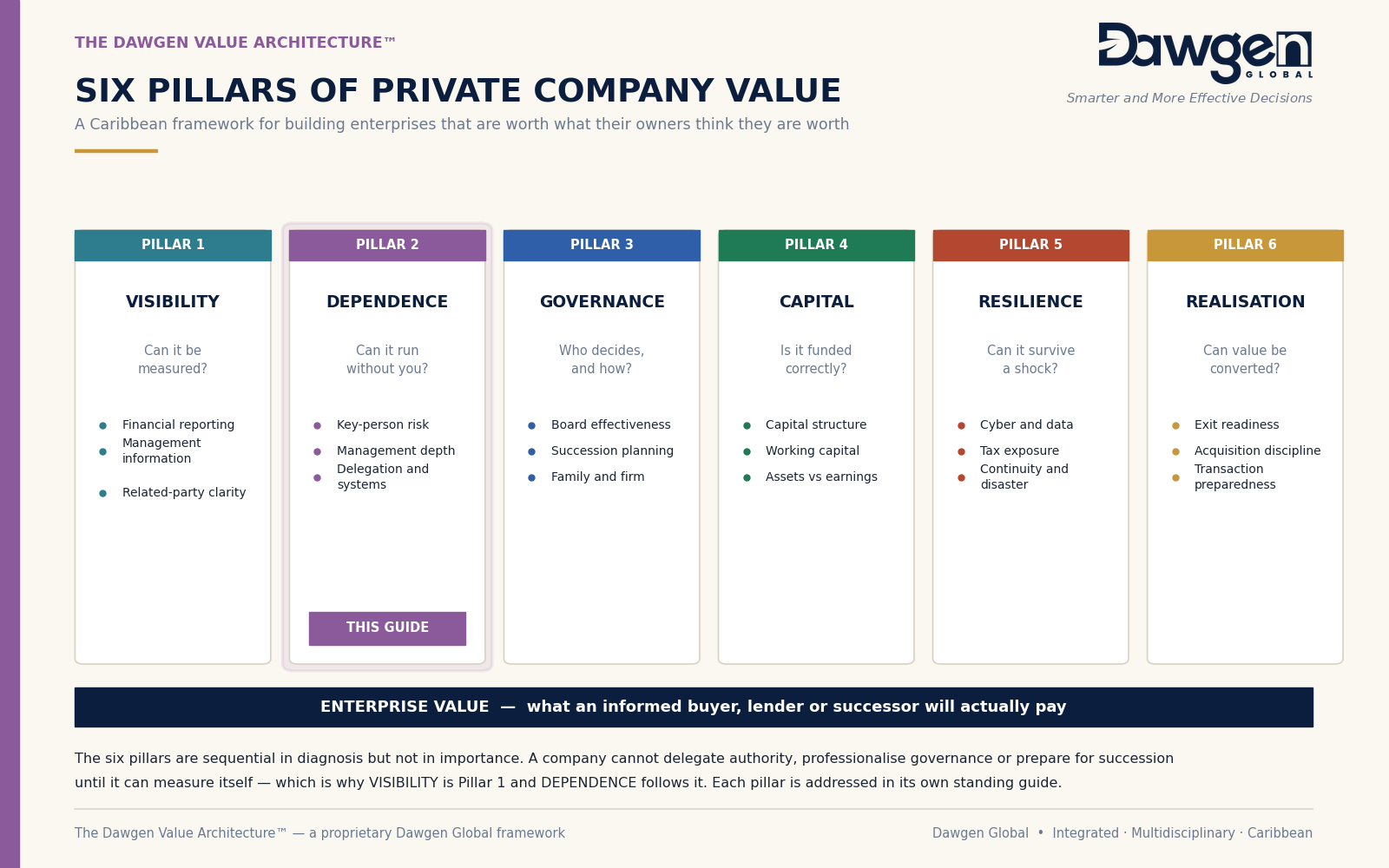
The Dawgen Value Architecture™ — six pillars of private company value. This guide addresses Pillar 2.
The Dawgen Value Architecture™
Most owner-managed businesses in the Caribbean are worth less than the people who built them believe. That is not a comment on the quality of those businesses. It is a comment on the difference between value that exists and value that can be demonstrated to a lender, a buyer, a regulator or a successor. The gap between the two is rarely closed by trading harder. It is closed by building the conditions under which value becomes visible, transferable and durable.
The Dawgen Value Architecture™ is the framework we use to name those conditions. It holds that what a private company is actually worth is determined by six things, each of which can be assessed, scored and improved. The framework was developed from patterns that recur across private company advisory engagements in this region, and it is set out here in full so that owners and boards can apply it to their own businesses without engaging anyone at all.
The six pillars
PILLAR 1 · VISIBILITY Can it be measured?
PILLAR 2 · DEPENDENCE Can it run without you?
PILLAR 3 · GOVERNANCE Who decides, and how?
PILLAR 4 · CAPITAL Is it funded correctly?
PILLAR 5 · RESILIENCE Can it survive a shock?
PILLAR 6 · REALISATION Can value be converted?
The order is deliberate, but it is an order of diagnosis rather than an order of importance. Pillar 1 asked whether a business can be measured at all, because nothing else can be fixed until it can. Pillar 2 asks the question that follows immediately: whether the business, having been measured, can operate without the person who built it. A company that can describe itself but cannot run itself has solved one half of the problem.
How each guide is built
Every guide in the series follows the same structure, so that a reader who has worked through one will know exactly where to look in the next. Each begins with the pattern as it presents itself in practice, then examines the Caribbean conditions that make the pattern harder to resolve here than elsewhere. It then sets out what the problem costs in cash terms, why owners nonetheless leave it unaddressed, and a staged remedy organised into the first ninety days, months three to twelve, and beyond. Each guide closes with a scored diagnostic the reader can complete unaided, and a short section on where to begin.
The guides are written as standing reference documents rather than articles. They are intended to be returned to, worked through with a management team, and used as the basis for a board conversation. Figures presented as ranges are indicative of what we observe in practice and in the published international literature; they are not the output of a survey, and they are labelled as such wherever they appear.
| Where this guide sits
This is Pillar 2 of 6. It addresses key-person risk, management depth, and delegation and systems — the three components of whether a business can operate without its owner. Pillar 1, VISIBILITY, precedes it and should be read first where the reporting foundation is weak. Pillars 3 through 6 follow in sequence, and the capstone across the whole framework is the Private Company Value Scorecard, which consolidates the six diagnostics into a single view of what a business would be worth to an informed buyer, lender or successor. |
SECTION 1
The Pattern

There is a compliment that is paid to owner-managers across this region more often than any other, and it is almost always meant kindly. The business could not run without him. Staff say it with admiration, customers say it with loyalty, and the owner hears it as confirmation that thirty years of work built something that depends on his judgement. It is the single most expensive compliment in private business.
It is expensive because every party who will ever put a number on the company hears the same sentence differently. A lender hears an unhedged exposure. A buyer hears a reason to defer half the consideration. An insurer hears a claim waiting to happen. A successor hears a job that cannot be inherited, only re-learned. What the owner experiences as indispensability, the market prices as risk.
A business that depends on one person is not more valuable because that person is excellent. It is less valuable because that person is singular.
The compliment, translated
The translation is worth stating plainly, because owners rarely hear it said out loud. When a business cannot function without its principal, the enterprise and the individual have not been separated. What is being sold, lent against or handed on is not a company. It is a personal practice with inventory, premises and staff attached — and personal practices do not transfer.
This is the second pillar of the Dawgen Value Architecture™ because it is the first structural question that arises once measurement exists. A company that has fixed its reporting can now describe itself accurately. Pillar 2 asks what that accurate description reveals: whether the entity being described has an existence independent of the person describing it.
The test that settles it
There is no need to speculate about the answer. The condition is directly measurable, and the measurement takes fourteen days. The owner becomes genuinely unreachable — not on email, not on WhatsApp, not available for the one urgent call — and someone keeps an honest record of what stops, what waits, and what is decided anyway.
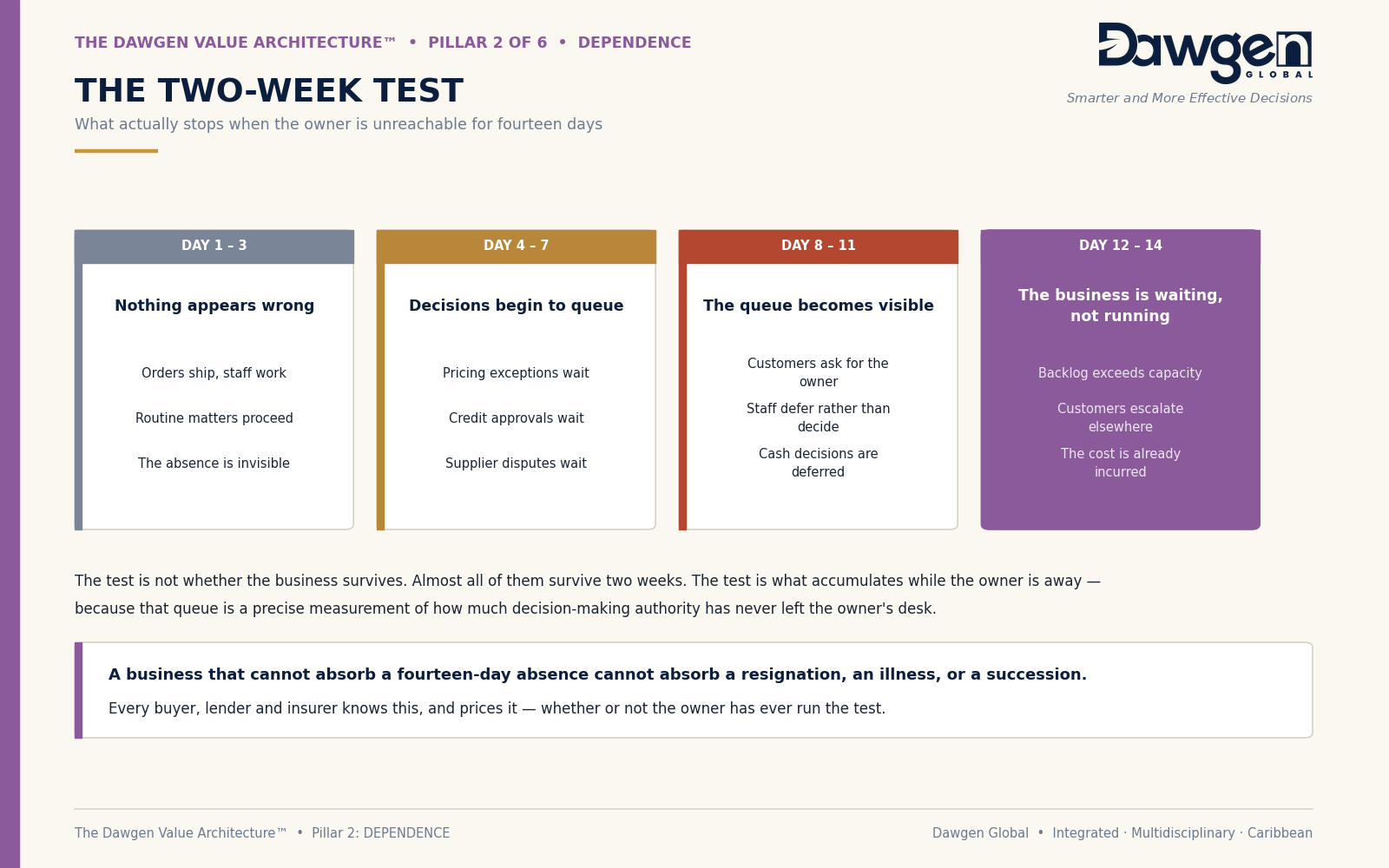
Almost every business survives the fortnight. That is not what the test measures. What it measures is the queue: the pricing exception nobody would approve, the credit limit nobody would extend, the supplier dispute that sat unresolved, the customer who was told the boss would call on his return. That queue is the most precise available measurement of how much decision-making authority has never left the owner’s desk — and it is the same queue a buyer will find in diligence, priced rather than described.
SECTION 2
The Caribbean Variant
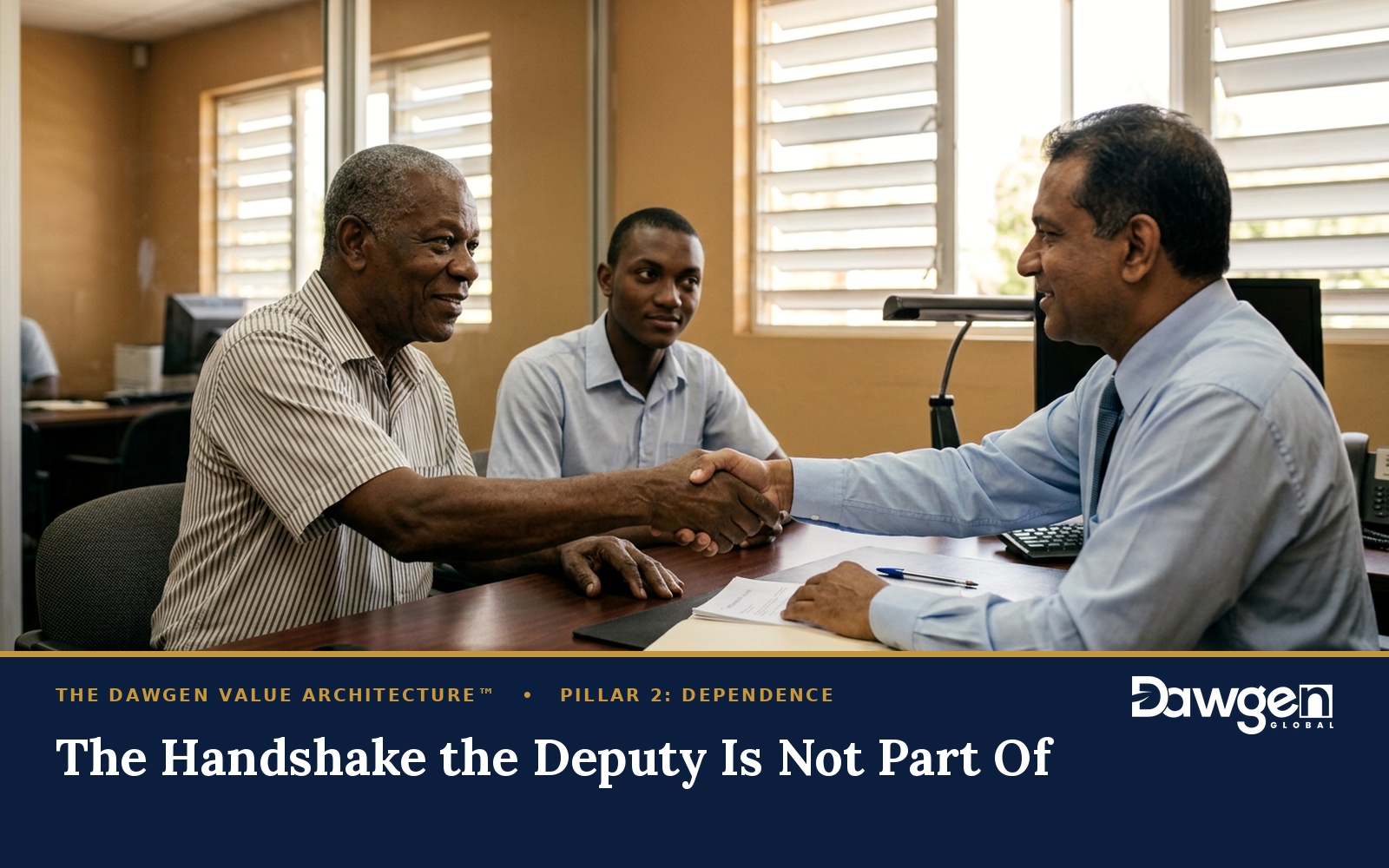
Owner dependence is a global condition of private business. What is regional is how hard it is to unwind here, and why the standard advice — hire a strong second line, document your processes, step back — collapses on contact with Caribbean conditions. Six of those conditions recur with enough regularity to be treated as structural rather than incidental.
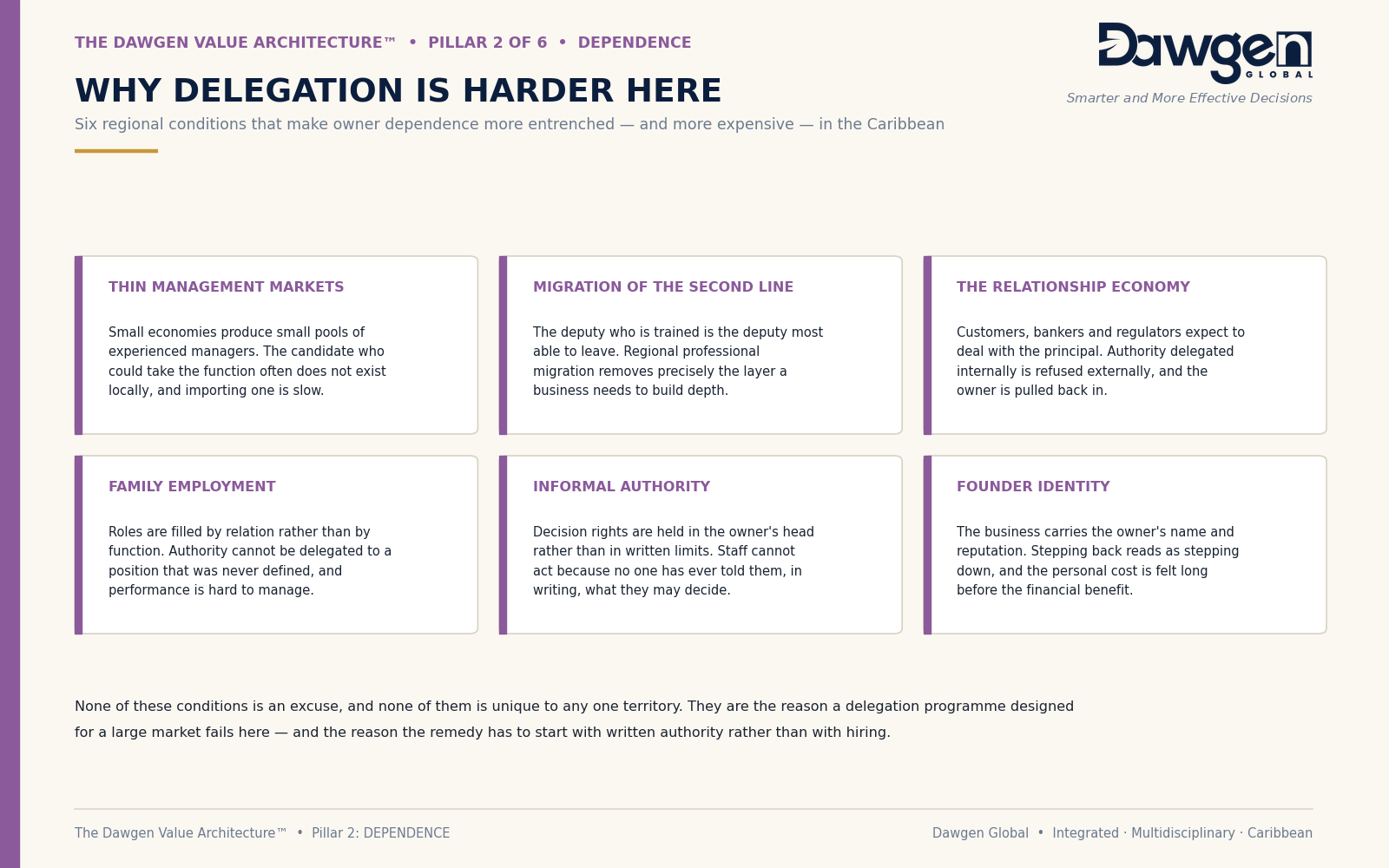
The first is the size of the management market. In a territory of a few hundred thousand people, the pool of managers who have run a function of comparable scale is genuinely small, and it is already employed. The advice to recruit a capable deputy assumes a market that in many territories does not exist at the required grade, and importing one carries a cost and a work-permit timeline that most owner-managed businesses will not carry.
The second compounds the first. The deputy who is developed is, by definition, the employee most able to secure work elsewhere — including overseas. Regional professional migration removes precisely the layer of management a business needs to build depth, and owners who have trained a successor only to lose them to a larger market or another country draw a rational, if damaging, conclusion about the value of doing it again.
The third is the relationship economy. In markets this size, the principal is known personally to the bank manager, the major customers, the regulator and the largest suppliers. Authority delegated internally is frequently refused externally: the customer calls the owner directly, the banker asks to speak to him, and the deputy’s decision is overturned by a telephone call. Delegation fails not because it was badly designed but because the counterparty declined to accept it.
The fourth is the entanglement of family and firm, which Pillar 3 addresses in full. Where roles are filled by relation rather than by function, authority cannot be delegated to a position that was never defined, and underperformance cannot be corrected without a domestic consequence.
The fifth is informality of authority. In most owner-managed Caribbean businesses, decision rights are held in the owner’s head. Staff do not act because nobody has ever told them, in writing, what they are permitted to decide — and in the absence of a written limit, the safe course is always to wait. The business is not short of capable people. It is short of permission.
The sixth is identity. The firm often carries the founder’s name, and his standing in the community is bound up with it. Stepping back reads to him, and sometimes to his staff, as stepping down. The personal cost of delegating is felt immediately; the financial benefit arrives years later, in a valuation he may not yet be contemplating.
| Why the standard prescription fails here
International guidance on key-person risk begins with recruitment and succession planning, because it assumes a deep management market and formal delegation as the default. In this region the sequence has to be inverted. Written authority comes first, because it costs nothing, requires no hire, and is the only step that works even when the management market is thin and the second line is mobile. |
SECTION 3
What It Costs

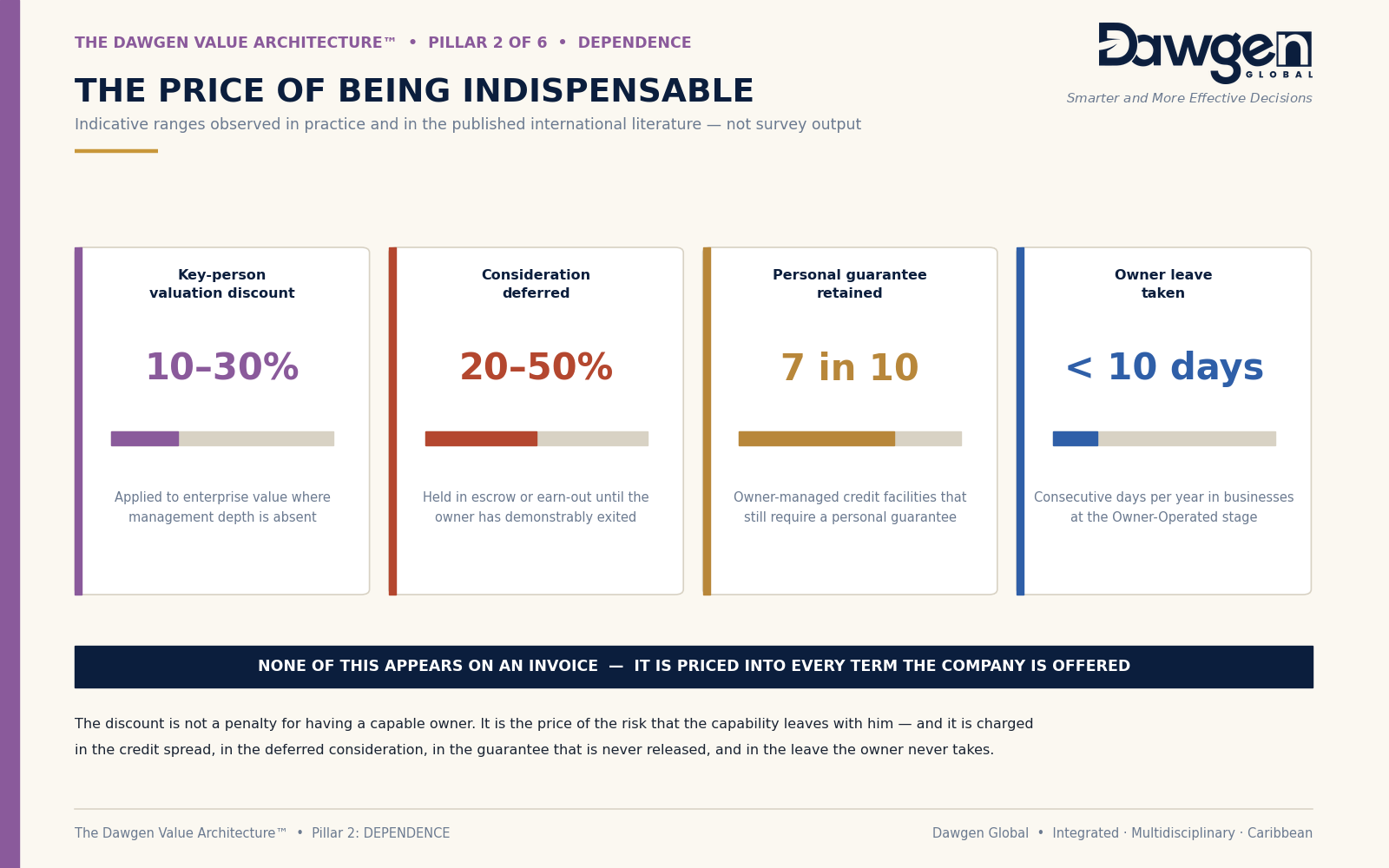
Owner dependence is charged, not billed. It never appears as a line item, which is why owners so often conclude it is costing them nothing. It is collected instead in the terms every counterparty offers — and the following ranges are indicative of what we observe in practice and in the published international literature. They are not the output of a survey, and they should be read as orders of magnitude rather than as measurements.
It is paid at exit
The key-person discount is the most direct charge. Where a buyer concludes that the earnings stream depends on an individual who will not remain, the discount applied to enterprise value commonly falls in the range of ten to thirty per cent, and the effect is not confined to price. Consideration is restructured: a substantial share is deferred into escrow or an earn-out, released only once the owner has demonstrably exited without the business deteriorating. The owner is, in effect, asked to guarantee his own redundancy before being paid for it.
It is paid to the bank
Lenders price the same risk earlier and more quietly. The personal guarantee that is never released, the key-man insurance assignment, the covenant that survives longer than it should — each is a response to a credit file in which the business and the borrower are indistinguishable. The owner who cannot be replaced cannot be released, and personal assets remain pledged years after the balance sheet would otherwise justify it.
It is paid every week, in the owner’s own time
The least visible cost is the one the owner bears personally. Where every exception returns to one desk, the owner’s week is consumed by decisions that a written limit would have settled without him. He is not working on the business because he is fully occupied being it. Leave is not taken, illness is deferred, and the strategic work that would raise the value of the company is the work that never has time allocated to it.
The discount is not a penalty for having a capable owner. It is the price of the risk that the capability leaves with him.
SECTION 4
Why Owners Do Not Fix It

If the cost is this large and the remedy this well understood, the persistence of the problem requires an explanation. In our experience five reasons account for nearly all of it, and only one of them is about capability.
The first is that the compliment is pleasant. Being needed is not a burden that owners are uniformly eager to put down. Thirty years of being the person who solves it produces an identity as well as a habit, and the request to delegate is heard, accurately, as a request to become less central to something that has been the centre of a life.
The second is that delegation is slower before it is faster. Explaining the decision takes longer than making it, and for the first several months the owner does both — he supervises the decision and remains accountable for it. Under commercial pressure the rational short-run choice is always to decide it himself, and the short run renews itself daily.
The third is that a previous attempt failed. Most owner-managers have tried. They hired a manager who did not work out, or they announced that a deputy would handle something and then overturned the deputy’s first unpopular decision in front of the staff. The conclusion drawn is that the people were wrong. The more common truth is that authority was announced but never defined, so nobody — including the deputy — knew what he was permitted to decide without asking.
The fourth is the fear of building a competitor. In a small market, the manager who learns the customer relationships, the margins and the supplier terms is a manager who could leave and reconstruct the business two streets away. This fear is not irrational, and it is rarely spoken aloud. It is best answered with contracts, incentives and equity design rather than with the withholding of information — but it is answered too seldom, and so the information is simply withheld.
The fifth is that nothing has gone wrong yet. The owner has not been ill, the deputy has not resigned at the wrong moment, and no buyer has yet looked at the file. Key-person risk is a low-probability, high-consequence exposure, and low-probability exposures lose every contest for attention against the operational problem that is on the desk this morning.
| The correct diagnosis
Owner dependence is not primarily a talent problem, and it is not solved by recruitment. It is an authority problem. In the great majority of cases the business already employs people capable of making the decisions that currently queue for the owner — they have simply never been told, in writing, which decisions are theirs. That is a document, not a hire, and it is why the remedy in the next section begins with a page rather than with a payroll. |
SECTION 5

What follows is a staged handover, not a resignation. The owner does not leave the business, and in most cases does not reduce his hours in the first year. What leaves is the decision — one category at a time, in writing, to a named person, with an evidence trail a lender or buyer can inspect.
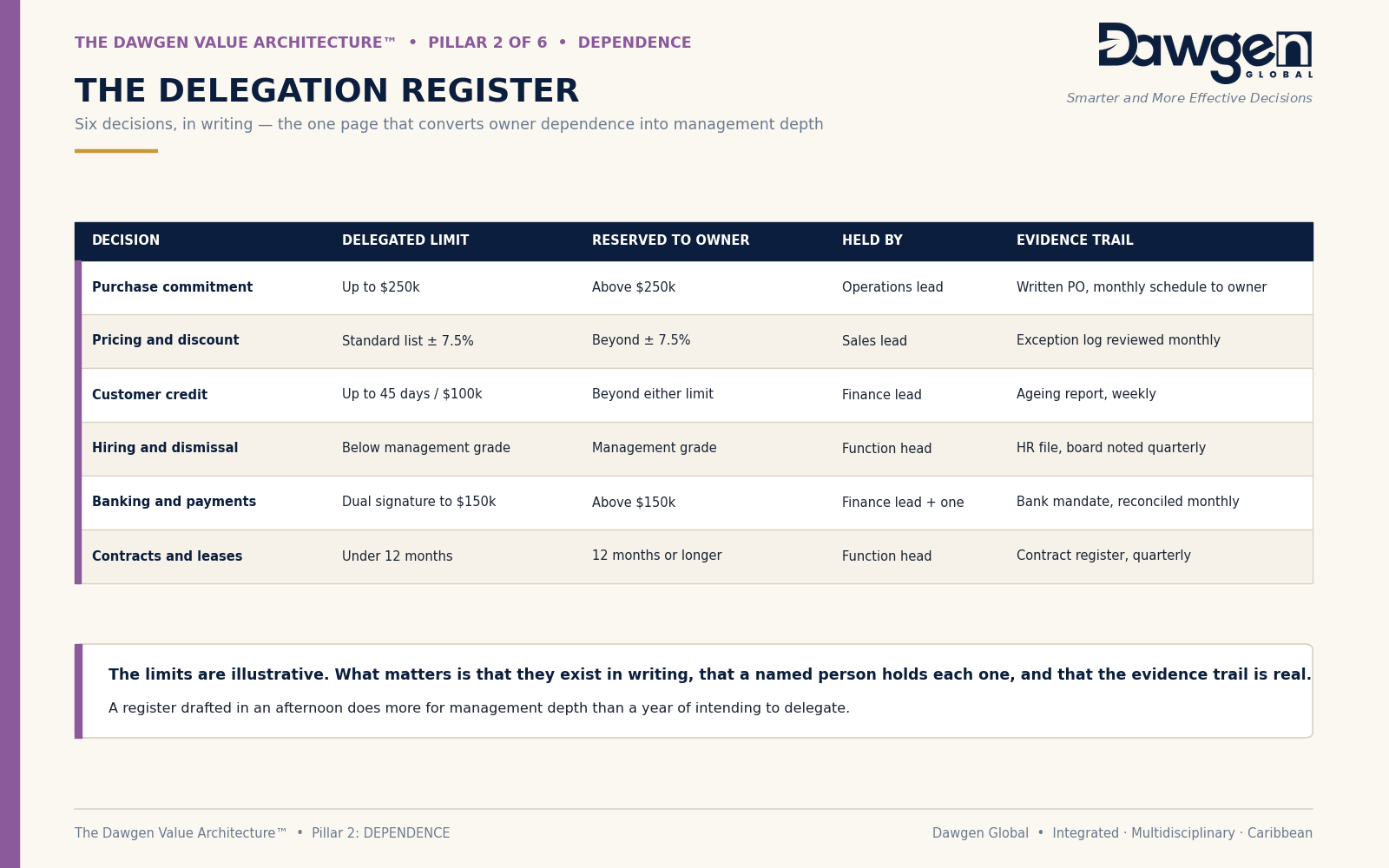
The instrument that does most of the work is unglamorous and costs nothing. It is a single page listing the decisions that recur, the limit below which each may be taken without the owner, the person who holds that limit, and the record that proves it was exercised properly.
Phase one: the first ninety days
The objective of the first ninety days is not good delegation. It is written delegation. Nothing else in this programme can proceed until decision rights exist on paper.
- Run the two-week test, or a scaled version of it, and keep an honest record of what queued.
- Draft the delegation register — six decision categories are usually enough to begin.
- Name one holder for each limit, and tell that person in writing what they may now decide alone.
- Document the ten processes that exist only in the owner’s head, at working-note level rather than as a manual.
- Move bank mandates to dual signature within the written limits, so the register has teeth.
Phase two: months three to twelve
With authority on paper, the second phase builds the depth that makes the authority credible — and, critically, does the external work that Caribbean conditions make necessary.
- Appoint or designate a deputy for each critical function, from inside where possible.
- Introduce those deputies personally to the top twenty customers and the principal suppliers, with the owner present at the first meeting and absent from the second.
- Ask the bank to deal with the finance lead on routine matters, and put that request in writing.
- Move the exception queue into a scheduled management meeting, so decisions are made in a forum rather than in a corridor.
- Transfer contracts, leases and licences that stand in the owner’s personal name into the name of the company.
- Tie incentives to function results rather than to the owner’s approval.
Phase three: beyond twelve months
The third phase converts a delegated business into a transferable one, and it is where the valuation effect is actually realised.
- Take a full two weeks away, genuinely unreachable, and measure the queue again against the baseline.
- Have the deputies present to the bank, and to the auditors, without the owner in the room.
- Formalise second-line succession: for each critical role, who acts if the holder resigns tomorrow.
- Review the register quarterly and raise the limits deliberately, so authority grows rather than calcifies.
- Move to Pillar 3, GOVERNANCE — once decisions are delegated, they need a forum in which they are reviewed.
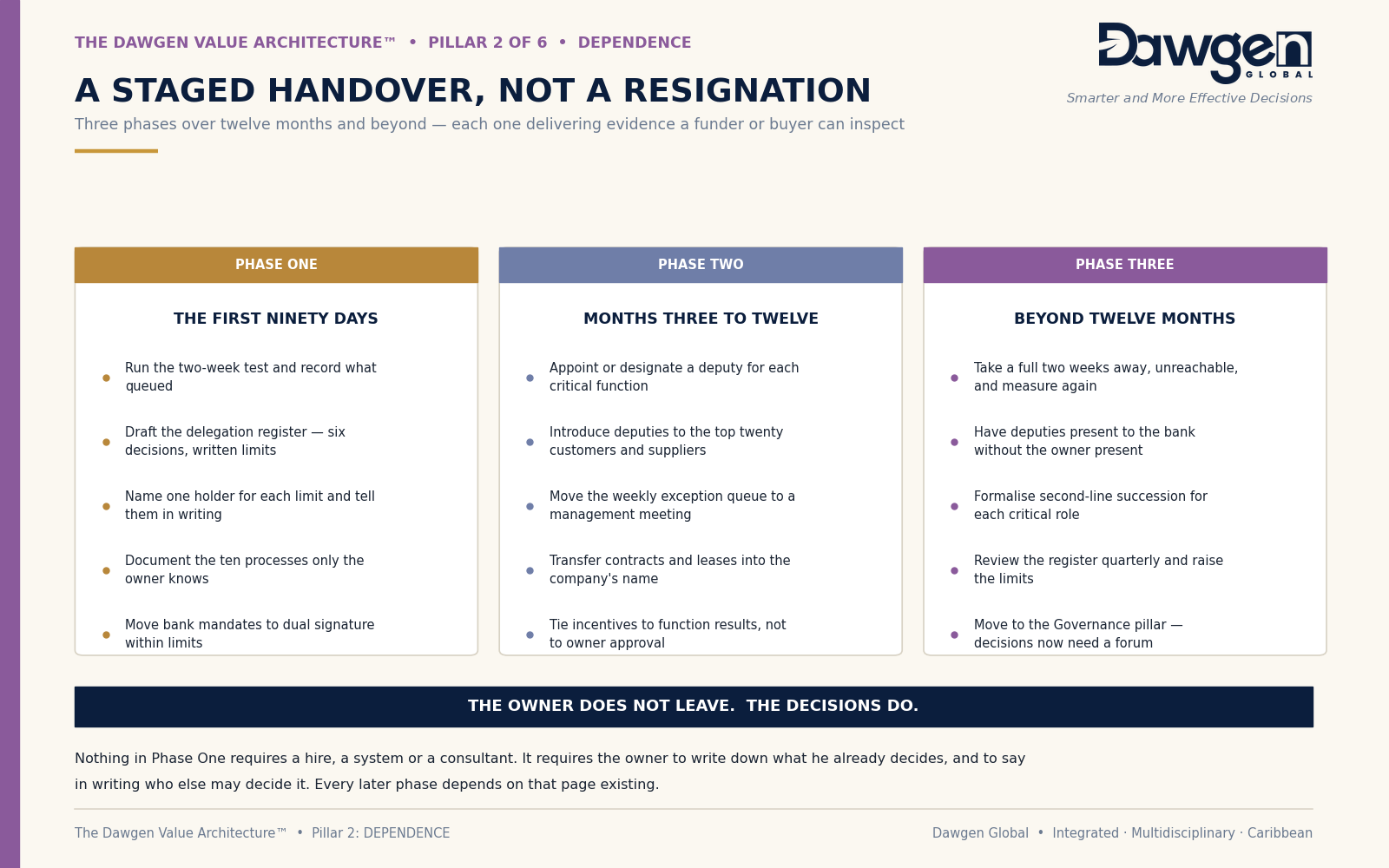
Nothing in the first ninety days requires a hire, a system or a consultant. It requires the owner to write down what he already decides, and to say in writing who else may decide it.
SECTION 6
The Diagnostic
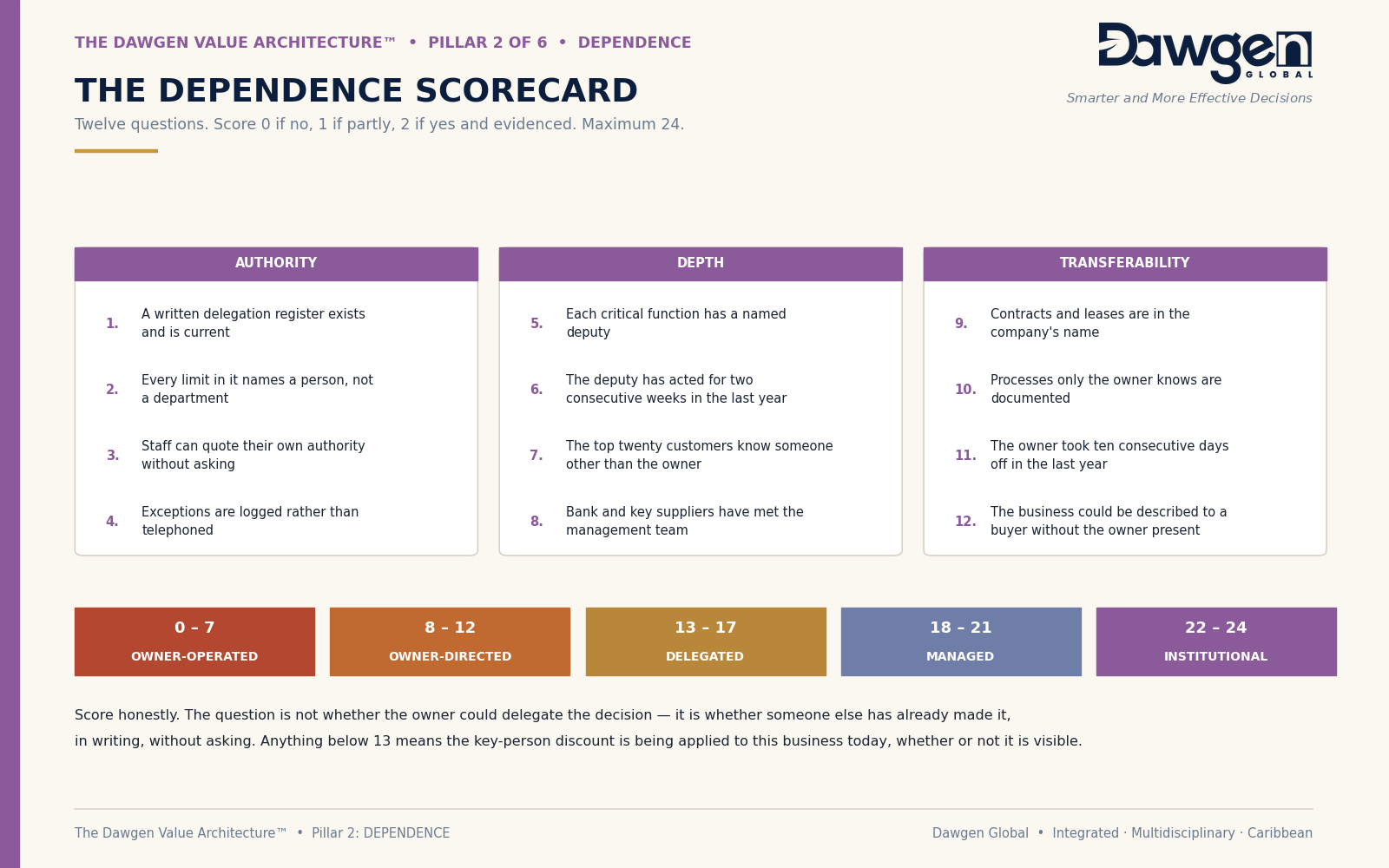
Before deciding where to begin, locate the business honestly on the dependence ladder. Most Caribbean owner-managed companies sit at Stage 1 or Stage 2. Lenders begin releasing personal guarantees around Stage 3. Buyers stop deferring the majority of consideration around Stage 4.
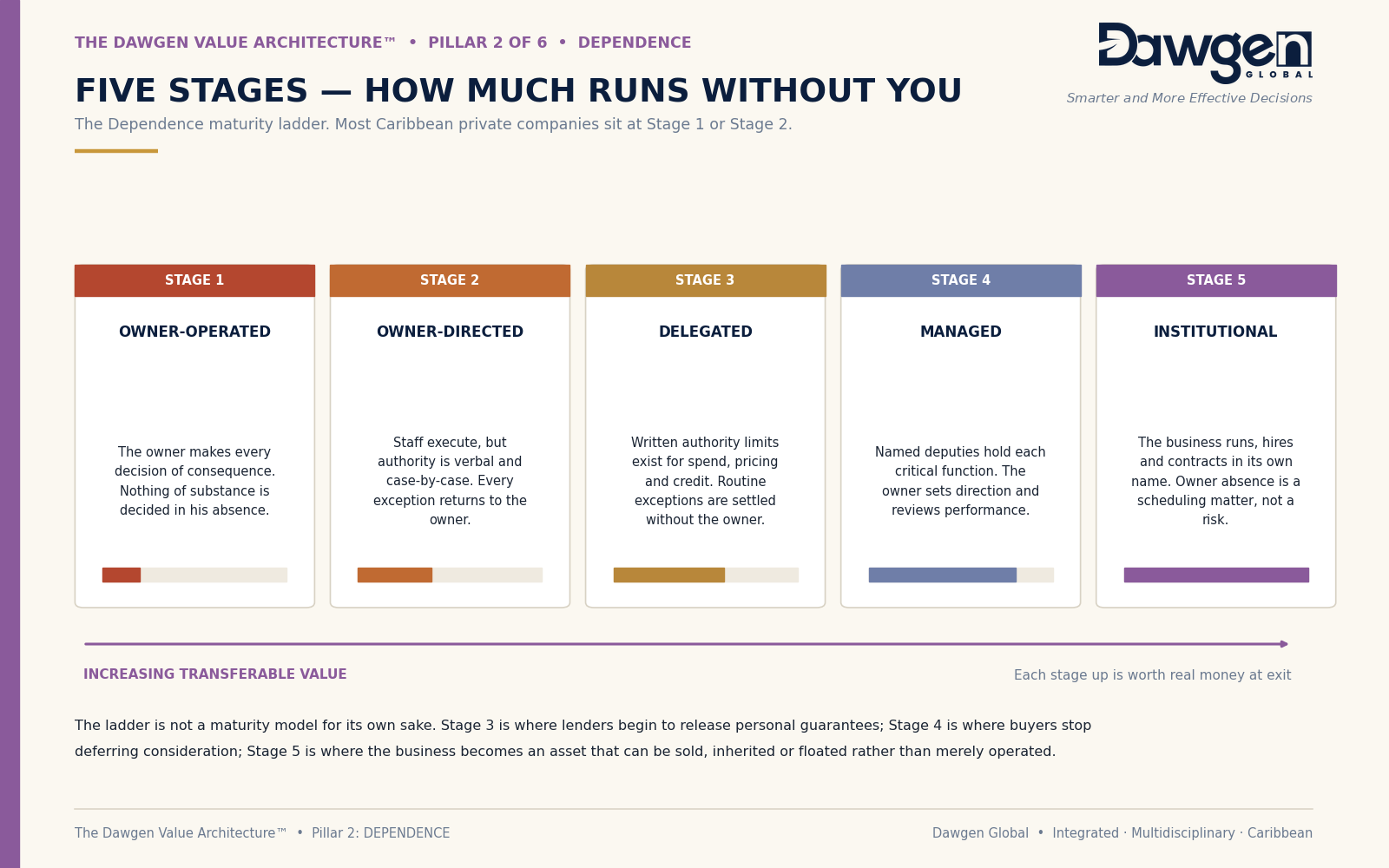
The scorecard below converts that judgement into a number. It is twelve questions, scored zero for no, one for partly, and two for yes and evidenced. The instrument is worthless flattered, and there is no benefit in scoring it generously — most owners score between two and five on first attempt, and almost all of them expected to score higher.
| The test that matters
Apply one question to the whole result: if you were unavailable for three months, could a competent outsider run this business from its documentation and its people alone? If the answer is no, the dependence work is not finished — however capable the team feels day to day. That question is also the bridge to Pillar 3 of the Value Architecture™, which asks who decides once the owner no longer decides everything. |
SECTION 7
Where to Start

If you scored between zero and seven, do not attempt the full programme. Do three things: run the two-week test, write the delegation register for the two decisions that queue most often, and name one person for each. Nothing else matters until decision rights exist on paper.
If you scored between eight and twelve, the reporting exists and the gap is authority rather than information. Set a limit, publish it, and then — this is the part that fails most often — do not overturn the first decision made under it. A limit that is reversed once in front of staff is a limit that no longer exists.
If you scored between thirteen and seventeen, the work is external rather than internal. Your people can decide; your counterparties have not yet accepted that they may. Introduce the deputies to the bank and to the largest customers, and stop taking the call that should have gone to them.
If you scored above eighteen, you are close to a transferable business. The remaining work is documentary and contractual: names on leases, second-line succession, and a register that is genuinely reviewed rather than merely filed.
| The one page to write this week
If nothing else in this guide is acted on, write the delegation register. Six rows, six limits, six names. It can be drafted in an afternoon, it requires no system and no recruitment, and it is the single intervention that moves a business from Stage 1 to Stage 3 faster than any other. Every other step in this guide assumes that page exists. |
ABOUT THIS SERIES
The Dawgen Value Architecture™ is a proprietary Dawgen Global framework addressing the six conditions that determine what a private company is actually worth. Each pillar is published as a standing guide: VISIBILITY, DEPENDENCE, GOVERNANCE, CAPITAL, RESILIENCE and REALISATION. The guides are written for Caribbean owner-managed businesses, their boards and their advisers, and are intended to be used without engaging anyone at all.
This series addresses patterns observed across private company advisory engagements and published international evidence. It does not comment on any listed issuer or any specific client, and no company referred to or resembled in these guides is intended to be identifiable.
Next in the series
Pillar 3 — GOVERNANCE: Who Decides, and How? Board effectiveness, succession planning, and the point at which family and firm must be separated.
Take the diagnostic further
The Dawgen Key-Person Risk and Delegation Review applies this scorecard inside your business, tests it against your counterparties’ actual terms, and delivers a maturity rating, a drafted delegation register and a board-ready summary.
At Dawgen Global, we help you make Smarter and More Effective Decisions.
About Dawgen Global
Dawgen Global is an independent, integrated multidisciplinary professional services firm headquartered at 47 Trinidad Terrace, New Kingston, Jamaica, serving more than 15 territories across the Caribbean. Founded and led by Dr. Dawkins Brown, Executive Chairman, the firm is independent and not affiliated with any international network. It delivers a full suite of professional services under one roof: audit and assurance; tax advisory; IT and digital transformation; risk management; cybersecurity; actuarial and insurance regulatory advisory; HR advisory; mergers and acquisitions; corporate recovery; business advisory and strategy; accounting BPO and virtual CFO services; and legal process outsourcing.
The proposition is simple: big-firm capability without the big-firm price. Dawgen Global’s integrated approach is built for the specific complexities and opportunities of the Caribbean market, helping organizations make sharper, better-informed decisions that drive measurable progress.
To explore a partnership, reach out:
- Website: dawgen.global
- Email: [email protected]
- WhatsApp (Global): +1 555-795-9071
- Caribbean offices: +1 876-665-5926 | +1 876-929-3670 | +1 876-926-5210


