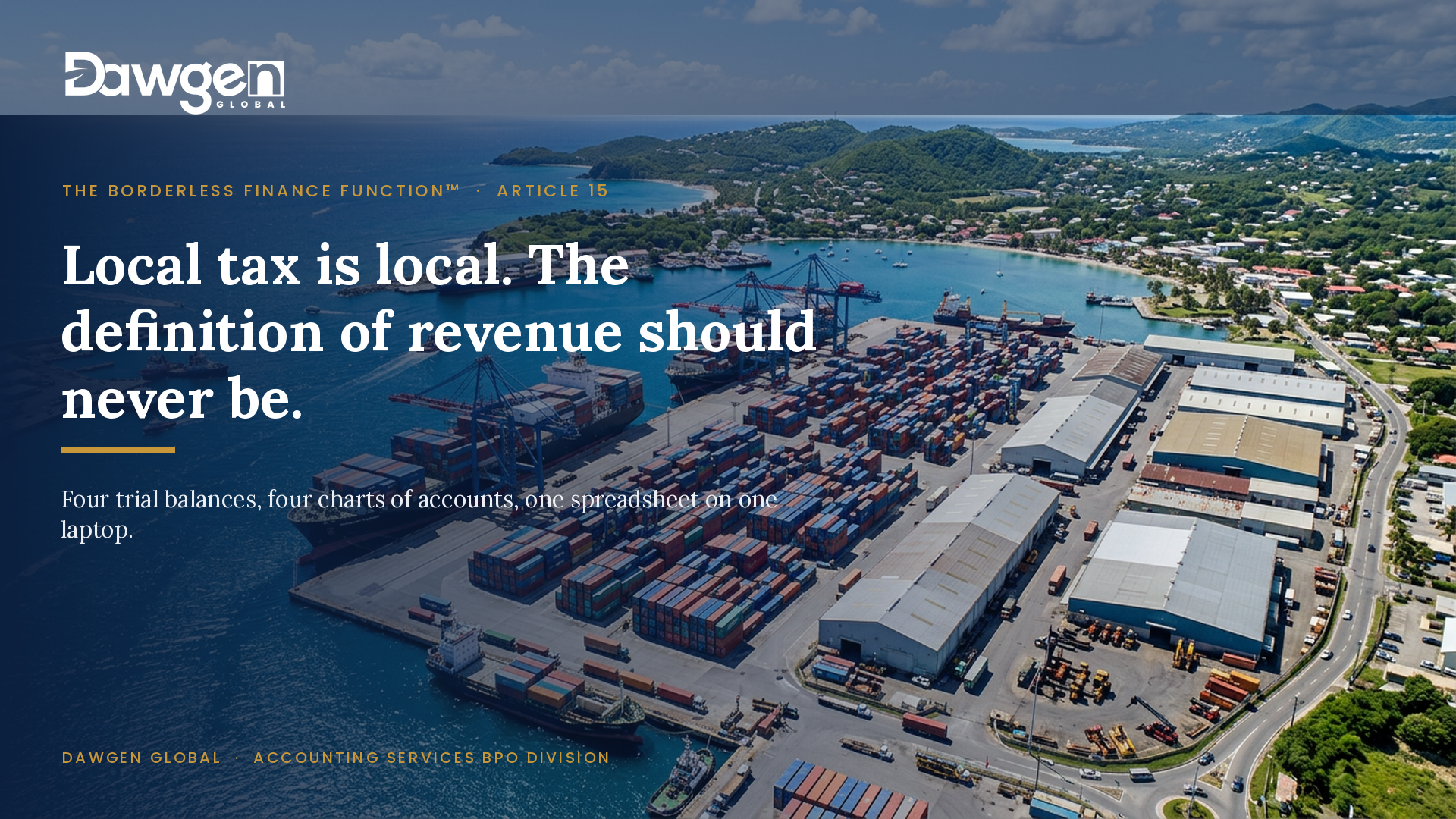
Local compliance is genuinely local and cannot be harmonised away. What can be harmonised is everything underneath it — the chart, the definitions, the cut-off and the eliminations. Most groups have it the other way round.
IN SHORT
| A multi-territory group has to file locally under local rules, in local currency, to local deadlines. That is not the obstacle. The obstacle is that the group view is usually assembled by hand each quarter from four differently structured trial balances. One group chart with local extensions, agreed definitions, intercompany matched at source and eliminations held as rules turns consolidation from a monthly reconstruction into an output. |
SECTION 01
The pattern
Six weeks after the quarter ends, four trial balances have finally arrived. They came at different times, in different currencies, on four charts of accounts that share no common structure, from four bookkeepers who have never met. One person in the group finance office now maps them into a spreadsheet, using judgement about what the line called other income means in the Port of Spain file and whether the Barbados entity has classified its vehicle costs the way the Jamaica entity has.

That spreadsheet is the group. It is not in any accounting system. It cannot be drilled into, tested or re-run. It exists in one file, on one laptop, maintained by one person, and it is the basis on which the board is asked to understand the business.

Inside it are the intercompany balances, which do not agree. They never do. The Jamaica entity has charged the Trinidad entity a management fee; Trinidad has recorded a different amount, in a different month, at a different rate, or has not recorded it at all. The difference is real and its resolution takes days, so at some point in the process it is absorbed into a line that nobody examines closely, and the consolidation balances because it has been made to balance.
By the time the group number is available it is six to ten weeks old. The quarter it describes is over and the quarter that followed is nearly over too. Management is being asked to make decisions about a business it can see only in the rear-view mirror, and at a distance that gets longer every time a territory files late.
The deeper failure is not lateness. It is that the group number is assembled rather than produced, which means nobody can interrogate it. A director asks why group margin fell three points and the honest answer is that finding out will take a week, because the answer is not held anywhere — it has to be rebuilt from the same four files by the same one person. A number that cannot be questioned is not management information. It is a report.
SECTION 02
The Caribbean variant
Six conditions make multi-territory consolidation harder in this region than the textbook treatment assumes.
Groups here grew by opportunity, not by design. An entity was incorporated in one territory because a contract required it, another was acquired with its existing accountant and software in place. Nobody ever chose four charts of accounts; the group simply accumulated them, one commercial decision at a time.

The tax regimes are genuinely different, and that is not a problem to be solved. Corporate rates differ, the consumption tax has a different name and base in each territory, withholding applies to cross-border payments at varying rates, and transfer pricing rules exist in some jurisdictions and not others. Local compliance must be done locally and correctly. The mistake is letting that local difference dictate the structure of the group’s own management information.

Several functional currencies, and translation that is economically real. Where entities earn and spend in different currencies, translation differences are not presentational noise. They change reported group equity, and in a devaluing currency they can swamp operating performance entirely if they are not separated from it.
Cash in the group is not always cash available to the group. Exchange control, repatriation approval and thin local foreign exchange markets mean a surplus in one territory may not be deployable in another on any useful timescale. A consolidated cash figure that ignores this is not merely optimistic; it is the number that causes a group to be surprised by a shortage it could see on paper.
Different frameworks and different calendars. One entity reports under full IFRS because of its size or its lenders, another under IFRS for SMEs, and the year ends do not always align. Statutory numbers and group management numbers will therefore legitimately differ, and the group needs to be able to explain the difference rather than be embarrassed by it.
Local finance capacity is thin. Each territory frequently has one bookkeeper and no local finance manager. There is no local reviewer between the source entry and the group consolidation, which means errors travel the whole distance before anyone competent sees them.
SECTION 03
What it costs
The cost of a manual consolidation is paid in three currencies: time, credibility and risk. None of them appears in the management accounts as a line.

Indicative figures, drawn from advisory experience across the region rather than from survey data:
- Six to ten weeks from period end to a group number management can act on, against a realistic target of nine to fifteen days
- Three to ten days of senior finance time each quarter spent mapping, translating and eliminating rather than analysing
- Intercompany differences absorbed rather than resolved, which return later as audit adjustments, tax exposure on cross-border charges, or both
- Audit fee uplift, where the auditor must re-perform a consolidation that cannot be tested as a process because it exists only as a spreadsheet
- A single point of failure, in that the group’s consolidated view is reproducible by exactly one person
The cost that matters most arrives at a transaction. A lender extending facilities across the group, or a buyer looking at it, will ask to trace a group figure down to a source document in one territory. Where that cannot be done, the response is not usually refusal. It is a discount, an indemnity, or a lengthened process — each of which is the price of an assembled number, charged at the least convenient moment.
The group exists in one spreadsheet, on one laptop. It cannot be audited, queried or reproduced by anyone other than the person who built it.
SECTION 04
What the capability actually does
Six mechanisms make consolidation an output of the accounting rather than a project performed on top of it.

One group chart of accounts, with local extensions beneath it. Group reporting lines are common across every entity; territory-specific accounts hang underneath them rather than sitting beside them. Mapping is done once, deliberately, at configuration — not re-derived each quarter by someone interpreting another accountant’s labels.
Definitions are agreed and written down before anything is configured. What revenue is recognised on, what a cost centre means, when a job is complete, which costs are direct. Most consolidation failures are definition failures wearing a technical disguise: four entities can each be correct and still not be comparable.
Translation is performed by the system at the right rates. Average rates for the income statement, closing rates for the balance sheet, and the translation difference carried to reserves where it belongs rather than being absorbed into operating lines. Operating performance and currency movement then remain separable, which is the only way to tell whether a territory is actually performing.
Intercompany transactions are matched at source. A charge raised in one entity creates the corresponding entry in the counterparty entity, at the same value, in the same period, at an agreed rate. The reconciliation stops being a quarterly negotiation between two bookkeepers and becomes a report with a short list of exceptions.
Eliminations are held as rules, not as keystrokes. Configured once, applied consistently every period, visible and re-runnable. The auditor can test the rule rather than re-performing the arithmetic, and a restated prior period does not require somebody to remember what was done last time.
Drill-through from the group line to the source document. The director’s question about group margin is answered in the meeting, by opening the line, then the entity, then the transaction, then the invoice. This single capability changes the character of a board meeting more than any other item on this list.
| Three limits worth stating plainly
Consolidation does not reduce local obligation: every entity still files under its own framework, to its own deadline, with its own local adviser, and nothing here is a substitute for that. A group management view is not the same thing as statutory consolidated financial statements, and where those are required they are prepared as a separate exercise with their own basis. And visibility is not availability — the system can show cash held in a territory, but it cannot repatriate it, and a group that mistakes one for the other will plan around money it cannot use. |
SECTION 05
How the Accounting Services BPO Division delivers it

The group chart and the definitions document come first. Before any configuration, the group agrees its reporting lines and the definitions behind them, in writing, and signs them off. This document outlives the software and it is the reason the numbers become comparable at all.
Local statutory requirements are mapped territory by territory. Framework, filing dates, consumption tax treatment, withholding on cross-border charges, and any transfer pricing documentation requirement. Existing local advisers and auditors are retained where they are working; the Division is not a substitute for local counsel and does not present itself as one.
An intercompany protocol is agreed and enforced. Who may raise a charge, on what basis, at what rate, by which date in the close calendar, and who confirms it in the receiving entity. Most intercompany disagreement is a protocol vacuum rather than a dispute, and the protocol takes an afternoon to write.
The close calendar is aligned across territories. Common cut-off dates, a common order of events, and a single deadline by which each entity is complete. This is the part that fails, and it fails on discipline rather than on technology: a group closing in nine days cannot wait three weeks for one island.
The monthly pack reports at three levels. Entity, segment and group, in group currency and in local currency, with operating performance shown separately from translation effect. Issued to a published date, with commentary, and with the drill-through available to anyone on the distribution list.
The consolidation is documented so that it can be audited as a process. Mapping, elimination rules, translation basis and intercompany protocol are all documented and versioned. The auditor tests the process once rather than re-performing a spreadsheet, which is both cheaper and considerably more persuasive.
SECTION 06
Where to start
Days 0 to 30 — put the group on one page. Every entity, its ownership, its functional currency, its reporting framework, its year end, its filing dates and who keeps its books. Then take last quarter’s intercompany balances and test whether the two sides agree. Finally, count the days between period end and the date the board actually saw a group number. Three facts, and the size of the problem is no longer a matter of opinion.
Days 30 to 90 — fix the structure, not the software. Group chart and definitions agreed and signed. Mapping configured once. The intercompany protocol live and being followed. The close calendar aligned, with each territory committing to a date. None of this requires every entity to move onto one platform in the same quarter, and attempting that is how these programmes stall.
Beyond 90 days — shorten the distance and widen the access. Group pack issued monthly to a published date with drill-through. Segment reporting alongside entity reporting. Translation effect separated from operating performance as standing practice. And the consolidation reproducible by someone other than the person who has always done it.
Local tax is local, and it should stay local: the rates, the returns, the deadlines and the advisers all belong in the territory. What should never be local is the definition of revenue. A group that permits four definitions has not decentralised anything useful — it has simply agreed to be unable to compare itself with itself.

FREQUENTLY ASKED QUESTIONS
Six questions this raises
Does every territory have to move onto one system at the same time?
No, and groups that attempt it usually stall. The group chart, the definitions and the intercompany protocol deliver most of the benefit and can be adopted while entities remain on different platforms. Migration then happens territory by territory, at a pace the local team can absorb, against a structure that is already agreed.
Will this interfere with our local auditors and local tax advisers?
It should make their work easier and cheaper. Local statutory reporting continues under local frameworks with local advisers retained. What changes is that the group consolidation becomes a documented, testable process rather than a spreadsheet the auditor has to re-perform from scratch each year.
What about entities we do not wholly own, or associates?
Ownership percentages and consolidation basis are configured per entity — full consolidation, proportionate treatment or equity accounting — and applied consistently each period with non-controlling interests calculated rather than estimated. The basis for each entity is documented, which is usually the first time a group has it written down in one place.
Which currency should the group report in?
Whichever currency the group’s owners, lenders and decision-makers actually think in, which is frequently United States dollars for Caribbean groups with regional operations. The important point is that the choice is made deliberately and that local currency reporting is retained alongside it, since operational managers do not manage in translated numbers.
Is this statutory consolidated financial statements or management reporting?
Management reporting, by default. Where statutory consolidated financial statements are required, they are a separate deliverable prepared on the applicable framework — but the same mapping, elimination rules and documentation make that exercise substantially shorter and better evidenced than it would otherwise be.
How is it priced?
Fixed monthly by scope — number of entities, territories, currencies, consolidation basis and reporting cadence — rather than by the hour. The group chart, definitions and mapping build are quoted separately as a one-time project with a defined deliverable, and scope is established by the Finance Function Diagnostic before any fee is quoted.
| Next step
Request the Finance Function Diagnostic. A 45-minute scoping conversation covering entities, territories, currencies, consolidation basis, close calendar and reporting cadence; a written recommendation on scope, division of labour and transition plan; and a fixed-scope service proposal priced by process, with service levels and exit terms stated. Dawgen Global · Accounting Services BPO Division [email protected] · dawgen.global/contact-us Caribbean (876) 926-5210 | (876) 929-3670 · United States 855-354-2447 Big firm capability without the big firm price. |
Continue reading: Two Currencies, One Truth. (Article 10) · One Login for Finance, People and Sales Is Not a Convenience. It Is a Control. (Article 11) · The Monthly Management Pack, Page by Page. (Article 20)
Indicative figures are drawn from advisory experience across the region and are not survey output. This series addresses patterns observed across accounting and advisory engagements and does not comment on any specific client. Nothing here is tax advice on any particular transaction or jurisdiction.
About Dawgen Global
Dawgen Global is an independent, integrated multidisciplinary professional services firm headquartered at 47 Trinidad Terrace, New Kingston, Jamaica, serving more than 15 territories across the Caribbean. Founded and led by Dr. Dawkins Brown, Executive Chairman, the firm is independent and not affiliated with any international network. It delivers a full suite of professional services under one roof: audit and assurance; tax advisory; IT and digital transformation; risk management; cybersecurity; actuarial and insurance regulatory advisory; HR advisory; mergers and acquisitions; corporate recovery; business advisory and strategy; accounting BPO and virtual CFO services; and legal process outsourcing.
The proposition is simple: big-firm capability without the big-firm price. Dawgen Global’s integrated approach is built for the specific complexities and opportunities of the Caribbean market, helping organizations make sharper, better-informed decisions that drive measurable progress.
To explore a partnership, reach out:
- Website: dawgen.global
- Email: [email protected]
- WhatsApp (Global): +1 555-795-9071
- Caribbean offices: +1 876-665-5926 | +1 876-929-3670 | +1 876-926-5210


