
A standing guide for owner-managed businesses, their boards and their advisers
The Dawgen Value Architecture™
Most owner-managed businesses in the Caribbean are worth less than the people who built them believe. That is not a comment on the quality of those businesses. It is a comment on the difference between value that exists and value that can be demonstrated to a lender, a buyer, a regulator or a successor. The gap between the two is rarely closed by trading harder. It is closed by building the conditions under which value becomes visible, transferable and durable.
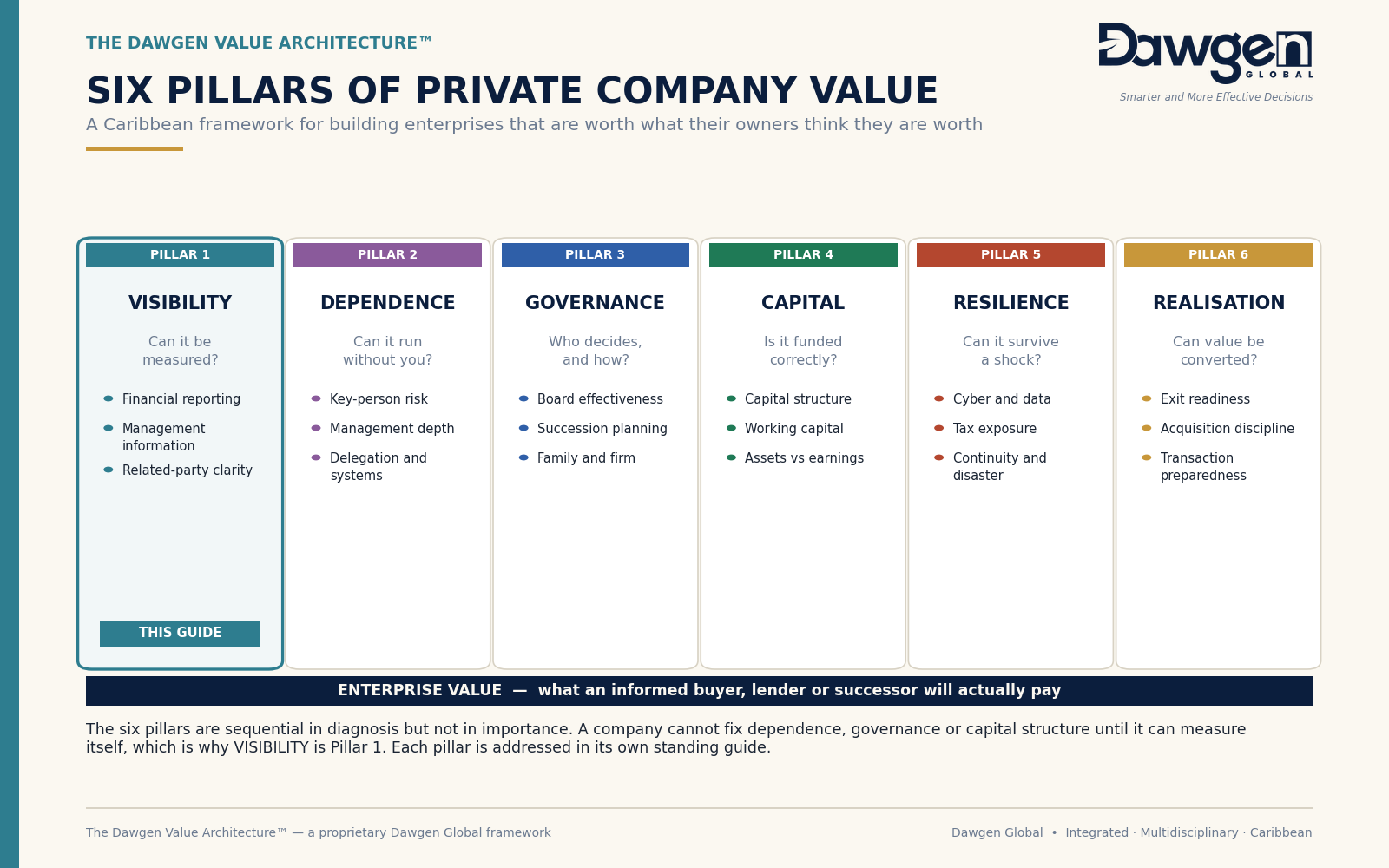
The Dawgen Value Architecture™ is the framework we use to name those conditions. It holds that what a private company is actually worth is determined by six things, each of which can be assessed, scored and improved. The framework was developed from patterns that recur across private company advisory engagements in this region, and it is set out here in full so that owners and boards can apply it to their own businesses without engaging anyone at all.
The six pillars
PILLAR 1 · VISIBILITY Can it be measured?
PILLAR 2 · DEPENDENCE Can it run without you?
PILLAR 3 · GOVERNANCE Who decides, and how?
PILLAR 4 · CAPITAL Is it funded correctly?
PILLAR 5 · RESILIENCE Can it survive a shock?
PILLAR 6 · REALISATION Can value be converted?
The order is deliberate, but it is an order of diagnosis rather than an order of importance. A company cannot sensibly address its dependence on a founder, restructure its capital, or prepare for succession while it is still unable to describe its own performance to a third party. Every intervention in Pillars 2 through 6 is built on measurement. That is why VISIBILITY is Pillar 1, and why this is the first guide in the series.
How each guide is built
Every guide in the series follows the same structure, so that a reader who has worked through one will know exactly where to look in the next. Each begins with the pattern as it presents itself in practice, then examines the Caribbean conditions that make the pattern harder to resolve here than elsewhere. It then sets out what the problem costs in cash terms, why owners nonetheless leave it unaddressed, and a staged remedy organised into the first ninety days, months three to twelve, and beyond. Each guide closes with a scored diagnostic the reader can complete unaided, and a short section on where to begin.
The guides are written as standing reference documents rather than articles. They are intended to be returned to, worked through with a management team, and used as the basis for a board conversation. Figures presented as ranges are indicative of what we observe in practice and in the published international literature; they are not the output of a survey, and they are labelled as such wherever they appear.
| Where this guide sits
This is Pillar 1 of 6. It addresses financial reporting, management information and related-party clarity — the three components of whether a business can be measured at all. Pillars 2 through 6 follow in sequence, and the capstone across the whole framework is the Private Company Value Scorecard, which consolidates the six diagnostics into a single view of what a business would be worth to an informed buyer, lender or successor. |
SECTION 1
The Pattern

There is a conversation that happens in Caribbean advisory practice more often than any other. An owner who has built a business over twenty or thirty years — profitable, respected, with real customers and real assets — discovers what it is worth to somebody else. The number is a fraction of what they expected. Sometimes it is half.
The owner’s instinct is that the buyer, or the banker, or the valuer, has got it wrong. Usually they have not. What has happened is more uncomfortable and more fixable than that: the business is worth what the owner thinks, and the owner cannot prove it.
This is the visibility problem, and it is the first pillar of the Dawgen Value Architecture™ because nothing else can be fixed until it is. A company cannot address its dependence on a founder, restructure its capital, or prepare for succession while it is unable to describe its own performance to a third party. Every other intervention is built on measurement, and measurement is precisely what is missing.
Three descriptions of the same company
In most owner-managed businesses there are three versions of the truth, and they never meet.
The first is what the owner knows. It is detailed, current and largely accurate. The owner knows which customers pay in ninety days rather than thirty, which product line carries the branch, which contract is quietly loss-making, and roughly what next quarter looks like. This knowledge is genuine commercial intelligence. It is also held entirely in one head, transmitted in conversation, and documented nowhere.
The second is what the books say. These are the statutory accounts, prepared for the revenue authority, arriving nine to fourteen months after the period they describe. They are compressed into a year-end exercise, structured to present the company’s tax position rather than to explain its trading, and once filed they are rarely opened again.
The third is what a funder or a buyer sees. This is the narrowest view of all: one set of stale statutory accounts, no segmental detail, related-party balances sitting on the balance sheet without explanation, and no means of testing whether last year was representative. It is on this third description that the price is set.
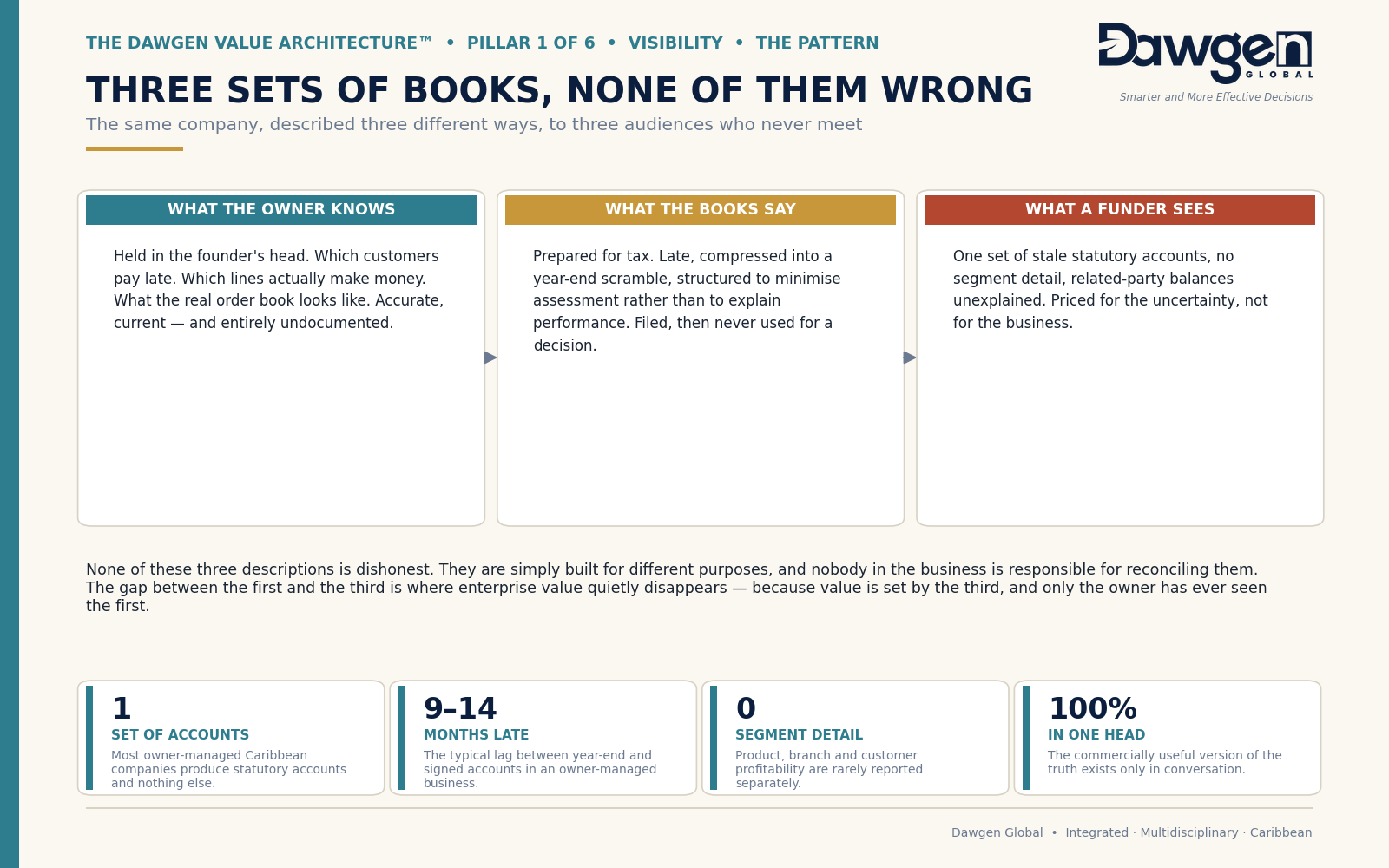
The same business, described three ways, to three audiences who never meet.
The value of a private company is not determined by what it earns. It is determined by what it can demonstrate that it earns.
None of these three descriptions is dishonest, and this is the point that owners most often miss. Nobody has done anything wrong. The three versions exist because they were built for different purposes and because no one person in the business has ever been made responsible for reconciling them. The gap between the first description and the third is where enterprise value disappears.
SECTION 2
The Caribbean Variant

The visibility problem is not unique to this region. It is documented in every market with a substantial owner-managed sector. What is distinctive here is the set of conditions that make it harder to solve, and that make the standard international prescription — hire a chief financial officer, implement an enterprise system, appoint a big-four auditor — largely unusable for a company with fifteen million dollars of turnover and forty staff.
Six conditions recur across Caribbean advisory engagements.
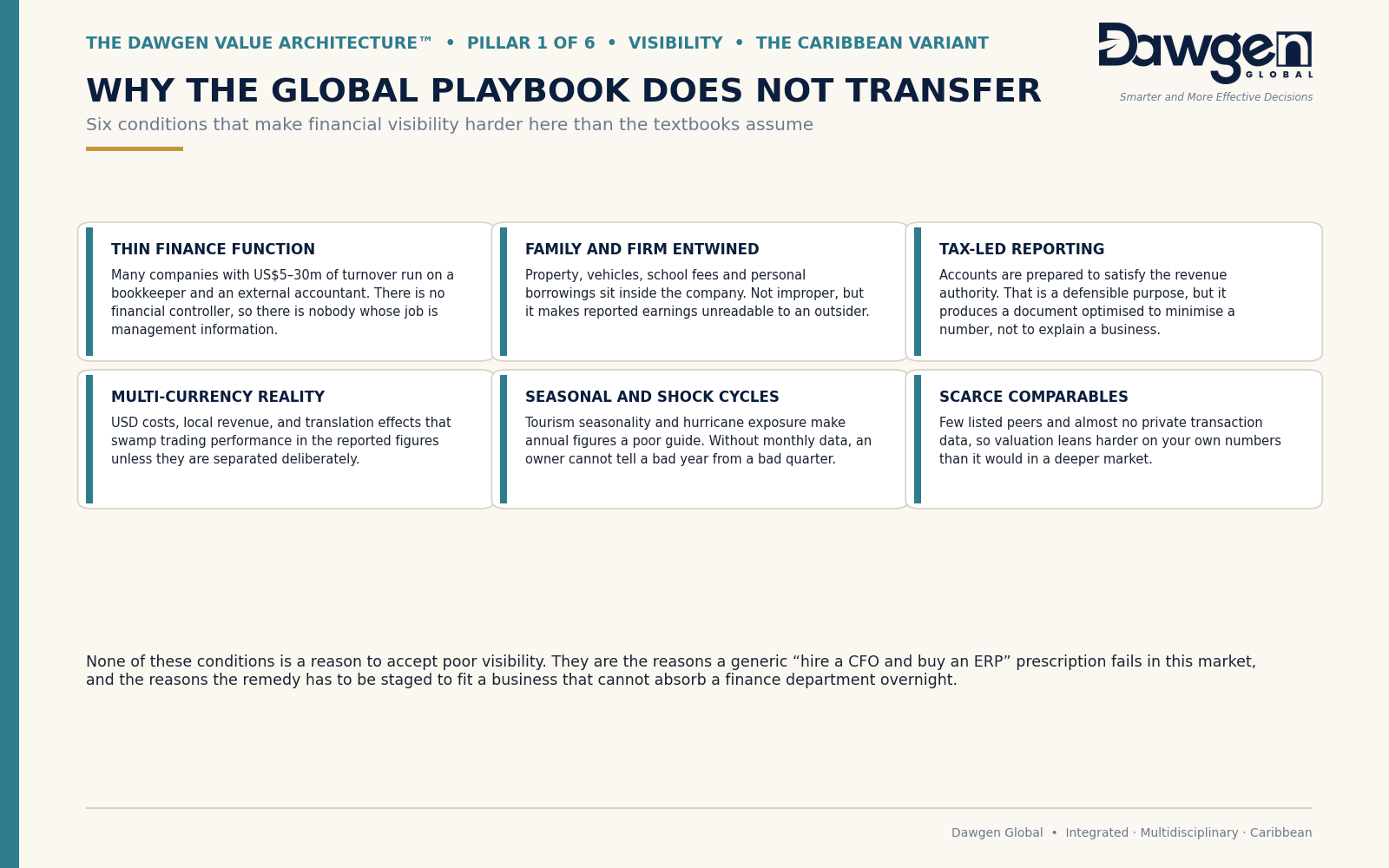
The first is the thin finance function. A great many Caribbean companies in the $5m to $30m range operate with a bookkeeper and an external accountant. There is no financial controller. This is not negligence; it is a rational response to the scarcity and cost of qualified finance staff in small markets. But it means there is nobody in the organisation whose actual job is management information, and work that belongs to nobody does not get done.
The second is the entanglement of family and firm. Property held in the company but used personally, vehicles, school fees, directors’ loans running in both directions, a building owned by the founder and rented to the business at a rate nobody has benchmarked. Most of this is ordinary and none of it is necessarily improper. All of it makes reported earnings unreadable to an outsider, and an outsider who cannot read earnings will assume the worst version.
The third is tax-led reporting. When accounts are prepared principally to satisfy the revenue authority, the resulting document is optimised to minimise a single number. That is a defensible objective. It is simply not the same objective as explaining a business to a lender, and a document built for the first purpose performs poorly at the second.
The fourth is multi-currency reality. Costs in United States dollars, revenue in local currency, and translation movements that can swamp trading performance in the reported figures. Unless currency effects are separated from operating results deliberately and consistently, neither the owner nor a reader can tell whether the business improved.
The fifth is the shape of the operating year. Tourism seasonality, agricultural cycles and hurricane exposure mean that annual figures are a poor guide to underlying performance, and that a single bad quarter can be mistaken for structural decline — or, more dangerously, structural decline can be excused as a bad quarter. Without monthly data an owner cannot distinguish the two.
The sixth is the scarcity of comparables. In deeper markets a valuer can triangulate using listed peers and private transaction data. In the Caribbean there are few of the first and almost none of the second. Valuation therefore leans much harder on your own numbers than it would elsewhere — which raises the return on making those numbers good, and raises the penalty for leaving them poor.
| Why this matters for the remedy
None of these six conditions is a reason to accept poor visibility. They are the reasons a generic prescription fails here, and the reasons the remedy set out in Section 5 is staged over eighteen months rather than delivered as a transformation programme. A business that cannot absorb a finance department overnight can absorb a monthly reporting discipline, and the discipline is what produces the value. |
SECTION 3
What It Costs
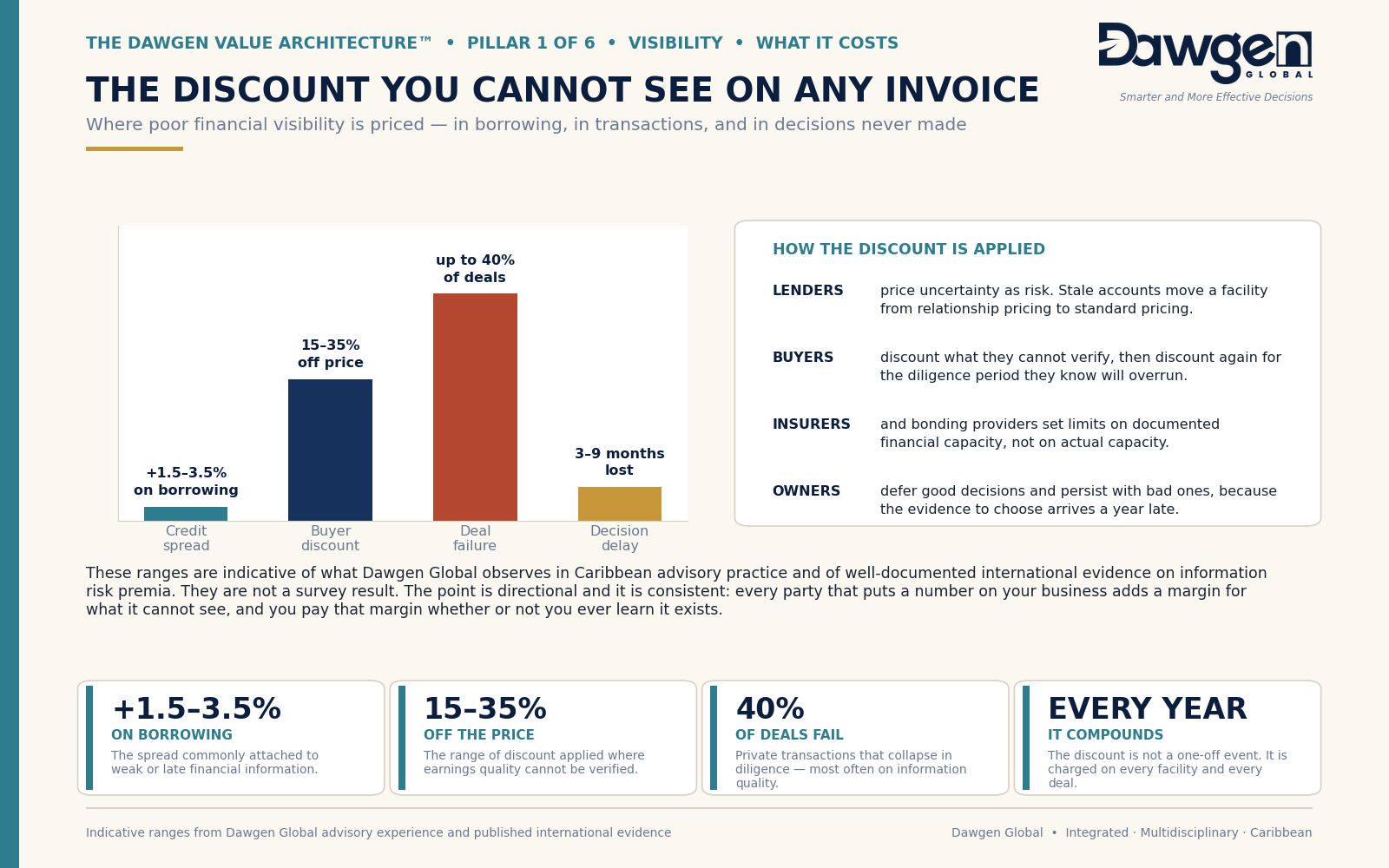
Owners find this section uncomfortable, because the cost of poor visibility never appears on an invoice. There is no line in the accounts labelled information risk premium. The cost is real, it is recurring, and it is paid in four places.
It is paid to lenders
A bank pricing a facility is pricing uncertainty. Where financial information is late, thin or unverifiable, the credit assessment moves from relationship pricing toward standard pricing, security requirements tighten, and covenants become more restrictive because the lender cannot monitor performance between annual accounts. The spread attached to this in Caribbean lending is commonly in the range of one and a half to three and a half percentage points — and it is charged every year, on every facility, for as long as the condition persists. On five million dollars of borrowing, the arithmetic is not subtle.
It is paid to buyers
A buyer discounts what cannot be verified, and then discounts again for the diligence period they know will overrun. In practice, private company transactions where earnings quality cannot be readily demonstrated are commonly priced fifteen to thirty-five per cent below comparable businesses with clean, current, segmented reporting. Worse, a material share of private transactions — international evidence puts it as high as forty per cent — collapse during diligence, and information quality is among the most frequent causes. A deal that dies in diligence does not merely cost the price difference. It costs the fees, the management time, the disclosure of commercial information to a competitor, and the owner’s willingness to try again.
It is paid to insurers, bonders and counterparties
Surety and bonding capacity, credit insurance limits, and the size of contract a counterparty will award are all set on documented financial capacity rather than actual financial capacity. A company that cannot document its balance sheet promptly is competing for smaller work than it can perform.
It is paid by the owner, in decisions
This is the largest cost and the least visible. An owner working from annual accounts that arrive eleven months late is steering by a rear-view mirror. Loss-making lines run for years longer than they should. Working capital tied up in slow inventory is not identified until it is written off. Good opportunities are declined because the cash position is uncertain, and bad ones are pursued because the true margin was never known. The compounding effect of decisions delayed or wrongly made dwarfs the credit spread, and unlike the credit spread it is never itemised anywhere.
The figures set out here are indicative of what Dawgen Global observes in Caribbean advisory practice and of well-documented international evidence on information risk. They are not the output of a formal survey and should not be read as one. The direction, however, is consistent and it is not seriously contested: every party who puts a number on your business adds a margin for what they cannot see.
SECTION 4
Why Owners Do Not Fix It
If the cost is this large and the remedy this well understood, the obvious question is why the condition is so widespread. In practice there are five reasons, and it is worth stating them plainly because a remedy that does not address them will not survive contact with the business.
The first is that it has not hurt yet. A profitable business generating cash does not feel a valuation discount, because it is not being valued. The cost is invisible precisely while the business is doing well, and becomes visible at the exact moment it is least convenient — during a refinancing, an illness, a succession, or a bid.
The second is that the owner does not experience the problem. The owner has the first description of the business, the accurate one, in their head. From inside that position the reporting problem looks like an administrative irritation rather than a commercial exposure, because the owner personally is never short of information.
The third is capacity. There is genuinely nobody to do it. The bookkeeper is fully occupied with transactions and the external accountant is engaged for compliance, not for management reporting. Adding the work to either without adding capacity produces a pack that is late, wrong, and quietly abandoned within four months.
The fourth is discomfort. Proper reporting makes visible things that some owners would rather not look at directly: the true margin on a favoured product, the size of the directors’ loan account, the profitability of the branch run by a family member. Visibility is not a neutral technical exercise. It has organisational consequences, and people who sense those consequences will slow it down.
The fifth is that previous attempts failed. Many companies have already bought a system, or hired a person, or engaged a consultant, and got nothing durable from it. That experience is real and it breeds justified scepticism. Almost invariably the failure was one of sequence — automating a chart of accounts that was never cleaned, or attempting segment reporting before the monthly close was reliable.
Visibility is not primarily a systems problem or a staffing problem. It is a sequencing problem, and that is why it is solvable at modest cost.
SECTION 5
The Remedy

What follows is a staged programme, designed for a company that cannot stop trading in order to reorganise itself and cannot absorb a finance department in a single step. Each phase is constructed so that the discipline built within it is what makes the following phase affordable.
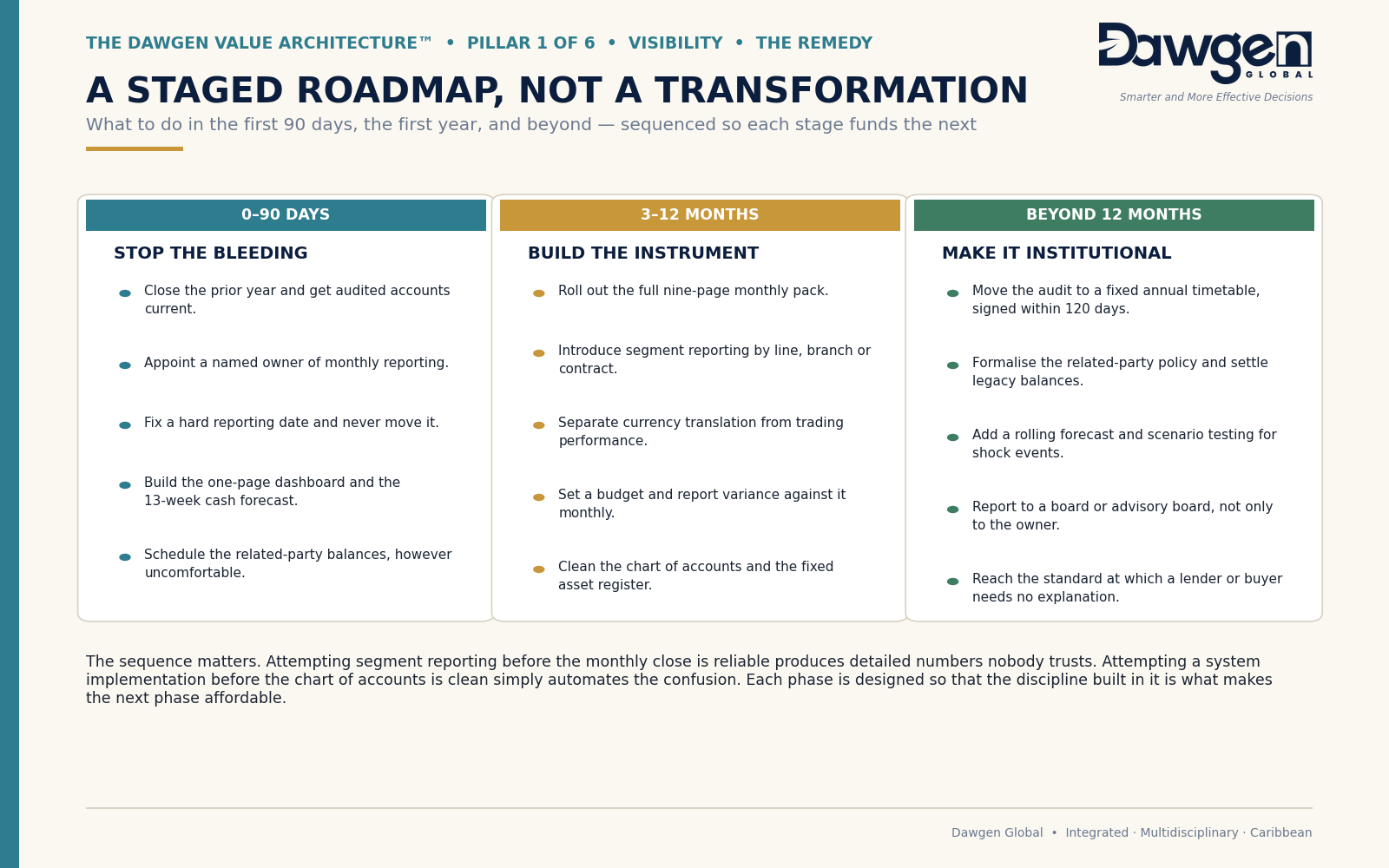
Phase one: the first ninety days
The objective of the first ninety days is not good reporting. It is reliable reporting, however basic. Five actions.
- Close the prior year and bring the audited accounts current. Nothing else in this programme can proceed on a foundation of unclosed years. If two or three years are outstanding, that is the ninety days.
- Appoint a named owner of monthly reporting. One person, named, whose performance is judged on it. This may be an existing employee given the responsibility explicitly, a part-time controller, or an outsourced virtual finance function — but it cannot be nobody, and it cannot be the business owner.
- Fix a hard reporting date and do not move it. Fifteen working days after month end. A pack that is late is not a pack; the date is the discipline, and the first three months of holding it are the whole battle.
- Build two documents only: the one-page dashboard and the rolling thirteen-week cash forecast. Resist the temptation to build everything at once. These two pages will change how the business is run before anything else is added.
- Schedule the related-party balances. Every loan, every transaction, every asset used personally. This is the uncomfortable one, and doing it early rather than in diligence is the difference between a disclosure and a discovery.
Phase two: months three to twelve
With a reliable close in place, the second phase builds the instrument that actually informs decisions.
- Roll out the full nine-page monthly pack described below.
- Introduce segment reporting — by product line, branch, contract or customer group, whichever matches how the business genuinely makes money. This single step is where most owners first discover a loss-making line they have been carrying for years.
- Separate currency translation from trading performance, so that the operating result can be read without foreign exchange noise.
- Set an annual budget and report actual against it monthly, with written commentary. The budget need not be sophisticated; it needs to exist, so that variance becomes a conversation.
- Clean the chart of accounts and the fixed asset register. Unglamorous, and the precondition for everything that follows, including any future system implementation.
Phase three: beyond twelve months
The third phase converts a well-run reporting function into an institutional standard — the point at which the business can be underwritten, financed or sold on its own documentation.
- Move the audit onto a fixed annual timetable, with accounts signed within a hundred and twenty days of year end, every year.
- Formalise a related-party policy and settle or properly document legacy balances.
- Add rolling forecasting and scenario testing, including a hurricane or shock scenario with a defined liquidity response.
- Report to a board or an advisory board rather than to the owner alone. This is the bridge into Pillar 3 of the Value Architecture.
The instrument itself
The monthly pack that supports all of this is nine pages. It is not an enterprise reporting suite, and in most cases it does not require new software — a properly configured accounting package and a disciplined spreadsheet will produce it. What it requires is a named person and a date that does not move.
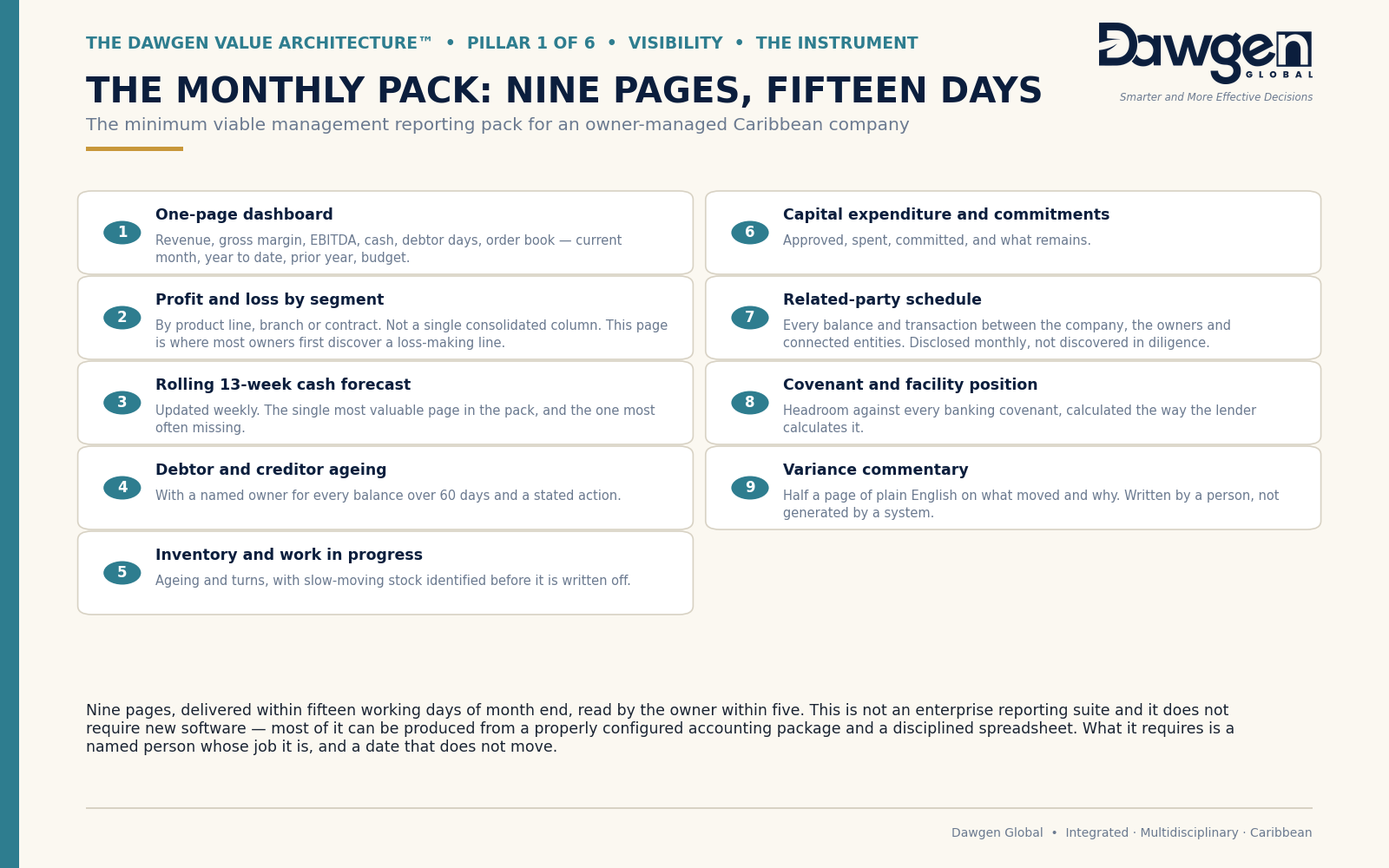
The minimum viable management reporting pack for an owner-managed Caribbean company.
Two pages in that list deserve particular emphasis, because they are the two most often absent and the two that change behaviour fastest. The rolling thirteen-week cash forecast, updated weekly, is the single most valuable page in the pack for a business of this size — it converts cash from a source of anxiety into a managed variable. And the related-party schedule, produced monthly and unprompted, is the page that most reliably protects value in a future transaction, because it turns the most-probed area of diligence into a routine disclosure the company has been making for years.
SECTION 6
The Diagnostic
Before deciding where to begin, locate the business honestly on the visibility maturity ladder. Most Caribbean owner-managed companies sit at Stage 1 or Stage 2. Lenders and buyers price Stage 4 and Stage 5. The distance between those positions is the discount.
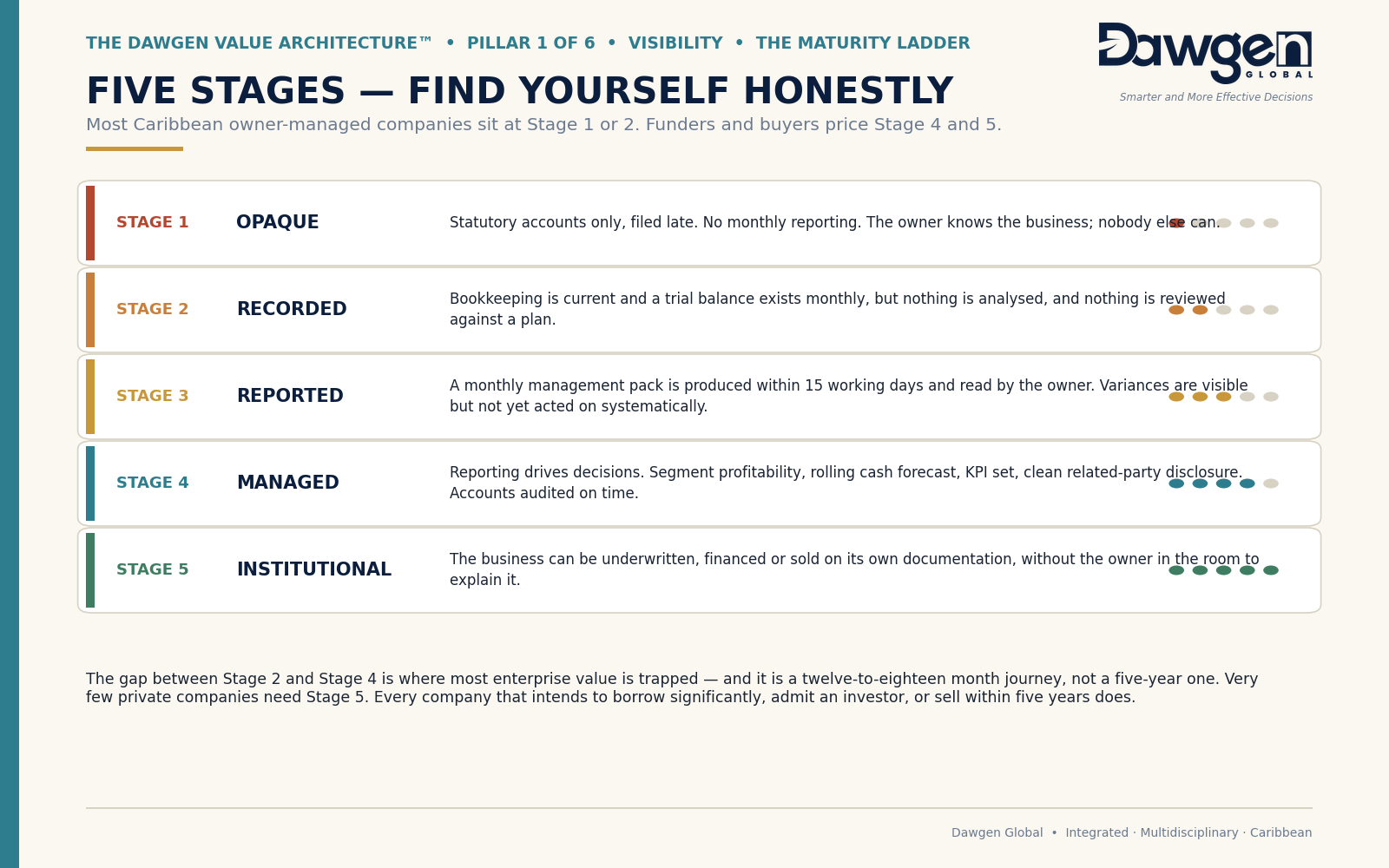
The scorecard below converts that judgement into a number. It is twelve questions, scored one point for each honest yes. The instrument is worthless flattered, and there is no benefit in scoring it generously — most owners score between two and five on first attempt, and almost all of them expected to score higher.
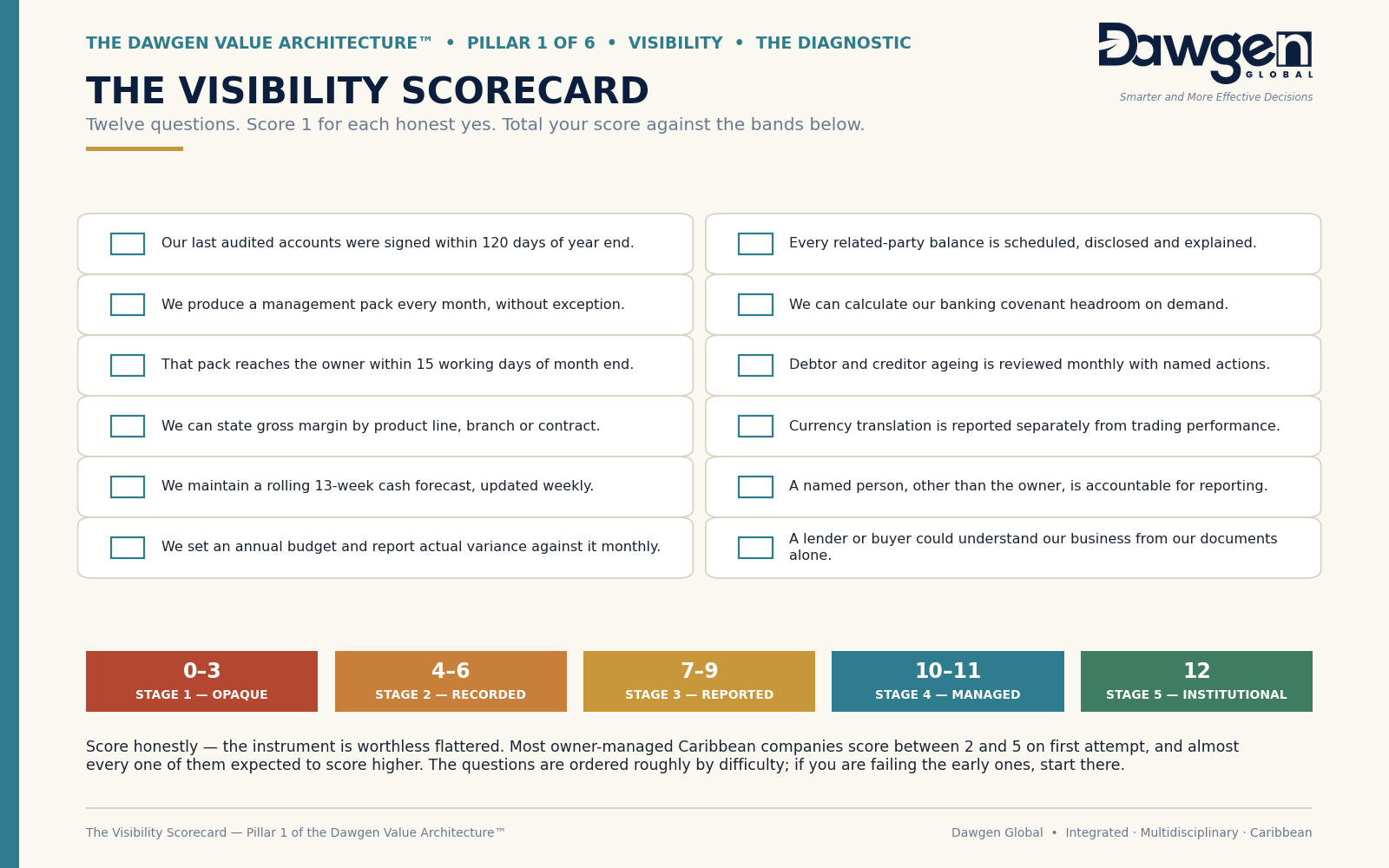
The Visibility Scorecard — Pillar 1 of the Dawgen Value Architecture™.
SECTION 7
Where to Start
If you scored between zero and three, do not attempt the full programme. Do three things: close the outstanding years, name the person responsible for reporting, and build the thirteen-week cash forecast. Nothing else, for ninety days. Companies at this stage fail by trying to do everything.
If you scored between four and six, the transactions are recorded but nothing is being learned from them. Your leverage is in analysis rather than capture: build the one-page dashboard and introduce segment reporting. You are closer to Stage 4 than you feel.
If you scored between seven and nine, the reporting exists and the gap is in use rather than production. Set a budget, report variance monthly with written commentary, and move the audit onto a fixed timetable. This is also the point at which an advisory board starts to earn its cost.
If you scored ten or above, the remaining questions are strategic rather than operational. The relevant work is likely in Pillars 2 through 6 — dependence, governance, capital, resilience and realisation — and the visibility foundation you have built is what makes those pillars addressable.
| The test that matters
Whatever your score, apply one question to the result. If you were unavailable for three months, could a competent outsider run this business from its documentation alone? If the honest answer is no, the visibility work is not finished — however good the accounts look. That question is also the bridge to Pillar 2 of the Dawgen Value Architecture™, which addresses dependence. |
About This Series
The Dawgen Value Architecture™ is a proprietary Dawgen Global framework addressing the six conditions that determine what a private company is actually worth. Each pillar is published as a standing guide: VISIBILITY, DEPENDENCE, GOVERNANCE, CAPITAL, RESILIENCE and REALISATION. The guides are written for Caribbean owner-managed businesses, their boards and their advisers, and are intended to be used as reference documents rather than read once.
This series addresses patterns observed across private company advisory engagements and published international evidence. It does not comment on any listed issuer, and it does not describe any specific client. Client engagement information is confidential and is never referenced in Dawgen Global’s public-facing materials.
Next in the series
Pillar 2 — DEPENDENCE: Key-Person Risk Is a Valuation Discount, Not a Compliment.
Take the diagnostic further
The Visibility Scorecard in this guide is the self-assessment version of the Dawgen Financial Reporting Health Check, a structured diagnostic review delivering a scored assessment across all twelve criteria, a maturity rating, a costed remediation roadmap and a board-ready summary.
At Dawgen Global, we help you make Smarter and More Effective Decisions.
dawgen.global/contact-us • [email protected] • Caribbean 876-929-3670 / 876-929-3870 • USA 855-354-2447
Dawgen Global is an independent, integrated multidisciplinary professional services firm serving 15+ Caribbean territories. Big Firm Capabilities. Caribbean Understanding.
About Dawgen Global
Dawgen Global is an independent, integrated multidisciplinary professional services firm headquartered at 47 Trinidad Terrace, New Kingston, Jamaica, serving more than 15 territories across the Caribbean. Founded and led by Dr. Dawkins Brown, Executive Chairman, the firm is independent and not affiliated with any international network. It delivers a full suite of professional services under one roof: audit and assurance; tax advisory; IT and digital transformation; risk management; cybersecurity; actuarial and insurance regulatory advisory; HR advisory; mergers and acquisitions; corporate recovery; business advisory and strategy; accounting BPO and virtual CFO services; and legal process outsourcing.
The proposition is simple: big-firm capability without the big-firm price. Dawgen Global’s integrated approach is built for the specific complexities and opportunities of the Caribbean market, helping organizations make sharper, better-informed decisions that drive measurable progress.
To explore a partnership, reach out:
- Website: dawgen.global
- Email: [email protected]
- WhatsApp (Global): +1 555-795-9071
- Caribbean offices: +1 876-665-5926 | +1 876-929-3670 | +1 876-926-5210


