
The Question Every Audit Committee Should Be Asking
At its core, the question that separates high-performing governance organizations from the rest is deceptively simple: “What role does Internal Audit play in our success?” Not in our compliance. Not in our risk avoidance. In our success.
If the honest answer is that Internal Audit primarily serves as a compliance verification function – checking boxes, confirming controls, and filing reports that satisfy regulatory expectations – then the organization is operating with one of its most powerful strategic capabilities locked at its lowest setting. It is the equivalent of owning a Formula One car and using it only to drive to the supermarket.
In Article 1 of this series, we diagnosed the Audit Expectation Gap – the widening chasm between what organizations need from Internal Audit and what most audit functions actually deliver. We introduced Dawgen Global’s IAVANTAGE™ Framework as the solution. In this second article, we go deeper into the engine of that framework: the IAVANTAGE™ Maturity Model.
The Maturity Model provides a clear, measurable, five-level progression path that takes Internal Audit from foundational compliance all the way to strategic business partnership. It is the roadmap that answers not just “where are we?” but “where should we be, and how do we get there?”
Why Maturity Matters More Than Activity
Most Internal Audit functions measure themselves by activity. How many audits were completed? How many findings were issued? What percentage of recommendations were implemented? These are not bad metrics in isolation, but they tell you almost nothing about value. A function that completes fifty audits per year and issues two hundred findings might be doing far less for its organization than one that completes twenty-five audits and delivers three strategic insights that prevent a material risk event or unlock a significant operational improvement.
Maturity, by contrast, measures capability. It asks: What is this function actually able to do? How sophisticated are its methods? How strategic are its relationships? How deep is its impact? A maturity-based approach shifts the conversation from “are we busy enough?” to “are we good enough?” And that is a far more honest and productive question.
| “The goal of Internal Audit maturity is not to do more auditing. It is to do more valuable auditing – and ultimately, to make the entire organization more resilient, more intelligent, and more competitive.” — Dawgen Global |
The IAVANTAGE™ Maturity Model is designed specifically for this purpose. It provides a structured framework that allows Internal Audit leaders, audit committees, and executive management to objectively assess where their function currently stands, define a realistic and ambitious target state, and build a concrete roadmap to close the gap – with measurable milestones at every stage.
The Five Levels: A Deep Dive
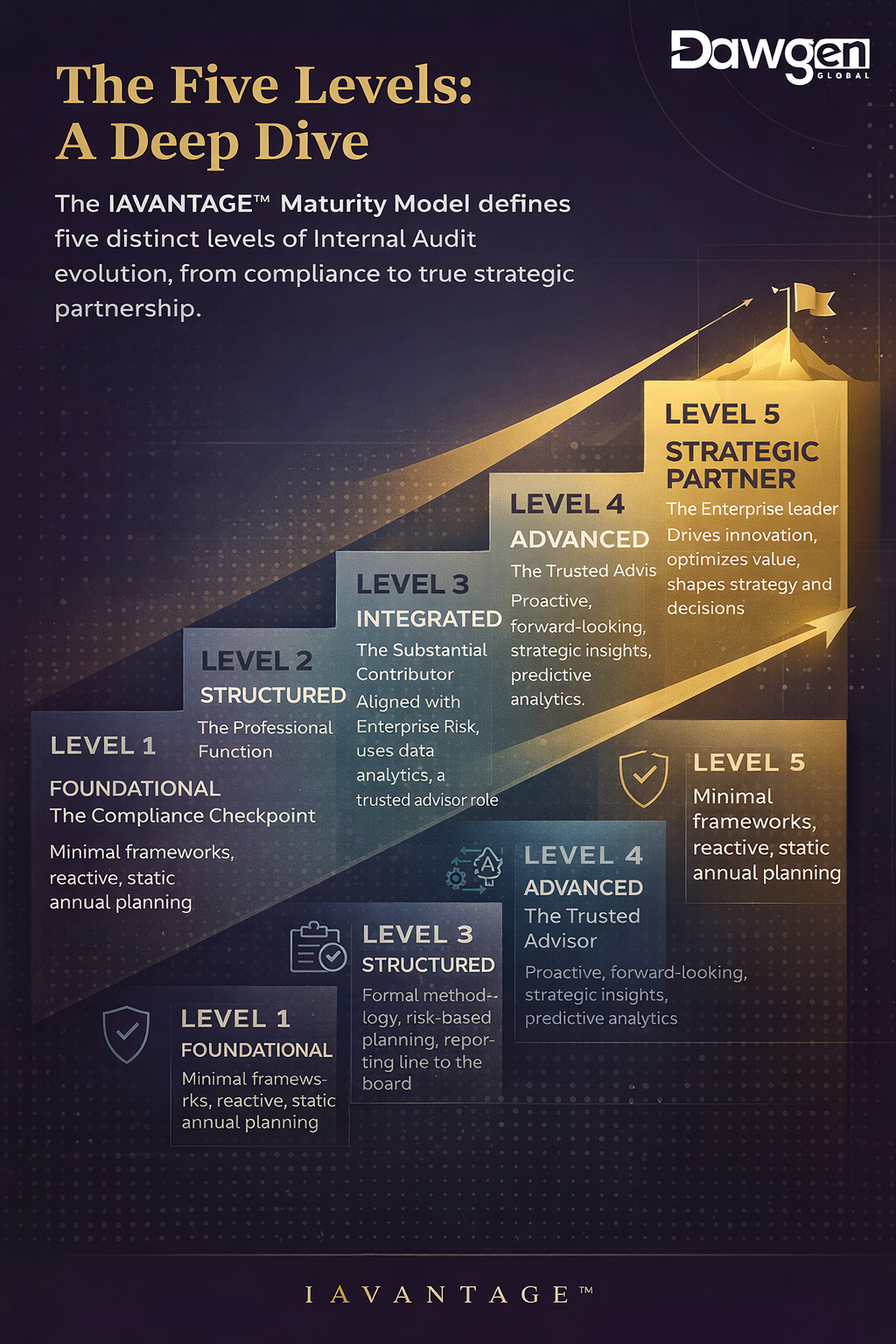
The IAVANTAGE™ Maturity Model defines five distinct levels of Internal Audit evolution. Each level represents a qualitatively different way of operating – not merely an incremental improvement, but a genuine transformation in how the function thinks, works, and creates value. Let us explore each level in detail.
| LEVEL 1: FOUNDATIONAL |
The Compliance Checkpoint. At Level 1, Internal Audit exists primarily because regulations, the board charter, or industry expectations require it. The function is reactive, operating from a static annual plan that is developed with minimal stakeholder input and rarely revised. Audit engagements focus overwhelmingly on financial controls verification and regulatory compliance checking.
The methodology is informal or borrowed from templates. Quality assurance is minimal or non-existent. Technology use is limited to basic spreadsheets and document management. The CAE reports to management rather than the audit committee, and there is little or no private access to the board. Audit reports are lengthy, procedural, and focused on documenting what was tested rather than what it means.
The talent profile at Level 1 tends toward junior staff with limited professional certifications. Experienced professionals often leave quickly, frustrated by the lack of strategic relevance and career development opportunity. The function is perceived internally as a “necessary evil” – something the organization tolerates rather than values.
The critical gap: At this level, Internal Audit provides virtually no insight into strategic risks, emerging threats, or operational improvement opportunities. The organization is essentially flying blind on its most consequential risks while its internal assurance function examines the routine.
| LEVEL 2: STRUCTURED |
The Professional Function. Level 2 represents a significant step forward. The Internal Audit function now operates with a formal, documented methodology. Risk-based audit planning has been established, meaning engagements are prioritized based on assessed risk rather than rotation schedules or management preferences. An audit management system is in place, and workpapers follow standardized templates.
The CAE has secured a functional reporting line to the audit committee, though the relationship may still be largely procedural – quarterly reports are delivered, but deep strategic dialogue is rare. The audit team includes professionals with relevant certifications such as CIA, CISA, or CFE, and continuing professional development is encouraged.
Data analytics is beginning to emerge, though its application is typically limited to specific engagements rather than embedded across the function. Audit reports have improved in structure and clarity, but they remain primarily focused on control weaknesses and compliance gaps rather than business impact.
The critical gap: While Level 2 delivers reliable, consistent assurance, it remains fundamentally backward-looking. The function can tell you what went wrong, but it struggles to tell you what might go wrong next or how to create value from its enterprise-wide perspective. It is professional but not yet strategic.
| LEVEL 3: INTEGRATED |
The Valued Contributor. Level 3 is the critical inflection point in the maturity journey. Here, Internal Audit begins to operate as a genuine contributor to organizational performance rather than merely a checker of organizational compliance. The transformation is visible across every dimension of the function.
The audit plan is now directly and explicitly aligned to the organization’s strategic plan and enterprise risk register. The CAE participates in strategic planning discussions – not as a passive observer, but as an active contributor whose perspective on risk and control is valued by the C-suite. The audit universe is dynamically refreshed at least semi-annually, and the function has built-in agility to redirect resources toward emerging risks.
Advisory engagements sit alongside traditional assurance work. Management begins seeking out Internal Audit’s perspective on new initiatives, system implementations, and process redesigns – not because they are required to, but because they have experienced the value of early audit involvement. Data analytics is routinely applied, with full-population testing replacing sampling in key risk areas.
Perhaps most importantly, Level 3 is where Internal Audit begins to measure and communicate its value in business terms. Cost savings identified, risk events prevented, process improvements recommended and implemented – these value metrics become part of the CAE’s regular reporting to the audit committee. The perception of Internal Audit shifts from “cost centre” to “value contributor.”
The critical gap: Level 3 organizations deliver strong, consistent value, but they have not yet achieved the predictive, technology-driven, and deeply embedded capabilities that characterize the most advanced functions. The journey from good to exceptional still lies ahead.
| LEVEL 4: ADVANCED |
The Trusted Advisor. At Level 4, Internal Audit has achieved something remarkable: it is sought out by the board and executive management not because governance requires it, but because its insights are genuinely indispensable. The CAE is a trusted advisor to the CEO and a valued partner to the audit committee chair. Internal Audit has a seat at the table – and everyone in the room is glad it is there.
Technology is now deeply embedded in the function’s DNA. Predictive analytics and AI-assisted tools enable real-time risk monitoring and anomaly detection. Continuous auditing covers all high-risk areas, providing the board with assurance that is measured in hours and days rather than months and quarters. Process mining reveals operational inefficiencies that no other function can see.
The team at Level 4 is highly skilled and diverse, combining traditional audit expertise with data science, cybersecurity, behavioural science, and industry-specific domain knowledge. The function attracts top talent because it is recognized as one of the most dynamic and influential teams in the organization.
Integrated assurance coordination is well-established. Internal Audit, risk management, compliance, and external audit work from a shared assurance map, eliminating duplication and ensuring comprehensive coverage. The annual audit opinion is deeply respected – a genuine reflection of the organization’s governance health, not a formulaic compliance statement.
The critical gap: Level 4 is exceptional by any standard. The remaining gap to Level 5 is less about capability and more about embeddedness – the degree to which Internal Audit’s perspective is woven into the fabric of every significant organizational decision.
| LEVEL 5: STRATEGIC PARTNER |
The Enterprise Value Creator. Level 5 represents the pinnacle of Internal Audit evolution. At this level, the distinction between “audit function” and “strategic business function” has effectively dissolved. Internal Audit is fully embedded in the organization’s decision-making architecture – not as an afterthought or a reviewer, but as an essential participant in every significant strategic conversation.
The function operates with a foresight-driven mandate. Rather than responding to risks that have already materialized, Level 5 Internal Audit identifies risks and opportunities on the horizon, providing the board with the intelligence it needs to act proactively. Culture and conduct assessment is a core capability – the function can diagnose the behavioural and ethical health of the organization with the same rigour it applies to financial controls.
Innovation is continuous. Level 5 functions are early adopters of emerging technologies, contributors to industry thought leadership, and benchmarked as best-in-class by peer organizations. They attract the most talented professionals in the market, and their alumni go on to become CFOs, CROs, and CEOs – a testament to the breadth and depth of experience the function provides.
The ROI on Internal Audit investment at Level 5 is unambiguous and compelling. The function can demonstrate, with clear evidence, that it has prevented material losses, identified revenue opportunities, accelerated strategic initiatives, and strengthened stakeholder confidence in ways that directly support the organization’s competitive position.
| “Level 5 Internal Audit does not just protect value. It creates value. It does not just manage risk. It enables intelligent risk-taking. It is not a cost of doing business. It is a competitive advantage.” — Dawgen Global |
Where Most Organizations Actually Stand
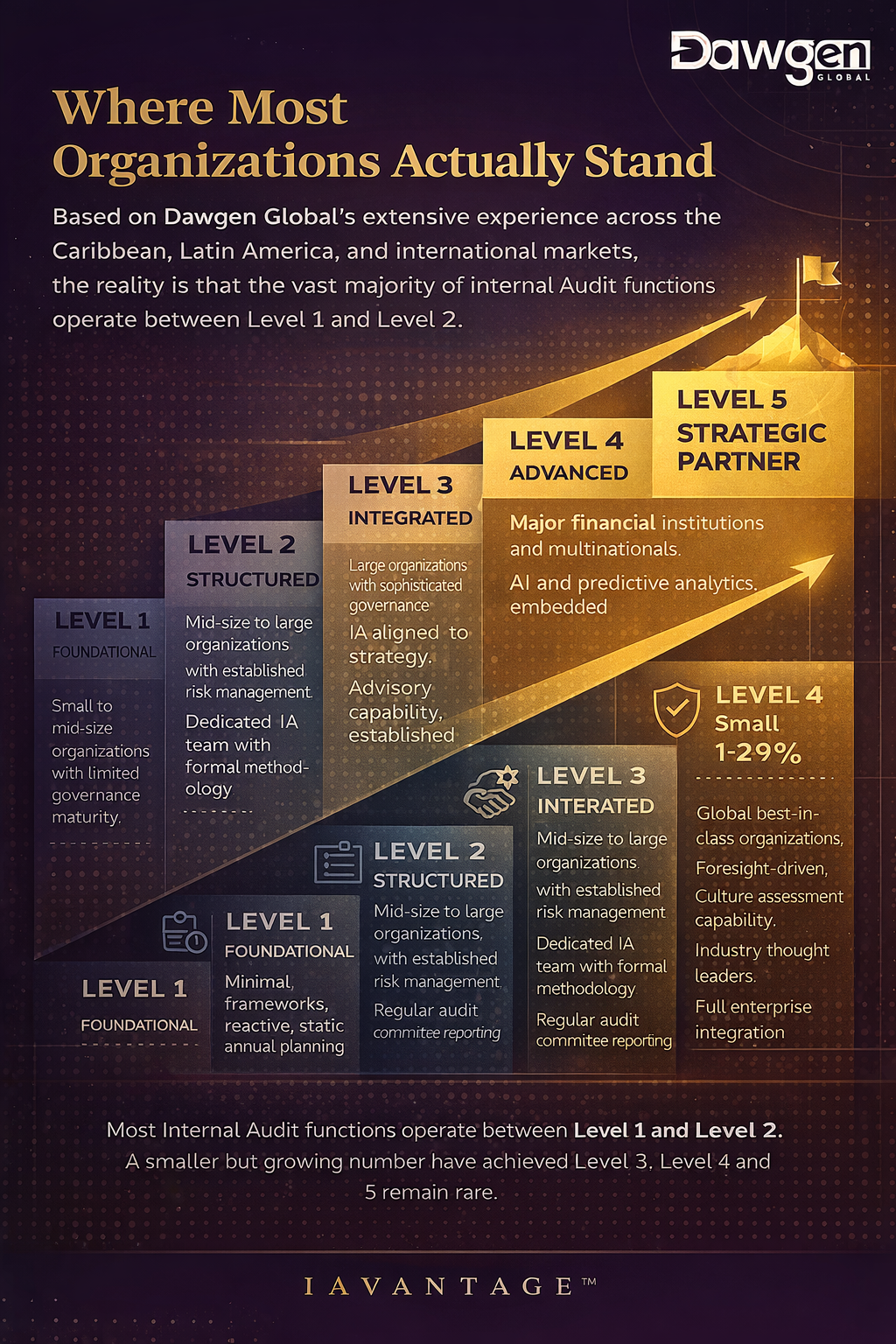
Based on Dawgen Global’s extensive experience across the Caribbean, Latin America, and international markets, the reality is that the vast majority of Internal Audit functions operate between Level 1 and Level 2. A smaller but growing number have achieved Level 3. Level 4 and 5 functions remain genuinely rare – concentrated primarily in large, heavily regulated financial institutions and multinational corporations with mature governance cultures.
| MATURITY LEVEL | ESTIMATED % | TYPICAL PROFILE |
| Level 1: Foundational | 35-40% | Small to mid-size organizations with limited governance maturity. IA function staffed with 1-3 people. Limited board engagement. Compliance-driven mandate. |
| Level 2: Structured | 30-35% | Mid-size to large organizations with established risk management. Dedicated IA team with formal methodology. Regular audit committee reporting. |
| Level 3: Integrated | 15-20% | Large organizations with sophisticated governance. IA aligned to strategy. Advisory capability established. Data analytics in use. Value measurement beginning. |
| Level 4: Advanced | 5-8% | Major financial institutions and multinationals. AI and predictive analytics embedded. CAE as trusted advisor. Integrated assurance model operational. |
| Level 5: Strategic Partner | 1-2% | Global best-in-class organizations. Foresight-driven. Culture assessment capability. Industry thought leaders. Full enterprise integration. |
These numbers should not discourage. They should motivate. The organizations that move decisively to advance their Internal Audit maturity will gain a governance advantage that competitors operating at lower levels simply cannot match. And the good news is that the journey from Level 1 to Level 3, or from Level 2 to Level 4, is entirely achievable within 18 to 36 months with the right framework, leadership commitment, and expert guidance.
What It Takes to Advance: The Critical Success Factors
Advancing through the IAVANTAGE™ Maturity Model is not simply a matter of implementing new tools or hiring more staff. Each level transition requires deliberate action across multiple dimensions. Based on our experience guiding organizations through these transitions, Dawgen Global has identified six critical success factors that consistently determine whether a maturity advancement effort succeeds or stalls.
- Leadership Commitment from the Top. Internal Audit transformation cannot be a bottom-up initiative. It requires visible, sustained commitment from the audit committee chair, the CEO, and the CFO. These leaders must articulate their expectation that Internal Audit will evolve, allocate the resources to make it possible, and hold the CAE accountable for delivering on the transformation roadmap. Without this top-down mandate, even the most talented CAE will struggle against organizational inertia.
- A CAE with Vision and Courage. The CAE is the architect of transformation. Advancing maturity requires a CAE who can see beyond today’s audit plan, who can articulate a compelling vision for what Internal Audit could become, and who has the interpersonal skill to build relationships with the C-suite and the professional courage to deliver difficult messages. Technical audit skill alone is not sufficient. The modern CAE must be a strategist, a communicator, and a change leader.
- Investment in Technology and Data. Every maturity level transition from Level 2 onwards demands increasing technological sophistication. Organizations must be willing to invest in audit management software, data analytics tools, and ultimately AI-assisted platforms. This investment must be accompanied by a commitment to developing the team’s data literacy and analytical capability. Technology without skill is merely expensive hardware.
- Talent Strategy and Team Composition. The team that can deliver Level 2 assurance may not be the team that can deliver Level 4 strategic advisory. As maturity advances, the audit team must evolve – incorporating professionals with data science backgrounds, industry-specific expertise, cybersecurity knowledge, and behavioural science skills alongside traditional audit competence. This requires deliberate hiring strategy, investment in training, and a willingness to rethink what an “auditor” looks like.
- Stakeholder Relationship Building. At every level, the quality of Internal Audit’s relationships with its stakeholders is a leading indicator of maturity. Functions that advance rapidly are those where the CAE has invested deeply in understanding what the board, the CEO, the CFO, and operational leaders actually need – and has demonstrated the ability to deliver it. Trust is the currency of maturity advancement.
- Measurement and Accountability. What gets measured gets managed. Organizations that successfully advance through the maturity model establish clear metrics for each level, track progress rigorously, and hold themselves accountable through regular reassessment. The IAVANTAGE™ Scorecard provides precisely this measurement framework – allowing organizations to track their advancement across all seven pillars with quantitative precision.
A Realistic Timeline for Transformation
One of the most common questions we receive from CAEs and audit committee chairs is: “How long will it take?” The answer depends on the starting point, the level of organizational commitment, and the resources available. However, based on our experience, the following represents a realistic progression timeline:
| TRANSITION | TYPICAL TIMELINE | KEY MILESTONES |
| Level 1 → Level 2 | 6 – 12 months | Formal methodology documented. Risk-based planning implemented. Audit committee reporting established. QAIP launched. Core team certifications underway. |
| Level 2 → Level 3 | 12 – 18 months | Strategic alignment achieved. Advisory capability established. Data analytics embedded. Value metrics in regular reporting. Stakeholder satisfaction improving measurably. |
| Level 3 → Level 4 | 18 – 24 months | AI and predictive analytics operational. Continuous auditing in all high-risk areas. Integrated assurance model functioning. CAE recognized as trusted advisor. Demonstrated 3:1+ ROI. |
| Level 4 → Level 5 | 24 – 36 months | Foresight-driven assurance operational. Culture assessment capability proven. Industry thought leadership established. Enterprise-wide integration complete. 5:1+ ROI demonstrated. |
These timelines are ambitious but achievable. Organizations that engage Dawgen Global’s IAVANTAGE™ Activation Journey benefit from a structured methodology, experienced advisory support, and proprietary tools that compress transformation timelines and reduce execution risk. The fastest-advancing organizations in our portfolio have achieved two-level jumps within 24 months.
The Transformation in Practice: A Composite Illustration
Consider a mid-size financial services organization operating at Level 1. The Internal Audit function consists of a CAE and two staff auditors. The annual audit plan is a static list of fifteen compliance-focused engagements, unchanged for three years. The audit committee receives a quarterly status update but has never had a strategic conversation about Internal Audit’s role. Management views the function as an overhead cost and quietly resents the disruption of audit fieldwork.
Following an IAVANTAGE™ Assessment, the organization scored an overall maturity of 1.4 – firmly in the Foundational range. However, the assessment also revealed that the existing team had significantly more capability than the current mandate allowed them to express. The gap was not primarily talent – it was vision, mandate, and structure.
Within twelve months of launching the IAVANTAGE™ Activation Journey, the organization had achieved Level 2 and was well on its way to Level 3. The audit plan was rebuilt around the enterprise risk register. The CAE presented the board with its first-ever strategic risk briefing. Data analytics was applied to full-population transaction testing in three high-risk areas, immediately identifying anomalies worth investigating. The function’s first advisory engagement – a review of the digital banking migration programme – was credited by the CTO with preventing a significant implementation failure.
The perception shift was dramatic. Within eighteen months, the CEO was publicly describing Internal Audit as “one of our most valuable strategic capabilities.” The audit budget increased by thirty percent – not because costs rose, but because the board recognized the return on investment and wanted more.
Where Are You on the Journey?
The maturity journey begins with honest assessment. Until you know precisely where your Internal Audit function stands today, you cannot chart a credible path to where it needs to be tomorrow.
| YOUR NEXT STEP
Book Your Complimentary IAVANTAGE™ Maturity Diagnostic Call Dawgen Global is a multidisciplinary professional services firm delivering audit, assurance, risk advisory, tax, and business consulting services across the Caribbean, Latin America, and emerging markets. Our Audit & Assurance Services practice is recognized for its deep industry expertise, innovative methodologies, and commitment to helping organizations transform governance from a compliance obligation into a competitive advantage. The IAVANTAGE™ Framework is a proprietary Dawgen Global methodology. © 2026 Dawgen Global. All rights reserved. In a focused 30-minute session with a Dawgen Global Partner, you will receive an indicative maturity assessment based on your responses to key diagnostic questions, an honest perspective on where your function stands relative to industry peers, and a clear view of the highest-impact actions you can take immediately to begin advancing. ↓ SCHEDULE YOUR FREE DIAGNOSTIC CALL ↓
|
| MISSED ARTICLE 1?
Read “Why Internal Audit Is the Most Undervalued Function in Your Organization – And How to Fix It” and download the free IAVANTAGE™ Readiness Self-Assessment Checklist. |
Coming Next in the IAVANTAGE™ Series
Article 3: “The Seven Pillars of Audit Value: How Leading Organizations Measure What Matters” – A detailed exploration of each IAVANTAGE™ pillar with practical implementation guidance and the tools to begin assessing your function immediately. Subscribe to the Dawgen Global IAVANTAGE™ Series to receive each article directly.
About Dawgen Global
“Embrace BIG FIRM capabilities without the big firm price at Dawgen Global, your committed partner in carving a pathway to continual progress in the vibrant Caribbean region. Our integrated, multidisciplinary approach is finely tuned to address the unique intricacies and lucrative prospects that the region has to offer. Offering a rich array of services, including audit, accounting, tax, IT, HR, risk management, and more, we facilitate smarter and more effective decisions that set the stage for unprecedented triumphs. Let’s collaborate and craft a future where every decision is a steppingstone to greater success. Reach out to explore a partnership that promises not just growth but a future beaming with opportunities and achievements.
 Email: [email protected]
  Visit: Dawgen Global Website

 WhatsApp Global Number : +1 555-795-9071
Caribbean Office: +1876-6655926 / 876-9293670/876-9265210  WhatsApp Global: +1 5557959071
USA Office: 855-354-2447
Join hands with Dawgen Global. Together, let’s venture into a future brimming with opportunities and achievements


