
Executive Summary
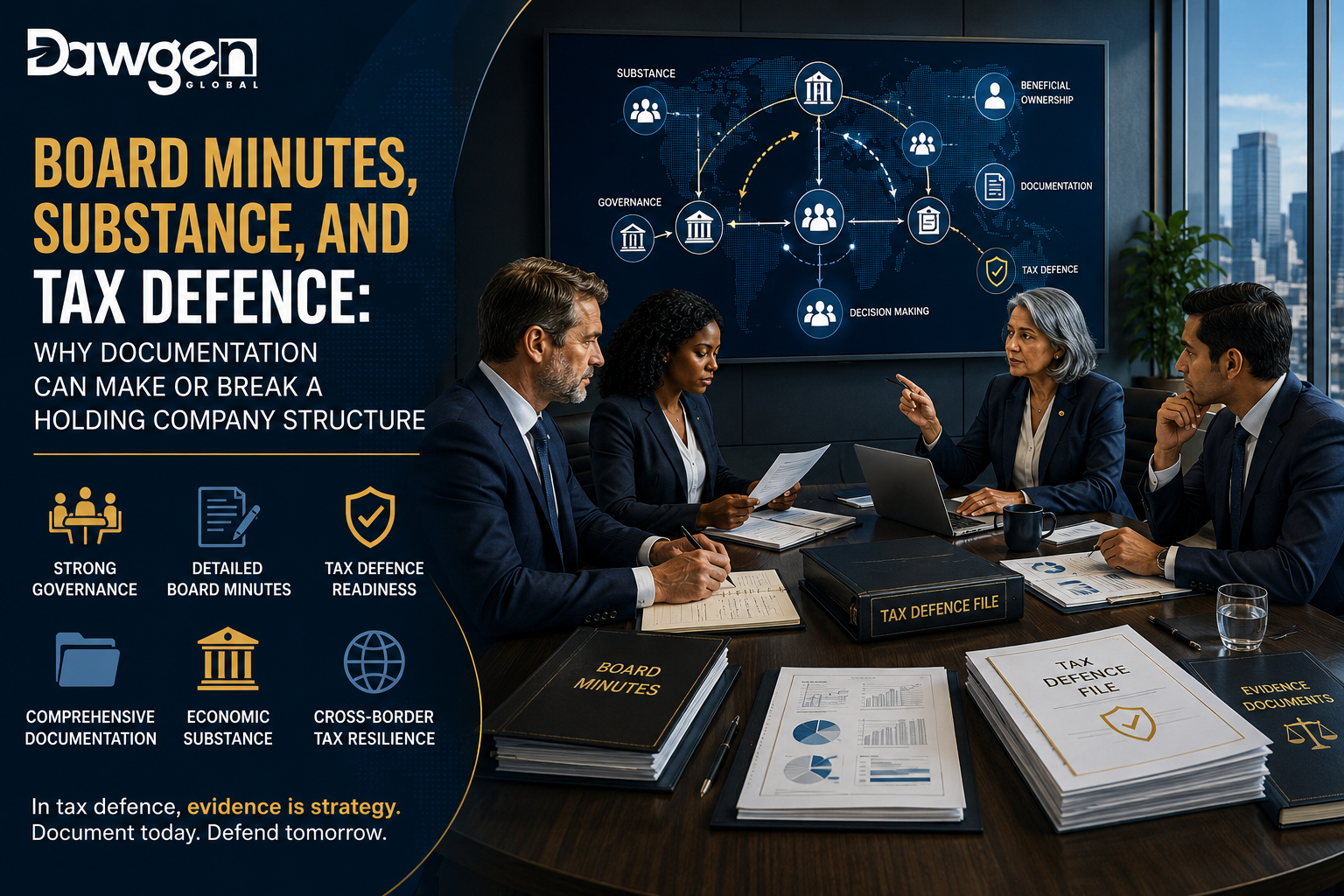
In modern international tax planning, documentation is no longer an administrative afterthought. It is a central part of tax defence. Holding companies, investment platforms, regional headquarters, and cross-border ownership structures may be legally valid, but they remain exposed if the evidence does not prove that they are commercially real.
The recent Milan First Instance Tax Court ruling involving Luxembourg holding companies highlights this point. The court reportedly rejected the Italian Revenue Agency’s attempt to tax a capital gain arising from the indirect sale of an Italian company, placing weight on the fact that the Luxembourg entities had genuine characteristics, including offices, staff, governance processes, and independent decision-making. The case reinforces a critical principle for taxpayers: substance must not only exist; it must be demonstrable.
For multinational groups, private equity investors, family offices, and Caribbean businesses using international structures, the practical lesson is clear. Board minutes, decision papers, director records, service agreements, financial evidence, and contemporaneous tax files can determine whether a structure is respected or challenged as artificial.
At Dawgen Global, we believe tax resilience requires more than technical planning. It requires disciplined governance, clear records, and a defensible evidence trail.
1. The Documentation Gap in International Tax Planning
Many international structures fail not because they are inherently abusive, but because they are poorly documented. A holding company may have a legitimate commercial purpose. It may hold investments, manage subsidiaries, review financing options, approve dividend policy, and participate in acquisition or exit decisions. However, if these functions are not evidenced, tax authorities may argue that the entity is merely a passive shell or conduit.
This creates what may be called the documentation gap: the difference between what a company claims it does and what its records can prove.
In tax controversy, this gap can be decisive. Tax authorities and courts do not rely solely on corporate charts or incorporation certificates. They examine conduct, documents, cash flows, board minutes, correspondence, contracts, and decision-making records. A structure that appears sound on paper may become vulnerable where the evidence suggests that decisions were made elsewhere, directors were passive, or the holding company had no real control over assets or income.
The discipline of documentation is therefore not cosmetic. It is a core element of tax governance.
2. Why Board Minutes Matter
Board minutes are often the first place tax authorities look when testing substance. They reveal whether directors actually considered key decisions or merely approved instructions prepared by others.
Strong board minutes show that the holding company had a functioning mind and will. They demonstrate that directors received information, considered risks, evaluated alternatives, and made decisions in the interests of the company. Weak minutes, by contrast, may suggest rubber-stamping.
For holding companies, board minutes should ideally show:
- The date, location, and participants in the meeting
- Whether the meeting was physically held, virtual, or hybrid
- The documents reviewed by the directors
- The commercial reasons for the decision
- The tax, legal, financial, and operational risks considered
- The alternatives reviewed
- Any professional advice received
- The questions asked by directors
- The decision reached and the reasons for it
- Any follow-up actions assigned
A one-line resolution may satisfy basic corporate law formalities, but it may not be enough to defend substance in a tax dispute. Modern tax authorities expect evidence of actual deliberation.
3. Substance Must Be Proportionate to Function
A key lesson from the Milan ruling is that a holding company does not need to look like a large operating company to be real. A holding entity may be lean, especially if its role is to own shares, manage investments, coordinate financing, or supervise subsidiaries. What matters is whether its resources, governance, and decision-making are proportionate to the functions it performs.
This proportionality principle is important for Caribbean and international groups. A holding company may not require large premises or a large employee base. However, it should have enough substance to support its claimed role.
For example, an investment holding company should be able to demonstrate that it:
- Maintains proper accounting and statutory records
- Has a functioning board
- Receives and reviews financial information
- Considers investment, financing, dividend, and exit decisions
- Uses competent professional advisers where necessary
- Controls its own bank accounts and cash flows
- Bears costs appropriate to its activities
- Complies with tax and corporate filing obligations
- Can explain the commercial rationale for its existence
The level of substance required will depend on the nature, value, and complexity of the structure. A holding company owning a single passive investment may require less infrastructure than a regional treasury company or intellectual property holding platform. But each must be able to prove that its form reflects commercial reality.
4. The Danger of Generic Minutes
Generic minutes are one of the most common weaknesses in tax defence files. Many companies use standard templates that record resolutions but do not explain the reasoning behind them. While templates may be administratively convenient, they can be dangerous when major tax-sensitive decisions are involved.
Tax-sensitive decisions include acquisitions and disposals; dividend declarations; financing arrangements; debt restructuring; intellectual property transfers; management-fee arrangements; intra-group service agreements; entity migrations; liquidations; treaty-based claims; capital gains planning; and private equity exits.
For these decisions, minutes should not simply state that the board “approved” a transaction. They should explain why the decision made commercial sense for the company. They should show that directors considered the company’s interests, not merely the preferences of the parent, fund, or ultimate shareholder.
A well-drafted minute creates a contemporaneous record of commercial reasoning. A generic minute creates ambiguity. In tax controversy, ambiguity often favours the tax authority.
5. What a Tax Defence File Should Contain
A tax defence file is a structured evidence package prepared before a dispute arises. Its purpose is to show that the company has substance, commercial purpose, proper governance, and compliance discipline.
For a holding company, the file should include:
- Corporate constitutional documents
- Group structure charts
- Shareholder registers
- Director appointment documents
- Director biographies and qualifications
- Board calendars
- Board agendas and minutes
- Board packs and decision papers
- Investment memoranda
- Financing papers
- Dividend policy documents
- Bank account records
- Accounting records and audited financial statements
- Tax returns and tax residency certificates
- Service agreements
- Office lease or service-office agreements
- Payroll or staff records, where applicable
- Professional adviser engagement letters
- Transfer pricing documentation, where relevant
- Evidence of local filings and regulatory compliance
- Correspondence showing real decision-making
- Transaction closing files
- Legal and tax opinions
- Evidence that funds were retained, reinvested, or distributed following board consideration
The file should be updated periodically. A defence file prepared only after an assessment has been issued is usually less persuasive than contemporaneous documentation maintained as part of normal governance.
6. Decision-Making Autonomy: The Core Evidence Question
The most important evidentiary question is whether the holding company made real decisions.
Tax authorities may accept that a company exists legally. They may accept that it has bank accounts, directors, and corporate records. But they may still challenge whether it had decision-making autonomy.
To demonstrate autonomy, the evidence should show that directors were not merely passive signatories. Directors should receive adequate information, ask questions, consider risks, and exercise judgement. The company should not appear to be controlled entirely by persons outside the jurisdiction or outside the board process.
This does not mean a holding company must ignore group strategy. Group alignment is commercially normal. However, group strategy should not eliminate the holding company’s own decision-making role. The board should consider how the decision affects the company itself.
For example, before approving a dividend, the board should consider solvency, cash requirements, investment plans, legal restrictions, tax implications, and the company’s commercial objectives. Before approving a disposal, the board should consider valuation, timing, risks, transaction alternatives, and use of proceeds.
The more significant the transaction, the stronger the evidence should be.
7. Cash Flows and the Evidence of Control
Cash-flow evidence is especially important in beneficial ownership and conduit-risk cases. A holding company may be challenged if income is received and immediately passed onward under a pre-arranged or mechanical obligation.
That does not mean distributions are prohibited. Companies may properly pay dividends, repay debt, or distribute sale proceeds. The issue is whether the company had discretion.
A defensible file should show:
Where cash movements appear automatic, the structure may look like a conduit. Where cash movements follow documented board consideration, the company is more likely to be seen as exercising control.
- Who decided whether funds would be distributed
- When the decision was made
- What financial information was reviewed
- Whether the company had alternative uses for the funds
- Whether the company retained any funds
- Whether the distribution was consistent with legal and commercial obligations
- Whether the decision was documented before payment
8. Practical Relevance for Caribbean Groups
Caribbean businesses and investors increasingly use international structures for acquisitions, regional expansion, asset protection, investor participation, estate planning, financing, and sale readiness. These structures may involve entities in Jamaica, Barbados, Cayman, BVI, Luxembourg, the Netherlands, the United States, the United Kingdom, Singapore, or other financial centres.
Many of these structures are legitimate. However, they are exposed if documentation is weak.
For Caribbean groups, documentation discipline is especially important in scenarios such as preparing for a sale of a regional or international business, receiving dividends from foreign subsidiaries, claiming treaty relief on cross-border payments, using a foreign holding company to own Caribbean or overseas assets, managing private equity or family office investments, restructuring group ownership, introducing external investors, financing subsidiaries through cross-border debt, holding intellectual property outside the operating jurisdiction, and preparing for tax due diligence.
In each scenario, taxpayers should ask whether the structure can withstand scrutiny not only from the local tax authority, but also from foreign revenue authorities, banks, auditors, buyers, lenders, and regulators.
9. Common Documentation Failures
The following failures frequently weaken holding-company tax defence:
- Board minutes prepared late or in bulk
- Minutes that contain only resolutions and no reasoning
- Directors who do not attend or participate meaningfully
- No board packs or supporting papers
- No evidence of local decision-making
- No record of alternatives considered
- No explanation of commercial purpose
- No documentation of tax advice
- No evidence that the company controlled funds
- Intercompany agreements that do not reflect actual conduct
- Financial statements inconsistent with the claimed functions
- Generic service agreements with no proof of services
- Unclear distinction between shareholder decisions and company decisions
- Failure to update structure charts and tax files
- No contemporaneous record of why the structure was established
These failures are avoidable. The solution is not excessive paperwork, but relevant, timely, and decision-focused documentation.
10. Dawgen Global’s Practical Documentation Framework
Dawgen Global recommends a practical five-part framework for strengthening holding-company documentation.
- Structure Evidence – document why the entity exists, what it owns, who controls it, and how it fits within the wider group.
- Governance Evidence – maintain minutes, agendas, board packs, director records, and evidence of actual deliberation.
- Substance Evidence – keep records of premises, staff, service providers, bank accounts, accounting systems, professional advisers, and local compliance.
- Transaction Evidence – for each major transaction, prepare a file explaining commercial purpose, alternatives, risks, tax analysis, approvals, and execution steps.
- Cash-Flow Evidence – document how income, dividends, interest, royalties, and sale proceeds are controlled, retained, reinvested, or distributed.
This framework helps transform a holding company from a legal structure into a defensible governance platform.
11. Composite Case Study: The Thin File Problem
Consider a Caribbean family-owned group that establishes a foreign holding company to hold shares in a regional operating business. Several years later, the business is sold to an international buyer. The group claims that the capital gain belongs to the foreign holding company.
During due diligence, the buyer’s tax advisers ask for evidence of substance. The group produces incorporation documents, annual returns, and a few signed resolutions. However, there are no detailed board minutes, no investment memoranda, no evidence that directors considered the sale terms, no record of how proceeds were managed, and no clear explanation of why the holding company was established.
The issue is not that the structure is necessarily invalid. The issue is that the file is thin.
Now consider a stronger version of the same facts. The holding company has board minutes showing investment oversight, annual reviews, dividend decisions, financing considerations, director involvement, tax advice, and documented approval of the sale. The company has financial statements, bank records, service agreements, and evidence that proceeds were considered by the board before any distribution.
The second structure is materially more defensible, not because it is more complex, but because it is better evidenced.
12. Conclusion: In Tax Defence, Evidence Is Strategy
The Milan ruling reinforces an increasingly important principle in international tax: real substance matters. But substance must be supported by evidence. A holding company may have a valid role, but if its records are weak, it may still be vulnerable.
Board minutes, governance files, decision papers, cash-flow records, and substance evidence are not mere formalities. They are the architecture of tax defence.
For businesses with cross-border structures, the practical message is simple: build the evidence before it is needed. Do not wait for an audit, buyer due diligence, financing review, or tax authority challenge.
At Dawgen Global, we help clients strengthen their international structures through practical tax advisory, governance review, substance diagnostics, transaction support, and tax controversy readiness.
In a world where tax authorities increasingly test economic reality, documentation is not just compliance. It is protection.
About Dawgen Global
“Embrace BIG FIRM capabilities without the big firm price at Dawgen Global, your committed partner in carving a pathway to continual progress in the vibrant Caribbean region. Our integrated, multidisciplinary approach is finely tuned to address the unique intricacies and lucrative prospects that the region has to offer. Offering a rich array of services, including audit, accounting, tax, IT, HR, risk management, and more, we facilitate smarter and more effective decisions that set the stage for unprecedented triumphs. Let’s collaborate and craft a future where every decision is a steppingstone to greater success. Reach out to explore a partnership that promises not just growth but a future beaming with opportunities and achievements.
 Email: [email protected]
  Visit: Dawgen Global Website

 WhatsApp Global Number : +1 555-795-9071
Caribbean Office: +1876-6655926 / 876-9293670/876-9265210  WhatsApp Global: +1 5557959071
USA Office: 855-354-2447
Join hands with Dawgen Global. Together, let’s venture into a future brimming with opportunities and achievements


