
Beyond the Annual Plan: Rethinking What Audit Value Really Means
If you asked ten Chief Audit Executives to define the value their function delivers to their organization, you would likely receive ten different answers. Some would point to the number of audits completed. Others would cite the findings issued or the percentage of recommendations implemented. A few might reference regulatory satisfaction or cost savings identified. All of these are valid measures of activity. None of them, by themselves, constitute a comprehensive measure of value.
This is the fundamental challenge that confronts Internal Audit leaders worldwide: the profession lacks a universally accepted, holistic framework for defining, measuring, and communicating the full spectrum of value that a high-performing audit function can deliver. Without such a framework, Internal Audit is perpetually trapped in a conversation about cost and activity rather than impact and contribution.
In Articles 1 and 2 of this series, we diagnosed the Audit Expectation Gap and introduced the IAVANTAGE™ Maturity Model as the progression path from compliance function to strategic partner. In this third article, we turn to the structural foundation of the entire framework: the Seven Pillars of IAVANTAGE™.
These seven pillars represent the complete architecture of Internal Audit value. They provide a common language for CAEs, audit committees, and executive management to discuss what Internal Audit should be doing, how well it is doing it, and where the greatest opportunities for improvement lie. Together, they answer the question that every governance professional must be able to answer: “What does excellent Internal Audit actually look like?”
| “You cannot manage what you cannot measure. And you cannot measure audit value without first defining its dimensions. The Seven Pillars of IAVANTAGE™ provide that definition.” — Dawgen Global |
The Seven Pillars: A Comprehensive Exploration
Each pillar of the IAVANTAGE™ Framework addresses a distinct dimension of Internal Audit value. While all seven are essential, organizations will naturally find that their current strengths and weaknesses are unevenly distributed across the pillars – and this is precisely the insight that drives targeted, high-impact improvement.
| I | PILLAR: INSIGHT |
Transforming data into strategic intelligence for board-level decision making
The Insight pillar asks a provocative question: Does your Internal Audit function generate intelligence, or does it merely generate information? There is a critical difference. Information is raw data – a list of findings, a catalogue of control weaknesses, a schedule of completed engagements. Intelligence is processed, contextualised, and actionable – it tells stakeholders not just what is happening, but what it means, why it matters, and what they should do about it.
A Level 1 function produces audit reports. A Level 5 function produces strategic insight. The journey between these two endpoints requires deliberate investment in three capabilities: the ability to identify cross-enterprise themes and root causes from individual audit findings, the analytical skill to detect emerging patterns and trends before they become material issues, and the communication craft to present complex risk information in a format that resonates with board-level audiences.
Practically, this means the CAE should be delivering periodic risk intelligence briefings to the audit committee that go beyond the status of individual engagements. These briefings should synthesise observations from across the audit universe, incorporate external intelligence from regulatory developments and industry trends, and provide a forward-looking perspective on where the organisation’s risk profile is heading. When Internal Audit becomes the organisation’s most trusted source of enterprise-wide risk intelligence, the Insight pillar is operating at full strength.
Insight in Practice: Key Actions
- Establish a quarterly risk intelligence briefing for the Audit Committee, separate from engagement status reporting.
- Implement root cause analysis across all audit findings to identify systemic themes.
- Integrate external data sources (regulatory updates, industry benchmarks, peer incidents) into audit risk assessments.
- Train the audit team in data visualisation and executive communication techniques.
- Create an annual “State of Risk” report synthesising insights from the full year’s audit activity.
| A | PILLAR: ALIGNMENT |
Ensuring audit priorities dynamically link to enterprise strategy and risk appetite
The Alignment pillar addresses perhaps the single most common failure in Internal Audit functions worldwide: the disconnect between what the audit plan covers and what the organisation actually needs assurance on. In too many organisations, the audit plan is a static document developed once per year based on a risk assessment that may already be outdated by the time it is approved. The plan covers the same areas it covered last year, with minor adjustments at the margins. Meanwhile, the organisation’s strategy has shifted, new risks have emerged, and the board’s priorities have evolved – but the audit plan has not kept pace.
True alignment means that every audit engagement can be traced to a specific strategic objective, enterprise risk, or stakeholder priority. It means the audit universe is refreshed at least semi-annually – and ideally continuously – to reflect changes in the risk landscape. It means the CAE participates in strategic planning discussions, understands the board’s risk appetite, and builds an audit plan that directly addresses the questions keeping the C-suite and directors awake at night.
Critically, alignment also requires agility. The best audit plans are not rigid twelve-month schedules but dynamic frameworks that can be adjusted in response to emerging risks, regulatory changes, or strategic pivots. A function that cannot reallocate twenty percent of its capacity within a quarter to address an unforeseen risk has an alignment problem, regardless of how well its original plan was designed.
Alignment in Practice: Key Actions
- Map every audit engagement to a specific strategic objective or enterprise risk category.
- Refresh the audit universe and risk assessment at least semi-annually.
- Build a “flexibility reserve” of 15–20% of audit capacity for emerging risks and ad-hoc requests.
- Conduct formal stakeholder consultations (Board, CEO, CFO, CRO) during audit planning.
- Present the audit plan alongside the strategic plan to demonstrate explicit alignment.
| V | PILLAR: VALUE CREATION |
Measuring and communicating audit’s tangible contribution to enterprise value
The Value Creation pillar confronts the question that has haunted Internal Audit for decades: “How do we prove our worth?” The answer is not to work harder or produce more reports. The answer is to measure the right things and communicate them in the language that stakeholders understand – the language of business impact.
Dawgen Global’s IAVANTAGE™ Framework defines four dimensions of audit value. Protective Value encompasses risk events prevented or mitigated, fraud detected or deterred, and regulatory penalties avoided. Operational Value includes process efficiency improvements identified, cost savings recommended, and revenue leakage prevented. Strategic Value covers strategic risk intelligence provided, M&A due diligence support, and digital transformation assurance. Stakeholder Value addresses board and investor confidence, regulatory relationship strengthening, and organisational reputation protection.
The most effective CAEs we work with maintain a “value register” – a running log of quantifiable contributions that Internal Audit has made throughout the year. When the CFO asks, “What are we getting for our audit investment?”, these CAEs can answer with specific, credible numbers: “This year, Internal Audit identified $2.4 million in potential cost savings, prevented an estimated $800,000 regulatory penalty through early detection of a compliance gap, and provided due diligence support that informed the board’s decision on a $50 million acquisition.” That is a conversation about value, not about cost.
Value Creation in Practice: Key Actions
- Establish a Value Register to track quantifiable contributions (cost savings, risks prevented, improvements implemented).
- Include value metrics in every audit committee report alongside traditional activity metrics.
- Calculate and present Internal Audit’s ROI annually using the four-dimension value model.
- Conduct an annual stakeholder satisfaction survey with specific value perception questions.
- Train audit teams to identify value opportunities during every engagement, not just control weaknesses.
| A | PILLAR: ASSURANCE QUALITY |
Maintaining world-class audit execution through methodology, QA, and standards adherence
The Assurance Quality pillar is the bedrock upon which all other pillars rest. An Internal Audit function can be perfectly aligned, technologically sophisticated, and strategically embedded – but if its core assurance work is not executed to a consistently high standard, everything else is built on sand. Credibility, once lost through poor-quality work, is extraordinarily difficult to rebuild.
Quality in the IAVANTAGE™ context means adherence to the IIA’s Global Internal Audit Standards, a formally documented and consistently applied methodology governing all phases of engagement, a robust Quality Assurance and Improvement Programme (QAIP) that includes both ongoing internal assessments and periodic external reviews, and a team of certified professionals who maintain their competence through continuous professional development.
The external quality assessment (EQA) deserves particular attention. The Global Standards require an EQA at least once every five years, yet many organisations treat this as a box-ticking exercise rather than a genuine opportunity for improvement. Organisations that embrace the EQA process – selecting rigorous assessors, acting transparently on findings, and using results to drive meaningful change – consistently outperform those that approach it as a compliance obligation.
Assurance Quality in Practice: Key Actions
- Ensure the Internal Audit charter is formally approved, reviewed annually, and aligned to Global IA Standards.
- Document and enforce a comprehensive methodology covering planning, fieldwork, reporting, and follow-up.
- Implement a QAIP with ongoing supervision reviews and periodic self-assessments.
- Schedule and complete an External Quality Assessment within every five-year cycle.
- Set team certification targets (CIA, CISA, CFE) and allocate budget for continuing professional development.
| N | PILLAR: NAVIGATION |
Guiding organisations through complex and emerging risk landscapes
The Navigation pillar recognises that the risk landscape confronting modern organisations is more complex, more volatile, and more interconnected than at any point in history. Cybersecurity threats evolve daily. Regulatory requirements proliferate across jurisdictions. ESG and climate-related risks demand new forms of assurance. Artificial intelligence raises novel governance questions. Geopolitical instability disrupts supply chains and market assumptions.
Internal Audit functions that confine themselves to traditional risk categories – financial controls, operational processes, regulatory compliance – are failing to cover the risks that pose the greatest threat to organisational survival and success. The Navigation pillar demands that Internal Audit actively expands its risk coverage into emerging and complex territories, providing the board with assurance and advisory on the risks that matter most in today’s environment.
This does not mean that every Internal Audit team must become a cybersecurity specialist or an ESG expert overnight. It means that the function must develop a systematic capability to scan the risk horizon, identify which emerging risks are most relevant to the organisation, and either build internal capability or engage external expertise to provide meaningful assurance. The CAE who tells the audit committee, “We don’t cover that” on topics like AI governance, climate risk, or digital transformation assurance is actively creating a governance gap.
Navigation in Practice: Key Actions
- Include at least two emerging risk engagements (cyber, ESG, AI, climate, digital) in every annual audit plan.
- Establish a horizon scanning process to identify new risks quarterly and assess relevance.
- Build advisory capability for major transformation programmes (digital, M&A, restructuring).
- Develop partnerships with external specialists for emerging risk areas where internal expertise is limited.
- Brief the Audit Committee quarterly on the evolving risk landscape and Internal Audit’s coverage response.
| T | PILLAR: TECHNOLOGY & INNOVATION |
Leveraging technology to multiply audit effectiveness and coverage
The Technology and Innovation pillar is the great multiplier. While every other pillar describes what Internal Audit should be doing, this pillar determines how much of it the function can actually achieve with its available resources. A technology-enabled audit function can test entire populations instead of samples, monitor risks continuously instead of periodically, detect anomalies in real time instead of months after they occur, and automate routine procedures to free up professional capacity for higher-value advisory work.
The technology journey typically progresses through four stages. First, basic digitisation: audit management software, electronic workpapers, and standardised reporting templates. Second, analytics integration: data extraction and analysis tools applied routinely to audit engagements for full-population testing. Third, continuous capability: automated monitoring dashboards, real-time exception reporting, and integrated GRC platforms. Fourth, intelligent automation: AI-assisted anomaly detection, predictive risk modelling, process mining, and natural language processing for contract and policy analysis.
The critical insight is that technology investment must be accompanied by capability investment. Tools without skills produce dashboards that nobody uses and analytics that nobody trusts. Every technology initiative should include a corresponding training programme, a clear use-case definition, and measurable success criteria.
Technology in Practice: Key Actions
- Deploy audit management software if not already in place (engagement planning, workpapers, issue tracking).
- Implement data analytics for full-population testing in at least three high-risk areas within 12 months.
- Develop a technology roadmap for the IA function with a dedicated annual budget allocation.
- Pilot continuous auditing in one high-transaction process area (e.g., procure-to-pay, payroll).
- Evaluate AI-assisted tools for risk assessment, anomaly detection, or automated report generation.
| G | PILLAR: GOVERNANCE PARTNERSHIP |
Strengthening the three lines model through collaboration and effective reporting
The Governance Partnership pillar addresses the relationships and reporting structures that determine whether Internal Audit’s work actually influences organisational behaviour and decision-making. The most brilliant audit insight is worthless if it never reaches the right person, at the right time, in a format they can act upon.
Effective governance partnership operates on three levels. First, the board relationship: the CAE must have direct, unimpeded access to the Audit Committee Chair, with regular private sessions free from management presence. The quality of this relationship – the degree to which the CAE is seen as a trusted, independent voice – is the single strongest predictor of Internal Audit’s organisational influence. Second, the management relationship: Internal Audit must shift from adversarial oversight to collaborative partnership. This does not mean compromising independence. It means building relationships of mutual respect where management actively seeks out audit’s perspective because they have experienced its value. Third, the assurance ecosystem: Internal Audit must coordinate effectively with risk management, compliance, and external audit to create a unified assurance framework that eliminates gaps and reduces duplication.
Reporting quality is a particularly critical element of this pillar. Audit reports that are lengthy, jargon-laden, and buried in procedural detail actively undermine the function’s influence. The best audit reports are concise (one to two pages for the executive summary), visually compelling, risk-prioritised, and structured around business impact rather than audit procedure. Every finding should answer three questions: What is the risk? How significant is it? What should management do about it?
Governance Partnership in Practice: Key Actions
- Secure quarterly private sessions between the CAE and Audit Committee Chair without management present.
- Redesign audit reports to be concise, visual, and focused on business impact (max 2-page executive summary).
- Establish formal coordination protocols with risk management, compliance, and external audit.
- Create a combined assurance map showing coverage across all three lines of defence.
- Deliver an annual overall opinion on governance, risk management, and internal control effectiveness.
| E | PILLAR: ENTERPRISE EXCELLENCE |
Driving organisational performance through integrated assurance and culture assessment
The Enterprise Excellence pillar represents the highest aspiration of the IAVANTAGE™ Framework: an Internal Audit function that does not merely examine the organisation but actively contributes to making it better. This is where Internal Audit transcends its traditional role and becomes a genuine driver of organisational performance.
Enterprise Excellence manifests in three key capabilities. First, culture and conduct assessment: the ability to evaluate not just whether controls exist, but whether the organisational culture supports ethical behaviour, risk awareness, and accountability. This includes assessing tone at the top, incentive alignment, whistleblowing effectiveness, and the gap between stated values and actual behaviour. Second, integrated assurance: contributing to a holistic view of assurance coverage across the entire enterprise, ensuring that the board has a complete picture of where assurance exists, where gaps remain, and how different assurance providers complement each other. Third, performance improvement: leveraging Internal Audit’s unique enterprise-wide perspective to identify opportunities for operational enhancement, best practice transfer between business units, and strategic capability development.
This pillar also demands that Internal Audit holds itself to the same standard of excellence it applies to the rest of the organisation. Functions that aspire to Enterprise Excellence benchmark their own performance against industry peers, seek external recognition and validation, contribute to professional thought leadership, and continuously innovate their own practices.
Enterprise Excellence in Practice: Key Actions
- Conduct a culture and ethics assessment engagement at least once every two years.
- Contribute to an enterprise-wide integrated assurance map updated at least annually.
- Establish a knowledge-sharing programme to disseminate risk insights and best practices across the organisation.
- Benchmark Internal Audit’s own performance metrics against industry peers annually.
- Encourage audit team members to contribute to professional publications, conferences, and industry forums.
The Integration Principle: Why All Seven Pillars Matter
It is tempting to approach the Seven Pillars as a menu from which organisations can select their priorities. While it is true that resource constraints may require phased implementation, the IAVANTAGE™ Framework is fundamentally built on the principle of integration. The pillars are not independent modules – they are interconnected and mutually reinforcing.
Insight without Alignment produces brilliant analysis that addresses the wrong questions. Alignment without Value Creation delivers strategically relevant work that nobody can quantify. Technology without Assurance Quality automates mediocre processes. Governance Partnership without Navigation builds strong board relationships but leaves critical emerging risks uncovered. Enterprise Excellence without the other six pillars is an aspiration without a foundation.
The organisations that achieve the highest IAVANTAGE™ scores – and deliver the most transformative value – are those that develop all seven pillars in concert, recognising that strength in one area amplifies the impact of every other.
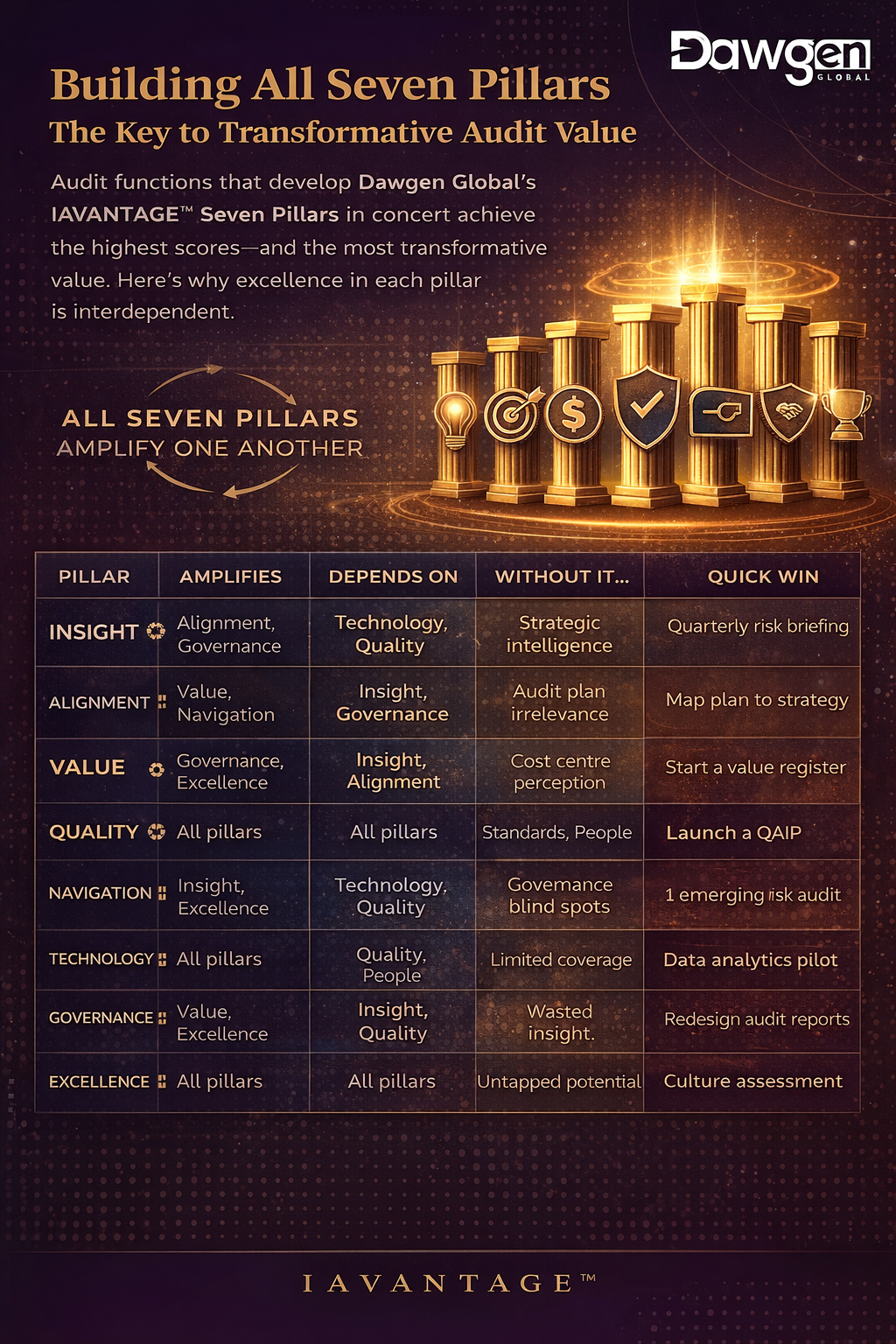
| PILLAR | AMPLIFIES | DEPENDS ON | WITHOUT IT… | AT FULL STRENGTH… | QUICK WIN |
| INSIGHT | Alignment, Governance | Technology, Quality | Reports without meaning | Strategic intelligence | Quarterly risk briefing |
| ALIGNMENT | Value, Navigation | Insight, Governance | Audit plan irrelevance | Dynamic risk coverage | Map plan to strategy |
| VALUE | Governance, Excellence | Insight, Alignment | Cost centre perception | Compelling ROI story | Start a value register |
| QUALITY | All pillars | Standards, People | Credibility erosion | Unshakeable foundation | Launch a QAIP |
| NAVIGATION | Insight, Excellence | Technology, Quality | Governance blind spots | Foresight capability | 1 emerging risk audit |
| TECHNOLOGY | All pillars | Quality, People | Limited coverage | Force multiplication | Data analytics pilot |
| GOVERNANCE | Value, Excellence | Insight, Quality | Wasted insight | Board-level influence | Redesign audit reports |
| EXCELLENCE | All pillars | All pillars | Untapped potential | Enterprise transformation | Culture assessment |
Assess Your Pillars Today
The Seven Pillars provide a comprehensive framework for evaluating where your Internal Audit function excels and where the greatest opportunities for improvement lie. The first step is honest assessment.
| YOUR NEXT STEP
Download the IAVANTAGE™ Pillar Self-Assessment Toolkit Dawgen Global is a multidisciplinary professional services firm delivering audit, assurance, risk advisory, tax, and business consulting services across the Caribbean, Latin America, and emerging markets. Our Audit & Assurance Services practice is recognized for its deep industry expertise, innovative methodologies, and commitment to helping organizations transform governance from a compliance obligation into a competitive advantage. The IAVANTAGE™ Framework is a proprietary Dawgen Global methodology. © 2026 Dawgen Global. All rights reserved. Dawgen Global has developed a comprehensive, pillar-by-pillar self-assessment toolkit that allows you to evaluate your Internal Audit function across all seven dimensions. The toolkit includes detailed scoring rubrics for each pillar, a visual maturity heat map generator, and a priority action planner that identifies your highest-impact improvement opportunities. ↓ DOWNLOAD YOUR FREE PILLAR ASSESSMENT TOOLKIT ↓
www.dawgen.global/iavantage-pillars
|
| CATCHING UP ON THE SERIES?
Article 1: “Why Internal Audit Is the Most Undervalued Function” | Article 2: “From Compliance Cop to Strategic Partner” Read the full series and download all free tools: www.dawgen.global/iavantage-series |
Coming Next in the IAVANTAGE™ Series
Article 4: “Proving Your Worth: The CFO-Ready Business Case for Internal Audit Transformation” – A practical guide to building the financial case for audit investment, with templates and methodologies for calculating ROI that will resonate with your CFO and Board.
About Dawgen Global
“Embrace BIG FIRM capabilities without the big firm price at Dawgen Global, your committed partner in carving a pathway to continual progress in the vibrant Caribbean region. Our integrated, multidisciplinary approach is finely tuned to address the unique intricacies and lucrative prospects that the region has to offer. Offering a rich array of services, including audit, accounting, tax, IT, HR, risk management, and more, we facilitate smarter and more effective decisions that set the stage for unprecedented triumphs. Let’s collaborate and craft a future where every decision is a steppingstone to greater success. Reach out to explore a partnership that promises not just growth but a future beaming with opportunities and achievements.
 Email: [email protected]
  Visit: Dawgen Global Website

 WhatsApp Global Number : +1 555-795-9071
Caribbean Office: +1876-6655926 / 876-9293670/876-9265210  WhatsApp Global: +1 5557959071
USA Office: 855-354-2447
Join hands with Dawgen Global. Together, let’s venture into a future brimming with opportunities and achievements


