B-READY 2025 CARIBBEAN SERIES TRINIDAD & TOBAGO
The Paradox of Resource Wealth and Regulatory Lag
Trinidad and Tobago occupies a singular position in the Caribbean economic landscape — an energy-exporting powerhouse whose per capita income substantially exceeds most of its regional neighbours, yet whose business environment data tells a story of institutional inertia and reform underperformance. The World Bank’s B-READY 2025 report provides the clearest global evidence yet of this paradox, and the findings demand urgent attention from T&T’s economic policymakers, private sector leaders, and development advisors.
Trinidad and Tobago’s B-READY 2025 scores place the twin-island republic in the bottom tier of Caribbean and LAC economies assessed, with particular weaknesses in Public Services (fourth quintile) and Operational Efficiency (fifth quintile globally). These are not peripheral metrics — they are direct measures of how easy it is for businesses to operate, comply with regulations, and contribute to economic diversification in an economy that urgently needs it.
T&T’s B-READY 2025 Pillar Scores: A Concerning Picture
| Economy / Benchmark | Reg. Framework (P1) | Public Services (P2) | Op. Efficiency (P3) | Quintiles |
| Trinidad & Tobago | 61.16 | 44.83 | 49.68 | 4th / 4th / 5th Quintile |
| LAC Average | 66.28 | 57.19 | 55.43 | Regional Benchmark |
| Global Average | 66.32 | 53.97 | 60.03 | Global Benchmark |
Every pillar score for Trinidad and Tobago falls below both the LAC regional average and the global average. The Operational Efficiency score of 49.68 — placing T&T in the fifth quintile globally — is the most alarming data point. This means that in terms of the actual day-to-day ease of regulatory compliance and use of public services, T&T is in the bottom 20 percent of all 101 economies assessed. For an upper-middle-income economy with T&T’s resource endowment and institutional heritage, this represents a profound governance and reform deficit.
The Public Services score of 44.83 — approximately 9 points below the global average and nearly 12.5 points below the LAC regional average — tells an equally stark story. Businesses in T&T face a regulatory landscape where the formal government service infrastructure is substantially inadequate to support compliance, transaction, and administrative requirements.
Topic-Level Analysis: The Full Extent of T&T’s Business Environment Challenges
| Topic | Score | Global Avg / Context |
| Business Entry | 72.17 | 71.74 — Near global average |
| Financial Services | 68.95 | ~63 — Above average |
| Labor | 65.86 | ~65 — Near global average |
| Utility Services | 64.94 | 70.69 — Below global average |
| Business Location | 43.37 | ~62 — Significantly below average |
| International Trade | 42.42 | ~59 — Significantly below average |
| Dispute Resolution | 42.04 | ~53 — Below global average |
| Business Insolvency | ~40 | 48.19 — Below global average |
| Market Competition | ~42 | 50.22 — Below global average |
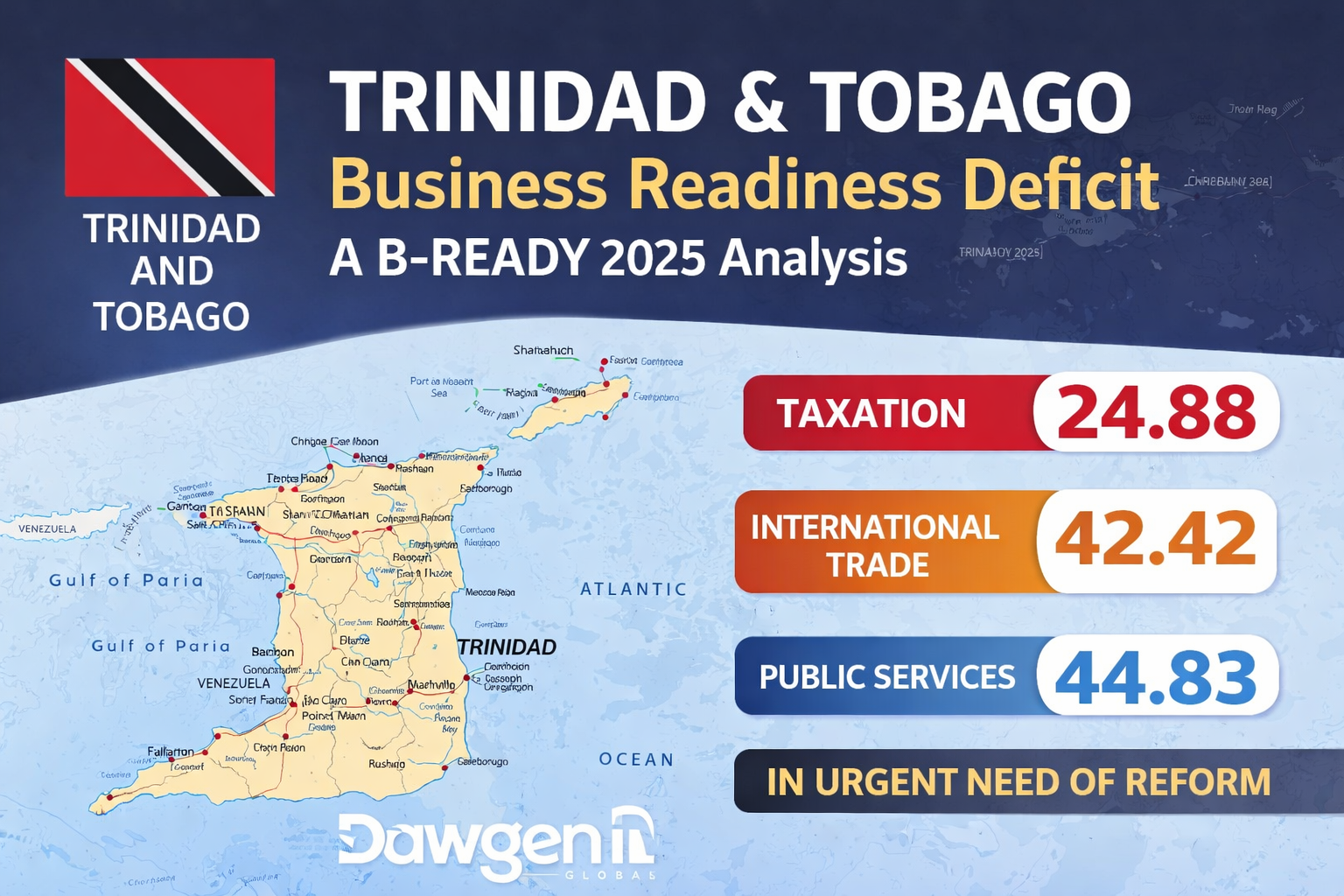
| Taxation | 24.88 | ~54 — Critically below average (less than half) |
The Taxation Crisis: 24.88 — A National Competitive Emergency
Trinidad and Tobago’s Taxation score of 24.88 is the most alarming data point in the entire Caribbean subset of B-READY 2025. Against a global average of approximately 54, T&T’s taxation performance score is less than half the global benchmark. This is not a marginal underperformance — it is a fundamental indictment of the tax administration environment that businesses in T&T are required to navigate. Tax compliance complexity, inefficiency of tax administration systems, unpredictability of the tax framework, and the absence of modern digital tax platforms all contribute to this outcome. For an economy seeking to diversify away from energy dependence, a dysfunctional tax environment for non-energy businesses is a critical barrier.
International Trade (42.42): Competitiveness Constraint
With a score of 42.42 on International Trade against a global average of approximately 59, T&T’s trade facilitation environment significantly underperforms. Border infrastructure quality, customs efficiency, trade document processing, and the reliability of trade-supporting public services all fall well below global standards. In a small open economy like T&T, where trade competitiveness directly determines economic diversification potential, this score represents a material constraint on growth beyond the energy sector.
Business Location (43.37): The Property Rights Problem
A score of 43.37 on Business Location — well below the global average — reflects well-documented challenges in T&T’s property registration, land administration, and permitting environment. The cost and time involved in property transactions, the opacity of land registries, and the complexity of construction permitting create friction that disproportionately affects SMEs and new market entrants who lack the resources to navigate bureaucratic complexity.
“T&T’s Taxation score of 24.88 — less than half the global average — is not a business environment metric, it is a national competitiveness emergency requiring immediate structural reform.”
The Double Gap: Public Services and Operational Efficiency Both in Deficit
What makes T&T’s B-READY profile particularly concerning is that both the public services gap and the efficiency gap are deeply negative simultaneously — and in the same direction. The public services gap (61.16 minus 44.83 = 16.33 points) is substantially wider than the global average of 12.35 points, indicating that T&T’s regulatory ambitions significantly exceed its service delivery capacity.
More alarming is the efficiency gap (61.16 minus 49.68 = 11.48 points) — nearly double the global average efficiency gap of 6 points. This means that not only are T&T’s written regulations below global standards, but businesses experience even greater difficulty in operational compliance than the regulatory framework itself would predict. This is the signature of an economy where institutional friction, bureaucratic inefficiency, and absence of digital service delivery combine to create a compounding barrier to business activity.
Economic Diversification and the B-READY Imperative
The urgency of T&T’s B-READY findings is amplified by the structural economic context. Trinidad and Tobago’s economy remains heavily dependent on hydrocarbon revenues — revenues that are structurally declining as global energy markets shift, reserves deplete, and the energy transition accelerates. Economic diversification is not an abstract policy goal — it is a national survival imperative.
B-READY 2025 makes clear, through its data, that the non-energy private sector in T&T is attempting to operate in one of the least supportive business environments in the assessed world. An Operational Efficiency score in the fifth quintile globally does not support diversification — it suppresses it. Entrepreneurs and investors evaluating T&T as a base for non-energy businesses will find, in the B-READY data, quantified confirmation of the obstacles they face.
Reform Priorities: Where T&T Must Act First
- Emergency tax administration reform: A Taxation score of 24.88 demands an emergency response. The Government of T&T should commission an immediate review of the tax compliance architecture, prioritising the digitalisation of tax filing and payment systems, simplification of compliance requirements for SMEs, and modernisation of the Board of Inland Revenue’s service delivery model.
- Trade facilitation overhaul: Improving the International Trade score requires investment in customs digitalisation, port infrastructure modernisation, single-window trade platforms, and the reduction of documentary requirements for import and export. The T&T Port Authority and Customs and Excise Division are the operational focal points for this reform.
- Land administration modernisation: Property registration reform — including the digitalisation of the Land Registry, streamlining of conveyancing processes, and reduction of stamp duty complexity — would materially improve the Business Location score and reduce friction for business establishment.
- Public services digital transformation: T&T’s public services gap of 16.33 points requires a systematic digital government transformation programme — encompassing business registration portals, permit management systems, and accessible public data infrastructure that reduces the administrative burden on businesses of all sizes.
- Competition and market regulation: A below-average Market Competition score signals that T&T’s regulatory architecture for market competition and consumer protection needs strengthening — particularly as the economy seeks to attract new entrants and disrupt incumbency advantages that have historically protected less productive economic activity.
The Moment of Structural Choice
Trinidad and Tobago stands at a structural crossroads. Its energy wealth has buffered the economy from the consequences of business environment underperformance for decades. That buffer is eroding. B-READY 2025 provides the clearest quantitative evidence yet that T&T’s non-energy business environment is not merely below regional standards — it is, in multiple dimensions, in the bottom tier globally.
The reform agenda is not technically complex — the solutions are well understood. What is required is the political will to prioritise business environment reform as a national economic security imperative, not merely an administrative project. The B-READY data provides the mandate. T&T’s leadership must now provide the response.
| ABOUT THIS ARTICLE SERIES
This article is part of Dawgen Global’s five-part Caribbean analysis of the World Bank B-READY 2025 report, covering Jamaica, Barbados, Trinidad & Tobago, Cabo Verde, and a Master Comparative Article. |
About Dawgen Global
“Embrace BIG FIRM capabilities without the big firm price at Dawgen Global, your committed partner in carving a pathway to continual progress in the vibrant Caribbean region. Our integrated, multidisciplinary approach is finely tuned to address the unique intricacies and lucrative prospects that the region has to offer. Offering a rich array of services, including audit, accounting, tax, IT, HR, risk management, and more, we facilitate smarter and more effective decisions that set the stage for unprecedented triumphs. Let’s collaborate and craft a future where every decision is a steppingstone to greater success. Reach out to explore a partnership that promises not just growth but a future beaming with opportunities and achievements.
 Email: [email protected]
  Visit: Dawgen Global Website

 WhatsApp Global Number : +1 555-795-9071
Caribbean Office: +1876-6655926 / 876-9293670/876-9265210  WhatsApp Global: +1 5557959071
USA Office: 855-354-2447
Join hands with Dawgen Global. Together, let’s venture into a future brimming with opportunities and achievements


