Executive Summary
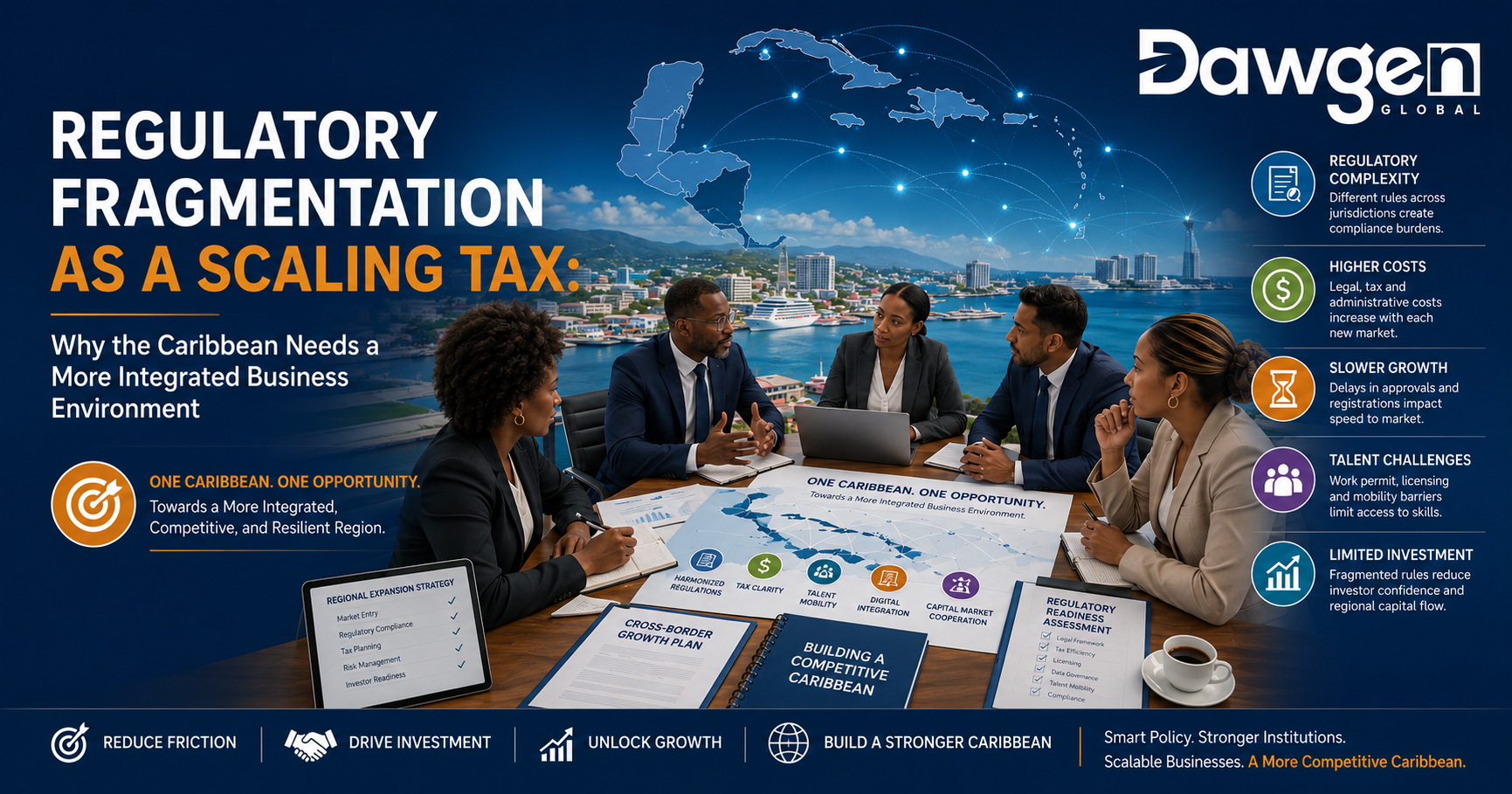
The Caribbean has no shortage of entrepreneurial talent, business ambition, sector opportunities, or regional potential. Yet many companies that succeed in one Caribbean market struggle to expand efficiently across the wider region. The reason is not always lack of demand or lack of vision. Often, the challenge is structural: regulatory fragmentation.
A business seeking to expand across Caribbean jurisdictions may encounter different company laws, tax rules, licensing requirements, employment regulations, securities rules, banking processes, foreign exchange considerations, data protection obligations, and professional compliance requirements. These differences create cost, delay, uncertainty, and execution risk.
A recent World Economic Forum report, produced in collaboration with the Stanford Graduate School of Business Venture Capital Initiative, describes regulatory fragmentation as an “invisible scaling tax” that makes it harder for companies outside large unified markets to grow into global champions. Although the report focuses on global venture capital and innovation finance, the lesson is directly relevant to the Caribbean: small markets must reduce cross-border friction if they want companies to scale.
For Caribbean businesses, regulatory fragmentation affects capital raising, investor confidence, market entry, talent mobility, tax planning, corporate structuring, mergers and acquisitions, fintech growth, AI adoption, private equity investment, and regional expansion. It can turn what should be a growth opportunity into a complex compliance exercise.
Dawgen Global believes that the Caribbean’s next stage of private-sector development requires a deliberate shift from fragmented national business environments toward a more coordinated regional scale-up architecture. This does not mean eliminating national sovereignty or local regulation. It means creating more practical pathways for businesses to incorporate, raise capital, hire talent, protect investors, comply with tax obligations, move data responsibly, and expand across borders with greater certainty.
The future of Caribbean competitiveness will depend not only on entrepreneurship, but on how effectively the region reduces the hidden costs that prevent businesses from scaling.
1. What Is Regulatory Fragmentation?
Regulatory fragmentation occurs when businesses operating across multiple jurisdictions must comply with different, overlapping, or inconsistent rules. In the Caribbean, this issue is especially important because the region is made up of many relatively small economies, each with its own legal, tax, regulatory, and administrative systems.
For a company expanding from one Caribbean country into another, fragmentation may arise in areas such as:
- Company incorporation and registration
- Tax compliance and transfer pricing
- Labour and employment law
- Work permits and talent mobility
- Securities and fundraising rules
- Banking and account opening
- Foreign exchange regulations
- Data protection and privacy
- Licensing and sector-specific approvals
- Import and customs requirements
- Intellectual property protection
- Consumer protection rules
- Anti-money laundering requirements
- Reporting obligations
- Professional accreditation
- Environmental and planning approvals
Each requirement may be reasonable when viewed individually. The problem is the cumulative effect. When businesses must navigate many different processes across multiple markets, expansion becomes slower, more expensive, and more uncertain.
This is why regulatory fragmentation operates like a scaling tax.
2. Why Fragmentation Matters More for Small Markets
Large economies benefit from scale. A company incorporated in a large unified market can often access millions of customers under a broadly consistent legal and commercial framework. Smaller economies do not have this advantage.
Caribbean businesses often need to expand regionally to achieve scale. A company in Jamaica, Barbados, Trinidad and Tobago, Guyana, The Bahamas, Saint Lucia, Cayman, or any other Caribbean market may reach domestic limits quickly. To grow meaningfully, it may need to sell, hire, partner, raise capital, or operate across multiple jurisdictions.
However, if each new market requires substantial legal, tax, regulatory, and administrative effort, the cost of expansion can become prohibitive.
This affects:
- Start-ups seeking regional customers
- SMEs expanding distribution
- Professional service firms serving regional clients
- Fintech companies seeking licensing clarity
- Tourism-related businesses building multi-island operations
- Renewable energy companies working across jurisdictions
- Healthcare and education providers expanding digitally
- Technology firms scaling platforms
- Family businesses pursuing regional acquisitions
- Private equity investors seeking cross-border opportunities
In small markets, fragmentation can determine whether a business remains local or becomes regional.
3. The Scaling Tax on Caribbean Businesses
The “scaling tax” is not always visible in a company’s financial statements, but it appears in real business costs.
Legal Costs
Every new jurisdiction may require local counsel, entity structuring, contract review, licensing advice, shareholder documentation, employment terms, and regulatory interpretation.
Tax Complexity
Companies may face different corporate tax rates, withholding taxes, indirect taxes, transfer pricing requirements, permanent establishment rules, and tax reporting obligations.
Administrative Delays
Business registration, licences, banking setup, work permits, tax registrations, and approvals can take time. Delays can affect market entry and investor confidence.
Management Distraction
Leadership teams must spend time navigating compliance instead of focusing on strategy, customers, innovation, and execution.
Investor Uncertainty
Investors may discount valuations if regulatory pathways are unclear or if cross-border expansion appears too complex.
Operational Duplication
Companies may need separate local processes, reporting systems, service providers, and compliance calendars for each market.
Talent Constraints
If skilled professionals cannot move easily across the region, businesses struggle to place the right people where they are needed.
Capital Raising Challenges
Different securities and private placement rules can make regional fundraising more complicated than it should be.
The scaling tax is ultimately paid through slower growth, higher costs, lower valuations, and missed opportunities.
4. Regulatory Fragmentation and Investor Readiness
A business seeking investment must show that it can grow efficiently. Investors want to understand not only the company’s product or service, but also its ability to expand.
For Caribbean businesses, regulatory fragmentation can raise investor questions such as:
- Can the company legally operate in multiple jurisdictions?
- Are tax structures efficient and compliant?
- Are licences required in each market?
- Can the company hire regional talent?
- Are contracts enforceable across jurisdictions?
- Are customer data and privacy obligations managed properly?
- Are foreign exchange risks understood?
- Can profits be repatriated?
- Are shareholder rights protected?
- Are cross-border related-party transactions properly documented?
- Can the company raise capital regionally?
- Is expansion dependent on unclear approvals?
If the answers are weak, investors may hesitate.
Dawgen Global believes that regional expansion readiness should become part of every investor-readiness assessment. A company with strong local performance but no regulatory expansion plan may not be fully prepared for serious growth capital.
5. Regulatory Fragmentation and Capital Formation
The Caribbean needs more private capital to support innovation, SMEs, scale-ups, infrastructure, climate resilience, digital transformation, and regional business growth. However, capital formation is harder when rules vary significantly across jurisdictions.
Investors may face uncertainty around:
- Private placement rules
- Fund registration
- Investor qualification standards
- Cross-border marketing of funds
- Tax treatment of investment vehicles
- Currency movement
- Reporting obligations
- Securities regulation
- Beneficial ownership disclosure
- AML/KYC requirements
- Exit and secondary sale rules
Fund managers may also find it difficult to build regional investment vehicles if each jurisdiction requires separate treatment.
To deepen Caribbean private capital markets, the region should explore more harmonized frameworks for:
- Private equity funds
- Venture capital funds
- Angel investor networks
- Family office co-investment vehicles
- Private credit funds
- SME growth funds
- Climate and resilience funds
- Regional private placements
- Qualified investor platforms
A more coordinated capital market environment would make it easier to mobilize regional and diaspora capital.
6. Regulatory Fragmentation and M&A
Mergers and acquisitions can help Caribbean companies scale, consolidate fragmented sectors, attract foreign investment, support succession, and unlock shareholder value. However, cross-border M&A can be difficult when regulatory requirements vary widely.
A regional acquisition may require review of:
- Company law
- Tax structuring
- Stamp duties and transfer taxes
- Competition law
- Sector licences
- Labour obligations
- Real estate ownership rules
- Banking consent
- Foreign investment restrictions
- Exchange control considerations
- Regulatory approvals
- Data protection requirements
- Environmental obligations
- Pension and employee benefit issues
These issues are manageable with professional advice, but they increase transaction complexity.
For smaller transactions, the cost of cross-border due diligence can become disproportionately high. This may discourage consolidation and prevent businesses from achieving regional scale.
Caribbean policymakers should recognize that M&A readiness is part of regional competitiveness. If acquisitions and mergers are too difficult, companies may remain fragmented, undercapitalized, and less competitive.
7. The Role of Tax Clarity in Regional Scaling
Tax uncertainty is one of the strongest barriers to regional expansion.
Businesses need clarity on:
- Where profits are taxed
- Whether withholding tax applies
- How dividends, royalties, management fees, and interest are treated
- Whether transfer pricing documentation is required
- Whether tax losses can be used
- How indirect taxes apply to cross-border services
- Whether permanent establishment risk exists
- How employee mobility affects payroll taxes
- Whether double taxation relief is available
- How share transfers are taxed
- How intellectual property should be structured
Without tax clarity, companies may under-expand, overpay tax, face penalties, or create inefficient structures.
Dawgen Global believes that regional tax planning should be addressed before expansion begins. Tax should not be an afterthought. It should form part of the business model, pricing strategy, legal structure, and investment plan.
8. Talent Mobility and the Caribbean Scale-Up Agenda
A scale-up company needs talent. It may need finance professionals, software developers, AI specialists, cybersecurity experts, engineers, compliance professionals, marketers, project managers, and experienced executives.
If talent cannot move efficiently across the region, businesses struggle to scale.
Talent mobility barriers may include:
- Work permit delays
- Professional licensing differences
- Immigration restrictions
- Payroll and tax complications
- Recognition of qualifications
- Social security coordination
- Employment law differences
- Remote work uncertainty
The Caribbean should view talent mobility as an economic growth issue. If companies cannot access regional talent, they may relocate functions outside the region or fail to scale at all.
A stronger Caribbean talent framework could include:
- Faster work authorization for specialized skills
- Mutual recognition of selected professional qualifications
- Regional talent databases
- Digital nomad and remote work clarity
- Start-up and scale-up visa pathways
- University-industry partnerships
- Cross-border internship and apprenticeship programmes
- Diaspora talent engagement
Capital follows talent. Talent follows opportunity. Regulation should help connect both.
9. Data, AI and Digital Regulation
As Caribbean businesses adopt digital platforms and AI tools, regulatory fragmentation in data protection, cybersecurity, digital identity, fintech, electronic transactions, and consumer protection will become more important.
A business offering digital services across the region may face questions such as:
- Can customer data be transferred across borders?
- What privacy rules apply?
- Are consent requirements different?
- What cybersecurity standards are expected?
- Are electronic signatures recognized?
- Are digital contracts enforceable?
- Does AI use require special disclosure?
- Are fintech licences required?
- Are online payments regulated differently?
- What happens if there is a data breach?
Digital businesses scale across borders faster than traditional businesses. If regulation is fragmented, digital growth becomes harder.
The Caribbean needs more coordinated digital business rules to support:
- E-commerce
- Fintech
- AI adoption
- Digital health
- Online education
- Cloud services
- Cross-border professional services
- Digital identity
- Remote work
- Cybersecurity resilience
Digital integration should become a core pillar of regional economic integration.
10. Lessons from Global Innovation Ecosystems
The WEF report emphasizes that the ability to scale companies depends not only on capital, but also on the regulatory and institutional environment in which companies operate. It notes that fragmented rules governing incorporation, employment, equity compensation, securities issuance, and data compliance can add cost and complexity to cross-border growth.
For the Caribbean, this is an important lesson. Start-up support programmes are useful, but they are not enough if companies later face major barriers to regional expansion.
The region needs to ask:
- Can a company incorporate once and expand regionally with ease?
- Can investors participate across borders efficiently?
- Can employees receive equity incentives with tax clarity?
- Can companies raise capital regionally?
- Can businesses move data safely and legally?
- Can professional talent move where needed?
- Can M&A transactions close without excessive friction?
- Can founders access regional support systems?
The future belongs to regions that make it easier for companies to scale.
11. Building a More Integrated Caribbean Business Environment
Reducing regulatory fragmentation does not require every country to have identical laws. But it does require deliberate coordination.
Possible reforms include:
1. Regional Business Passporting
A system allowing approved businesses registered in one Caribbean jurisdiction to operate more easily in others, subject to defined conditions.
2. Harmonized Private Placement Rules
Clear regional standards for raising capital from qualified investors.
3. Model Shareholder and Investment Documents
Standardized templates for start-ups, scale-ups, angel investments, and private equity transactions.
4. Mutual Recognition of Selected Licences
Where appropriate, professional and business licences could be recognized across participating jurisdictions.
5. Regional Digital Business Identity
A trusted digital identity system for companies operating across borders.
6. Coordinated Data Protection Standards
Greater alignment in privacy, data transfer, cybersecurity, and breach reporting rules.
7. Employee Equity Reform
Clear and predictable treatment of stock options and employee share plans.
8. Start-Up and Scale-Up Visa Pathways
Regional mechanisms to help high-growth companies access specialized talent.
9. Regional Tax Guidance
Clearer guidance on cross-border services, withholding taxes, permanent establishment issues, and investment structures.
10. Private Capital Market Cooperation
Stronger collaboration among securities regulators, stock exchanges, fund managers, and professional advisors.
The Caribbean does not need one single perfect system immediately. It needs practical steps that reduce friction and build confidence.
12. What Businesses Should Do Now
Businesses should not wait for regional reform before preparing for expansion. They can take practical steps now.
A Caribbean company planning regional growth should:
- Conduct a regional expansion readiness assessment.
- Review legal and tax implications in target markets.
- Map required licences and approvals.
- Prepare a cross-border corporate structure.
- Develop a regional financial model.
- Review employment and talent mobility needs.
- Assess data protection and cybersecurity obligations.
- Strengthen governance and board oversight.
- Prepare investor-ready financial reporting.
- Document contracts and intellectual property.
- Review pricing and tax implications across markets.
- Identify regional partners, distributors, or acquisition targets.
- Develop an M&A or partnership strategy.
- Assess foreign exchange and repatriation risks.
- Seek professional advice before entering new markets.
Regional expansion should be structured, not improvised.
13. How Dawgen Global Can Help
Dawgen Global assists businesses, investors, family offices, boards, and institutions in navigating regional expansion, governance, finance, tax, legal, risk, and strategic complexity.
Our services include:
- Regional expansion readiness assessments
- Corporate structuring
- Tax advisory and cross-border tax planning
- Legal and compliance advisory
- Investor readiness assessments
- Business valuation
- Financial modelling
- Corporate finance advisory
- M&A advisory
- Private equity and venture advisory
- Governance advisory
- Risk assurance
- AI and digital transformation advisory
- Cybersecurity risk advisory
- Accounting and financial reporting
- Audit and assurance
- Strategic planning
- Business coaching
- Board advisory
Dawgen Global’s integrated multidisciplinary approach helps businesses reduce uncertainty, structure growth properly, and prepare for scalable regional execution.
Conclusion: The Caribbean Must Reduce the Hidden Cost of Scaling
The Caribbean has the talent, ambition, and market opportunity to build stronger regional businesses. But entrepreneurship alone will not overcome structural friction.
Regulatory fragmentation acts as a hidden tax on scaling. It increases cost, slows expansion, complicates capital raising, discourages investors, limits talent mobility, and makes regional growth harder than it should be.
The region’s competitiveness will depend on how effectively policymakers, regulators, businesses, investors, and advisors work together to reduce cross-border friction. Practical coordination in company registration, tax, capital raising, data protection, employment, licensing, and private market development could unlock significant value.
Dawgen Global believes that the Caribbean must move toward a more integrated business environment—one that allows companies to launch locally, scale regionally, and compete globally.
The future of Caribbean growth belongs to businesses and jurisdictions that make scaling easier, faster, safer, and more investable.
Next Step:
Is your business planning regional expansion, capital raising, M&A, tax structuring, investor readiness, or cross-border growth?
Dawgen Global can help you navigate regulatory complexity and design a practical regional scale-up strategy.
Request a proposal from Dawgen Global today.
📧 Email: [email protected]
🌐 Contact Form: https://www.dawgen.global/contact-us/
📞 Caribbean: 876-9293670 | 876-9293870
📞💬 WhatsApp Global: +1 555 795 9071
At Dawgen Global, we help you make smarter and more effective decisions. Let’s have a conversation.
About Dawgen Global
“Embrace BIG FIRM capabilities without the big firm price at Dawgen Global, your committed partner in carving a pathway to continual progress in the vibrant Caribbean region. Our integrated, multidisciplinary approach is finely tuned to address the unique intricacies and lucrative prospects that the region has to offer. Offering a rich array of services, including audit, accounting, tax, IT, HR, risk management, and more, we facilitate smarter and more effective decisions that set the stage for unprecedented triumphs. Let’s collaborate and craft a future where every decision is a steppingstone to greater success. Reach out to explore a partnership that promises not just growth but a future beaming with opportunities and achievements.
 Email: [email protected]
  Visit: Dawgen Global Website

 WhatsApp Global Number : +1 555-795-9071
Caribbean Office: +1876-6655926 / 876-9293670/876-9265210  WhatsApp Global: +1 5557959071
USA Office: 855-354-2447
Join hands with Dawgen Global. Together, let’s venture into a future brimming with opportunities and achievements


