
Marketplaces, booking sites and delivery apps now stand between Caribbean sellers and their customers. The law increasingly decides who collects the tax by who controls the transaction, not by who owns the product. Sellers who assume “the platform handles it” are carrying risk they have not measured.
Executive summary
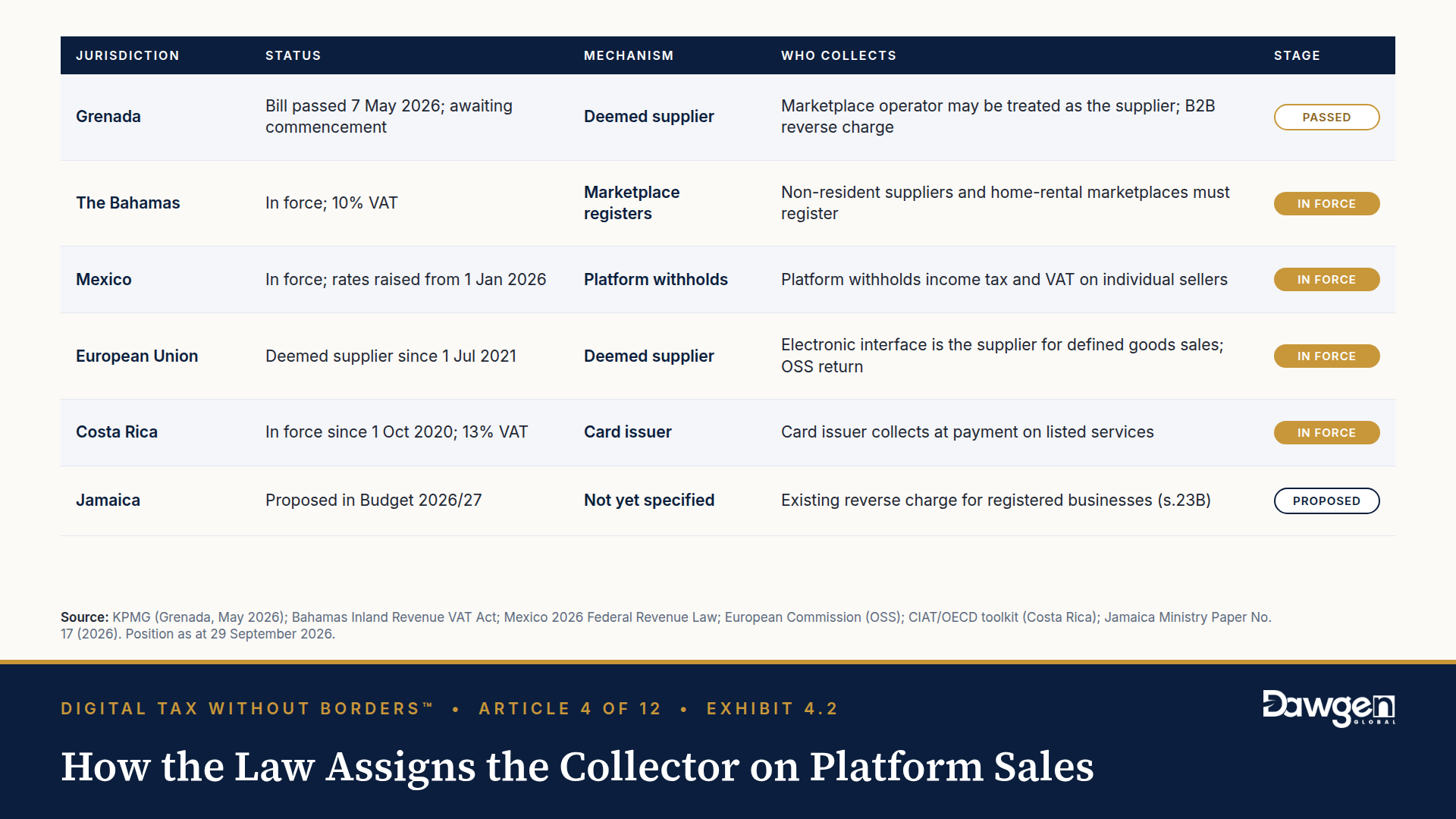
A single online sale can involve a maker, a platform, a payment processor, a courier and a customer. When a value added tax (VAT) or General Consumption Tax (GCT) is due, the law must decide which of them collects it. Caribbean and Latin American governments are answering that question in different ways. Grenada’s VAT (Amendment) Bill 2026 allows marketplace operators to be treated as the supplier. The Bahamas requires home-rental marketplaces to register. Mexico makes platforms withhold income tax and VAT on individuals who sell through them. The European Union (EU) deems certain electronic interfaces to be the supplier of goods. Costa Rica takes a different path, collecting through card issuers at the point of payment. Jamaica has announced GCT on imported digital services but has not yet said who will collect it.
For a Caribbean craft producer, villa owner or app operator, the consequences are practical: revenue booked at the wrong figure, tax collected twice or not at all, and platform fees carrying their own tax and withholding questions. This article sets out the roles a platform plays, how collector rules work, how to reconcile a platform statement and which contract clauses to negotiate.
Four roles a platform can play
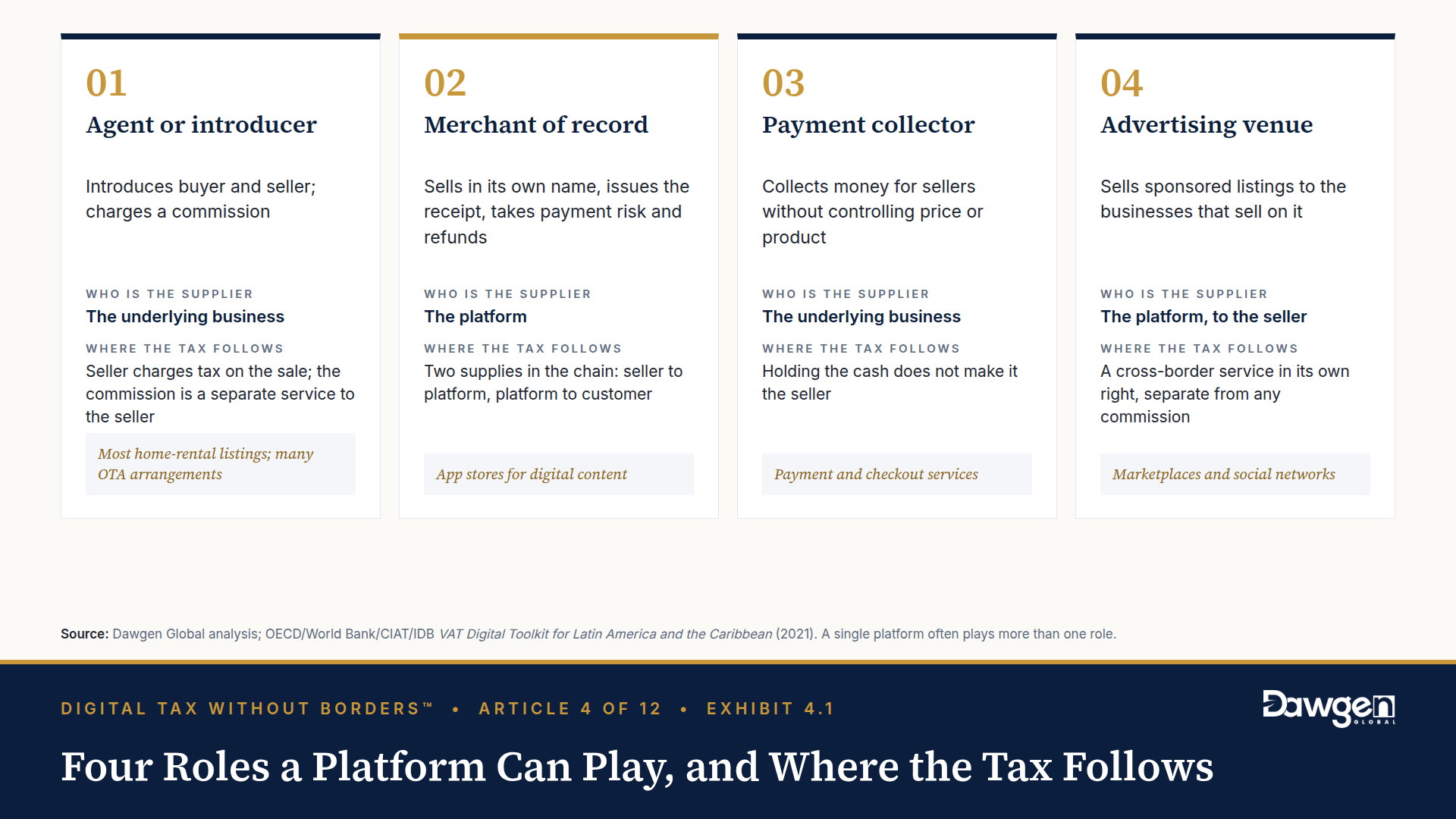
The word “platform” hides very different legal relationships. Before any tax question can be answered, a seller must know which of four roles the platform actually performs, and it will often perform more than one.
Agent or introducer. The platform introduces buyer and seller and charges a commission. The customer contracts with the underlying business, which remains the supplier. The platform supplies intermediation to the seller, and sometimes a booking fee to the buyer. Most home-rental listings and many online travel agency (OTA) arrangements start here.
Merchant of record. The platform sells in its own name: it sets the customer terms, issues the receipt, takes the payment risk and handles refunds. App stores typically work this way for digital content. There are two supplies in the chain, and the tax follows each.
Payment collector. The platform collects money for sellers without controlling price or product. Holding the cash does not, by itself, make it the seller.
Advertising venue. Marketplaces and social networks also sell sponsored listings to the businesses that sell on them, a cross-border service in its own right, separate from any commission.
Cash custody is not the same as tax responsibility. The party that holds the money is not automatically the supplier, and the party that owns the goods is not always the party the law requires to collect. Every material channel needs both answers written down: who is the commercial supplier, and who, if anyone, is the statutory collector.
How the law assigns the collector
Thousands of small overseas sellers are hard to register and audit; a handful of platforms are not. The VAT Digital Toolkit for Latin America and the Caribbean, launched in June 2021 by the Organisation for Economic Co-operation and Development (OECD), the World Bank, the Inter-American Center of Tax Administrations (CIAT) and the Inter-American Development Bank (IDB), sets out the options [1]. Four families are in use.
Deemed-supplier rules
A deemed-supplier rule treats the platform as if it had bought from the seller and sold to the customer, so the platform charges and remits the tax, whatever its terms call it. Grenada’s VAT (Amendment) Bill 2026, passed by Parliament on 7 May 2026 and awaiting assent and commencement by Gazette notice, requires non-resident digital suppliers to register and charge VAT on business-to-consumer (B2C) supplies, applies a reverse charge to business-to-business (B2B) supplies, and allows marketplace operators to be treated as the supplier [2]. Customer location is fixed by two non-conflicting indicators, such as billing address or the Internet Protocol (IP) address of the customer’s device, data platforms hold and small sellers usually do not. The EU has deemed certain electronic interfaces to be the supplier for defined distance sales of goods since 1 July 2021, alongside its One Stop Shop (OSS) for reporting [3]. Australia has done the same for platforms selling imported digital products since 1 July 2017 [4].
Registration of specific intermediaries
The Bahamas charges VAT at 10 per cent on electronic commerce services supplied to persons in The Bahamas, requires non-resident suppliers to register, and separately requires home-rental marketplaces to register [5][6]. For a villa owner in Exuma, the platform is inside the VAT system, not outside it.
Platform withholding on sellers
In Mexico, platforms withhold both income tax and VAT on individuals selling through them, with rates increased from 1 January 2026 [1]. The platform becomes a collection agent for the seller’s own taxes.
Card-issuer collection
Costa Rica charges 13 per cent VAT on cross-border digital services and, since 1 October 2020, has card issuers collect the tax at the point of payment on services listed by the tax authority, with an optional simplified registration for providers [1]. Colombia offers a card-issuer withholding alternative for its 19 per cent VAT on digital services from abroad [7]. The model needs no platform cooperation, but it is blunt: the bank sees a payment to a listed merchant, not what was bought or whether the buyer is a business.
Where the rest of the Caribbean stands
Barbados (VAT at 17.5 per cent since 1 December 2019) and Suriname (VAT at 10 per cent since 1 January 2023) make foreign suppliers register [8][9]. Guyana relies on recipients self-accounting for VAT on imported services [10]. Trinidad and Tobago has no specific regime for foreign digital services [11]. Jamaica’s Ministry Paper No. 17, tabled on 12 February 2026, proposes GCT on digital services and intangibles supplied from abroad, projected to yield J$300 million in the final quarter of fiscal year (FY) 2026/27 and about J$4.2 billion a year from FY2027/28 [12]. The collection mechanism, threshold and B2B treatment have not been announced, and enabling legislation and Tax Administration Jamaica (TAJ) guidance had not been published by late September 2026.
Three Caribbean examples
A craft producer selling through a global marketplace
A Montego Bay producer of hand-finished wooden homeware sells through a global marketplace to buyers in the United States (US), the United Kingdom (UK) and the EU. The marketplace takes the payment, deducts referral and fulfilment fees and pays the balance monthly in US dollars.
Three questions arise. First, whether the marketplace is deemed the supplier of the export sale depends on the destination’s law; for EU consumers it can be, in defined cases. Second, the fees are imported services. If the producer is registered for GCT, they fall within the reverse charge under sections 3(1)(b) and 23B of the GCT Act, and the producer self-accounts for the tax [13]; below the J$15 million registration threshold, it does not. Third, payments to a non-resident for services raise withholding questions: under Jamaican domestic law, service fees attract 33⅓ per cent, reduced to 15 per cent under the Caribbean Community (CARICOM) Double Taxation Agreement where it applies, and potentially further under other treaties [14]. Whether a commission netted from proceeds attracts withholding should be settled once and documented, not ignored because no cheque was written.
A villa listed on a home-rental platform
A north coast villa is listed on two home-rental platforms and takes direct bookings. Today, the platform’s fee to the owner is an imported service. From 1 April 2027, under the General Consumption Tax (Amendment of Schedules) Order, 2026, approved by the House on 29 April 2026, short-term rental accommodation comes within GCT [15]. The owner must then know who charges GCT on the accommodation, on what amount, and how cancellations are handled. A Bahamian villa faces those questions now.
A Caribbean food-delivery or ride app
A regional delivery app operating in Kingston and Port of Spain takes the customer’s payment for the meal, a delivery fee and a service charge, then pays restaurants less commission and riders a per-trip fee. Here the questions are domestic: is the app the seller of the meal or only of the delivery and intermediation service; are riders independent contractors supplying the app or the customer; and does the app’s commission form part of a GCT-registered restaurant’s costs on which input tax is claimed? In Trinidad and Tobago, where the FY2026 Budget signalled a VAT review [11], an app that builds its data around these distinctions now will adapt faster.
Reconciling the platform statement to the bank
Platforms pay a net amount, and the statement often shows a single line labelled “taxes” or “fees”. Revenue booked from bank deposits is almost always wrong. The illustrative exhibit below uses a hypothetical villa, one month of bookings and an assumed consumption tax of 10 per cent collected by the platform; it does not represent any jurisdiction’s rate or any platform’s fee structure.
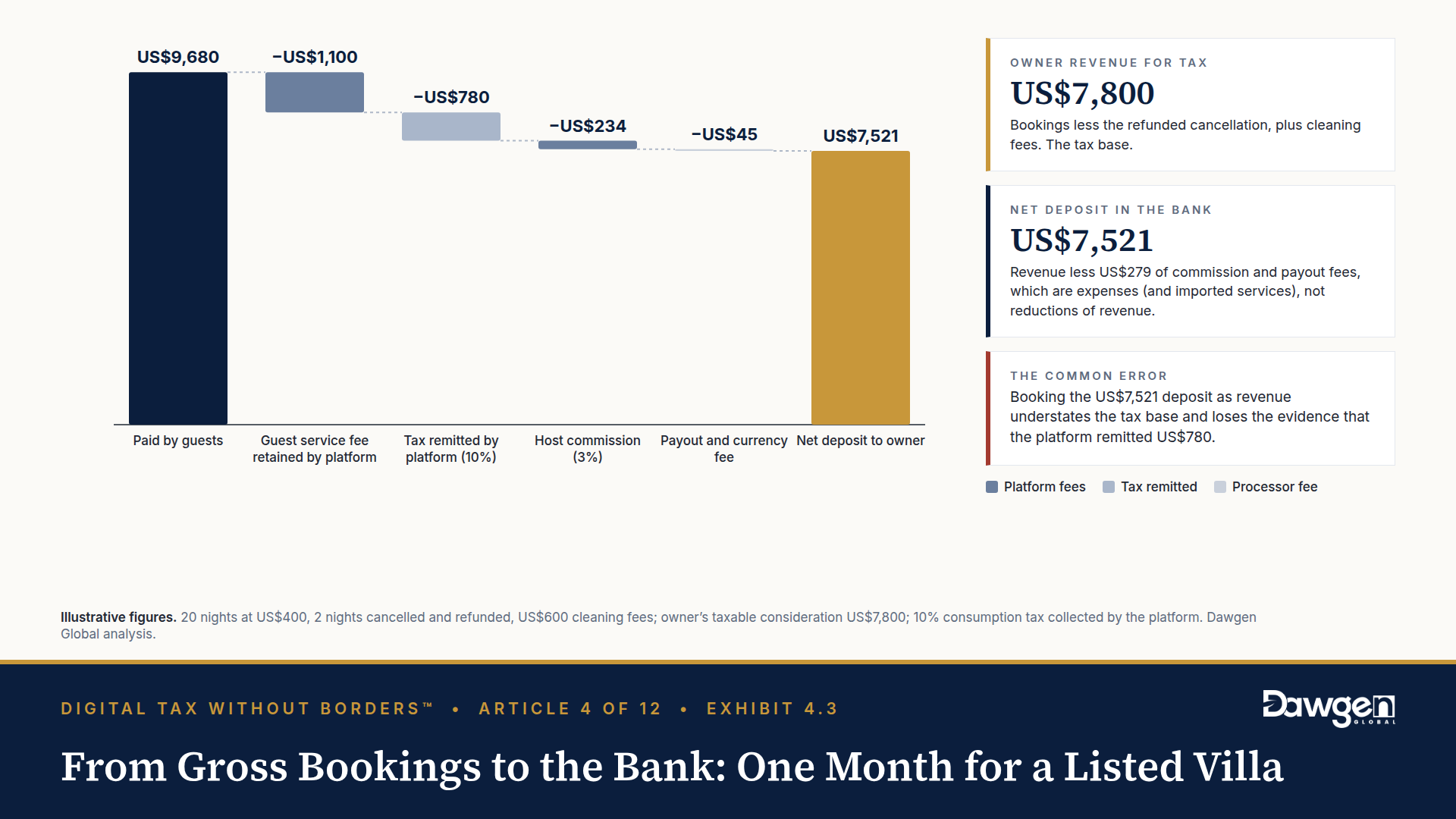
The exhibit exposes three failures. Booking the US$7,521 deposit as revenue understates revenue by US$279 and loses the commission and payout fee as expenses, along with any reverse charge on them. If the owner’s booking engine also adds tax to the US$7,800, US$780 is collected twice. If the platform’s registration does not cover that booking, US$780 has leaked, and the authority will look to the supplier.
Double collection and leakage
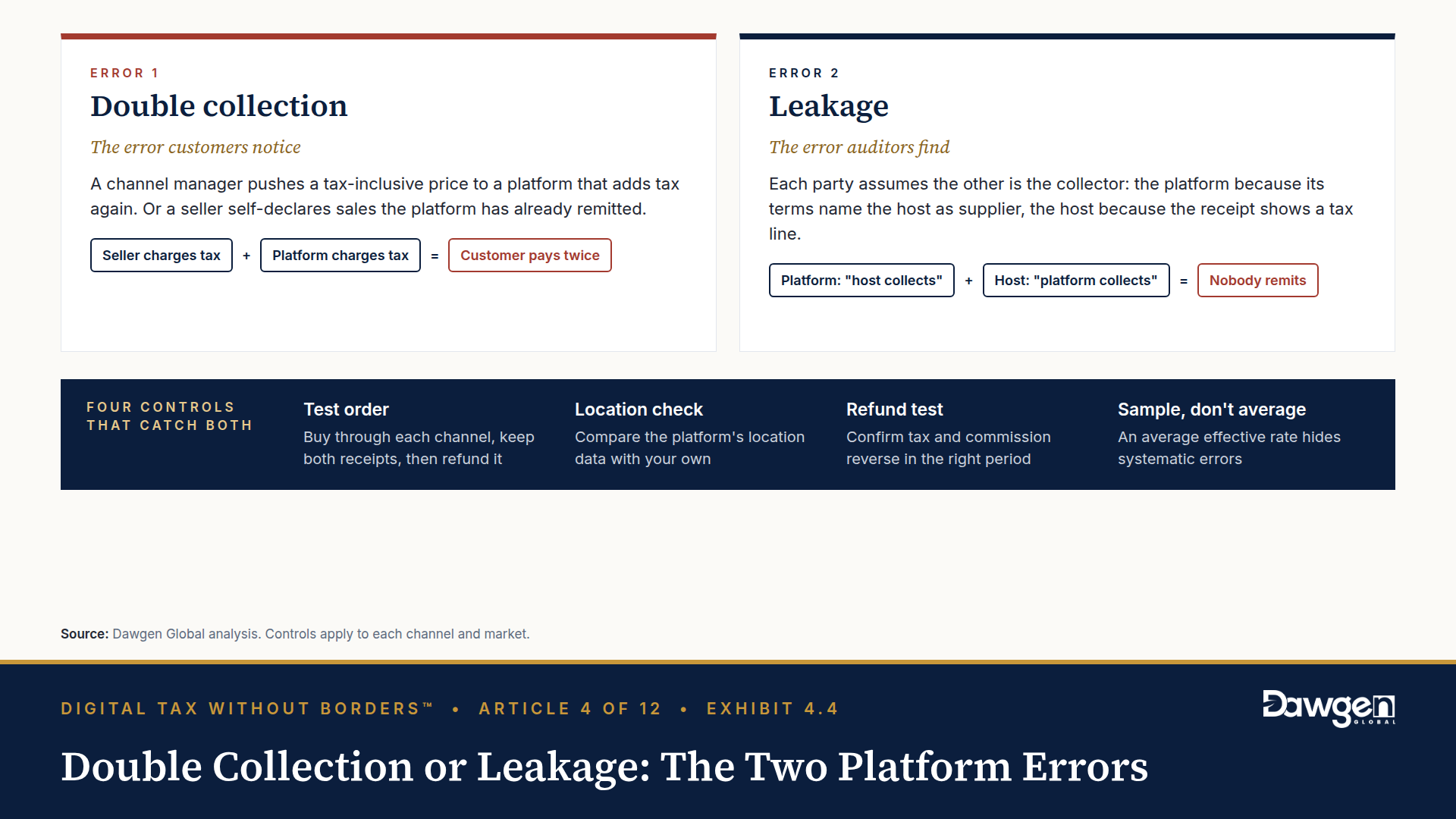
Double collection is the error customers notice; leakage is the error auditors find. Double collection typically happens when a channel manager pushes a tax-inclusive price to a platform that adds tax again. Leakage happens when each party assumes the other is the collector: the platform because its terms name the host as supplier, the host because the receipt shows a tax line.
The controls are simple. Place a real test order through each channel, keep both receipts, and refund it. Compare the platform’s location data with your own. Test refunds separately, and sample by product and market; an average effective rate hides systematic errors.
Contract clauses to negotiate
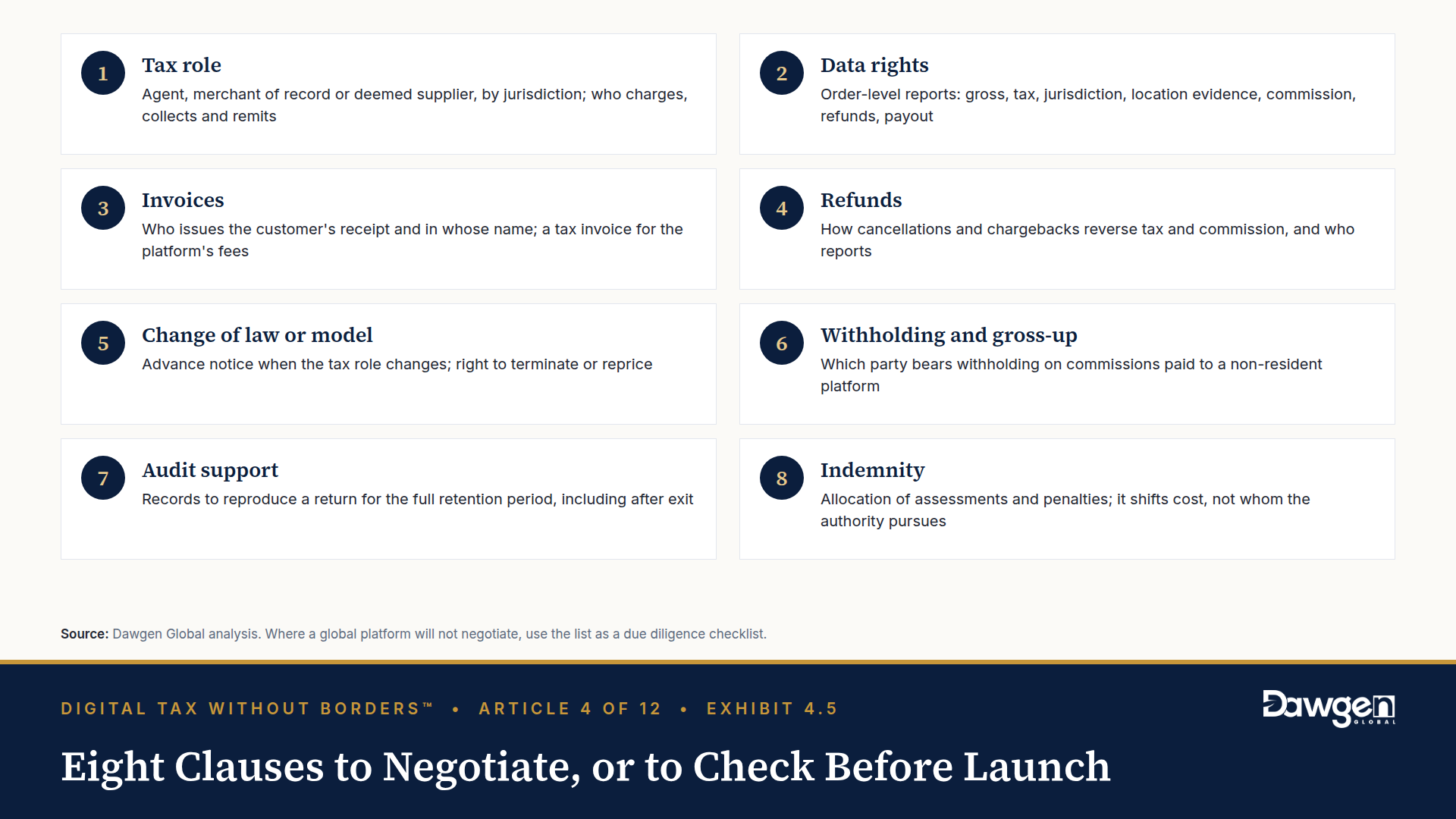
Global platforms rarely negotiate with small sellers, but regional platforms, OTAs dealing with hotel groups and local apps signing restaurants do. These are the clauses that matter.
- Tax role. By jurisdiction and transaction type, whether the platform is agent, merchant of record or deemed supplier, and who charges, collects and remits each tax.
- Data rights. Machine-readable order-level reports showing gross price, tax type and amount, jurisdiction, location evidence, commission, refunds and payout, within a fixed period after month-end.
- Invoices. Who issues the customer’s receipt, in whose name and registration number, and a tax invoice to the seller for the platform’s fees.
- Refunds. How cancellations and chargebacks reverse tax and commission, and who reports the adjustment.
- Change of law or model. Advance notice when a new law or new platform functionality alters the tax role, with a right to terminate or reprice.
- Withholding and gross-up. Which party bears withholding on commissions paid to a non-resident platform.
- Audit support. Access to records needed to reproduce a return for the full retention period, including after termination.
- Indemnity. Allocation of assessments, penalties and interest caused by one party’s error. An indemnity shifts cost; it does not change whom the tax authority pursues.
Where a global platform will not negotiate, the list becomes a due diligence checklist: obtain its merchant-of-record model by country, registration details, sample invoices and a sample settlement file before launch. If it cannot name the supplier and collector for a market, do not tell customers the tax is handled.
The Dawgen Digital Tax COMPASS™
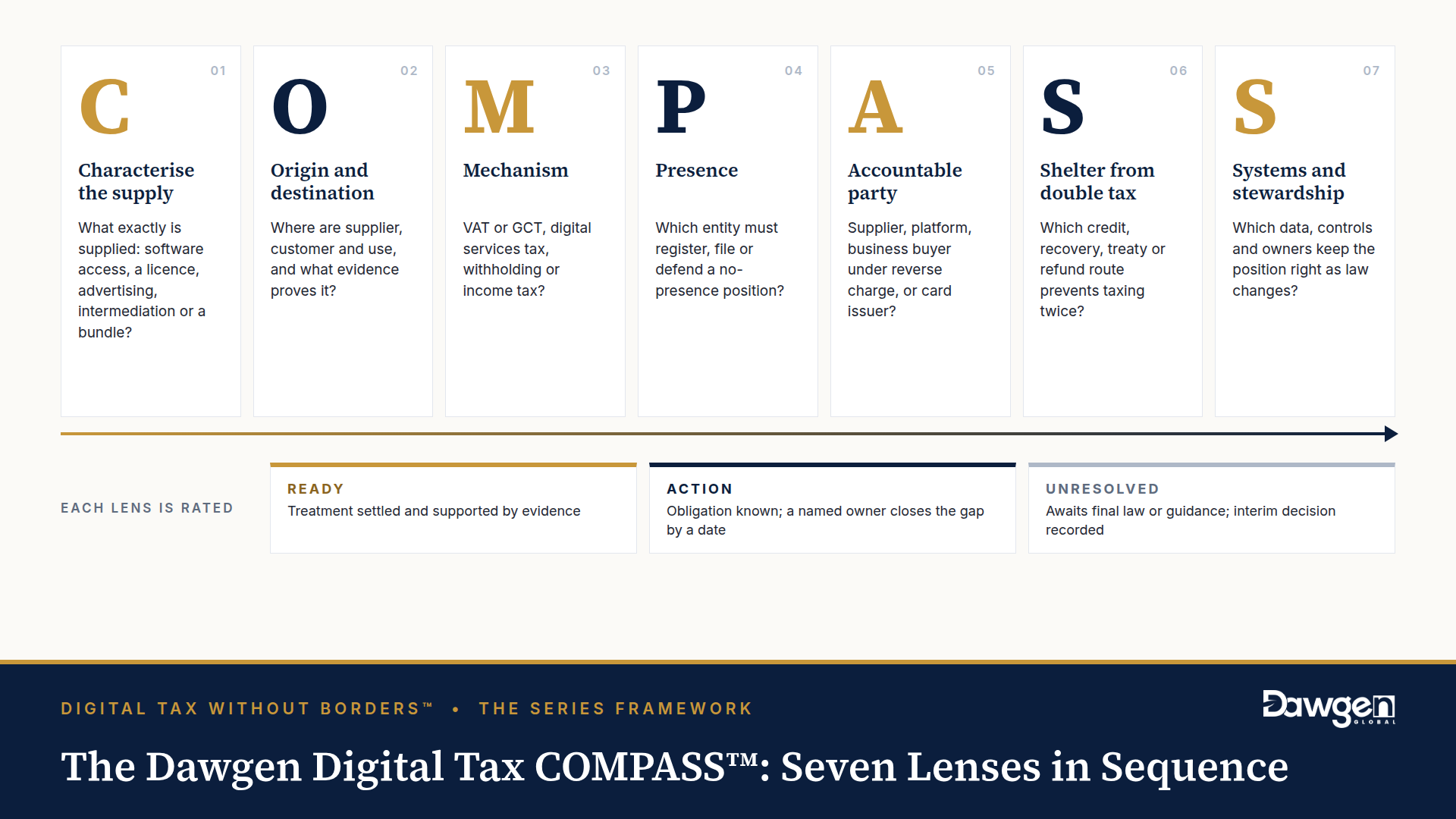
The Dawgen Digital Tax COMPASS™ is the method Dawgen Global uses to turn the broad phrase “digital tax” into specific, answerable questions. It works transaction by transaction, and it applies equally to what a business buys and what it sells. Seven lenses are applied in sequence, because each answer depends on the one before it.
- C — Characterise the supply. What exactly is supplied: access to software, a licence of intellectual property, advertising, intermediation, a professional service delivered remotely, or a bundle of several? The contract and the actual performance decide, not the invoice description.
- O — Origin and destination. Where are the supplier, the customer and the place of use or consumption, and what evidence proves it? Billing address, card country, IP address and contract terms often disagree.
- M — Mechanism. Which tax is in play: VAT or GCT on consumption, a gross-revenue digital services tax, withholding tax on the payment, or income tax on profits? Each has a different taxpayer, base and remedy.
- P — Presence. Which entity has a taxable connection with which jurisdiction, and must it register, file or defend a no-presence position?
- A — Accountable party. Who must actually charge, collect or remit: the supplier, a platform deemed to be the supplier, the business customer under a reverse charge, or a payment intermediary?
- S — Shelter from double taxation. Which credit, input tax recovery, treaty provision or refund route prevents the same value being taxed twice, and is it documented?
- S — Systems and stewardship. Which data fields, controls, owners and monitoring routines keep the position right as volumes grow and the law changes?
Each lens is rated on a simple three-tier scale. Ready means the treatment is settled and supported by evidence. Action means the obligation is known and a named owner is fixing a gap by a date. Unresolved means the answer depends on law or guidance that is not yet final, and an interim commercial decision has been recorded. The output is a transaction-level exposure map and an action plan with owners, not a list of countries. The COMPASS™ identifies and prioritises the questions; each material conclusion is then supported by the law of the jurisdiction concerned.
Applying the COMPASS™ to platform and marketplace sales
| Lens | What to ask in this context | Evidence to hold |
| Characterise | Is the platform an agent, merchant of record, payment collector or advertising venue for this channel, and what does it supply to the seller? | Platform terms, customer-facing terms, sample receipts |
| Origin and destination | Where is the customer, the property or the place of consumption, and does the platform’s location data agree with ours? | Order-level location fields, booking addresses, test-order results |
| Mechanism | Is the tax VAT or GCT on the underlying sale, on the platform fee, withholding on the seller, or income tax withholding? | Mapping of each statement line to a tax type |
| Presence | Is the seller, or the platform, required to register in the customer’s jurisdiction, or is the platform registered on the seller’s behalf? | Platform registration numbers; seller registration status by market |
| Accountable party | Does a deemed-supplier, marketplace registration, platform withholding or card-issuer rule make someone other than the seller the collector? | Statutory reference by jurisdiction; platform confirmation in writing |
| Shelter | Is tax on the platform fee recoverable as input tax, is withholding creditable, and is any tax collected twice? | Reverse-charge entries, withholding certificates, double-collection test log |
| Systems | Does a monthly gross-to-net reconciliation tie platform reports to the ledger and bank, with an owner who reviews term changes? | Signed reconciliations, change log of platform terms, exception reports |
Questions for the board
- For each material sales channel, can management state in one sentence who the supplier is and who collects each tax?
- Is revenue recognised gross, from platform booking reports, or net, from bank deposits, and has the difference been quantified?
- Which of our platforms are registered in the jurisdictions where our customers are, and do we hold written confirmation?
- Have we tested, with real orders, that no channel charges customers tax twice or fails to charge it at all?
- Are platform commissions and advertising fees self-accounted under the reverse charge, and is the withholding question settled?
- How will Jamaica’s proposed GCT on imported digital services, and GCT on short-term rentals from 1 April 2027, change the role our platforms play?
- Do our contracts give us order-level data, notice of changes in the platform’s model and support in an audit?
- Who owns each platform relationship, and when were its terms and settlement files last reviewed?
How Dawgen Global can help
Dawgen Global’s Caribbean Tax Advisory practice helps boards, finance leaders and owner-managers establish who collects tax on sales made through marketplaces, booking sites and apps, and reconcile what platforms report to what reaches the bank. Using the Dawgen Digital Tax COMPASS™, we map digital transactions across the jurisdictions in which you operate, separate law in force from proposals, quantify exposure and help your team put in place the contracts, systems and controls to stay compliant as the rules change. To discuss your organisation’s position, contact us at [email protected] or visit www.dawgen.global/contact-us.
This article provides general information and does not constitute tax or legal advice. The application of tax law depends on specific facts and on the law in force at the relevant date; readers should obtain advice before acting.
Abbreviations used
- B2B — business-to-business
- B2C — business-to-consumer
- CARICOM — Caribbean Community
- CIAT — Inter-American Center of Tax Administrations
- EU — European Union
- FY — fiscal year
- GCT — General Consumption Tax
- IDB — Inter-American Development Bank
- IP — Internet Protocol (in “IP address”)
- OECD — Organisation for Economic Co-operation and Development
- OSS — One Stop Shop
- OTA — online travel agency
- TAJ — Tax Administration Jamaica
- UK — United Kingdom
- US — United States
- VAT — value added tax
Sources
- CIAT, OECD, World Bank Group and IDB, “New toolkit to strengthen value added taxes on e-commerce in Latin America and the Caribbean” (VAT Digital Toolkit for Latin America and the Caribbean), 23 June 2021. https://www.ciat.org/new-toolkit-to-strengthen-value-added-taxes-on-e-commerce-in-latin-america-and-the-caribbean/?lang=en
- KPMG, “Grenada: Nonresident digital services VAT”, May 2026. https://kpmg.com/us/en/taxnewsflash/news/2026/05/grenada-nonresident-digital-services-vat.html
- European Commission, “VAT One Stop Shop”, in operation since 1 July 2021. https://vat-one-stop-shop.ec.europa.eu/
- Australian Taxation Office, “GST for non-resident businesses”. https://www.ato.gov.au/businesses-and-organisations/international-tax-for-business/gst-for-non-resident-businesses
- Department of Inland Revenue, The Bahamas, Value Added Tax Act (consolidated), 2024. https://inlandrevenue.finance.gov.bs/wp-content/uploads/2024/11/Value-Added-Tax-Act.pdf
- VATcalc, “Bahamas VAT on foreign digital services”. https://www.vatcalc.com/bahamas/bahamas-vat-on-foreign-digital-services/
- DIAN, Decree 2039 of 2023 (Colombia). https://normograma.dian.gov.co/dian/compilacion/docs/decreto_2039_2023.htm
- PwC, Worldwide Tax Summaries, “Barbados: Other taxes”. https://taxsummaries.pwc.com/barbados/corporate/other-taxes
- VATcalc, “Suriname 10% VAT on foreign digital service providers 2023”. https://www.vatcalc.com/suriname/suriname-10-vat-on-foreign-digital-service-providers-2023/
- Guyana Revenue Authority, “Imported services”. https://www.gra.gov.gy/tax-services/vat-services/imported-services/
- Grant Thornton, “Indirect tax guide: Trinidad and Tobago”; and Ministry of Finance, Trinidad and Tobago, Budget Statement FY2026, October 2025. https://www.grantthornton.global/en/insights/indirect-tax-guide/indirect-tax—Trinidad_and_Tobago/ ; https://www.finance.gov.tt/wp-content/uploads/2025/10/Budget-Statement-FY-2026-2.pdf
- Jamaica Information Service, “Gov’t projects $29.4B from new revenue measures in fiscal year 2026/27”, February 2026. https://jis.gov.jm/govt-projects-29-4b-from-new-revenue-measures-in-fiscal-year-2026-27/
- Tax Administration Jamaica, Technical Bulletin, “Accounting for GCT on Imported Services”, 23 April 2020. https://www.jamaicatax.gov.jm/documents/10181/17838406/Technical+Bulletin+(2020)+-+GCT+Imported+Services_23042020.pdf/547fce5a-fa9c-1481-ec55-6d8e40456f08
- PwC, Worldwide Tax Summaries, “Jamaica: Withholding taxes”; and CARICOM, “Double Taxation Agreement” (1994). https://taxsummaries.pwc.com/jamaica/corporate/withholding-taxes ; https://caricom.org/treaties/double-taxation-agreement/
- The Gleaner, “Airbnb and short-term rentals to face GCT from April 2027”, 30 April 2026. https://jamaica-gleaner.com/article/news/20260430/airbnb-and-short-term-rentals-face-gct-april-2027
About Dawgen Global
Dawgen Global is an independent, integrated multidisciplinary professional services firm headquartered at 47 Trinidad Terrace, New Kingston, Jamaica, serving more than 15 territories across the Caribbean. Founded and led by Dr. Dawkins Brown, Executive Chairman, the firm is independent and not affiliated with any international network. It delivers a full suite of professional services under one roof: audit and assurance; tax advisory; IT and digital transformation; risk management; cybersecurity; actuarial and insurance regulatory advisory; HR advisory; mergers and acquisitions; corporate recovery; business advisory and strategy; accounting BPO and virtual CFO services; and legal process outsourcing.
The proposition is simple: big-firm capability without the big-firm price. Dawgen Global’s integrated approach is built for the specific complexities and opportunities of the Caribbean market, helping organizations make sharper, better-informed decisions that drive measurable progress.
To explore a partnership, reach out:
- Website: dawgen.global
- Email: [email protected]
- WhatsApp (Global): +1 555-795-9071
- Caribbean offices: +1 876-665-5926 | +1 876-929-3670 | +1 876-926-5210


