
The Caribbean is not one market. It is a chain of small ones — and regional expansion fails when it is treated as the same business at a new address
The Problem, Lived
“Danielle” makes natural skincare products in Kingston — a brand strong enough that a Trinidadian distributor sought her out at a regional trade show and, over one enthusiastic lunch, ordered a container. It felt like the moment every founder dreams of: the region calling. She shipped on a handshake and a purchase order.
The container’s journey since has been an education priced in demurrage. Product registration requirements she did not know existed. Labeling standards that differ from the ones her packaging meets at home. Duties and charges that quietly consumed the margin her Kingston pricing assumed. A distributor whose payment terms turned out to be aspirational, in a currency she had no plan for converting. Months later, a meaningful share of that dream order sits in a bonded warehouse, aging — while the distributor’s calls grow shorter and her own team back home absorbs the cost of her divided attention.
Danielle did not fail at expansion. She was never doing expansion — she was doing an accident with paperwork. And the distinction matters, because her instinct was right: for a business on a small island, regional growth is not a luxury strategy. The home market has a ceiling you can see from the shop floor. The question is never whether to cross the water. It is whether you cross it with a method or a handshake.
Why It Happens Here
The Caribbean presents a unique expansion puzzle: markets close enough to feel familiar and separate enough to punish the assumption. Each territory is its own legal, tax and regulatory jurisdiction — its own product registration regimes, labeling standards, duties and indirect taxes, business registration requirements and currency. Regional integration frameworks genuinely help, and every serious expander should understand what they provide — but the working reality on the ground still varies island by island, and the gap between the framework on paper and the procedure at the port is where containers go to wait.
Add the practical frictions: inter-island logistics that can be slower and costlier than the map suggests; distributor ecosystems where the loudest suitor is not the strongest partner; and real cultural variation — what sells, where it sells, and how it is bought differs between Kingston, Port of Spain and Bridgetown more than outsiders ever expect. Then the cruel structural twist: because home markets are small, Caribbean businesses face the expansion question earlier and at smaller scale than firms elsewhere — with thinner management benches and less room for tuition-priced mistakes. Expansion is more necessary here and less forgiving. That combination is exactly why it needs a playbook.
| The Single-Market Paradox
Plan with the regional frameworks; execute for the island in front of you. Treat the region as one market in your ambition — and as separate jurisdictions in your checklist. Every expansion horror story in the Caribbean begins with a business doing the reverse: executing on the assumption of sameness, and discovering the differences one bonded warehouse at a time. |
Why Generic Advice Fails
International expansion literature is written for country-to-country leaps by companies with market-entry teams, legal departments and subsidiary budgets. It has nothing useful to say to a twelve-person Kingston manufacturer entering Barbados — a move too small for the global playbooks and too consequential to improvise. Nor does global content contain a word about the specific terrain: intra-regional trade rules, island-level registration regimes, the practical realities of inter-island freight and multi-currency collections. The Caribbean expansion playbook exists — but it lives in the experience of those who operate across these territories, not on the international business shelf.
The Framework: The Five Crossings™, Step by Step
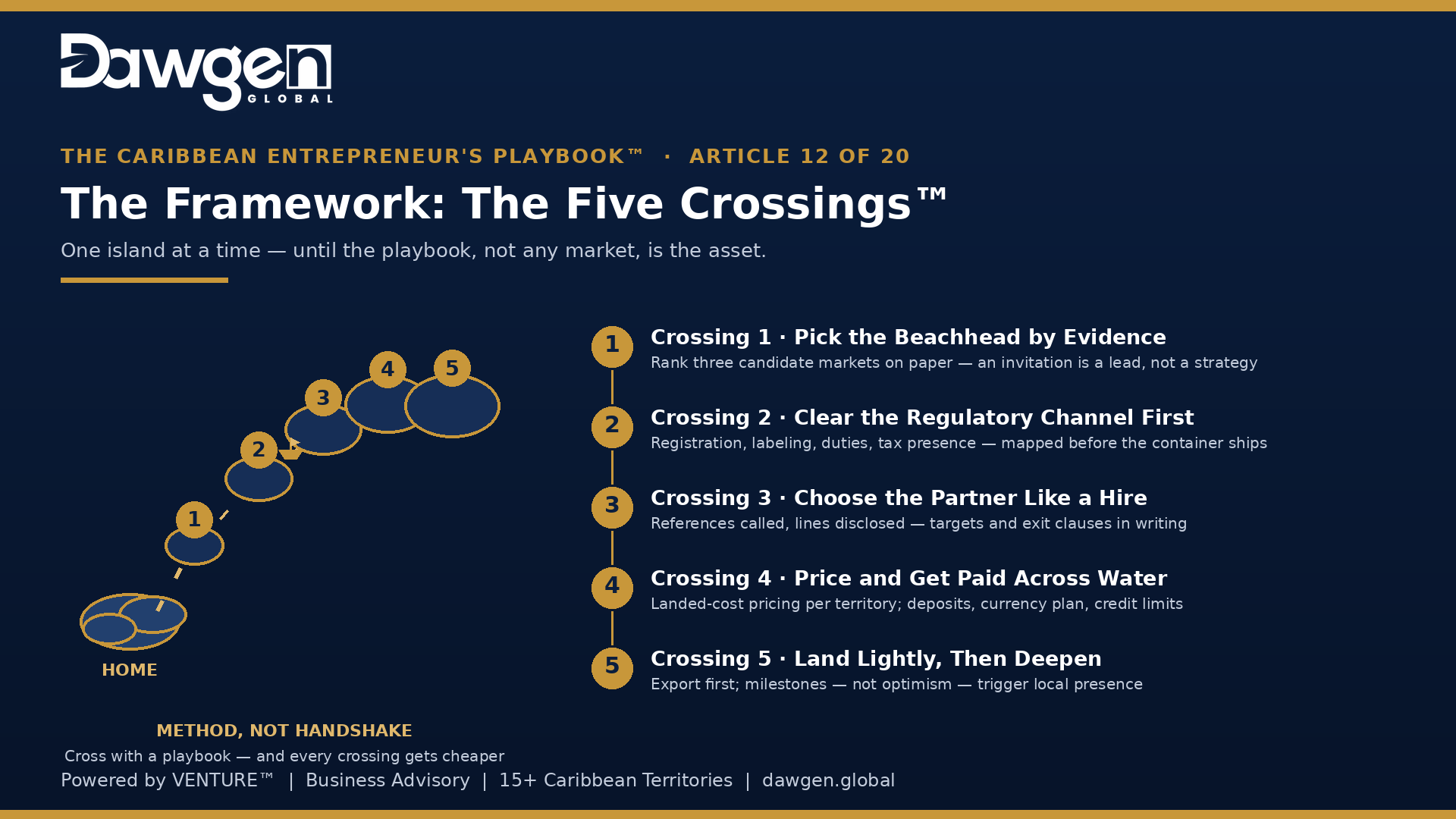
Every new territory is a crossing, and every crossing has five parts. Get all five right in your first new market, and you will have built something more valuable than one export channel — a repeatable playbook:
- Crossing 1 · Pick the Beachhead by Evidence, Not Invitation — The distributor who approached you first is a lead, not a strategy. Choose your next territory the way you would make any capital decision: demand signals for your category, the competitive gap, regulatory ease of entry, logistics lanes and costs from your home base, and payment reliability. Rank three candidate markets on paper before committing to one. The right first crossing is the one that teaches your playbook cheaply — not necessarily the biggest, and almost never simply the loudest.
- Crossing 2 · Clear the Regulatory Channel Before the Container Ships — For the chosen territory, map the full compliance path in advance: product registration and standards approvals, labeling requirements, duties and indirect taxes, and whether your model requires local business or tax registration at all — the export-through-distributor question that shapes everything downstream. Verify each item for that specific island, with current local knowledge. Every requirement discovered before shipping is an errand; every one discovered after is demurrage.
- Crossing 3 · Choose the Partner Like a Hire — Your distributor or agent will be your business in that market — interview like it. Apply the discipline of Article 11’s Gate 4: references actually called, coverage and channel strength verified, competing lines in their portfolio disclosed, financial standing checked. Then put the relationship in writing: territory and exclusivity terms, minimum purchase targets, marketing obligations, payment terms and — critically — performance-based exit clauses. A distributor who resists targets and exits is telling you how the partnership will go. Handshakes are for the trade show; targets are for the contract.
- Crossing 4 · Price and Get Paid Across Water — Rebuild your price for each territory from the landed cost up: freight, duties, port charges, the local indirect tax, the distributor’s margin — then check what survives for you. If the answer is ‘not enough,’ fix it now, with the PRICE Discipline™ of Article 7, not after the second container. Then engineer the money’s journey home: currency and conversion strategy, deposits or documentary terms for early orders, credit limits that grow with payment history — the receivables disciplines of Article 6, now with a sea in the middle. Export margin that cannot be collected is not margin; it is inventory with a passport.
- Crossing 5 · Land Lightly, Then Deepen — Enter with the lightest structure that works — export through a strong partner — and let milestones, not optimism, trigger deeper presence: a merchandiser, then a local entity, then perhaps operations, each step earned by the numbers before it. One island at a time; prove the crossing, document what you learned, and only then repeat. By the second territory you are executing a playbook. By the third, the playbook — not any single market — is the asset. That is the moment a Kingston business quietly becomes a Caribbean one.
The Framework in Action: A Worked Scenario
The following scenario is a fictional composite created for this series to illustrate the framework. It does not depict any actual business or client of the firm.
Danielle’s recovery begins in Trinidad, in reverse order: the registration completed properly, the labels corrected, and the distributor relationship either rebuilt on a written agreement with quarterly targets — or ended by its own exit clause. In this illustration, the distributor, offered structure, chooses structure; the warehoused stock finally moves, at a discount she books as tuition.
The second crossing is done in the right order. Barbados wins the beachhead analysis over two larger candidates — stronger category demand, cleaner regulatory path, better freight lane. The compliance channel is cleared before a single unit ships. Three distributor candidates are interviewed; the winner is the quietest of the three, whose references describe eight years of paying on time. Landed-cost pricing preserves her margin at a shelf price the market accepts, and first orders move against deposits. Twelve months later — targets met, payments clean — a part-time merchandiser goes in: the first earned deepening. The Barbados entry takes a fraction of what Trinidad’s accident cost, and the playbook it produced makes the third territory faster still. The container in the bonded warehouse turned out to be the most expensive business course Danielle ever took. The Five Crossings are the notes.
Self-Diagnostic: Are You Expanding or Drifting Across?
One point for every “no”:
- Was your next territory chosen from a ranked comparison of at least three candidates?
- Is the full regulatory path for that territory mapped and verified before anything ships?
- Is your partner relationship governed by a written agreement with targets and exit clauses?
- Do you know your landed cost, per territory, and what margin survives it?
- Do you have written milestones defining when — and whether — you deepen your presence?
Two or more points means the water is being crossed on hope. Hope is not a freight-insurable cargo.
When to Call In Help
Regional expansion is the one problem in this series where the advisor’s footprint is the answer: multi-jurisdiction questions need answers grounded in each jurisdiction. Bring in support when the compliance path for a target market is unclear or contested; when a distributor agreement needs drafting or a broken one needs restructuring; when landed-cost and currency modeling exceed the home team’s bandwidth; or when milestone triggers point to local registration and tax presence decisions. This is precisely why Dawgen Global operates across 15+ Caribbean territories — so that a business crossing the water is advised by a firm already standing on both shores.
| BOOK A REGIONAL EXPANSION STRATEGY SESSION
Dawgen Global’s Business Advisory team, operating across 15+ Caribbean territories, delivers the Five Crossings™ as a structured engagement: beachhead analysis across candidate markets, the pre-shipment regulatory map for your target island, partner due diligence and agreement structuring, landed-cost and currency modeling, and the milestone plan for deepening presence — with our local teams on the ground in the markets you are entering. One firm, both shores. Contact us today to book your session. 📩 [email protected] | 📞 876-929-3670 / 876-665-5926 | 🇺🇸 855-354-2447 | 🌐 dawgen.global GET THE FULL PLAYBOOK This is Article 12 of The Caribbean Entrepreneur’s Playbook™ — 20 problems, 20 how-to frameworks, one system. Pre-register at dawgen.global to receive the complete Playbook e-book on release, free. |
About Dawgen Global
Dawgen Global is an independent, integrated multidisciplinary professional services firm headquartered at 47 Trinidad Terrace, New Kingston, Jamaica, serving more than 15 territories across the Caribbean. Founded and led by Dr. Dawkins Brown, Executive Chairman, the firm is independent and not affiliated with any international network. It delivers a full suite of professional services under one roof: audit and assurance; tax advisory; IT and digital transformation; risk management; cybersecurity; actuarial and insurance regulatory advisory; HR advisory; mergers and acquisitions; corporate recovery; business advisory and strategy; accounting BPO and virtual CFO services; and legal process outsourcing.
The proposition is simple: big-firm capability without the big-firm price. Dawgen Global’s integrated approach is built for the specific complexities and opportunities of the Caribbean market, helping organizations make sharper, better-informed decisions that drive measurable progress.
To explore a partnership, reach out:
- Website: dawgen.global
- Email: [email protected]
- WhatsApp (Global): +1 555-795-9071
- Caribbean offices: +1 876-665-5926 | +1 876-929-3670 | +1 876-926-5210


