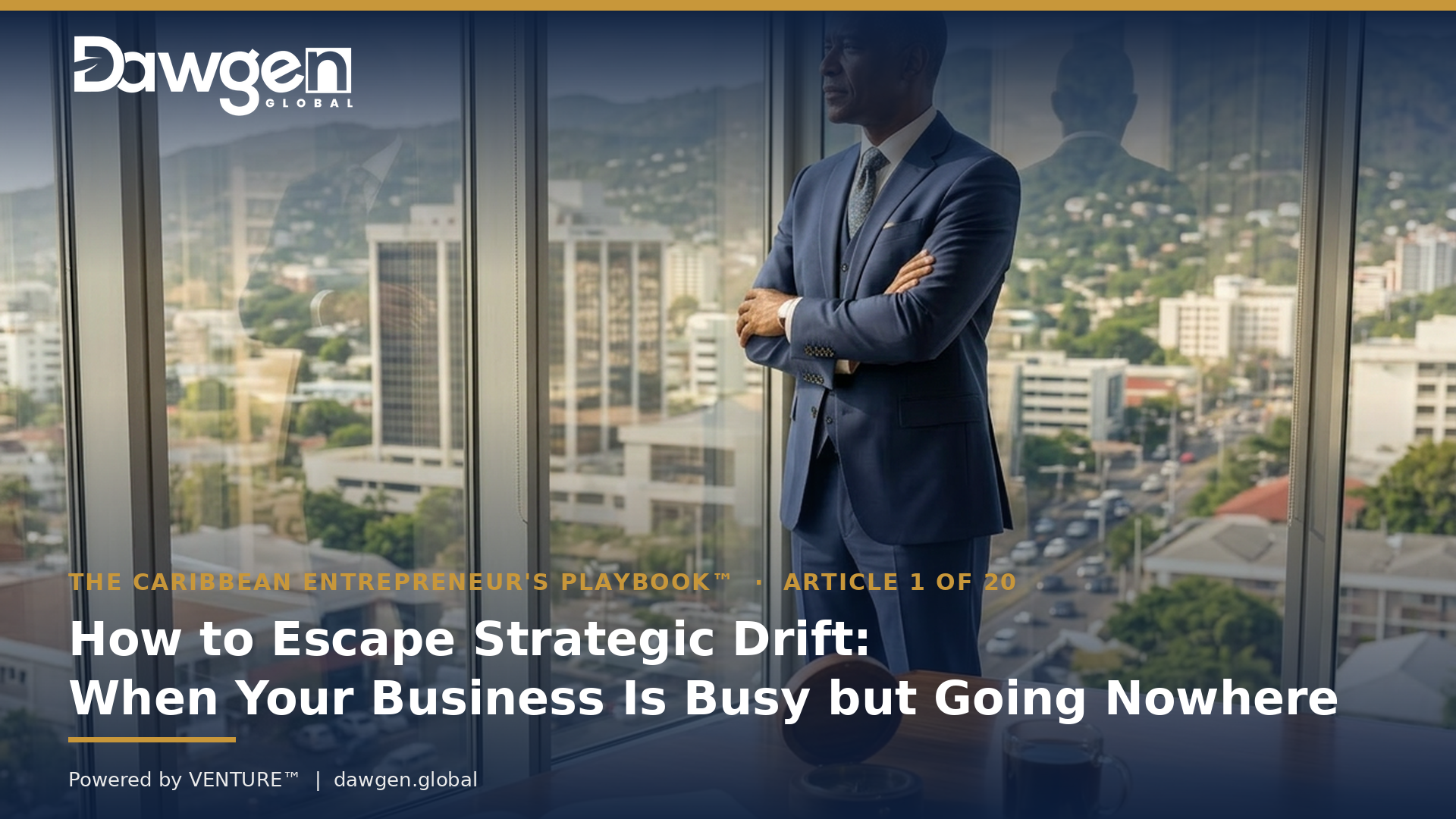
You are working harder than ever. So why does your business look exactly the way it did three years ago?
The Problem, Lived
It is 5:45 on a Monday morning and you are already answering WhatsApp messages from a supplier, approving a staff schedule, and mentally rehearsing the conversation you need to have with the customer whose payment is three weeks late. By 8:00 you have solved six problems. By 6:00 in the evening you have solved twenty more. You will do it again tomorrow, and the day after that.
Here is the uncomfortable question: when you close the books at year end, is the business meaningfully different from where it stood three years ago? For thousands of Caribbean business owners, the honest answer is no. Revenue hovers in the same band. The team is the same size. The owner works the same punishing hours. The business is intensely busy — and going nowhere.
This condition has a name: strategic drift. It is what happens when a business loses — or never had — a directional anchor. Effort is high, but it is scattered across whatever the week demands rather than concentrated on a defined destination. Busy is not the same as strategic. Motion is not the same as progress.
Why It Happens Here
Strategic drift is not a Caribbean failing, but Caribbean conditions make it more likely and more costly. Consider how most businesses in the region actually begin: not with a business plan and investor capital, but with a skill, a hustle, and necessity. The founder is the salesperson, the accountant, the HR department and the delivery driver. Survival-mode habits formed in year one become the operating system for year ten.
Layer on the structural realities. Our domestic markets are small, so an unfocused business ends up competing everywhere and winning nowhere. Formal strategic planning support has historically been priced for corporations, not micro and small enterprises. And the owner-does-everything model leaves no protected time for the one activity that changes trajectories: stepping back and deciding, deliberately, where the business is going.
There is also a quieter, psychological driver. In many businesses, busyness has become the owner’s identity. Firefighting delivers a daily sense of accomplishment that strategic work never matches — you can see a solved problem by lunchtime, while a strategy shows its value in eighteen months. So the urgent perpetually crowds out the important, and the owner mistakes exhaustion for progress. Any framework that ignores this human reality will fail; any framework that works must build strategic thinking into the weekly rhythm of the business rather than leaving it to willpower.
The Research Is Sobering Studies consistently show that small businesses with a clearly articulated strategic plan are significantly more likely to grow revenue and survive economic downturns than those operating without one. Yet across the Caribbean, documented strategic planning remains the exception rather than the rule — particularly among micro and small enterprises.
Why Generic Advice Fails
Type “business strategy” into a search engine and you will drown in content — almost all of it written for a different world. The templates assume a strategy team, a data analytics function, and a market of 300 million consumers. They do not contemplate a two-island customer base, foreign exchange exposure on every imported input, tourist-season revenue cycles, or the reality that your head of operations is also your cousin.
Strategy for a Caribbean SME is not a diluted version of corporate strategy. It is a different discipline: sharper choices in smaller markets, positioning that leverages proximity and trust, and execution systems built for teams of five, not five hundred. Done well, it also exploits advantages the generic playbooks never mention — the ability to know your best customers personally, to reposition in weeks rather than quarters, and to dominate a niche that a larger competitor considers too small to fight for. That is precisely why Dawgen Global built a framework for it.
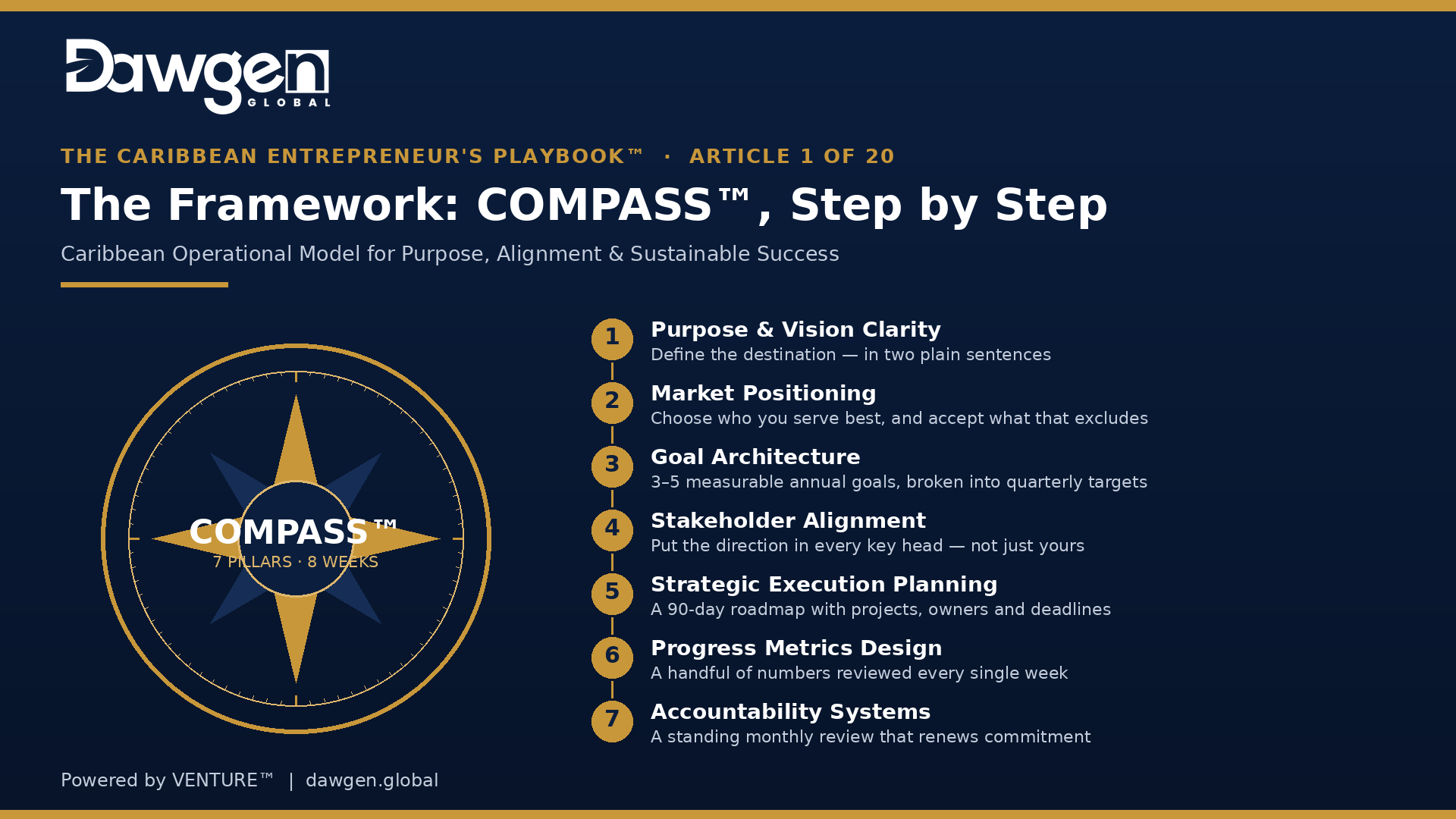
The Framework: COMPASS™, Step by Step
COMPASS™ — the Caribbean Operational Model for Purpose, Alignment & Sustainable Success — is the strategic clarity framework within Dawgen Global’s VENTURE™ Business Coaching System.
Delivered as a structured eight-week programme by certified VENTURE™ coaches across 15+ territories, it moves a business from drift to direction through seven pillars. Here is how to begin applying each one this month:
- Pillar 1 · Purpose & Vision Clarity — Write, in plain language, what the business exists to do and what it should look like in three years — revenue, team, markets, and your own role. If you cannot state the destination in two sentences, neither can your staff. This single page becomes the test for every decision that follows.
- Pillar 2 · Market Positioning — Decide who you serve best and what you want to be known for — then accept what that excludes. In small markets, the businesses that thrive are rarely the ones that do everything; they are the ones a customer names first for one thing.
- Pillar 3 · Goal Architecture — Translate the vision into three to five measurable annual goals, each broken into quarterly targets. A goal without a number and a date is a wish.
- Pillar 4 · Stakeholder Alignment — Share the direction with the people who can advance or quietly sabotage it: staff, family members in the business, key suppliers, your banker. Drift often persists because the owner’s vision lives only in the owner’s head.
- Pillar 5 · Strategic Execution Planning — Build a 90-day roadmap: the specific projects, owners and deadlines that move the first quarterly targets. Strategy dies in the gap between the annual plan and Monday morning; the 90-day horizon closes that gap.
- Pillar 6 · Progress Metrics Design — Choose a handful of numbers you will review every single week — sales pipeline, cash position, on-time delivery, whatever expresses your strategy. What gets measured weekly gets managed weekly.
- Pillar 7 · Accountability Systems — Install a standing monthly review — with your team, a coach, or an advisory board — where progress against the roadmap is examined and commitments are renewed. Accountability is the difference between a plan and a document.
Notice the architecture of the seven pillars: the first three define direction, the middle two convert direction into commitment and action, and the final two make the whole thing survivable — because every strategy meets a difficult quarter, a departing staff member or a supply shock. Businesses that endure those moments are not the ones with the most elegant plan; they are the ones with metrics that reveal problems early and accountability rhythms that force a response. In the structured eight-week COMPASS™ programme, participants work through the pillars in sequence with a certified coach, emerging with four concrete deliverables: a documented strategic plan, a positioning statement, a 90-day execution roadmap, and a measurement-and-review system installed in the business’s calendar.
The Framework in Action: A Worked Scenario
The following scenario is a fictional composite created for this series to illustrate the framework. It does not depict any actual business or client of the firm.
Consider “Marlene,” who runs a Kingston catering company doing roughly J$28 million a year — the same figure, give or take, for four consecutive years. She caters weddings, corporate lunches, funerals, school events and private parties. She works six days a week and cannot remember her last full holiday.
Working through COMPASS™, Marlene discovers her drift in the numbers: corporate lunch contracts produce nearly twice the margin of event work, with predictable weekly volume — yet they receive the least of her attention because events shout louder. Her vision statement becomes specific: within three years, a corporate catering business serving contracted weekly clients in New Kingston, with events accepted selectively at premium pricing.
Her goal architecture sets a target of eight corporate contracts within twelve months. Her first 90-day roadmap includes exiting two low-margin service lines, repricing events upward, and a structured outreach programme to facilities and HR managers. Her weekly metrics: contracted recurring revenue, proposal pipeline, and gross margin by job. Within two quarters — in this illustration — recurring revenue covers her fixed costs, margins improve materially, and Saturday becomes optional. The revenue line barely moves at first. The business underneath it is transformed.
Self-Diagnostic: Are You Drifting?
Answer honestly — one point for every “no”:
- Can you state, in two sentences, where your business will be in three years?
- Do you have written annual goals with numbers and dates attached?
- Could your most senior staff member describe your strategy if asked?
- Do you review a fixed set of performance numbers every week?
- Is there a scheduled monthly session where you examine progress against a plan?
A score of two or more suggests the business is running on momentum rather than direction — and momentum, in a small market, eventually runs out.
When to Call In Help
Some owners can self-administer this discipline. Most cannot — not for lack of intelligence, but for lack of distance. You are inside the business every day; drift is invisible from the inside. The threshold question is this: if you have known for more than a year that the business needs a clearer direction and it still does not have one, the constraint is not knowledge. It is structure and accountability — and that is precisely what a coaching framework supplies.
There is also an economic argument that owners rarely run. Take your average annual revenue over the last three years and ask what even a modest, sustained improvement in growth and margin would have compounded to by now. Measured against that number, the cost of a structured programme is trivial. Strategic clarity is one of the few investments in business where the price is fixed and modest while the return compounds for as long as the business exists. The cost of a programme is measured in weeks; the cost of another drifting year is measured in the growth you never captured — and can never recover.
BOOK A COMPASS™ STRATEGIC CLARITY SESSION The COMPASS™ programme is an eight-week structured engagement facilitated by certified VENTURE™ coaches, available in three formats — virtual one-on-one coaching, facilitated group cohorts, and self-paced digital modules — across 15+ Caribbean territories. You emerge with a documented strategic plan, a 90-day execution roadmap, a positioning statement, and measurable goals tied to your long-term vision. Contact us today to book your Strategic Clarity Session.
📩 [email protected] | 📞 876-929-3670 / 876-665-5926 | 🇺🇸 855-354-2447 | 🌐 dawgen.global
GET THE FULL PLAYBOOK
This is Article 1 of The Caribbean Entrepreneur’s Playbook™ — 20 problems, 20 how-to frameworks, one system. Pre-register at dawgen.global to receive the complete Playbook e-book on release, free.
About Dawgen Global
Dawgen Global is an independent, integrated multidisciplinary professional services firm headquartered at 47 Trinidad Terrace, New Kingston, Jamaica, serving more than 15 territories across the Caribbean. Founded and led by Dr. Dawkins Brown, Executive Chairman, the firm is independent and not affiliated with any international network. It delivers a full suite of professional services under one roof: audit and assurance; tax advisory; IT and digital transformation; risk management; cybersecurity; actuarial and insurance regulatory advisory; HR advisory; mergers and acquisitions; corporate recovery; business advisory and strategy; accounting BPO and virtual CFO services; and legal process outsourcing.
The proposition is simple: big-firm capability without the big-firm price. Dawgen Global’s integrated approach is built for the specific complexities and opportunities of the Caribbean market, helping organizations make sharper, better-informed decisions that drive measurable progress.
To explore a partnership, reach out:
- Website: dawgen.global
- Email: [email protected]
- WhatsApp (Global): +1 555-795-9071
- Caribbean offices: +1 876-665-5926 | +1 876-929-3670 | +1 876-926-5210


