Across fourteen articles, this series has built one argument — that actuarial thinking is not a back‑office discipline but a way of seeing. This closing piece asks what it takes to convert that sight into decisions, and decisions into advantage.
A number, on its own, decides nothing. A reserve estimate, a capital ratio, a stress-test result, a projected loss — each is a measurement, and a measurement is only ever a description of where an organisation stands. The work that has occupied this series — pricing risk honestly, reserving prudently, optimising capital, testing the plan against severe but plausible shocks — produces a great many such numbers. Yet an organisation can possess every one of them and still decide badly, because the numbers do not, by themselves, tell anyone what to do.
The advantage promised by the actuarial discipline has never lived in the numbers. It lives in the translation — the movement from measurement to meaning, from meaning to choice, and from choice to a position no competitor without the same insight could hold. That translation is a deliberate act, and it is the subject of this final article. Having spent fourteen pieces on the craft of producing reliable numbers, it is worth closing on the harder question: what must a board actually do to turn them into strategy?
The translation problem
Most boards do not lack data; they are flooded with it. Numbers arrive as the outputs of models — dense, technical, and caveated — and the distance between an actuarial appendix and a strategic decision is wide. This is the central failure mode of every technical function: precise work that never reaches the decision it was meant to inform. The model that is never translated is, for practical purposes, work that was never done.
The actuary’s real product, then, is not the model but the sentence that begins “this means that we should…”. A reserve number that stays in the appendix is information; the same number, translated into “we have room to write more of this business, but not of that”, is strategy. The discipline of translation is what separates an organisation that owns expensive analysis from one that is actually guided by it.
Measurement, foresight, decision
Actuarial work is distinctive because it is forward-looking by construction. Every technique in this series answers a question about a future that has not yet arrived: what will claims ultimately cost, how much capital must be held against what cannot yet be seen, where the plan breaks if the world turns hostile. The numbers are estimates of tomorrow, not records of yesterday — and that is precisely what makes them strategic raw material.
Foresight is the bridge between a number and a decision. A capital figure becomes useful when it tells the board how much growth it can fund before its buffers thin; a stress test becomes useful when it tells the board which contingency to pre-agree, and at what trigger. The sequence is always the same and rarely made explicit: measurement establishes where we stand, foresight establishes where we are heading, and decision establishes what we will do about the gap between the two. Skip the middle step and the number is inert; honour it and the number becomes a lever.
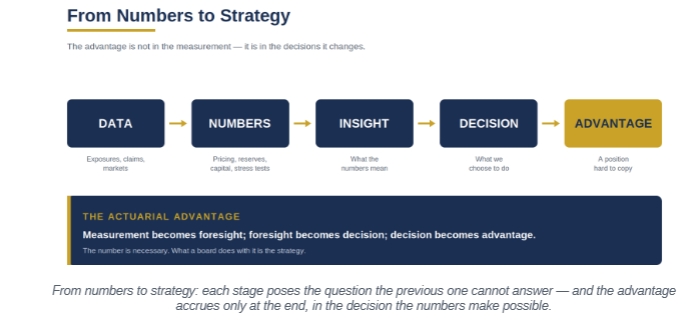
From numbers to strategy: each stage poses the question the previous one cannot answer — and the advantage accrues only at the end, in the decision the numbers make possible.
Three questions that turn a number into a decision
For every significant number that reaches the board, three questions convert it from information into strategy. The first is: what is this telling us about the future we are walking into? A figure with no implied trajectory is a fact; a figure understood as a signal about tomorrow is the beginning of a plan.
The second is: what decision would change if this number were materially different? A number that alters no choice, however precisely computed, is overhead — and a great deal of reporting is exactly that. Tying each number to the decision it should influence is the fastest way to separate analysis that matters from analysis that merely accumulates.
The third is the most uncomfortable and the most valuable: what would have to be true for us to be wrong, and could we survive being wrong? It imports the discipline of stress-testing into every strategic conversation, forcing the board to hold its confidence and its fragility in view at the same time. A board that asks these three questions of its actuarial work has already crossed from measurement into strategy.
The actuary in the room
Translation is far more likely to happen when the person who understands the numbers is present when the decisions are made. Too often the actuarial function sits at the end of a process, validating choices already taken, rather than at the start, shaping them. The result is technically excellent work delivered one step too late to change anything.
Moving the function from the appendix to the table — into capital allocation, product design, pricing strategy, reinsurance structuring and the evaluation of acquisitions — is the single highest-return change most organisations can make to their use of actuarial talent. The actuary’s instinct for the tail, discomfort with overconfidence, and habit of asking “what if we are wrong?” are precisely the qualities a strategy conversation most needs and most often lacks. Placed where decisions are made, that temperament is not a brake on ambition; it is what allows ambition to be pursued safely.
The Caribbean case for actuarial strategy
The argument has particular force in the Caribbean. Small markets concentrate risk: a single hurricane season, a single large counterparty, a single regulatory shift can move an entire balance sheet in a way that diversification across a larger economy would soften. Capital is scarcer and buffers are thinner, which raises the cost of every poorly-informed decision. And actuarial talent is genuinely rare, which makes the few who hold it disproportionately valuable — but only when they are placed where decisions are made rather than where reports are filed.
A regional board that treats actuarial insight as a strategic asset, not a regulatory obligation, therefore holds an advantage that is difficult to copy precisely because the talent and the discipline are hard to assemble. This is what “Big Firm Capabilities, Caribbean Understanding” means in practice: the technical depth to produce the numbers, and the proximity to the market to know what they mean for the businesses that actually operate within it.
Closing the series
Fourteen articles have made a single cumulative case: that actuarial thinking, properly understood, is a strategic capability rather than a compliance cost. We have argued that risk should be priced honestly, that reserves should tell the truth, that capital should be set free where it is trapped, and that plans should be tested against the shocks that have not yet come. Each of those arguments produces numbers. None of them, on its own, produces an advantage.
The advantage belongs to the organisations that build the bridge the whole series has described — from measurement to foresight, from foresight to decision, and from decision to a position competitors cannot easily reach. A business that measures well but decides poorly has wasted its measurement. A business that decides well because it measures well — that asks of every number what future it describes, what choice it changes, and what it would mean to be wrong — has turned the actuarial discipline into what it was always meant to be: not a record of the past, but an advantage in the future. That is the whole of the case, and it is where this series ends — not with the numbers, but with what a board chooses to do with them.
About Dawgen Global
Dawgen Global is an independent, integrated multidisciplinary professional services firm headquartered at 47 Trinidad Terrace, New Kingston, Jamaica, serving more than 15 territories across the Caribbean. Founded and led by Dr. Dawkins Brown, Executive Chairman, the firm is independent and not affiliated with any international network. It delivers a full suite of professional services under one roof: audit and assurance; tax advisory; IT and digital transformation; risk management; cybersecurity; actuarial and insurance regulatory advisory; HR advisory; mergers and acquisitions; corporate recovery; business advisory and strategy; accounting BPO and virtual CFO services; and legal process outsourcing.
The proposition is simple: big-firm capability without the big-firm price. Dawgen Global’s integrated approach is built for the specific complexities and opportunities of the Caribbean market, helping organizations make sharper, better-informed decisions that drive measurable progress.
To explore a partnership, reach out:
- Website: dawgen.global
- Email: [email protected]
- WhatsApp (Global): +1 555-795-9071
- Caribbean offices: +1 876-665-5926 | +1 876-929-3670 | +1 876-926-5210


