A business plan is a single confident line into an uncertain future. Stress-testing fills the silence around it — answering not what we expect, but what would happen if we are wrong, and how wrong we can afford to be.
Every business plan is a single confident line drawn into an uncertain future. It projects revenues, costs, claims, capital and growth along the path management considers most likely — the base case. There is nothing wrong with having a base case; an organisation must plan around its central expectation. The error is in mistaking that line for the future itself. The actual future will deviate from it, often sharply and often suddenly, and the line says nothing about how far the business can bend before it breaks. Resilience lives in that silence — in everything the base case does not tell you.
Stress-testing is the discipline of filling that silence before circumstances fill it for you. It does not try to predict the shock — the next hurricane, the next downturn, the next market dislocation cannot be timed — but it answers a more useful question: if a severe shock arrives, will the business survive it, and what would have to go wrong for it not to? Building that knowledge in advance, while there is still time to act on it, is the difference between an organisation that is merely planning and one that is genuinely prepared. It is how resilience is built before the shock, rather than discovered during it.
Why the base case is not enough
A single projection, however carefully constructed, carries a hidden and dangerous message: that the future is knowable. It is not. Interest rates move, markets fall, catastrophes strike, customers behave unexpectedly, and the assumptions beneath any forecast are estimates, not facts. A plan expressed as one number for each year invites everyone who reads it to treat that number as the destination, when it is really only the midpoint of a wide range of possibilities — and, in any given year, often one of the less likely points within it.
The questions that actually determine survival are therefore not the ones a base case answers. They are: what if we are wrong? How wrong can we afford to be before our capital is threatened? Which assumptions, if they move against us, hurt the most? And what combination of adverse events would push us past the edge? A base case is silent on all of these. Stress-testing exists precisely to ask them — and to turn the comfortable single line into an honest map of the terrain around it.
Three ways to test
There are three complementary techniques, each answering a different question. Sensitivity testing moves one assumption at a time — what happens to our position if interest rates fall by a point, or claims rise by a tenth? — and reveals which assumptions the result is most sensitive to, and therefore which deserve the closest attention. Scenario or stress testing goes further, applying a coherent set of severe adverse conditions all at once, to see whether capital and solvency hold under a genuinely bad state of the world. And reverse stress testing inverts the exercise entirely, beginning not with a scenario but with failure itself.
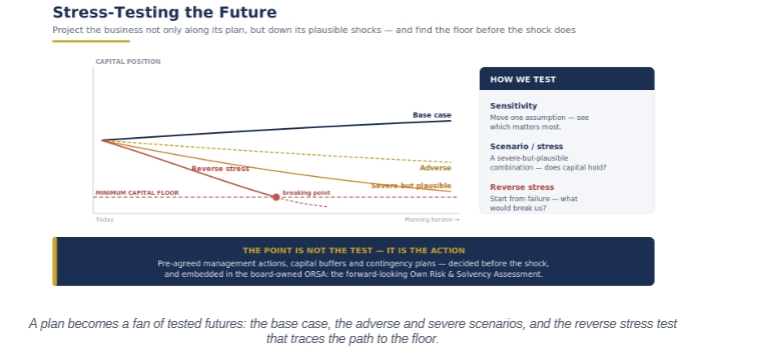
A plan becomes a fan of tested futures: the base case, the adverse and severe scenarios, and the reverse stress test that traces the path to the floor.
Used together, these techniques convert a single plan into a fan of possible futures, each tested against the floor of minimum capital the business must always hold. The base case shows the expected path; the adverse and severe scenarios show how far the position falls under deteriorating conditions; and the reverse stress test traces the path that reaches the floor — the point at which the business would no longer be viable. Seeing all of these at once is what transforms a forecast into a resilience assessment.
Severe but plausible — and correlated
The craft of scenario design lies in two words: severe but plausible. A scenario too mild tells you nothing you did not already know; a scenario so extreme that no one believes it can happen is dismissed and ignored. The useful stress sits in between — bad enough to threaten the business, credible enough to compel a response. Calibrating that balance is a matter of judgement informed by history, modelling and an honest understanding of the organisation’s exposures.
The most important and most neglected aspect of severe scenarios is correlation. Risks that appear independent in calm times tend to move together in a crisis: a major shock rarely strikes one part of a business while leaving the rest untouched. A single-factor test — what if claims rise? what if markets fall? — therefore understates the danger, because real catastrophes bring several stresses simultaneously. A credible severe scenario combines them, asking not what happens if one thing goes wrong, but what happens when many things go wrong at once, as they so often do.
Reverse stress testing: starting from failure
Of the three techniques, reverse stress testing is the most uncomfortable and, often, the most valuable. Rather than choosing a scenario and asking what it does to the business, it starts from the outcome no one wants to contemplate — the point at which the business becomes unviable — and works backwards to ask: what would it take to get us there? What combination of events, how severe, and in what sequence, would break this organisation?
The discomfort is the value. Reverse stress testing forces a management team to confront its own mortality, and in doing so it surfaces vulnerabilities that forward scenarios miss: the concentration no one worried about, the correlation no one modelled, the assumption whose failure would be fatal. It also reveals how close the cliff edge actually is — whether the breaking point lies comfortably beyond any plausible event, or unnervingly within reach. An organisation that knows precisely what would destroy it is far better placed to ensure those things never combine.
ORSA: the forward-looking, board-owned view
These techniques find their home in a single, increasingly central framework: the Own Risk and Solvency Assessment, or ORSA. Originating in insurance regulation and now spreading more widely, the ORSA is the process by which an organisation assesses, for itself, whether it will remain adequately capitalised across its planning horizon — under expected conditions and under stress. Each word of the name carries weight. It is the entity’s own assessment, tailored to its specific risk profile rather than a regulator’s standard formula. It is forward-looking, projecting risk and capital over the years ahead rather than reporting last year’s position. And it is, crucially, owned by the board.
That ownership is what gives the ORSA its power. It is not a technical report prepared by actuaries and filed away; it is a governance process through which the people responsible for the organisation engage directly with its risks, its capital and its strategy as a single connected question. Done well, the ORSA links the three: it shows how the strategy generates risk, how that risk consumes capital, and whether the capital will hold under the scenarios the business has chosen to test — and it does so continuously, informing real decisions rather than ticking a box once a year.
From test to action
A stress test that changes nothing is theatre. The entire purpose of testing is to act on what it reveals — and to decide those actions in advance, while the organisation is calm and clear-headed, rather than improvising them in the middle of the crisis the test foresaw. The outputs of a serious programme are practical: pre-agreed management actions to be taken if a scenario begins to unfold; capital buffers held deliberately above the minimum to absorb the shocks identified; contingency plans, reinsurance and de-risking triggers set before they are needed; and a clear sense of which early warning signs indicate that a tested scenario is arriving.
This is the deepest reason to test before the shock. In the moment of crisis, options narrow, time vanishes and judgement is clouded by pressure; the cheapest and best decisions have usually already closed. Resilience is built in the calm, through the unhurried work of imagining what could go wrong and deciding now what would be done. The organisation that has stress-tested and prepared meets the shock with a plan; the one that has not meets it with panic.
The Caribbean case for stress-testing
Nowhere is this discipline more necessary than in the Caribbean, because nowhere are risks more concentrated and more correlated. A single major hurricane does not strike one exposure in isolation; it damages property, interrupts tourism, depresses employment, pressures the currency, depletes insurers’ capital and strains public finances — all at once, and all in the same instant. The region’s economies are, in effect, a living example of the severe, correlated scenario that stress-testing exists to capture. A single-factor test designed for a large, diversified economy badly understates the reality of a small island where almost everything is exposed to the same storm.
This correlation, combined with small scale and often thin buffers, makes combined-scenario stress-testing not a regulatory nicety but a survival discipline for Caribbean institutions. The shock will come — the only uncertainties are its timing and its severity. Testing for the correlated, severe scenario in advance, and building the buffers and contingency plans to withstand it, is how a regional business turns its exposure from a source of fragility into a managed, survivable risk. The alternative is to learn the lesson the expensive way, in the aftermath, when it is too late to prepare.
You cannot schedule the shock, and no amount of analysis will tell you when the storm will make landfall or the market will turn. But you can know, before any of it happens, whether your organisation is built to withstand it — and exactly what you would do if it looked as though it might not. That is what stress-testing offers: not a prediction, but a preparation; not certainty about the future, but resilience within it. The future will test every business eventually. The only choice is whether to run the test yourself, in advance, while you can still act on the result — or to let circumstances run it for you, at the worst possible moment, with everything at stake.
| TAKE THE NEXT STEP
Request a Stress-Testing & ORSA Workshop We will help your board design severe-but-plausible and reverse-stress scenarios tuned to your real, correlated exposures, project capital and solvency across them, and translate the results into pre-agreed management actions, buffers and a forward-looking ORSA — so resilience is built before the shock, not after it. Speak with our Actuarial Advisory team: [email protected] · 876-929-3670 · 876-665-5926 · dawgen.global |
About Dawgen Global
Dawgen Global is an independent, integrated multidisciplinary professional services firm headquartered at 47 Trinidad Terrace, New Kingston, Jamaica, serving more than 15 territories across the Caribbean. Founded and led by Dr. Dawkins Brown, Executive Chairman, the firm is independent and not affiliated with any international network. It delivers a full suite of professional services under one roof: audit and assurance; tax advisory; IT and digital transformation; risk management; cybersecurity; actuarial and insurance regulatory advisory; HR advisory; mergers and acquisitions; corporate recovery; business advisory and strategy; accounting BPO and virtual CFO services; and legal process outsourcing.
The proposition is simple: big-firm capability without the big-firm price. Dawgen Global’s integrated approach is built for the specific complexities and opportunities of the Caribbean market, helping organizations make sharper, better-informed decisions that drive measurable progress.
To explore a partnership, reach out:
- Website: dawgen.global
- Email: [email protected]
- WhatsApp (Global): +1 555-795-9071
- Caribbean offices: +1 876-665-5926 | +1 876-929-3670 | +1 876-926-5210


